Opposing AI is Marxian

Since it’s obviously too difficult for the average individual who denigrates the use of AI and opposes its use on the grounds of insufficient human involvement to understand their own position well enough to recognize its obvious intellectual roots, I asked Claude to dumb down my observations enough to permit their little midwit minds to grasp it.


The Hidden Marxism Behind “AI Slop” Complaints

When critics dismiss AI-generated art as “soulless pablum” or “AI slop,” they’re often unknowingly channeling a 19th-century economic theory that most economists abandoned long ago. Their argument, stripped to its core, reflects the labor theory of value that Karl Marx popularized—the idea that something’s worth comes from the human work put into it. This perspective, while emotionally appealing, fundamentally misunderstands how we actually value art and creativity.

The Labor Theory in Disguise

Marx argued that a product’s value stemmed from the “socially necessary labor time” required to produce it. A chair was valuable because a carpenter spent hours crafting it; a coat, because a tailor labored over its seams. Critics of AI art make remarkably similar claims: a painting matters because an artist struggled with brushstrokes for days, a novel has worth because a writer agonized over every sentence, a song touches us because a musician practiced for years to master their instrument.

Notice the pattern? The anti-AI argument insists that art without human toil is worthless—that the struggle itself creates the value. When someone calls AI art “slop,” they’re not really critiquing the output’s quality. They’re saying it lacks value because it lacks human labor input. A beautiful AI-generated landscape might be visually indistinguishable from one painted by hand, but critics dismiss it anyway. Why? Because no one suffered for it.

Where This Theory Falls Apart

Economists largely abandoned the labor theory of value because it couldn’t explain basic market realities. Why does water, essential for life, cost less than diamonds? Why can two painters spend equal time on portraits, yet one sells for millions while the other goes unsold? The answer isn’t labor—it’s what economists call subjective value. Things are worth what people believe they’re worth, based on their preferences, needs, and circumstances.

Art has always been the ultimate refutation of labor-value thinking. Van Gogh died penniless despite pouring his soul into his work; his paintings gained value only when audiences decided they mattered. A child’s finger painting might take minutes but become priceless to a parent. Street artists create elaborate chalk drawings knowing rain will wash them away. If labor determined artistic value, none of this would make sense.

The Real Source of Artistic Value

What actually makes art valuable? The answer varies by person and context. Sometimes we value technical skill—but photography didn’t become worthless when cameras replaced the painstaking work of portrait painters. Sometimes we value emotional resonance—but a simple song can move us more than a technical masterpiece. Sometimes we value novelty, sometimes tradition, sometimes the story behind the work, sometimes pure aesthetic pleasure.

AI art can fulfill any of these value sources. It can create novel combinations no human imagined, generate perfectly crafted compositions, or help disabled individuals express visions they couldn’t physically create themselves. When someone uses AI to illustrate their novel or design their album cover, the value comes from bringing their creative vision to life, not from how many hours they spent learning how to use Photoshop.

The Ignorance in the Argument

The “AI slop” position reflects a peculiar ignorance about how art has always evolved. Every new tool faced similar criticisms. Photographers were told they weren’t real artists because machines did the work. Electronic musicians heard that synthesizers were cheating. Digital artists were dismissed because “the computer does it for you.” Yet each tool simply changed how humans express creativity, not whether the results had value.

More fundamentally, the anti-AI position ignorantly assumes we value art for the artist’s effort rather than our own experience. But people don’t listen to music thinking, “I enjoy this because someone practiced his scales for years.” They don’t admire paintings on the basis of the painter’s hours invested. Art’s value lives in the connection between work and audience, not in the production method.

Moving Beyond Marxian Mysticism

The fear driving “AI slop” rhetoric is understandable—artists worry about their livelihoods, and change is scary. But wrapping economic anxiety in Marxian labor mysticism doesn’t help anyone. It obscures real conversations about attribution, consent, and fair compensation while promoting a backward-looking view that confuses suffering with value.

Art made with AI tools isn’t automatically valuable, but neither is it automatically worthless. Like art made with brushes, cameras, or computers, its value depends on whether it resonates, inspires, or satisfies human needs and desires. Artistic value, like all value, is inherently subjective. That’s how value has always worked, despite what Marx claimed.

The next time someone dismisses AI art as “soulless,” ask them this: are they evaluating the work itself, or are they calculating the human hours that weren’t required to make it? The answer usually reveals that they subscribe to an outdated socialist economic theory from 1867, whether they know it or not.

DISCUSS ON SG


The Transience of Attention

The Swan Throne contemplates two public figures, one famous, one increasingly forgotten:

The Transience of Social Media Metrics

The smarter the idea, the fewer that can follow it.

Social media rewards the lowest impulses. The more outrageous the performance, the more it spreads. The system favors anger, envy, and spectacle, not clarity or endurance. Metrics rise when a man panders to the audience’s worst appetites, and they collapse the moment that appetite shifts. This volatility is the core weakness of treating metrics as a measure of worth.

A politician can buy bots and inflate his follower count overnight. A platform can tweak its algorithm and bury a channel with a single update. A wave of coordinated harassment can erase visibility as though it never existed. None of this reflects reality. It reflects only the whims of code, the biases of moderators, and the fleeting moods of a distracted public. When importance is measured by such numbers, it becomes indistinguishable from chance.

The men who have mattered most to the world have almost always been out of step with the crowd. They did not flatter their followers but forced them to confront truths. Their importance could not be captured in likes or shares, because those very metrics would have been turned against them. Plato’s Academy, Aquinas’ Summa, or Burke’s Reflections cannot be reduced to the applause they received at the time. They endured because they held structures of thought that outlived the moment.

The man who mistakes social metrics for real significance plays with shadows. When the crowd moves on, his numbers vanish, leaving him where he began: irrelevant, not because the crowd says so, but because he built nothing beyond it.

What Endures Beyond Metrics

It’s simple math: Nick Fuentes – Noise = 0

What lasts is not the rise and fall of trending graphs but the deeper architecture of culture. Values, language, ideas, institutions, and elite influence form the skeleton that endures when the noise of platforms fades. These are the measures by which true importance is weighed.

Values set the moral direction of a people. When they shift, entire movements tilt with them. Language provides the tools of thought itself; to coin a term is to shape the way others perceive reality. Ideas supply the patterns that give coherence, allowing men to order their experience and chart a course. Institutions anchor those ideas in the world, giving them a physical presence that resists decay. And elites, though often despised in populist rhetoric, are the carriers of continuity. They determine what is preserved, what is discarded, and what is advanced.

The older I get, the more I come to value the historical minds that focused on the Good, the Beautiful, and the True instead of whatever their daily reality happened to be. Not that there isn’t real value in the latter, as without them we simply wouldn’t know anything about what life was like during their times. But the more an author focuses on today’s issues, today’s politics, today’s public figures, the less readable and the less relevant his work tends to be over time.

This is true of fiction, of course. The imaginary landscape of Tolkien hold up much better than, say, Mack Bolan’s never-ending battles with a mafia that no longer exists or even Hollywood’s interminable retellings of that one bad thing that happened during that one war.

Not everything one does has to be significant, of course. One of the beautiful things about AI-generated text is the fact that writers can now accelerate our writing processes and increase our literary output to the point that we might even begin to approach the superhuman levels of John C. Wright and The Legend Chuck Dixon.

However, the writer is correct to observe that which is most popular is seldom that which lasts. One has only to peruse the bestseller lists of 100 years ago to recognize that.

DISCUSS ON SG


The Kenobi Years

Vox Day… it’s a name they haven’t heard for a long, long time.

Vox Day – some ‘oldtroons’ know who that is – called out Jordan Peterson as a troubled person who shouldn’t be giving advice over 10 years ago. He did this just by reading Peterson’s first book.

He also called out ‘SJWs’ as liars and wrote a book about it – which some large accounts on here have plagiarized for years.

He still has a blog. But he’s a good example of how mainstream people just pillage from smarter underground people – and really never give credit.

It’s really fascinating to see how lazy the average person is about following anyone off the usual five sites. Unless you’re on YouTube, Twitter, or Spotify, you may as well not exist for 90 percent of the population. No wonder Clown World finds it so easy to program all the NPCs. For the most part, we might as well be living in Boomerville circa 1970 with the three network channels plus public television.

The amusing thing about all of this is that given the ephemerality of the Internet, ebooks, and human memories, about the only thing that is going to survive from our era are the physical books. Which means that as forgotten by the mainstream as I already am, future generations will probably believe that my influence and popularity were much greater than they actually are.

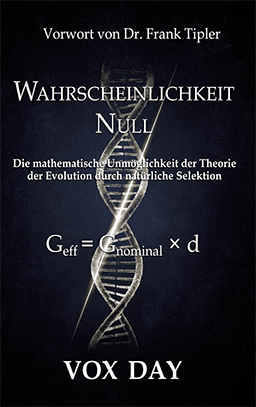
But, as I have always said, the names don’t matter. It’s the ideas that are important, and I suspect that my most important idea will likely prove to be the mathematical impossibility of evolution by natural selection. I’m already seeing signs in the AI systems that it has been quietly accepted and that TENS is being abandoned by biologists in favor of a mathematical model based on large quantities of random mutations gradually fixing in parallel throughout entire populations independent of reproduction or selection advantage, which is a non-Darwinian concept so far outside the traditional evolutionary box that I haven’t grasped it well enough to critique it yet.

I’m pretty sure it’s nonsense, but I won’t take a position on it until I can be certain of that. The point is that the biologists have given up on both Darwin and evolution, and now they’re clinging to randomness to avoid the obvious implications concerning intelligent design, genetic manipulation, and artificial selection.

UPDATE: Everyone is going to have to revert back to our old GamerGate practices, as within two hours of my linking to that particular X post, it was deleted, along with the nearly 200 comments, both positive and negative, in the thread. So don’t send me links to anything anymore if they’re not already archived, and send me links to the archived version.

DISCUSS ON SG


Rhetoric and Pride

It’s always fascinating to see how those inclined toward rhetoric will always find a way to declare something to be bad, even if it requires a complete inversion of common, every-day terminology. This exchange was in the comments in Sigma Game, after I made an observation that applies generally to a large class of people.

EM: Nothing like painting with a broad brush, lol. I’ve never met anyone so certain of every single thing they say.

VD: That’s because if I’m not certain, I don’t say anything. You should try it.

EM: Only a fool is so certain of every single thing they say. I hope you hear the pride in your own words. That is a dangerous stance, my friend. Humility would be a good medicine.

VD: You have it completely backwards. Only a fool blurts out his thoughts when he knows little and opines in ignorance. I have 22 years of daily experience with hundreds of people who dislike me intensely dissecting every single word I write in order to discredit me or expose any weakness in my arguments. There is no pride in knowing when to speak and when to remain silent. What you mistake for pride is just absolute confidence based on the experience of having been repeatedly challenged and tested over a period of decades.

Now, obviously even the local midwits know perfectly well what’s going on here. But the interesting thing is the way that the rhetorical attacker doesn’t hesitate to invert the idea that remaining reticent about sharing one’s opinion and refusing to opine in ignorance is somehow based in pride rather than intellectual humility and the recognition that one’s opinion might well be wrong.

For example, I was very hesitant to do more than ask questions when I happened to notice the first anomalies in evolutionary scientistry, such as the inability of biologists, professors, and teachers to understand the concept that there not only is an average rate of evolution by natural selection, but that there absolutely has to be. Even after that first glimpse of innumeracy and philosophical inepititude, ittook years of cautious inquiry and detailed reading of various papers and books before I was confident enough in my reasoning, certain enough in my conclusions, to publicly challenge the likes of JF Gariepy and point out the mathematical impossibility of mainstream evolutionary theory.

And now, of course, all of those evolutionists who were so eager to lecture me on a subject they presumed I did not understand not only don’t want to answer any of my questions anymore, they are in full retreat from the very strong point they have defended for decades.

I am referring here, of course, to their headlong retreat to randomness, which is vastly amusing to anyone who recalls Dawkins’s passionate, but inept, attempt to argue that natural selection “is the very opposite of random”.

Those who have been here since 2008 will also notice that I no longer attempt to calculate the impact of debt on the economy despite a respectable past record. That’s because I don’t have the relevant information anymore; the Federal Reserve’s changes to its reporting has deprived me of the data I require to even begin formulating an opinion. So, I don’t say anything because I don’t know anything.

But to the rhetorical, intellectual humility can be pride for the same reason that black can be white and war can be peace. Because there is no information content in rhetoric, it’s merely an attempt to emotionally manipulate other individuals.

DISCUSS ON SG


Point of Order

If you are a business, and you do basically the same thing in a variety of ways, DO NOT PRETEND THAT YOU HAVE NO IDEA WHAT THE PRICE IS.

We make books. I can, and will, tell you what it costs to make a book. Now, obviously the specific price will vary depending upon whether you want to make one small paperback that will spontaneously combust within 15 years or a giant tome bound in albino orca leather and stamped with pure platinum, but the average price for a basic book is what it is.

For some reason, more and more businesses seem to get off on absolutely refusing to tell you anything at all about the price of their goods and services. Which in addition to being infuriating, and a waste of time, is counterproductive, because the first thing I do when I can’t get a price estimate is to go somewhere else where I can.

Is this an instinctive response to Amazon price-shoppers? Or are they simply attempting to delay the moment of truth when the potential customer decides if the acquisition is worth it or not? I don’t know and I don’t care.

Speaking of making books, I’m very pleased to say Castalia House is making a new book. Publishing it would probably be the more apt term, as I just finished the initial edit of a new Chuck Dixon novel. And it is really good, in fact, it’s even better than those Conan novels that, in a very real, official, and legal sense, never existed except as figments of your very vivid imaginations.

DISCUSS ON SG


The Bear Necessities

A UATV supporter explains the necessity of Big Bear on Instagram.

Et tu, Spacebunny? She added a comment there.

We have had this convo – your ability to make Vox comprehensible is legendary.

To be fair, it is a genuine problem. My idea of what is a sufficient explanation and pretty much everyone else’s don’t tend to have much in common. I see this coming and going, both in what apparently are popularly regarded as my insufficient explanations and everyone else’s determination to give me ten times more information than I need or want. What is so impressive about Big Bear in this regard is his ability to instantly grasp the various levels of detail required to explain a given concept to different people.

I still remember one time on a stream when he asked me to explain something, so I provided what I felt was the requisite explanation in what I thought was all the necessary detail. Big Bear just stared at me for a second, then said: “Yeah, you’re going to need to go two levels deeper for that to make any sense.”

Which was very helpful, because it’s not a problem to do that. The real challenge that most people don’t seem to grasp is that when you do understand something, you seldom know the precise point of another person’s failure to understand, except that it is somewhere between the complete absence of information and the comprehension of the whole. Compounding this problem is that it is quite normal for people to get offended if you begin at the beginning.

“What do you think I am, an idiot?”

Well, yes, at least in relative terms, given that you’ve already demonstrated that you don’t understand something despite being provided everything that is required for you to do so. But it only took a few beatings from fellow elementary school scholars and a lecture or three from teachers and parents to realize that it is never socially acceptable to say what you are actually thinking about anyone.

That’s why I always think it is outright comical whenever people say, in real life or on TV, that honesty is paramount in relationships. It quite obviously isn’t, in fact, I would go so far as to say that at least for the intelligent individual, relentless dishonesty is the basis for all human relationships, from the most casual to the most intimate. Because if there is one skill that is necessary for surviving the endless sea of retardery in which Man must daily swim, it is relentlessly concealing the truth of one’s thoughts, feelings, and opinions from absolutely everyone.

Marcus Aurelius, Roman emperor and Stoic philosopher, obviously understood that.

Begin each day by telling yourself: Today I shall be meeting with interference, ingratitude, insolence, disloyalty, ill-will, and selfishness – all of them due to the offenders’ ignorance…

Do you know what that is? That’s the rock-solid stoicism born of the despair that comes from 19 years of putting up with a son like Commodus and knowing he had no choice but to leave the whole empire in the care of the solipsistic lunatic.

DISCUSS ON SG


Not All Cancellations are Created Equal

It’s always fascinating to see who gets cancelled because some random nobody made false assertions about someone in an article nobody read, who gets cancelled due to a single tweet, and who doesn’t get cancelled when multiple women accuse him of monstrous acts for which he paid hundreds of thousands of dollars to keep quiet.

“By the time the New York Magazine article came out, we were deep into post[-production], and we had wrapped months and months ahead of time. So that’s when it became a factor for me. Prior to that, I was aware of a podcast that I did not listen to, just because I don’t have time. Do you know what I mean? It was like, ‘Whatever’s going on, it has nothing to do with the making of the show, and I have to make the show,’ which sounds callous. I have so much empathy for anyone who has a terrible experience, and especially is brave enough to speak about it and come forward about it. But because it didn’t involve me personally, and it didn’t involve the show, it wasn’t part of my experience of making the show, if that makes sense. And because my contact with him was so limited, it didn’t have an impact upon our dynamic, because I was fairly independent at that point.”

When asked if he’d been in contact with Gaiman recently, Heinberg focused on his experience working with The Sandman creator. “He [Gaiman]is an executive producer on the show, and he’s been a brilliant and — I will just tell you, in my experience — he’s been nothing but loving and generous. And I don’t know that if I had created a comic and some guy came in and made it into a TV show, I don’t know that I would have been as loving and trusting and generous. And that’s my Neil Gaiman experience.”

Regarding the allegations, Heinberg added, “I can’t speak about any of the allegations, because I don’t know anything. So I feel for everyone involved, and I wish we lived in a world where there was room for nuance, and everybody’s point of view is valid, including Neil’s. And that’s where I am: Everybody has a truth, everybody has an experience as it happened to them. And if there is — this is going way too far — but I’m not involved in it, in any of it. I respect everybody involved, and the worst thing I could do is make it about me in any way, if that makes sense.”

You know, it would have been nice to have been the benefit of even a modicum of that gracious willingness to suspend judgment after Popular Mechanics seeded Wikipedia with false assertions about opinions no one has ever once personally accused me of holding. Not even once in more than fifty years.

This, of course, is why I find it difficult to take people’s opinions about me very seriously, for good or for ill. Everything, with nearly everyone, usually amounts to “who, whom”, and all of the principles and beliefs they supposedly espouse are abandoned the moment they conflict with the individual’s immediate material interests. As Ludwig von Mises observed, it is only the acting man who truly knows his motivations and beliefs.

Everything else is just noise. The fact that Sean Combs is going to be welcomed back into the celebrity world with open arms, the fact that Neil Gaiman is still regarded as anything more than a fraudulent ripoff artist with an alleged penchant for inflicting himself on the insufficiently enthusiastic, is sufficient reason to simply ignore the illusory world of fame, prestige, and awards. Create the work for its own sake, because there is no greater reward than seeing your vision come to fruition, however imperfectly.

DISCUSS ON SG


The Smartest Conclusion

If you’re relying on an appeal to intelligence, it’s just not looking very good for atheists or satanists these days.

I had severe depression and anxiety disorder. I even tried to end my life. But when I met Jesus, everything changed. He healed me and set me free. I’m living proof that Jesus is God. He is the only way. Heaven is the only rational conclusion because only in Heaven can the human mind find eternal meaning, and perfect justice be fulfilled. And it is Jesus Christ, who rose from the dead, who guarantees both.

I’m just a humble 3SD myself, but I note that although YoungHoon Kim came at it from a different direction, his reasoning and his conclusion is essentially the same as Greg Boyd’s.

DISCUSS ON SG


The Science is Settled

How do you know you are an influential intellectual? People quote you and cite your ideas all over the world.

And how do you know you are a dangerous intellectual deemed a persona non grata by the scriptwriters of the Narrative? People quote you and cite your ideas all over the world without ever once referring to you by name or even implication.

This “Male Hierarchy Test” developed by “Experts from IDRlabs” on the basis of “the six categories of men identified by scientists” will look more than a little… familiar to the readers of this and one or two other sites.

The thing to remember is that this is standard practice when you’re not useful to the Narrative for one reason or another. It is amazing at how many innovative intellectuals have been effectively erased from history so that iconic frauds like Darwin, Edison, and Einstein can be manufactured and sold to the public in the place of the real innovators.

It’s no different than what we see in the world of political commentary, where new gatekeepers are constructed, inflated, and pushed on the public as soon as their fraudulent predecessors inevitably expose themselves as controlled opposition.

But the important thing is that the ideas get out there and take on a life of their own. The true intellectual has no need whatsoever of public adulation or awards, because the only reward that is worth treasuring is that magic moment of clarity one experiences when the summa encyclopedia of human knowledge and understanding is genuinely expanded. Not only is that something that no one can ever take away, it is something that the famous frauds, charlatans, and grifters will never, ever, know.

DISCUSS ON SG


The Boomers’ Last Boom

I find it tremendously amusing and absolutely satisfying to watch how the Boomers are struggling to grasp that the world is going to continue on without them. The new Stephen King movie, The Life of Chuck, may well serve as the last will and testament of that most wicked generation.

If there’s a useful rough division of King’s stories, it’s between the ones that describe a world of horrors on one hand, and the ones that consider what to do about being in a world of horrors on the other. This isn’t a clean distinction, certainly, nor does it map cleanly to downbeat versus upbeat — sometimes the straight-up horrors are told with dark humor, as in “Survivor Type,” a gnarly little short story about a doctor who gets marooned on a desert island and starts eating himself. A King story usually has an element of warning. This could happen to you, says Stephen King, as the doctor eats his foot, or as a finger comes up out of a bathroom drain, or as a haunted car or a pandemic or a vampire or a rabid dog appears. This could happen to you.

But many of his stories have a paradox at their cores. He believes in menace and evil, and in the brutality of a world that kills kids, and helpless people, and good people. He is not a horror writer who punishes the foolish above others.

At the same time, he writes with a deeply humane central thesis, which is that in light of all those monsters, you are blessed to have in your life at least your own resilience and the company of other people. The Stand is not really about the flu, after all; it is about creating a new community and choosing to make sacrifices for it. It is only superficially about the clown. Really, it’s about fear and trauma, and especially about strength in numbers. These are what you might call the “What now?” stories: You know the world is full of pain … what now? The worst has happened … what now? You are fully aware of your own mortality … what now?

An SGer posed the question: Can you guess the “shocking” twist from boomer Stephen King’s latest movie adaptation ? Possibly the most boomer sentiment ever.

That’s a pretty obvious hint. My guess: The world ends with Chuck.

And, of course, I was correct, as I confirmed when I asked Deepseek about the theme of King’s novella.

  • Life as a Universe: Chuck’s existence literally sustains the world; when he dies, reality dies with him.
  • Death’s Inevitability: The reverse structure mirrors how life is understood only in hindsight.
  • Legacy: The billboards (“Thank You, Chuck”) suggest even ordinary lives have cosmic significance.

King blends horror, fantasy, and melancholy in this existential fable, leaving much open to interpretation. The story’s emotional core lies in Chuck’s quiet acceptance of his role—both as a man and as the “engine” of a fleeting world.

Quelle surprise. It’s not an “existential fable”, it’s a quintessential Boomer fable. I genuinely wonder who was more shocked that Jesus Christ didn’t return during their lifetime, the apostles or the average Christian Boomer? I’ve never forgotten the declaration of a female Boomer who admitted that she didn’t know when Jesus would return amidst fire and sword, but was certain it would be during her lifetime.

O say do those fading old Boomers still boom,
As their sunset descends in the fullness of doom?

Isn’t it fascinating to observe that regardless of what their religion or their beliefs happen to be, so many Boomers tend to believe exactly the same thing about reality ending with them?

DISCUSS ON SG