Mailvox: defending free trade

EJ takes exception to my previous post critiquing Ricardian comparative advantage:

I have to disagree with you regarding free trade.

You write: “This example assumes that there is something that the old man can do that is of value to the young man. But that’s not necessarily true. What if instead of 2 people, there are 20 and all the old man can usefully do is gather 5 coconuts a day when two young girls with no other useful skills can gather 100, more than the castaway society needs, in the same time? Yes, total production will increase +5, but so what? No one is going to give him anything for his worthless coconuts because there is already a coconut glut thanks to the highly productive young girls. Austrian-savvy individuals should be able to see the seeds of an Austrian critique of Ricardo here.”

Your example fails to take into account that there are always other needs to be satisfied, needs which require other goods beside coconuts. Either the old man or the young girls can, for instance, gather berries, help build a hut, etc. Ricardo is right in that, by shifting the old man’s production into that which he does comparatively best, society benefits. The only time this isn’t true is if every need has already been satisfied and there is absolutely no other task that the old man can do. Your assumption strikes me as an unwarranted; it is certainly not true that all needs have been met in the world we live in.

Ricardo’s discovery has astounding consequences for libertarians. I’ve noticed in your writings that your libertarianism seems to stem from an understanding that men is fallen, and that, therefore, it makes little sense to allow a fallen man to lord it over his fellow creatures. This was largely my take, too, but thanks to Voxiversity, I’ve been reading my Rothbard. Since voluntary exchange benefits both parties, free trade between two people is a good which should be extended as far and wide as possible.

This is not to say tariffs are always wrong. As Ilana Mercer pointed out in last week’s column, a revenue tariff on all goods would be a reasonable way to fund a minimal state. But free trade itself remains sound.

There are two significant errors here that render EJ’s criticism invalid. The first flaw is this erroneous simplification. “The only time this isn’t true is if every need has already been satisfied and there is absolutely no other task that the old man can do.”

The proper formulation would have been as follows: “It isn’t true whenever there is no other need that the old man is not only capable of satisfying, but willing to satisfy in return for the compensation that he is offered in return.” It is irrelevant to argue that all needs have not been met in the world; the old man on his desert island has no ability to meet the needs of a hungry child in Somalia and the meager compensation he is offered for collecting sea shells may be insufficient to move him to collect them.

Furthermore, there may be no demand for the services he can supply. The bankruptcy of Say’s Law can be seen in the way the old man’s ability to donate sperm to his nubile female castaways in no way creates any demand for the product. In much the same way, the international market for American workers whose only skills concern filling out paperwork for regulatory compliance and creating Powerpoint demonstrations is extremely limited.

The second and much more serious error is in the statement that “voluntary exchange benefits both parties”. This is both logically and empirically false because it posits a non-existent human rationalism without temporal limits. While it is true that value is subjective, thereby allowing the possibility to defend totally irrational actions as at least nominally rational, this still doesn’t avoid the problem of how the subjective values that the Misean acting man assigns are necessarily momentary in nature. What the acting man defines as a beneficial exchange at one moment he may very well not define as beneficial in the very next moment for a wide variety of reasons. And it is this fatal flaw in the logical foundation that causes the entire edifice in support of free trade to collapse.


Mailvox: praxeology and free trade

S asks about reconciling trade barriers with distrust of government:

as always, great work with the blog. I’m a big fan of your writing on economics, especially when applying Austrian theory to show how badly Keynesians misunderstand the subject. As such, I was hoping to ask you for some clarification regarding free trade. I read your book, The Return of the Great Depression, and found your comments on free trade rather interesting. (It’s been 9 months since I read the book so I apologise if I misrepresent any of your arguments.)

If I understand what you write correctly, it seems that the paradigm of comparative advantage espoused by Ricardo and his intellectual descendants doesn’t really make sense because of what you characterise as “the n-body problem”. In other words comparative advantage might work when dealing with two isolated counterparties, but what works for two entities does not necessarily work for three or more because of the exponentially increasing complexities introduced by additional trading entities. On this basis, you argue that a policy of unrestricted free trade doesn’t make any sense from a theoretical or practical perspective.

Here’s my question: given that the conclusions of praxeology generally argue that government intervention is a bad idea, how can this be consistent with a policy of government intervention in trade using tariffs to support specific industries or the general economy?

I’ve been trying to figure this out for a while. The articles at Mises.org generally reference Ricardo’s theory to support their arguments even though Ricardo wasn’t an Austrian theorist. Then there’s this article which makes a lot of interesting points in favour of protectionism, even though it’s written by a guy who is a Keynesian (as far as I can tell). What are your thoughts on the “correct” policy regarding trade?

There are three ways to consider the problem. We can look at it logically, we can look at it empirically, and we can look at it historically. The Ricardian position fails by all three metrics, in part because there is an inherent fallacy in your observed dichotomy. To observe that government is always inefficient and to mistrust its application of power is not synonymous with saying that there is absolutely no role for national governments. Libertarian minarchy is neither anarchy nor the U.S. Constitution, but I think it is worthwhile to note that protecting the borders and funding itself through tariffs are two of the very few genuine powers that the U.S. Constitution grants the federal government.

It is a very odd and perverted form of American conservatism that supports democracy-building on the other side of the globe, but argues against American industry-protecting import duties.

But that’s a tangent. Getting back to the logical angle, the Ricardian notion of comparative advantage completely fails because it is too focused on the TOTAL production rather than the nation-specific production or the effects on a nation of being forced to exchange its manufacturing from one set of goods to another. But the biggest problem is that because it relies on a labor theory of value, it fails to take demand, much less the limits of demand, into account. Furthermore, being a pre-industrial concept, comaprative advantage simply does not envision that a nation could possibly have nothing to physically produce that is considered worthy of trade. Consider the Wikipedia example.

Two men live alone on an isolated island. To survive they must undertake a few basic economic activities like water carrying, fishing, cooking and shelter construction and maintenance. The first man is young, strong, and educated. He is also faster, better, and more productive at everything. He has an absolute advantage in all activities. The second man is old, weak, and uneducated. He has an absolute disadvantage in all economic activities. In some activities the difference between the two is great; in others it is small.

Despite the fact that the younger man has absolute advantage in all activities, it is not in the interest of either of them to work in isolation since they both can benefit from specialization and exchange. If the two men divide the work according to comparative advantage then the young man will specialize in tasks at which he is most productive, while the older man will concentrate on tasks where his productivity is only a little less than that of the young man. Such an arrangement will increase total production for a given amount of labor supplied by both men and it will benefit both of them.

This example assumes that there is something that the old man can do that is of value to the young man. But that’s not necessarily true. What if instead of 2 people, there are 20 and all the old man can usefully do is gather 5 coconuts a day when two young girls with no other useful skills can gather 100, more than the castaway society needs, in the same time? Yes, total production will increase +5, but so what? No one is going to give him anything for his worthless coconuts because there is already a coconut glut thanks to the highly productive young girls. Austrian-savvy individuals should be able to see the seeds of an Austrian critique of Ricardo here.

Anyhow, that’s just a superficial first pass at the intrinsic logical flaw of Ricardian comparative advantage. More on the empirical and historical flaws as well as the government question in future posts.


WND column

America is Done and Dusted: Vox Day interviews Max Keiser

Vox: What is your take on the recent announcement of the 28.7 percent collapse in existing home sales reported by the National Association of Realtors?

Max: The economy and the markets are broken. There isn’t going to be any increase in demand without jobs or wages. Furthermore, there is the situation where the commercial banks are holding huge mortgage pools that they claim hold values above zero, which is not the case. These huge write-downs mean huge problems for the Fed.

Will Obama’s financial-reform act that passed Congress earlier this year lead to any improvements in the economy?

No, because it doesn’t solve the structural and systemic problems. The problem is that the banking system is fundamentally broken. It broke in 2008. The big stimulus enacted in 2009 threw new credit into the economy, but it was like giving a blood transfusion to a corpse; we saw some movement, but the corpse still isn’t alive. The system broke in 2008, and no one has done anything about it. It’s a pail with no bottom in the pail.


Mailvox: the decline of Broadway

CB has a request:

I’ve seen you mention several times before how gays have killed Broadway. I recently mentioned that to someone who jumped down my throat about being ‘ignorant’ and ‘homophobic’ and the other crap liberals throw at people. I was wondering if you knew any articles or statistics to throw back at him to shut him up. I mean I have no raw data to confirm it, it just seems observably true. Like the sky being blue. Got anything more concrete I could hit him with. I’d love to shut him up.

It’s easy enough. According to The Broadway League, there were 39 shows running a combined 1,070 weeks that sold 8.4 million tickets in the 1989-1990 season. That is 7,850 tickets sold per show-week. In the 1999-2000 season, there were 37 shows running a combined 1,460 weeks that sold 11.38 million tickets. That is 7,794 tickets sold per show-week. In the 2009-2010 season, 39 shows ran a combined 1,464 weeks resulting in 8,121 tickets per show-week.

So, despite a 24% increase in the US population over the last 20 years, Broadway attendance has remained relatively flat. Consider the stock market and the housing market by way of comparison; it would be considered an epic disaster if the Dow returned to its January 1990 level of 2,707 (now 10,463) or the Case-Shiller index returned to its January 1990 level of 75.58 (now 138.03). Broadway’s gross revenues have increased 106% in inflation-adjusted dollars over the last two decades, which is why the superficial observer is likely to erroneously conclude that it is in good shape, but it must be kept in mind that this increase is primarily the result of a 45% increase in show-weeks and therefore gross costs as well.

However, the situation is almost certainly somewhat worse than it looks. The reason is that the 2009-2010 statistics are exaggerated due to a recent change from “Net Gross” to “Gross Gross” and “Paid Attendance” to “Total Attendance”. Hence the change from “tickets sold” to “tickets” in the 2009-2010 season. During the 2008-2009 season, for which the previous statistical metric remained relevant, tickets sold per show week were already flat at 7,848. That means Broadway required ten percent more shows and 478 more show-weeks than the 1989-1990 season in order to stay even on average paid attendance.

One can, of course, quite reasonably argue that there are other factors involved in causing this 20-year attendance stasis, but there can be no argument that stasis and relative decline do not exist. And given this, there can be little doubt that the content, particularly the increasingly homo-esoteric nature of it that appears to have begun in earnest in 1991 with the premiere of Tony Kushner’s Angels in America: A Gay Fantasia in National Themes, is one of the significant causal factors.


Mailvox: economics and immigration

LR asks about low interest rates:

So this may be a dumb question, but I was reading an article that was talking about the returns bank were receiving on home loans (5-6%) and the returns that savers were receiving on their savings accounts (practically nothing) and how elderly people that had previously been able to live off of Social Security and the interest from their savings were now having to spend their principal. My question is why don’t people take their savings out of the banks so that the banks then have to compete for their business by offering decent interest rates? If enough people did this, could it force the banks to operate differently?

Because people primarily use banks as a place to store their money. They aren’t going to take the risk of stuffing their cash under a mattress and only one in a thousand Americans utilizes precious metals as a store of value, so the Fed has realized that it can crush depositors with impunity without having to worry about mass withdrawals. In other words, what you’re describing is theoretically possible but realistically implausible. If people aren’t withdrawing their money because two percent of the banks are failing every year, they’re not going to withdraw it over zero interest either.

MB wants to know if a Republican sweep in November can stave off economic contraction:

I’m hearing from a few pundits that if the Republicans take the House (at least) the stock market will pick up because business will trust that no more insane bills will pass for two years or more. They’ll “trust” that govt won’t make things worse. If the equities market does swing up, when will this Depression hit home if the day of reckoning keeps getting postponed?

There might be a very short term bump, but the reality is that the central problem with the economy isn’t the Obama administration, the health care act, or the business community’s inability to calculate future employment and regulatory costs. The central problem is the massive amount of debt that is crippling the private sector and no amount of change in the political makeup of Congress is going to change that. Furthermore, there is absolutely no reason to expect that the Republicans aren’t going to do pretty much the same thing that they did before and resolutely defend the interests of Wall Street and the Federal Reserve against the futile fury of the electorate.

MM asks about different waves of immigration:

I would like to first say that though this is my first time to write you, I enjoy reading your blog, and I do so regularly. Second, I would like to ask you a question regarding immigration, I have been reading your posts on that subject, and would like to get a clearer picture of your opinion on the subject (or maybe of the US history as well).

Here is my question: I would like to understand how you differentiate what happened during the 16th and 17th centuries (even the US as a nation was founded by early settlers from other countries or at least their children) from the immigration which is recently happening in the US? If you can label the latter as detrimental do you consider the former to have been so as well?

Again, you mentioned in a previous post that there were 3.3 million more people in the US every year during the period (1997-2010). Do you think that this is necessarily a bad thing to the US nation? What if the 3.3 million were not mostly Mexicans, Somalis and people from the third world, but rather wealthy and skilled western Europeans, would that be okay?

The main differentiation between the various waves of immigration was ethno-cultural. The English and Dutch immigrants were very different from the later Irish, German, and Scandinavian immigrants. They, in turn, were very different from the later Asian, African, and South Central American immigrants. The significance of these ethno-cultural differences is much greater than most people can imagine, let alone understand.

For example, the present American public school system would not exist were it not for the heavy German influence, hence the term “kindergarten”. Having grown up in Minnesota, I can testify the reason the upper Midwest is so inclined to the left is due to the German/Scandinavian heritage of the immigrants who settled there; this is the reason that the University of Wisconsin, Madison is more socialist than the erstwhile Patrice Lumumba University and why Democrats in Minnesota are more properly known as the Democratic-Farmer-Labor Party.

So, I don’t regard the formative Anglo-Dutch immigration to have been harmful; that was the America of the Constitution, after all. The German/Irish/Scandinavian immigration transformed the Constitutional Republic into a Progressive Democratic Empire and laid the groundwork for the present Third World immigration that will convert the Democratic Empire into an Authoritarian Oligarchy. I consider that to be detrimental, but those who prefer authoritarian oligarchs will obviously feel otherwise.

In answer to the last question, one percent new immigrants every year is simply too much for any nation that is even nominally democratic. If you consider that the average presidential vote margin is around 3.5 percent, such an immigration rate means that new immigrants can theoretically control national elections within a single electoral cycle. Immigration and democracy are simply not compatible and I am confident this will soon become eminently apparent as the recent wave of immigrants transform the areas they settle into plausible replications of the lands from whence they came.


A futile CYA attempt

It appears that those of us who have been pointing out that Krugman advocated a $600 billion stimulus only two months before claiming a $787 billion stimulus was too small have finally force the man to address the issue. Unsurprisingly, he does so both dishonestly and incompetently:

Oy, it seems that another out-of-context quote of mine is being used to claim that I thought the Obama stimulus plan was just dandy. So: back in 2008, I wrote this piece in which I called for stimulus of 4 percent of GDP, or $600 billion. Didn’t we get that, and more?

No. If you read the actual argument — which explains in detail how I arrived at the number — you’ll see that I was thinking in terms of a one-year program; $600 billion is 4 percent of one year’s GDP. I wasn’t clear about the issue of stimulus spread out over 2 years; but if you apply the math in that post, you’ll see that it implies a two-year program twice that size, which was just about what Christina Romer concluded was appropriate.

There is one little problem here, which should be obvious to everyone. Krugman never said anything about a multi-year stimulus package. The fact that the $787 billion stimulus package covered two years has no bearing on the length of the $600 billion stimulus he was advocating. He can no more claim to have advocated a $1.2 trillion stimulus package over two years than a $6 trillion stimulus package over ten.

Furthermore, as one of his commenters pointed out, he used the specific $600 billion figure – indicating a one year stimulus – only four days later: “All indications are that the new administration will offer a major stimulus package. My own back-of-the-envelope calculations say that the package should be huge, on the order of $600 billion. So the question becomes, will the Obama people dare to propose something on that scale? Let’s hope that the answer to that question is yes, that the new administration will indeed be that daring.”

He was wrong, he was busted and no amount of equivocation on his part can demonstrate otherwise.


VDH piles on

He addresses Krugman’s WWII stimulus argument from the historian’s perspective:

I’m not an economist, but as an historian, I consider this an abject misreading of the postwar period, at least through the early 1950s. The war years were characterized by frenetic hyperactivity: Americans worked long hours, women were brought into the work force, new towns and manufacturing centers sprang up, and people gave up necessities — all on the assurance that this furious pace and consumer scarcity would be short-lived.

As WWII ended and the clean-up began, there was an enormous amount of pent-up global demand for goods. Given the wreckage in Europe, Japan, and Russia and the underdevelopment of India, Asia, and South America, we were about the only ones with the industrial and commercial wherewithal to supply the world rebound — often receiving cheap oil, gas, minerals, and interest in exchange, which supplemented our own vast supplies of comparatively cheap and easily recoverable resources. Nor should we forget the psychological element: Americans, after winning two wars, were enormously confident about their newfound international stature and influence.

At home, four years of consumer deprivation during the war and the weak demography of the 1930s had combined to create huge demand, all while society was increasingly leaving the farm for good and becoming suburbanized. The result was that in the late 1940s and 1950s, the birth rate soared and consumers enthusiastically made first-time purchases of washers, dryers, fridges, cars, etc. Thus, the American economy grew by leaps and bounds.

Today’s situation is not comparable: We are in hock to foreign creditors for trillions and have not been a net creditor since the 1980s. A China, Brazil, South Korea, Taiwan, or India is as or more likely to supply recovering demand for food, steel, or electronics.

Krugman should be careful what he wishes for. England, the Soviet Union, Germany, Japan, and Italy all engaged in massive WII spending; England did so to a much greater extent than the USA ever did. And how did it work out for their postwar economies? The Broken Window fallacy only isn’t a fallacy when you win a war while incidentally breaking all the windows and killing all the glaziers in the neighboring towns. And the history of warfare declares that this doesn’t happen very often even when you are fortunate enough to win.


Seven Years Off

The first problem with Paul Krugman’s hypothesis is that 2010 is not 1938, it is 1931. This should be obvious because at no point in the last two years has anyone except me, Robert Prechter, Mike Shedlock, Karl Denninger and a few other economic heretics admitted that we have been in a depression for months now.

Here’s the situation: The U.S. economy has been crippled by a financial crisis. The president’s policies have limited the damage, but they were too cautious, and unemployment remains disastrously high. More action is clearly needed. Yet the public has soured on government activism, and seems poised to deal Democrats a severe defeat in the midterm elections.

The president in question is Franklin Delano Roosevelt; the year is 1938….

From an economic point of view World War II was, above all, a burst of deficit-financed government spending, on a scale that would never have been approved otherwise. Over the course of the war the federal government borrowed an amount equal to roughly twice the value of G.D.P. in 1940 — the equivalent of roughly $30 trillion today.

Had anyone proposed spending even a fraction that much before the war, people would have said the same things they’re saying today. They would have warned about crushing debt and runaway inflation. They would also have said, rightly, that the Depression was in large part caused by excess debt — and then have declared that it was impossible to fix this problem by issuing even more debt.

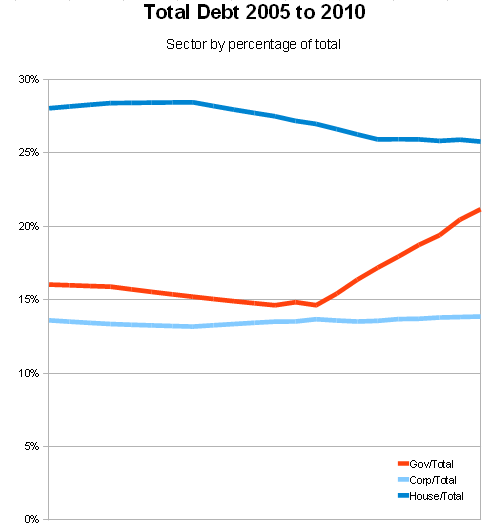
But guess what? Deficit spending created an economic boom — and the boom laid the foundation for long-run prosperity. Overall debt in the economy — public plus private — actually fell as a percentage of G.D.P., thanks to economic growth and, yes, some inflation, which reduced the real value of outstanding debts. And after the war, thanks to the improved financial position of the private sector, the economy was able to thrive without continuing deficits.

The second problem here is that Krugman is making a standard post hoc ergo propter hoc mistake. While the US did engage in a massive burst of unrestrained federal spending, it was not the spending that produced the postwar prosperity except in that it paid for the munitions and manpower that was used to destroy every industrialized economy that was not already destroyed by the Germans or the Japanese.

And the third problem, of course, is that the Keynesian notion that government spending is economic growth, let alone is capable of creating growth that is a multiple of the spending, is both logically and empirically false. Remember, no one even began to recognize that the Great Depression was a great depression until the end of 1931.


Double bubble trouble

A number of people have asked me what “the education bubble” means. While it’s not actually a true investment bubble since purchasing a college education is not a bona fide investment, the ever-rising cost of a college degree does have frothy and bubblicious aspects that can be seen very clearly in this chart from TaxProfBlog that compares CPI inflation vs the increase in US home prices vs the increase in college tuition.

In combination with the huge increase in students attending college, the value of a college degree is presently around one-third of what it was in 1990. I had previously estimated it was 28% of the value… but in either case, this assumes you are one of the 50% of college attendess who manages to successfully complete a college program and receive a degree within five years.


Hiding the decline

Karl Denninger is alerted to potential fraud in the housing price statistics:

I have a very disturbing email that came in this evening. It alleges out-and-out fraudulent reporting of home sales in one of the regional MLS systems. That is, prices paid that are in fact much lower than the “sold” prices reported in the MLS.

The person in question claims to have seen over 100 of these in his area. I have copies of two, and it appears, from the evidence that I have, that at least for those two the claim is accurate.

One in particular I was able to pull the auction data on. It “sold” under reserve, is listed as sold in the MLS at ~25% higher than the “sold” bid, and the premium is disclosed as 5%. This property also has a 90-day “anti-flip” provision on it, implying that the paper may be held by one of the GSEs. (It’s a nice-looking place, incidentally.)

Here’s the problem, obviously – Case-Schiller and other “home statistics” numbers related to price paid are all computed off these numbers provided by the local Realty boards (via NAR.) If the data in the MLS is bogus then so is the so-called “median sales price” and so are Case-Schiller’s numbers! These are not small discrepancies either – in both cases the “over-reporting” is by approximately 25%!

This would explain why housing prices have been mysteriously moving up while the number of home sales continues to plummet. It’s as if it’s not enough to cook the GDP, CPI-U, and U3 numbers, things are getting so bad that they have to create fictional statistics for practically everything in order to “hide the decline”.

Hey, it worked for the climate scientists. For a while.