Krugman asks the question

Fresh from presenting a FIFTH Neo-Keynesian definition of inflation in the form of “core inflation”, Paul Krugman finally begins to pay attention to the actual issue at hand:

I’d like to highlight one aspect of this discussion that has been striking me: the conservative focus on the evils of increasing the money supply. You hear it all the time: the Fed is printing money! Danger, Will Robinson! In some comments on this blog I see assertions that the true measure of inflation isn’t prices, it’s what happens to the quantity of money.

Now, one thing you might immediately say is that for those who care about, know, actually buying things — you can’t eat money — it’s prices of goods that matter; and for the past three decades, as shown above, there has been remarkably little relationship between the standard monetary aggregates and the inflation rate.

But here’s an even more basic question: what is money, anyway?

As I’ve shown in the first two inflation videos on Channel Vox, it’s absurd for Krugman to talk about “the inflation rate” when he can’t settle on one single reliable definition of inflation. However, he would have been correct to say that the relationship between the standard money aggregates and those various definitions is questionable, but he ignores the fact that the monetarists utilize, (or, as it suits them, refuse to utilize) a fudge factor called “velocity” in order to explain the variances in that relationship.

About which more anon. I would have already released the third video if I hadn’t lost my voice last week. I hope to record it soon, but I doubt I’ll be able to get it down before Christmas. Regardless, I find it ironic that Austrian theory is logically strong enough that even a blind squirrel like Krugman can stumble onto the foundation of some of its definitions despite his willful ignorance of its teachings.

“The truth is that these days — with credit cards, electronic money, repo, and more all serving the purpose of medium of exchange — it’s not clear that any single number deserves to be called “the” money supply.”

Of course, Krugman still manages to miss the obvious conclusion, which is that either the inflation rate depends upon whatever metric most merits being described as the money supply or else there is no such thing as inflation. As for his statement that one can maintain a reasonable monetary policy without knowing what money actually is, one need only point to the track record of the Federal Reserve in maintaining price stability and full employment to shatter that assertion.


Supply does not create demand

The present state of Spain’s real estate market should suffice to explode that theory:

A better known real estate debacle is a sprawling development in Seseña, south of Madrid, one of Spain’s “ghost towns.” It sits in a desert surrounded by empty lots. Twelve whole blocks of brick apartment buildings, about 2,000 apartments, are empty; the rest, only partly occupied. Most of the ground floor commercial space is bricked up.

The boom and bust of Spain’s property sector is astonishing. Over a decade, land prices rose about 500 percent and developers built hundreds of thousands of units — about 800,000 in 2007 alone. Developments sprang up on the outskirts of cities ready to welcome many of the four million immigrants who had settled in Spain, many employed in construction.

At the same time, coastal villages were transformed into major residential areas for vacationing Spaniards and retired, sun-seeking northern Europeans. At its peak, the construction sector accounted for 12 percent of Spain’s gross domestic product, double the level in Britain or France.

But almost overnight, the market disappeared. Many immigrants went home. The national unemployment rate shot up to 20 percent. And the northern Europeans stopped buying, too.

A number of mainstream analysts believe that the downturn has reached its bottom and things are turning around. However, it defies reason to believe that a 12.8% decline in prices is enough to offset the preceding 500% increase, especially when the banks that financed the boom haven’t booked their existing losses from the bust yet. My suspicion is that we are getting very, very close to the end of the reactive bounce in Europe and the USA alike. All of the conventional signs of Wave 2 bullishness appear to be present now and the rejection of the omnibus spending bill indicates that Congress is not going to play along with the Fed’s plan to replace private debt and spending with public debt and spending.

Those who think the Fed can print money ad infinitum have forgotten that it requires the government to play along and take on more debt that can be monetized. While I don’t expect an actual reduction in public debt, I do expect a rate of increase that is insufficient to keep pace with the private contraction.

UPDATE: Thanks to Wikileaks, we now know that the central bankers were lying and those of us who identified the crisis as being a solvency issue rather than a liquidity problem were right all along. Notice the date of March 2008, while Bernanke was still making speeches about how the Federal Reserve would solve the liquidity problem in May.

“Monday, 17 March 2008, 18:27
C O N F I D E N T I A L LONDON 000797
SIPDIS
NOFORN
SIPDIS
EO 12958 DECL: 03/17/2018
TAGS ECON, EFIN, UK
SUBJECT: BANKING CRISIS NOW ONE OF SOLVENCY NOT LIQUIDITY
SAYS BANK OF ENGLAND GOVERNOR”


Post-WWII American power

I recently read the 2008 paper that was the foundation of Carmen Reinhart and Kenneth Rogoff’s successful book that has often kept RGD from topping the Kindle charts in the Economic History category, This Time It’s Different. It’s an interesting paper for a variety of reasons, but one thing that struck me about the following chart is the way it underlines the fact that the post-war US economic dominance was an artifact of the hardships that struck other economies as a result of the wartime devastation and wartime expenditures rather than the implementation of FDR’s New Deal as the common historical myth has it.

Notice how many countries were in default – in other words, went bankrupt – during the 1940 to 1945 period: almost 50%.  To the extent that FDR drove up the public debt to previously unseen levels and wasted productive capacity on military expenditures, he actually put the US economy at some risk.  It was a reasonable bet, however, since the Allied nations incurred tremendous debts to the USA during the war, Americans had the benefit of being a creditor nation as well as being in possession of the only industrial infrastructure that had been undamaged by the war.  The postwar economic boom was therefore inevitable, barring any injudiciously stupid actions on the part of the politicians.  

Of course, this also meant that the relative decline of American wealth was inevitable, especially given the quasi-free trade policies that have permitted other nations, who were always bound to start catching up once they shed their debts and rebuilt their infrastructures, to catch up even more quickly. 


The $52 trillion question

This is a graph of the four primary debt sectors from 2008 through Q3 2010, which between them account for 90% of the total credit market debt outstanding in the USA.  The red line represents the total of federal debt plus state and local debt; $9 trillion belongs to the federal government while $2.4 trillion is owed by the state and local governments.

So, while Z1 reports a quarterly increase of 0.43% in overall credit, the first increase after five straight negative quarters, this meager increase almost entirely consists of swapping financial sector debt for federal government sector debt.  This is consistent with what I described was likely to happen in The Return of the Great Depression and is also consistent with the Misean definition of inflation that includes credit as opposed to the Friedmanite one that does not.  The $52 trillion question is how long this debt transference process can be maintained.  If it can go on indefinitely, then there will eventually be hyperinflation.  If it cannot, there will be deflation.  High metal prices notwithstanding, I still maintain that it cannot go on indefinitely, and the fact that the Fed and the Treasury are limiting their credit expansion to approximately the level of the private sector credit contraction tends to suggest that this is the case.  Three years is impressive, but it is neither infinite nor conclusive.

I don’t deny that we have seen what looks like inflation due to the steady increase in M1 and M2.  But keep in mind that we know beyond any shadow of a doubt that the mortgage banks have not been accurately accounting for the bad debts being incurred by defaulting homeowners and that they may not even hold title to many of the homes that supposedly back  those home loans.  This means that the yellow line should be declining more rapidly than it is.  Also, we know that the insolvent nature of many of the large financial institutions means that the light blue line is going to decline dramatically once the first one fails and sets off the chain reaction that the Fed has been so desperately attempting to forestall.  Those debts are not going to be inflated away, they are going to be deleveraged through default as has been happening on a smaller $3.1 trillion scale since the 4th quarter of 2008.

Since the government now accounts for 21.8% of all debt, up from 14.6% in only 27 months, the government looks to be facing a choice between assuming ownership of all debts owed in the economy within two decades or to stop fighting the deflationary process that Austrian theory dictates is not only necessary, but inevitable.  Those looking to the historical example of the Great Depression should keep in mind that the federal government had a good deal more leeway at that time because it was not already saddled with one-fifth of the debt in the economy.  And don’t forget, this accounting doesn’t include the very large debts imposed by off-budget pension plans at the state and local level and entitlements at the federal level.


Default and devalue

Iceland shows that the arguments put forth by the banksters and the europhiles are simply incorrect:

Iceland’s real gross domestic product grew by 1.2 percent in the July-September period from the previous quarter, the first quarterly increase since the same period in 2008. Iceland entered a slump after its overleveraged financial sector collapsed in the wake of Lehman Brothers’ bankruptcy.

Like Ireland and Greece, Iceland has taken a large dose of austerity measures to rebuild its economy. Unlike Ireland and Greece, however, Iceland allowed private banks to fail, and its currency, the krona, has declined by about 46 percent against the dollar since the start of 2008.

“Excluding the financial system, the real economy is doing well,” Arsaell Valfells, a professor of business and finance at the University of Iceland, said in telephone interview. Retail spending was still shrinking, he said, but the export sector, consisting mainly of fish, aluminum and tourism, was improving.

Just as a man cannot serve two masters, a government cannot serve two economies. The USA and Europe have chosen to preserve the financial economy at the cost of the real economy. Iceland chose the opposite. Needless to say, Iceland made the wiser choice because there are a lot more people in the real economy than the financial one. More importantly, the real economy is not a parasite completely dependent upon the financial economy, which is why putting the interests of the financial economy first is bound to be disastrous when viewed from a longer term perspective.


The Fifth Definition

Paul Krugman explains why Keynesian economists have now begun to switch to a fifth definition of inflation, “core inflation”, that is distinct and increasingly distant from the Keynesian school’s theoretical, official, textbook, and practical definitions.

Since I’m taking a break from shoveling, I thought I might take a few minutes to address an issue that seems to confuse many people: the idea of core inflation. Why do we need such a concept, and how should it be measured? So: core inflation is usually measured by taking food and energy out of the price index; but there are alternative measures, like trimmed-mean and median inflation, which are getting increasing attention.

First, let me clear up a couple of misconceptions. Core inflation is not used for things like calculating cost-of-living adjustments for Social Security; those use the regular CPI.  And people who say things like “That’s a stupid concept — people have to spend money on food and gas, so they should be in your inflation measures” are missing the point. Core inflation isn’t supposed to measure the cost of living, it’s supposed to measure something else: inflation inertia….

The standard [core inflation] measure tries to do this by excluding the obviously non-inertial prices: food and energy. But are they the whole story? Of course not — and standard core measures have been behaving a bit erratically lately. Hence the growing preference among many economists for measures like medians and trimmed means, which exclude prices that move by a lot in any given month, presumably therefore isolating the prices that move sluggishly, which is what we want.

And then these great minds of the dismal science wonder why their models don’t work in either a predictive or an explanatory manner. Of course, the reason they need to keep coming up with these additional “definitions” is because not because the “measures have been behaving a bit erratically” but because the conclusions that are based on the definitions don’t line up with what is visibly taking place in the actual economy.

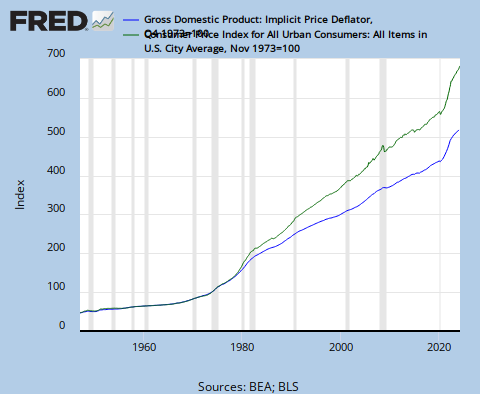
The red line is the standard “core inflation” CPI-FLENS measure that Krugman is citing in his second “Core Logic” post; the blue line is the standard CPI-U.  However CPI-FLENS cannot possibly measure the inflation inertia because the practical application of the various Keynesian definitions of inflation requires something to measure those price changes against.  Simply removing some of the more volatile (and generally higher) prices from the price index only smooths out the price index while tending to reduce it.  Since inflation – and therefore its inertia – depends upon the comparison of those price changes with changes in the production of goods and services, (in practical terms, with GDP minus the price increase of one’s preferred index, be it CPI-U or CPI-FLENS), anything that leaves GDP out of the equation cannot be considered the inflation inertia anymore than the mere change in prices can be considered inflation if it does not take the change in production into account.


So much for inflation

Apparently QE III is in the cards:

In an effort to thwart counterfeiting, the US Government has implemented a $100 bill design so difficult to print even the U.S. Treasury cannot print them. The government needs to burn $110 billion in flawed $100 bills, more than 10% of all existing cash. The cost of printing the flawed bills was a mere $120 million.

If inflation is derived from the money supply, then burning 10% of the the entire currency stock should cause prices to fall, right? Given the current M2 figure of $8,767 billion, this bonfire of the Franklins should result in an immediate 1.3% reduction in the rate of inflation.


Voxiversity 5.2: Inflation and Keynesian Economics

This should be an interesting discussion. The conclusion will initially strike some as a priori insane, but I encourage everyone to consider the empirical evidence before issuing a diagnosis. I may need to revisit this one after the critics have shared their presumably constructive input, so I look forward to hearing everyone’s take on it.

In case you’re wondering why these esoteric and pedantic debates over definitions are of interest to me or why they are important, consider this recent interview with Ben Bernanke. The relevant statement is highlighted in bold.

Pelley: Some people think the $600 billion is a terrible idea.

Bernanke: Well, I know some people think that but what they are doing is they’re looking at some of the risks and uncertainties with doing this policy action but what I think they’re not doing is looking at the risk of not acting.

Pelley: Many people believe that could be highly inflationary. That it’s a dangerous thing to try.

Bernanke: Well, this fear of inflation, I think is way overstated. We’ve looked at it very, very carefully. We’ve analyzed it every which way. One myth that’s out there is that what we’re doing is printing money. We’re not printing money. The amount of currency in circulation is not changing. The money supply is not changing in any significant way. What we’re doing is lowing interest rates by buying Treasury securities. And by lowering interest rates, we hope to stimulate the economy to grow faster. So, the trick is to find the appropriate moment when to begin to unwind this policy. And that’s what we’re gonna do.”

It should be clear that the Fed Chairman does not define inflation in any of the Keynesian manners described in this video. But is his definition correct? That is the $600 billion question.


Let the women work

Calculated Risk presents a chart showing that the percentage of men aged 25-54 participating in the labor force declined to a record low of 88.8% in November.  And that was BEFORE the release of the new World of Warcraft expansion.  The chart goes back to 1948 and shows that the idea women first entered the workforce en masse after WWII or in the 1970s simply isn’t true; about one-third of women have always had to work.  The increase in the percentage of women participating in the workforce is predominantly the result of young women who previously got married and had children while being supported by a husband now working instead of or in addition to having a family.  The chart is also a little misleading in that it only measures to age 54.  One of the chief impacts of more women entering the workforce is that men over the age of 60, who had previously been much more inclined to work, exited the workforce en masse thanks to the establishment of Social Security and Medicare.

So, as I have often said, the primary benefit to society from employing young women is to pay for old men collecting retirement.  In return for which the societal costs include declining marriage rates, skyrocketing illegitimacy rates, lower average wages for both men and women, reduced productivity, and demographic decline.  This would not appear to be either a rational or sustainable policy for any nation, especially considering that the first attempted solution, importing third-world workers to replace the missing children, has not worked out well for any nation that has adopted it.  The choice is as stark as it is simple.  Either abandon the notion of sexual equality and return to the traditional model where 70% of women are occupied with raising families or experience complete societal collapse.

On a tangential note, I saw this in the comment’s at CR’s place.  I don’t see it as a positive indicator: A friend picked up a hitch-hiker in the National Park last week and gave him a ride, and it turned out he was a marine that had done 3 tours in the sandbox, but apparently our military is getting picky about who they allow to re-up, and he told my friend, “I hope something happens in Korea, so I can go back to work.”  It is a time-honored fact of history that when men cannot find jobs, the rulers of society attempt to keep them occupied killing people somewhere else.


Low hurdles

I was bemused when I checked Channel Vox this morning preparatory to uploading the next video in the inflation series and saw that it had won a YouTube award. It appears Voxiversity was #3 Most Subscribed Channel in Italia this week. Of course, I would have needed 360x more to have reached the same ranking in the USA. Clearly the next video should be entitled Victoria’s Secret Economics: Alessandra Ambrosio Explains Inflation.

But since I’m on the subject, I should mention there is a slight change of plans with regards to the 5.2 video. I am extremely loathe to make a case that depends upon anyone accepting my assertions undemonstrated, so the second video will not concern the credit-money definition of inflation as I’d originally planned, but will instead demonstrate the inutility of the four – yes, four – primary Keynesian definitions of inflation. The third video will examine the Monetarist definition, and only then, once the case against the various mainstream definitions is concluded, will I explain and defend my contention that the correct definition of inflation is an increase in the money supply plus outstanding debt.

Anyhow, I’m planning to do the recording tonight and upload it sometime this weekend, in case you’re interested.