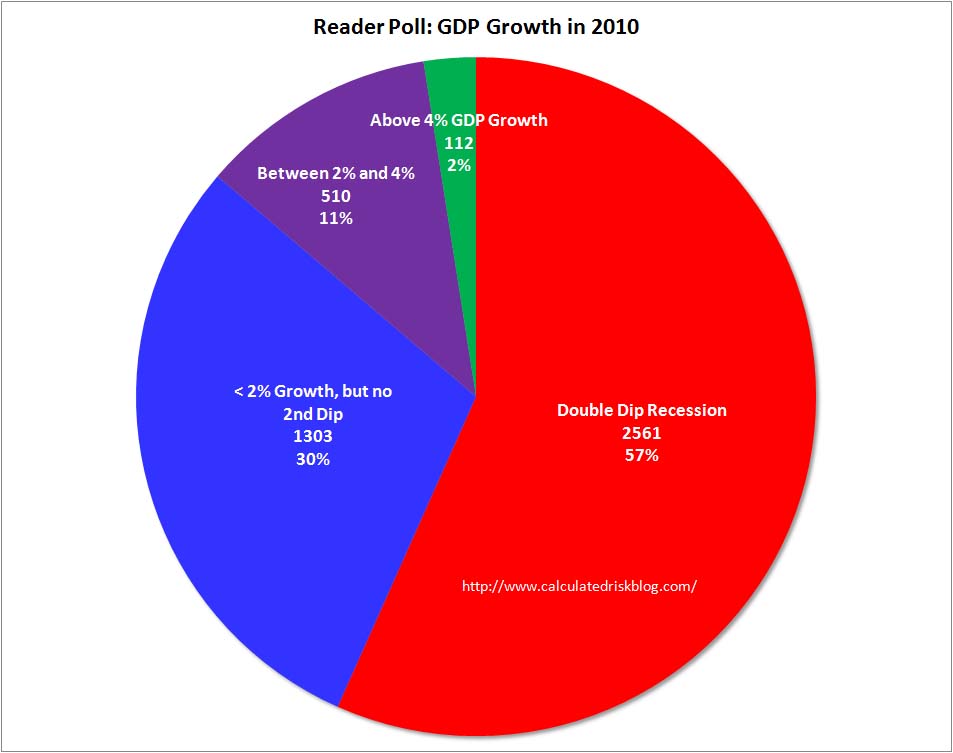
Am I that good?

Or are they just that predictable?

Real gross domestic product — the output of goods and services produced by labor and property located in the United States — increased at an annual rate of 2.8 percent in the third quarter of 2009, (that is, from the second quarter to the third quarter), according to the “second” estimate released by the Bureau of Economic Analysis. In the second quarter, real GDP decreased 0.7 percent. The GDP estimate released today is based on more complete source data than were available for the “advance” estimate issued last month. In the advance estimate, the increase in real GDP was 3.5 percent (see “Revisions” on page 3).

You may recall my warning that the 3.5 percent figure in the Advance report would be revised downward on the day it was published. Now, according to the BEA’s newly revised estimate, only 1.3 percent of GDP growth was NOT provided by Cash for Clunkers. So, if you consider the even larger stimulus provided by the $8k housing credit, which is not separately accounted for, it is quite obvious that economic activity is still contracting even if the GDP statistic is not. This won’t be the last revision for 3Q09… and I’m not talking about the scheduled third report, formerly known as the Final one, either.

UPDATE – And in the “Why I should never be allowed on the radio” category, we have tonight’s performance on a national show. I explained how the economic pain of a contraction shouldn’t be confused with the actual cause of the problem by using the analogy of a sexually transmitted disease. Halfway through, I stopped and said “Okay, that’s probably a terrible analogy.” The host concurred and said that he preferred to compare a contraction to chemo. In retrospect, I don’t think that actually works as well, however, because the salient point is that the damage is actually done during the good times and the resulting pain is merely the natural consequence of the damage.


Krugman and the babysitting coop

Paul Krugman loves to use the story of the baby-sitting coop told in an article published by Joan and Richard Sweeney in the Journal of Money, Credit, and Banking in 1978 and has repeatedly recycled it, all the while failing to understand that it is a very poor analogy for the American economy and that the lessons he draws from it are false. I have updated and modified it to explain what is actually going on in the U.S. economy as well as to show why Krugman’s proposed solution – print more money – cannot possibly work:

Twenty years ago I read a story that changed my life. I think about that story often; it helps me to stay calm in the face of crisis, to remain hopeful in times of depression, and to resist the pull of fatalism and pessimism….

A group of people (in this case about 150 young couples with congressional connections) agrees to baby-sit for one another, obviating the need for cash payments to adolescents. It’s a mutually beneficial arrangement: A couple that already has children around may find that watching another couple’s kids for an evening is not that much of an additional burden, certainly compared with the benefit of receiving the same service some other evening. But there must be a system for making sure each couple does its fair share.

The Capitol Hill co-op adopted one fairly natural solution. It issued scrip–pieces of paper equivalent to one hour of baby-sitting time. Baby sitters would receive the appropriate number of coupons directly from the baby sittees. This made the system self-enforcing: Over time, each couple would automatically do as much baby-sitting as it received in return. As long as the people were reliable–and these young professionals certainly were–what could go wrong?

Well, it turned out that there was a small technical problem. Think about the coupon holdings of a typical couple. During periods when it had few occasions to go out, a couple would probably try to build up a reserve–then run that reserve down when the occasions arose. There would be an averaging out of these demands. One couple would be going out when another was staying at home. But since many couples would be holding reserves of coupons at any given time, the co-op needed to have a fairly large amount of scrip in circulation.

Now what happened in the Sweeneys’ co-op was that, for complicated reasons involving the collection and use of dues (paid in scrip), the number of coupons in circulation became quite low. As a result, most couples were anxious to add to their reserves by baby-sitting, reluctant to run them down by going out. But one couple’s decision to go out was another’s chance to baby-sit; so it became difficult to earn coupons. Knowing this, couples became even more reluctant to use their reserves except on special occasions, reducing baby-sitting opportunities still further.

In short, the co-op had fallen into a recession.

Since most of the co-op’s members were lawyers, it was difficult to convince them the problem was monetary. They tried to legislate recovery–passing a rule requiring each couple to go out at least twice a month. But eventually the economists prevailed. More coupons were issued, couples became more willing to go out, opportunities to baby-sit multiplied, and everyone was happy.

Later in the article, Krugman goes on to explain how the coop’s “central bank” can manage the coupon supply to prevent couples intent on staying in from accumulating too many coupons and acquire coupons on loan if they found it necessary to go out more often than they’d planned. But what he fails to anticipate is the situation where the coop board has provided lots and lots of coupons to the various couples in anticipation of their future use for an extended period of time. In short, he fails to account for the possibility that the “recession” is not caused by a coupon shortage, but rather by the limits of babysitting demand.

There are three limits to the demand for babysitting coupons, one physical, one practical, and one psychological. The physical limit is that a couple cannot possibly make use of more than seven evenings-worth of coupons per week since that is the maximum number of evenings they can go out and leave the children home. The practical limit is the financial resources the couple has to spend on going out, and the psychological limit is based on the amount of the couple’s desire to actually spend evenings with their children. If, in a given time period, any of these three limits are exceeded by the amount of the coupons distributed or loaned out to the couple, the couple will not make use of them regardless of how many more coupons they are given. Therefore, it should be obvious that any decline in the amount of going out that is based on one of these three limits of demand cannot be solved by simply distributing more coupons for babysitting.

In fact, for the coop, the correct policy prescription is to do exactly the reverse of what Krugman is recommending. Not only should more coupons not be distributed, but all coupon distribution should stop so that people can use up the coupons they have. Coupons given out on loan should be either repaid or simply cancelled; more coupons can be distributed once people have used up their existing supply and actually require more babysitting.

Note: the fact that babysitting coupons are less fungible and important to the coop than money is to a national economy means that one cannot concoct an example of the Austrian business cycle utilizing this analogy. The coupon supplier is not causing the problems here; they are exogenous to the coupon supply. But, this invocation of the material and immaterial limits of demand should demonstrate that Krugman’s analogy is not necessarily relevant to the present economic situation, and to the extent that it can be shown that the American consumer has exceeded the limits of his demand, it shows that his conclusions are demonstrably inapplicable.


Where is the money?

Here’s something I wish I’d been able to devote some space in RGD. Where is all the stimulus money? Where is the TARP money? Consider the non-defense Federal expenditures plus Federal investments in the most recent GDP report.

3Q08 $344.7 billion
4Q08 $355.4 billion
1Q09 $356.0 billion
2Q09 $362.1 billion
3Q09 $368.4 billion

So, according to the GDP reports, non-defense government spending has increased only $23.7 billion despite the fact that we know $700 billion was spent in the banking and automotive bailouts and at least $336 billion was spent in the Bush and Obama stimuli to date. Where is it? Why does it not show up in the GDP reports as government expenditures or anything else? Even if items such as the automotive bailouts are considered loans, it should have showed up as expenditures by Chrysler and GM. And moreover, the $100 billion in TARP loans to bailed-out corporations that went bankrupt should be written off as an expenditure since they’re never going to be repaid.


Unreliable retail numbers

Karl Denninger explains why the “positive” retail numbers reported today are, in fact, nothing of the kind:

We start with one store in the world that has net sales of “100”.

Store #2 opens with sales of 10. Half of that is new activity, half comes from Store #1. First month shows a sales report of “95”, a decrease. But in the next month Store #2’s numbers come online, the “95” is revised to the (true) 105, and Store #2s numbers (which have climbed to 60, while Store #1 has lost share and now also has an amount of 60) are all reportable. Net activity is now accurate at 120 and the previous month is revised to the (true) net 105.

Store #1 and #2 both are operating with sales of 60. Store #2 fails, and half of its business goes to Store #1. In the month it fails Store #1 shows an increase and Store #2’s numbers are DROPPED ENTIRELY, since it did not report. This is not revised. We now report a “50% increase” in retail activity, which is total crap – we really had a 25% net decrease for the current month. But the revision to the previous month does get posted, and depresses the previous month’s numbers.

Did this just happen?

The August to September 2009 percent change was revised from -1.5 percent (±0.5%) to -2.3 percent (±0.3%).

Oh, it did! Now we know where the revision to the previous month came from – stores closed in the present month and their sales loss was intentionally dropped from the current month.

Of course, it’s relatively easy to tell if the retail sales numbers are cooked or not. If the state sales tax numbers are falling while “retail sales” are increasing, then it’s obvious that the model is an inherently unreliable one.


WND column

Fallacy of Recovery

A one-time skeptic of fiscal stimulus, [German chancellor] Ms Merkel plans what amounts to a third stimulus package worth about € 7 billion ($10.4 billion), starting on January 1st.
– The Economist, Oct. 31, 2009

The mainstream media is full of reports of economic recovery and an end to the recession of 2008, even though the Business Cycle Dating Committee of the National Bureau of Economic Research has not yet spoken its official word on the matter. The significant rise in the stock markets and a single advance GDP report has been enough to convince nearly every economist and financial analyst that the worst is past, that 10.2 percent unemployment is a lagging indicator, and that the primary concern at hand is now too much monetary and fiscal stimulus leading to inflation.

Read the rest of the column at WND
Karl Denninger at the Market Ticker appears to have reached the same conclusion. Note that I wrote my column prior to reading his post To the Barkers: Answer This Question:

“The recession ended in June”: Dennis Kneale

“The recession was definitely over in September”: Any one of a number of people.

Ok. Let’s say that I accept all this at face value, even though while driving through my definitely-beach-oriented local town here this afternoon I noted even more closed-and-gone storefronts than there were a couple of weeks ago, and last night at the local open-air mall, although the evening was absolutely gorgeous, you could have fired a 155mm Howitzer down the “main drag” without killing anyone – because there was almost nobody there, and literally not one shopping bag was in evidence.

I simply have to ask the pundits and the carnival barkers, of which CNBC is the worst (but certainly not the only sinner) the following – why do we need any of these programs if in fact the economy is growing again:

Something clearly isn’t adding up. So, who is more likely to be correct? The skeptical economists looking at the evidence and seeing that nothing fundamental has changed or the mainstream economists utilizing the very same models that didn’t let them see a recession coming in the first place? And furthermore, if the models are known to be unreliable, then how does it make any sense to put faith in an estimate that is constructed on the bases of those models?


The man who predicted the Great Depression

Mises finally gets his rightful due from the Wall Street Journal:

“Theorie des Geldes” did not become the playbook for policy makers. The 1920s were marked by the brave new era of the Federal Reserve system promoting inflationary credit expansion and with it permanent prosperity. The nerve of this Doubting-Thomas, perma-bear, crazy Kraut! Sadly, poor Ludwig was very nearly alone in warning of the collapse to come from this credit expansion. In mid-1929, he stubbornly turned down a lucrative job offer from the Viennese bank Kreditanstalt, much to the annoyance of his fiancée, proclaiming “A great crash is coming, and I don’t want my name in any way connected with it.”

We all know what happened next. Pretty much right out of Mises’s script, overleveraged banks (including Kreditanstalt) collapsed, businesses collapsed, employment collapsed.

This is why I’m pretty relaxed about RGD. As an economist, I’m not fit to replace the battery on Mises’s calculator. If he wasn’t afraid to be dismissed as a lunatic for standing against the socialist tide, I’m not afraid to risk the same for standing against the Neo-Keynesian one. The market and the GDP statistics are totally irrelevant in my opinion. The former looks terrible when measured in terms of gold or any foreign currency and the latter have been twisted and contorted so greatly that I suspect it will have to be trashed altogether by the time the Great Depression 2.0 comes to an end.

Remember that GDP comparisons to the Great Depression are intrinsically questionable because GDP didn’t exist until it was created in order to measure industrial output in World War II. Which, astute history buffs will recall took place after the economic events of 1929-1933.


Green shoots!

One of the economic measures I track actually showed signs of life! Total loans and leases at commercial banks increased by $12.4 billion the week of October 28th, the first weekly increase since May 27th. Of course, that little uptick was only a two-week rise of $15.7 billion and preceded a five-month, $451.4 billion decline, so I would be hesitant to put too much confidence into it. It will require an increase of at least $250 billion to be meaningful in any way, but it only seemed fair to point out that for at least one week, the credit contraction process appears to have reversed itself.

Of course, more debt can’t possibly solve any of the myriad economic and financial problems, but let’s not bicker and argue over esoteric theory. GDP is up! Debt is growing! And how about that Dow! It’s a bull market straight to 36,000! Unemployment? Lagging indicator. Now, wait a minute, this suddenly all sounds very familiar….


Slippery slope or cliff-jumping

Government goes vertical:

But what about the slippery slope? Well, it went totally vertical. On the very day that the government czar announced that he would cut the pay of companies that received taxpayer bailouts, the Federal Reserve announced that it would start regulating compensation at the thousands of banks that it regulates, as well as American subsidiaries of non-U.S. financial companies. Some state regulators said they planned to issue similar requirements for state-regulated banks not covered by the Fed plan.

All of this is being done without any legitimate power under the Constitution, and much of it without even the authorization of Congress. Congress refused to bail out the auto companies, so Bush did it on his own authority. Congress never authorized the Federal Reserve to regulate the pay of bank employees.

This is not a slippery slope. This is falling off a cliff. As one news story pointed out: “The restrictions were the latest in more than a year’s worth of government intervention in matters once considered inviolable aspects of the country’s free-market economy and represent a signal moment in the history of the American economic experiment.”

It’s amazing that the lesson so many Americans took from the fall of the Soviet Union appears to have been: “Well, if giant government worked for them….”


The tide flows out

Guess who’s naked now?

A widening gap between data and reality is distorting the government’s picture of the country’s economic health, overstating growth and productivity in ways that could affect the political debate on issues like trade, wages and job creation.

The shortcomings of the data-gathering system came through loud and clear here Friday and Saturday at a first-of-its-kind gathering of economists from academia and government determined to come up with a more accurate statistical picture.

The fundamental shortcoming is in the way imports are accounted for. A carburetor bought for $50 in China as a component of an American-made car, for example, more often than not shows up in the statistics as if it were the American-made version valued at, say, $100. The failure to distinguish adequately between what is made in America and what is made abroad falsely inflates the gross domestic product, which sums up all value added within the country…. Grappling with these blind spots, nearly all of the 80 experts at the conference, which was sponsored by the Upjohn Institute and the National Academy of Public Administration, agreed that the statistics now published tend to overstate the strength of the economy.

If you’re only watching GDP, you are getting an increasingly inaccurate picture of the economic situation. There is no way that economic activity is growing in a credit-based economy where credit is contracting. It’s like watching a football game where the team fails to get into the end zone, but somehow racks up 28 points on the scoreboard. As I’ve shown in RGD, the variance in reports for the same quarter is not infrequently larger than the average growth reported.

It’s interesting that they should finally admit these statistical problems now, just as the gap between reported growth and reported employment is becoming apparent to the casual observer.


Double-digits

Unemployment sails over the predicted high for 2010. The ever-reliable mainstream economists were forecasting an increase to 9.9 percent… and I’d encourage you to stop and think about why they might have assumed that. Remember, Keynesian economics is all based on psychology.

Unemployment Rate Rises to 10.2 Percent
The nation’s unemployment rate rose above 10% for the first time since 1983 in October, a much worse jump than expected as employers continued to trim jobs from payrolls…. According to a survey of top forecasters by the National Association of Business Economics last month, the consensus estimate among economists was that unemployment would hit a high of 10% in the final three months of this year and the first quarter of 2010.

Expect a lot of happy talk about how unemployment is a “lagging indicator”. Anyhow, the employment-population ratio is down to 58.5 percent and U-6 is now 17.5 percent. I will be very surprised if U-3 does not exceed 12 percent in 2010.

Karl Denninger reminds us that the consensus forecast for 2009 was 8.4% and breaks it down at the Market Ticker with the help of this graph.  He’s looking primiarly at loan losses while I’m looking at declining bank credit, but the perspective is the same.