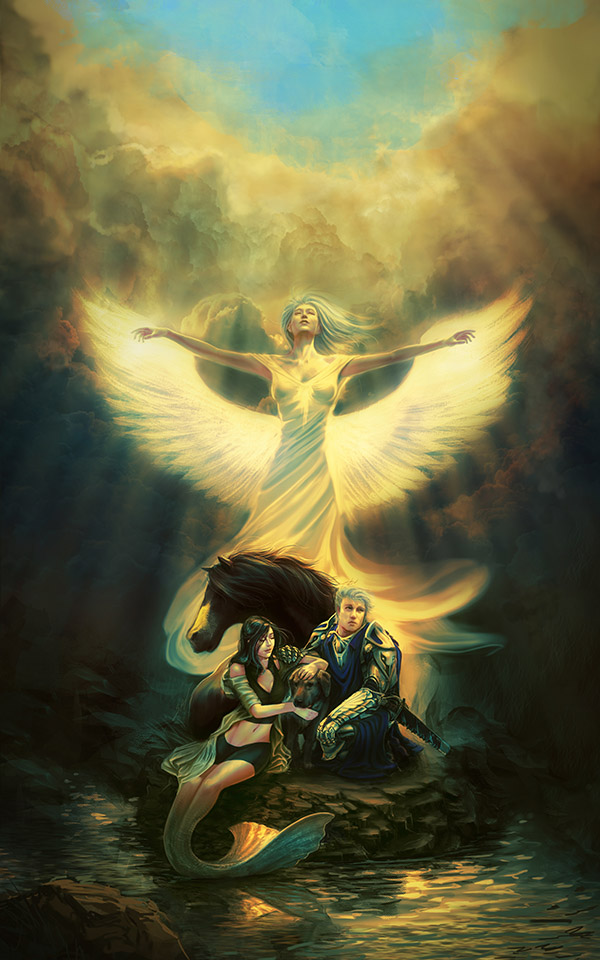
Another category bestseller

Congratulations to Fenris Wulf, whose Loki’s Child is now, thanks to you all, the #1 bestseller in the Dark Humor category and is rapidly closing in on Kurt Vonnegut in Satire.

Amazon Best Sellers Rank: #1,488 Paid in Kindle Store
#1 in Books > Literature & Fiction > Humor & Satire > Dark Humor
#2 in Books > Literature & Fiction > Genre Fiction > Satire

Read the reviews. If you liked Owen Stanley’s brilliant The Missionaries, the chances are pretty good you’ll like this one too. The main difference is that where The Missionaries was a stiletto silently slipped in to the strains of Vivaldi, Loki’s Child is a sledgehammer, and the sound of skulls being smashed is drowned out by Metallica.

Or, you know, Babymetal.

Loki’s Child

Loki’s Child is a tale of music, revolution, and revenge. A pagan dystopian paean to chaos, a libertarian manifesto, and an insider’s scathing critique of the music industry, this is a book that Robert Anton Wilson might have written if he had known how to play electric guitar. This is a book so metal that even the consonants require umlauts. This is a book that will make you first question the author’s sanity, and then the sanity of the society in which you live.

Jasmine, Mitzi, and Sandy are Fatal Lipstick, a three-piece girl-metal band with a million-dollar record contract and less musical talent than the average gangster rapper. They dedicate songs such as “Whoredumb”, “Greed is Bad”, and “Guts Ripped Out” to the Devil and declare their greatest ambition is to inspire their fans to kill themselves. Their own sound engineer thinks they should be dragged out into the street and shot for their crimes against music. And it falls to Ezron Blenderman, a record producer who puts on his pants one leg at a time and makes hit records, to somehow transform their horrendous incompetence into something that will sell millions of records to unsuspecting teenagers around the world.

But one day, Blenderman catches Jasmine playing the guitar by herself… and begins to discover that the daughter of the Norse God of Chaos has no intention of becoming a manufactured one-hit wonder. Loki’s Child is angry, and she intends to set the whole world on fire.

Loki’s Child is 380 pages, DRM-free, and retails for $4.99 on Amazon. This is the same book that some New Release subscribers received as a bonus book last year, but it has been considerably edited since. However, please note that the book contains a number of elements that some Castalia House readers may find objectionable, including vulgarities, a pagan perspective, drug use, violence, the music industry, and a revolutionary libertarian theme.

If you are, like me, a fan of either Robert Anton Wilson or Philip K. Dick during his VALIS phase, (which is to say his most reality-challenged phase) you will not like this book, you will love it. Loki’s Child is a satire even more biting than The Missionaries; while it is often funny, the humor is considerably darker and there is an angry edge to it that is more than a little appropriate to the political situation in which we find ourselves today.

Like its recent predecessor, Loki’s Child is a novel that would never have gotten past the gatekeepers at any other publishing house. And the fact that the book is about the music industry, takes place in part in Tokyo, refers to kawai metal, has a libertarian theme, and is written by someone named Fenris Wulf might lead some to believe it was written by a three-time Billboard-charting recording artist who studied in Japan, recently attended a Babymetal concert, has been named one of the 25 leading internet libertarians, and founded a game development house named Fenris Wolf.

However, I assure you, these things are mere coincidences.

From the reviews:

  • The book is smoothly-written. That’s a considerable feat, as it also manages to be rambling, nihlistic, and insane! The language is well-chosen, and events flow naturally from one to another, with no unnatural transitions. It is also very funny. The hypothetical bands and artists are wonderful… I would strongly recommend “Loki’s Child” to virtually any reader, particularly those that enjoy Douglas Adams, satire, music, science fiction and fantasy, or simply entertaining, unhinged stories.

Book of the Week

VFM, can you get me the contact information for Simon Nicholas Hawke? Preferably telephone, but I’ll settle for email. I can find his street address, but telephone numbers are restricted to IP addresses outside the USA. I cannot believe this guy’s books are not all in print. I loved the Time Wars books when I was younger; the first one, The Ivanhoe Gambit, is this week’s Book of the Week.


A tale of the Unwithering

Given the number of new readers who may not be familiar with it, I thought its recent Dragon Award nomination for Best Science Fiction novel justified posting this recent Amazon review of John C. Wright’s Somewhither: A Tale of the Unwithering Realm. Congratulations, John, on your Dragon Award finalist!

Just finished rereading Somewhither, a grand tour through John C. Wright’s daunting and vivid imagination, wherein dwell creatures eldritch, fell and fantastic beyond anything any one, or even any small number taken together, of earth’s many mythologies ever dreamed. Plus all the worlds and trained warriors and assassins and spies and superheroes from a dozen cultures, comics and RPGs kicked up a notch or two by Wright’s deft muse, and all tossed into one epic blender of an adventure, of which this is only Part I.

Which is why I needed to read it twice. At least.

Illya Muromets is a odd teenage boy living in rural Oregon with his even odder family. Illya has grown very large and very ugly – heavy brow ridge, huge teeth. He looks nothing like his 2 brothers or his parents. His homeschooling includes rigorous physical and combat training, as well as Latin and Hebrew. He doesn’t see this as particularly weird, just sort of odd like everything about his life. His best friend is Foster Hidden, fellow Boy Scout and champion archer.

Dad takes ‘business trips’ that involve getting armed and armored to the teeth, which arms and armor include any number of holy relics and silver bullets, and and hiking up the hill to the ruins of an old monastery and disappearing for days on end. His mother went on one such trip, and never came back.

Illya gets a job doing grunt work at a nearby ‘museum’ for the mad and colorful Professor Dreadful, who has an inexplicably beautiful and brave daughter Penelope. Penny Dreadful tries to become the youngest person to sale around the world alone, but her yacht goes down and troubles beset her. She doesn’t get the record, but she survives and returns in time for Illya’s raging hormones to inflict the world’s worst crush on him.

Professor Dreadful gets locked up in the local nuthouse, to the surprise of few. He had been working to decipher a set of what might be cuneiform letters that appeared mysteriously on a wall at CERN after a fatal accident.

Illya gets a desperate message: Professor Dreadful has deciphered the cuneiform, which contained instruction on how to build a gateway between worlds in Ursprache, the one language spoken before the fall of the Tower of Babel.

He has constructed the gateway. He left it running in the museum basement….


The Dragon Awards

Here’s how I see it. Your mileage may well vary. It’s a pretty good list, although I was surprised not to see Seveneves on it. It’s definitely light on the Pink SF, which is good to see. I’m a little disappointed that for all our military-related publications this year, we didn’t publish a single novel in the Mil-SF category this year.

Still, it’s great to see two Castalia novels up for awards in the inaugural year.

1. Best Science Fiction Novel
Somewhither: A Tale of the Unwithering Realm by John C. Wright

I liked Marc’s Traveller book, but I have to go with Mr. Wright here.

2. Best Fantasy Novel
Son of the Black Sword by Larry Correia

Not even close this year. Larry was always a fun and popular author, but he stepped it up with this and MH:Nemesis.

3. Best Young Adult / Middle Grade Novel
Changeling’s Island by Dave Freer

4. Best Military Science Fiction or Fantasy Novel
Hell’s Foundations Quiver by David Weber

I think Scalzi did the right thing by declining his nomination; his work doesn’t really belong in this category and this clearly isn’t his crowd. This is a bit of a career Oscar for Weber, but he deserves it.

5. Best Alternate History Novel
League of Dragons by Naomi Novik

Novik is an SJW-lite, but her Napoleonic dragons are an original and interesting alternate history take. Turtledove is all right. The Baen gang might like Eric Flint, but I’ve never enjoyed his books and the man isn’t just intellectually ossified, he’s also a dick.

6. Best Apocalyptic Novel
Ctrl Alt Revolt! by Nick Cole

Again, not even close. This is the best book on the whole list.

7. Best Horror Novel
Souldancer by Brian Niemeier

Sorry Declan, you are screwed.

8. Best Comic Book

Don’t know. Don’t care.

9. Best Graphic Novel
The Sandman: Overture by Neil Gaiman

10. Best Science Fiction or Fantasy TV Series
Game of Thrones – HBO

I’ll vote for quality work even if the creator is an obnoxious, creepy, rape-obsessed troll. Going into the final stretch, this is still the best TV series running, despite the inept battlefield consultants. Still bitter that they killed off Myranda, though.

11. Best Science Fiction or Fantasy Movie
Deadpool

Pretty good selection. This is the only one I would watch again.

12. Best Science Fiction or Fantasy PC / Console Game
Metal Gear Solid V by Konami Digital Entertainment

What else?

13. Best Science Fiction or Fantasy Mobile Game
Fallout Shelter by Bethesda Softworks

14. Best Science Fiction or Fantasy Board Game
Talon by GMT Games

15. Best Science Fiction or Fantasy Miniatures / Collectible Card / Role-Playing Game
Call of Cthulhu Roleplaying Game (7th Edition) by Chaosium Inc.


The Book of the Week


Pussycats: Why the Rest Keeps Beating the West and What Can Be Done About It, by Martin van Creveld, is the Book of the Week. Martin is always a must-read for anyone interested in military history or strategy, whether he is published by Castalia or, as in this case, not.

We’ll have a pair of new books out from him in the near future, but in the meantime, this book about the decline of Western military power should tide van Creveld fans over nicely.

The “West,” a term which from this point on will refer to the countries of Western Europe and North America while excluding Russia and Japan, reached the peak of its power just before 1914. Later, owing partly to the casualties sustained in World War I and partly to a loss of self-confidence, it found that its rule over subject peoples became harder and harder to sustain. During the interwar period several colonial countries in the Middle East, including Egypt, Iraq and Jordan, gained at least nominal independence. Translating that into real independence took longer; but by the second half of the 1950s that, too, had been achieved.


Here we are concerned with the strategic aspect of the matter, not the moral one. Still staying in the interwar period, struggles such as the one against the Rif of Morocco, when some 250,000 well-equipped, highly-trained, French and Spanish troops took several years to defeat a loose coalition of mostly barefoot, mostly illiterate, Moroccan tribesmen, pointed to the direction in which things were moving. By 1939 many colonial peoples around the world were preparing to challenge their masters. Although, in the event, it took World War II, in which those masters tore each other to pieces, to set the stage for the conflagrations that followed.


Since then almost the only time Western countries gained a clear military victory over their non-Western opponents was during the First Gulf War. In 1991 NATO, as the most powerful military alliance in history, had just emerged triumphant from the forty-five year struggle known as the Cold War. But its members had not yet begun to dismantle their armed forces as the European ones in particular were to do later on. As a result, they were free as never before or since to send those forces to any spot they wanted to wage any war they wanted against any opponent they wanted. Though few people realized it at the time, in retrospect to challenge NATO, reinforced by several other countries, with a conventional army, as Iraqi dictator Saddam Hussein did, represented the height of folly. Even so the US and its allies did not complete the job. With good reason, as it later turned out.


This episode apart, practically every time the West, or some country that was part of it, fought the rest it was defeated. Conversely the wars in question, and the people who waged them and fought in them, succeeded in liberating—whatever that might mean—entire continents with populations numbering in the hundreds of millions.


Books and commenters

All right, so there is clearly a sufficient amount of interest in the concept of annotated classics from Castalia. This leads to the obvious next question: which classics and which commentators?

I think some variant of MMP’s P500 system might work here, where people can preorder a book but will not be charged for it until a certain number is hit, thereby triggering the production process. But before we can figure out what goes in the place of the 500, we’d need to determine what is of the most interest to the most people.

So far, we have the two combinations that I’d originally mentioned:

  • Aristotle’s Rhetoric, Vox Day
  • Clausewitz’s On War, Martin van Creveld
What other specific combinations would you like to see? We’ll need a list first, after which we can order the priority. Then I can talk to the various authors to see if they’d be interested.

UPDATE: While I’m flattered that a number of you are interested in my comments on various classics, if you consider that my plate is already rather full, it would probably be more practical to suggest other commentators.


Tor doubles down

This is fantastic news for Castalia House and all readers of Blue SF. PNH has been anointed Tom Doherty’s heir and will be running Tor Books in the future.

Patrick Nielsen Hayden has been named Associate Publisher of Tor Books, effective immediately. This award-winning 28-year veteran of Tor has brought numerous prestigious and bestselling authors to the list, including John Scalzi, Cory Doctorow and Charlie Jane Anders, to name a few. His vision has been instrumental in the development of Tor.

Devi Pillai, who led the US division of Orbit to its position as Tor’s fastest-growing competitor, will be joining Tor, also as Associate Publisher. “I’ve watched Devi’s work with admiration for a long time now; her qualifications are outstanding, and she’ll be a great addition to our team,” said Tor Books publisher Tom Doherty. “As we continue our 35-year commitment to adult SF and fantasy, Devi and Patrick will work alongside each other to oversee our numerous editors who work primarily in these twin genres,” he continued.

It’s as if Lincoln promoted Custer to replace McClellan instead of Grant. In 28 years, PNH has brought a mediocrity, a tedious didact, and a no-talent transvestite to Tor. That’s the best he could do? Castalia House will be announcing two better, and better-selling, authors than any of those three in the next six weeks alone.

Tom Doherty should have fired PNH and Irene Gallo last year, but he was too old and infirm to find the courage to do it. Instead, he merely muzzled them while he could. With this promotion, however, PNH will have the opportunity to return to what is literally a bully pulpit.

This promises to be entertaining. When the Tor ship goes down, it should be PNH at the helm.


On the Existence of Gods in audio

A #1 bestseller in the Atheism category, On the Existence of Gods is a response to a public challenge posed by a militant atheist who claimed to have never encountered any good arguments for the existence of gods. It is a competitive discourse between a Christian and an atheist, each of whom argue for their position on the subject, after which the arguments are adjudicated by a team of three judges – a Christian, an agnostic, and an atheist – before additional arguments are presented.

The format is compelling and the results are at times surprising, as the discussion takes unexpected twists and turns, while the judges exhibit ruthless impartiality as they criticize the arguments without mercy or favor. Vox Day, the author of The Irrational Atheist, presents the Christian perspective, while Dominic Saltarelli argues for the atheist position. The debate is wide-ranging and intelligent, but remains civil throughout, even as the momentum swings in favor of one side, and then the other.

Narrated by Jon Mollison, On the Existence of Gods is three hours and 22 minutes long. Click on the links or the cover image to listen to a sample.

There is a vast quantity of extant documentary and testimonial evidence providing indications that gods exist. This evidence dates from the earliest written records to current testimonials from living individuals. While it is true that the quality of this evidence varies considerably, it cannot simply be dismissed out of hand anymore than one can conclude Gaius Julius Caesar did not exist because one cannot see him on television today. Each and every case demands its own careful examination before it can be dismissed, and such examination has never been done in the overwhelming majority of cases.

For example, there are many documented cases of confirmed fraud in published scientific papers. If we apply the same reasoning to published scientific papers that some wish to apply to documentary evidence of gods, we have no choice but to conclude that all science is fraudulent. But this is absurd, as we know that at least some science is not fraudulent. Therefore, if one is willing to accept the validity of published scientific papers that one has not been able to verify are not fraudulent, one must similarly accept the validity of documentary evidence for the existence of gods that one has not examined and determined to merit dismissal for one reason or another.

Because it is intrinsically testimonial in nature, the documentary evidence for gods has been impugned on the basis of studies concerning the unreliability of eyewitness testimony for various reasons. However, this critical analogy actually demonstrates the precise opposite of what it purports to show. Since eyewitness testimony has been variously determined to be somewhere between 12 percent and 50 percent inaccurate, this means that between 50 percent and 88 percent of the testimonial evidence for gods should be assumed accurate, at least concerning the correctly reported details of the divine encounter. The correct interpretations of the specific details, of course, are a different matter.


There Will Be War Volume VI

Volume VI is now out! Seven down, two to go.

THERE WILL BE WAR is a landmark science fiction anthology series that combines top-notch military science fiction with factual essays by various generals and military experts on everything from High Frontier and the Strategic Defense Initiative to the aftermath of the Vietnam War. It featured some of the greatest military science fiction ever published, such Orson Scott Card’s “Ender’s Game” in Volume I, Joel Rosenberg’s “Cincinnatus” in Volume II, and Arthur C. Clarke’s “Hide and Seek” in Volume III . Many science fiction greats were featured in the original nine-volume series, which ran from 1982 to 1990, including Robert Heinlein, Arthur C. Clarke, Philip K. Dick, Gordon Dickson, Poul Anderson, John Brunner, Gregory Benford, Robert Silverberg, Harry Turtledove, and Ben Bova.

THERE WILL BE WAR Volume VI is edited by Jerry Pournelle and features 25 stories, articles, and poems. Of particular note are “Battleground” by Gregory and James Benford, “The Eyes of Argos” by Harry Turtledove, “The Highest Treason” by Randall Garrett, “Crown of Thorns” by Edward P. Hughes, and “See Now, a Pilgrim” by Gordon Dickson. My personal favorite in this volume is “Nonlethal” by DC Poyer.

New Release subscribers, be sure to check your emails, as the bonus book is an especially good one this time around. Also, I’d like to encourage fans of the series to leave reviews for the benefit of those who are not familiar with it; some of the previous volumes are pretty scanty in this regard.