A True Soulsigma Fan

Or maybe he’s talking about Vibe Patrol?

As predictive as Vox’s SSH is, I have to admit, I am happy that he is on track to leave a significantly more profound legacy than that would offer. If you’re not paying attention to Vox Day, you are missing out on one of the most important minds of the last 100 years, hands down.

I expect the usual suspects are going to have a field day with this one… It’s kind of a pity they won’t be around to witness history’s eventual verdict.

On an unrelated note, the German edition of Probability Zero is now available in hardcover from Editions Alpines. This is not an AI translation; special thanks to Urs Hildebrandt who personally translated it from English into that most melodious of languages. Wahrscheinlichkeit Null… it just rolls beautifully off the tongue, doesn’t it!

DISCUSS ON SG


The Return of Appendix N

I would be remiss if I did not let everyone know that Jeffro Johnson’s excellent APPENDIX N: THE LITERARY HISTORY OF DUNGEONS & DRAGONS is available again on Amazon, in hardcover, Kindle, Kindle Unlimited, and audiobook.

APPENDIX N: The Literary History of Dungeons & Dragons is a detailed and comprehensive investigation of the various works of science fiction and fantasy that game designer Gary Gygax declared to be the primary influences on his seminal role-playing game, Dungeons & Dragons. It is a deep intellectual dive into the literature of SF/F’s past that will fascinate any serious role-playing gamer or fan of classic science fiction and fantasy.

It even features a lovely introduction by John C. Wright.


Imagine if you had lived in a house for decades, as had your father before you, and grandfather, and you thought you knew all its halls and chambers. Idly, some rainy day, or when the snow has covered all the roads, you take up a lantern and go to see what is stored in those old boxes in the cellar, or where that one small door you never opened before leads.

You pry the door open, and it groans on rusted hinges, and beyond are caves of wonder, heaped with treasure. Here, like a column of fire, stands a strange genii and other spirits bound to serve your family. They are willing to carry you whirling through the air like an autumn leaf, in less time than it takes to gasp in awe, to far and fabled lands beyond the cerulean ocean, to elfish gardens of dangerous glamor, to jeweled mountains, alabaster cities, or perfumed jungles dreaming in the moonlight where ancient fanes to forgotten gods arise. The genii explains that all these things are yours, your inheritance. You have merely to claim them.

Or, to make the image more true to life, let us say that you are exploring the attic, and you find a handcrank connected to an orrery, worked by a silver key you have always worn but never heretofore found to fit any lock. Turning the crank, you move the model of planets on their epicycles back to an earlier position: trumpets blare and lamps blaze, and now parts and opens the dome of what you had, until now, thought was the sky above your house.

You find yourself in the middle of larger heavens than you knew, with gem-bright suns of many colors, constellations rearing, moons and worlds like colored ornaments, and bearded stars in the high depths of space like runners with torches. And there are worlds beyond those worlds.

Here you find your grandfather, in armor of gold with a sword of white fire, still young and strong, and discover him to be a sorcerer prince, or a dark elf, or a warrior angel, whose ichor runs in your veins as well. All this explains that strangeness that has haunted you all your life.

So it is with all readers and fans of science fiction and fantasy, weird tales and amazing stories who have never looked at the older books from which the younger books spring up. These are tales from beyond the shelves you know, realms unexplored yet oddly familiar.

Jeffro Johnson was the man with that silver key to unlock the older heavens or call up the genii you inherited from the past. It started simply enough: he wrote a series of columns taking as his theme the books listed in Appendix N of the older rules for Advanced Dungeons & Dragons written by Gary Gygax.

And the list is nothing exceptional: nearly anyone alive in those days (as I was) and was familiar with fantasy or science fiction reading of the time (as I was) asked to compile a list of the essential books and authors would, no doubt, have issued nearly the same list. The world was smaller in those days, and we who read science fiction were a breed apart, in our own quarter, and a bookish fan could have read or been familiar with all the talented writers in the field, and the many of the untalented.

But like the man who explores his own basement and find a treasure trove, or opens his ceiling and finds the heavens rolled back like a scroll, Jeffro Johnson made an astonishing discovery: the things he had been told about the old books, the old pulps, the old days were misleading, or even false.

Because there was good stuff here!

Like a single spark in the dry leaves, other columnists and other readers began to reread the Appendix N books, and find that sense of wonder some writers seem willfully to wish to extinguish. Some modern books, sadly, are like a Xerox of a Xerox, and the freshness of the original is lost. Some are written in rebellion against ideas and themes in older works, but the nature of the rebellion is hidden from any reader to whom the old worlds are closed.

The genres were not demarked so clearly then, and the guards at the borders separating one kingdom from another were wont to nod and sleep, or wave through the wonder-hungry traveler without checking his papers. Works written in established worlds, Star Trek and Star Wars or Warhammer backgrounds, were utterly unknown.

Now imagine that there are some (they are rare, but they are real) whose mission is to bar you from those books, and see to it that you never enjoy the luxuries of your inheritance, or drink from the winebottles your grandfather laid down in his cellar long ago. All fashion of sneering accusation spills from these Grand Inquisitors, most of it senseless, telling you either that the artistic tastes or the personal flaws of those writers or those times render their work unfit.

Ignore the Thought Police. Read. Decide. Learn to enjoy what you enjoy. Because the heritage belongs to us all. And who knows? You may find the books that your favorite author read as his favorite books when he was young. All these worlds are yours. You have merely to claim them.

DISCUSS ON SG


Wizards and Their Games

I absolutely refuse to believe that this is a mere statistical coincidence one day after the release of the Big Bear’s first book, HOW TO SLAY A WIZARD.

That was earlier this morning. It’s already up to #374 #277 #246, which makes it the bestselling book of all the various category bestsellers that Castalia House has published since December. It certainly would be remarkable if it made it all the way to the top of Amazon.

Bears, it’s up to you. In the meantime, the Gammas are showing up, as expected.

DISCUSS ON SG


HOW TO SLAY A WIZARD

Owen Benjamin has published his first book, HOW TO SLAY A WIZARD. It is smart and it is funny, and it is much deeper than you would ever tend to expect at first glance.

THE SECRET GUIDE TO WORD MAGIC

Spelling is called spelling. Cursive is called cursive. And the most dangerous man in comedy just wrote a book explaining why.

Owen Benjamin grew up hiding under a cardboard desk to survive a nuclear blast, eating margarine because the food pyramid said so, and learning about heroin from a cop who made him act out an overdose in school. He was taught he descended from a primate through random mutation, that he was spinning on a ball of liquid nickel inside an explosion that came from nothing, and that the stars he saw at night were already dead. Then he was tested on everything and told he was smart because he could repeat all of it.

He became a comedian instead.

How to Slay a Wizard is about the people who run the tricks, the tricks themselves, and the one lie at the root of every spell ever cast on a living man or woman. It is not a political book. It is not a religious book. It is a book about manipulation, who does it, how it works, and why it requires your participation to be effective.

Starting from the dictionary definition of “wizard” and working outward through the mechanics of hypnotic language, the economics of fiat currency, the psychology of the con, the architecture of propaganda, and the spiritual sickness that turns a liar into a monster, Owen dismantles every major spell of the modern age and shows you exactly what they have in common. Every spell follows the same structure. Every spell requires the same ingredient. And that ingredient is you.

This book will teach you what a wizard is, what an alchemist is, and why the difference matters. It shows how spells are structured like jokes that never deliver the punchline. It explains why the most forbidden word in America is forbidden and what the vampire myth is actually describing. It tells you how to spot a liar before the lies take root. And at the very end, the book exposes the one lie that has to be believed in order for any of it to work on you. It is so simple you might laugh. That’s the point.

Once you see the secret spells, you will never stop seeing them. And then the wizards can no longer deceive you.

HOW TO SLAY A WIZARD is available via Kindle, KU, and audiobook. Paperback and hardcover editions will be released in about a month. And even if you don’t use audiobooks, listen to the audiobook sample…

DISCUSS ON SG


Service and Sales Disrupted

If you can’t buy Sigma Game on Amazon, it’s not shenanigans, it’s the Gulf war:

Amazon data centers have been deliberately destroyed for the third day. Last night there was an attack on Data Centers in Bahrain – this is already the fourth attack in 3 days; In Dubai, a data center was deliberately razed to the ground; The operation was carried out to “determine the role” of data centers in supporting US military and intelligence activities against Iran, the Iranians say.

Because of this, there is a complete collapse in the Middle East – banks are not working, a lot of information has been lost, even the delivery of goods is not working; Amazon panics and shifts capacity to other servers, but it doesn’t help —the load only increases and the speed drops.

For some reason, the UK and European sites are unaffected, but the US listings are mostly down.

DISCUSS ON SG


SIGMA GAME is Available

SIGMA GAME: The Complete Socio-Sexual Hierarchy is now available on Amazon in Kindle, KU, and audiobook formats. We will start work on the print editions in about a month, and the leather edition after that. We will make a Signed First Edition available in April and the original leather backers will be upgraded to that edition. A link to download the ebook will be emailed to the Kickstarter backers later today. Remarkably, it’s already the #1 New Release in Social Theory.

Imagine you could predict what the men around you are going to do before they do it.

Not because you’re psychic. Because you understand the game they’re playing even when they don’t.

For over a decade, the Socio-Sexual Hierarchy has been the most controversial and the most effective model of male social behavior on the Internet. Created by Vox Day, the man who coined the term “Sigma Male” and developed the SSH framework that launched a thousand YouTube videos, ten thousand memes, a hit Russian pop song, and more than 40 million references on social media, the SSH identifies the distinct behavioral patterns that men reliably exhibit in every social setting, from the boardroom to the bar to the battlefield.

Alpha. Bravo. Delta. Gamma. Omega. And, of course, Sigma.

You’ve seen the labels everywhere. Now read the book that started it all from the only man truly qualified to write it.

SIGMA GAME is the definitive guide to the Socio-Sexual Hierarchy, the first and only comprehensive treatment of the framework by its creator, 16 years after its introduction. It is not a pickup manual. It is not a self-help book. It is an observational model of male behavior based on a testable scientific hypothesis constructed by a bestselling philosopher: the normal behavior of the human male consists of a limited series of recognizable patterns.

Inside, you’ll find:

The complete SSH framework — what each rank actually is, how it behaves, and why, illustrated with examples from literature, history, pop culture, and real life. Not the oversimplified internet version. The real thing.

The predictive model in action — how the SSH allows you to anticipate the words, decisions, and reactions of the men around you with an accuracy that will unsettle you the first time it works. And it will work the first time.

The female perspective — what women expect and experience when they interact with each rank, told in their own words. This is the material that no male author could fabricate and no female author would publish.

Applied advice for every rank — practical, concrete guidance for Alphas, Bravos, Deltas, Gammas, Omegas, and Sigmas on how to become the best version of themselves, navigate relationships, operate inside organizations, and stop making the characteristic mistakes their behavioral patterns tend to exhibit.

The hard truths — why your wife is unhappy, why your employees keep quitting, why your buddy can’t keep a girlfriend, why the smartest guy in your office is the least respected, and why the man everyone warned her about is the one she can’t forget.

If you can set your ego aside long enough to learn the rules of the socio-sexual game, you will acquire something more valuable than any degree in psychology: a working model of social reality that reliably predicts the behavior of others.

DISCUSS ON SG


Jerry Pournelle Would Be Pleased

Our little experiment in how fast AI can be utilized to crank out a solid hard science fiction novel has proven to be an absolutely unmitigated success that has already far exceeded our expectations. SPACE FLEET ACADEMY: YEAR ONE has not only provided a solid foundation for our new BIOSTELLAR hard science fiction series, but has actually become the #1 bestseller in Military Science Fiction. Which is why we have moved up the schedule, and instead of releasing the first book in the companion series next, we will be releasing the next book in the series in less than four weeks.

In fact, SPACE FLEET ACADEMY: YEAR TWO is already available in preorder.

Survival of the fittest in space just became a lot more dangerous.

Eleven colonies have gone dark across Federation space. Senior cadets are being deployed to a frontier that devours ships and returns only silence. Constantine Ramsey returns to a Space Fleet Academy transformed by war. He and his fellow second-years are being thrust into leadership roles for which they’re not ready. The new curriculum sets aside theory for brutal new training in surviving first contact with alien predators and making terrible decisions where every choice comes with a body count.

But when their latest training exercise feels too dangerously specific, Constantine begins to suspect the Academy has crossed a line. As rumors about forbidden genetic programs and agency crackdowns intensify, he’s forced to confront a terrifying question: How far will the Federation go to indoctrinate the leaders humanity needs to survive in a harsh and unforgiving universe? And when the Mandate demands the unthinkable of him, will he have the strength to do what he believes to be right?

What this demonstrates is that science fiction is at its best when it is a literature of science-inspired ideas, not a literature of characters, ideologies, or representations. Biostellar is an idea that is the result of combining the latest in hard biological science as exhibited in The Frozen Gene with a) Star Trek and b) the boarding school tradition that realized its peak science fiction depiction in Ender’s Game.

There are, of course, other influences. JDA is heavily influenced by Lois McMaster Bujold’s Barrayar works. I am heavily influenced, in the science fiction context, by Frank Herbert, and, to a lesser extent, Dan Simmons. The combination effectively provides JDA’s lighter approach with gravity and my darker approach with humanism.

Our objective is to release one Biostellar novel every month for at least the next six months. It’s an ambitious one, particularly in light of how it is not even in my top seven priorities for 2026, but I genuinely think we can not only do it, but do it while maintaining a high level of entertainment value to the readers.

DISCUSS ON SG


BIOSTELLAR: Space Fleet Academy

BIOSTELLAR: Space Fleet Academy: Year One is now available on Amazon.

In the late twenty-second century, a team of population geneticists at the Zurich Institute for Genomic Studies made a discovery that would forever reshape human civilization. They were not looking for it. They were running routine models of allele frequency change across global populations when the numbers refused to behave. Beneficial mutations were not spreading. Deleterious mutations were not being purged. They discovered that the human genome, across every population they sampled, had stopped responding to selective pressure more than two centuries ago.

Humanity’s accumulated burden of harmful mutations had been increasing with each generation, invisibly, inexorably, for two hundred and eighty years. The projections were unambiguous: total functional genomic degradation within thirty generations, approximately 700 years. The species was not dying in a way that could be observed in a single lifetime. It was dying across centuries, at the level of the code that defined it.

But the genome, frozen on Earth, could thaw on the frontier.

This insight gave birth to the Human Dispersion Mandate. The Federation’s expansion programme was transformed from an economic or political enterprise into a biological imperative. Continuous colonisation was required not to acquire resources or spread ideology, but to maintain a genetically healthy species. Thousands of frontier colonies, each holding populations in the low thousands, would serve as distributed selection laboratories. Variants that failed under harsh conditions would be purged. Variants that succeeded would propagate. Periodic gene flow between colonies and the core worlds would reintroduce adaptive variants while preventing the genetic fragmentation that leads to speciation. The Federation became, in effect, a managed metapopulation: a structure designed to keep humanity’s genome dynamic across seven thousand worlds.

The irony was bitter. Humanity had spent centuries conquering nature, eliminating the selection pressures that had shaped the species. Survival now required reintroducing those pressures—not on the core worlds, where such measures would be politically impossible, but on the frontier, where hardship was simply the cost of expansion. Less than one percent of humanity’s seven hundred billion people would carry the genetic burden for the rest.

The stars were not merely humanity’s destiny. They were its salvation.

Maintaining this structure—a civilisation of seven hundred billion souls spread across seven thousand worlds, connected by the Resonance Network’s instantaneous communications but separated by the Cascade Drive’s months-long transit times—requires officers of extraordinary capability. Pathfinders to chart new worlds. Administrators to manage the delicate balance between colonial development and the Mandate’s demographic requirements. Defenders to protect the frontier against threats both alien and human. Seeders to establish the pioneer outposts where selection operates at its most intense.

This is the purpose of the Space Fleet Academy. Twelve academies across human space train the officers who hold the structure together, but Earth’s Academy is the oldest and the most demanding. Its four-year programme does not merely teach tactics and navigation. It forges courageous leaders capable of making decisions that will be hated by the people they are meant to protect—decisions driven not by the politics of a single world or the comfort of a single generation, but by the survival requirements of the entire race of Man.

The cadets who enter the Academy arrive believing they understand what is asked of them. They do not. True understanding can only come later, in the crucible of training, in the weight of choices that permit no easy answers and the recognition that someone must ensure the sacrifice of millions is not made in vain.

This is their story.

DISCUSS ON SG


Mo Soseki もっと良い

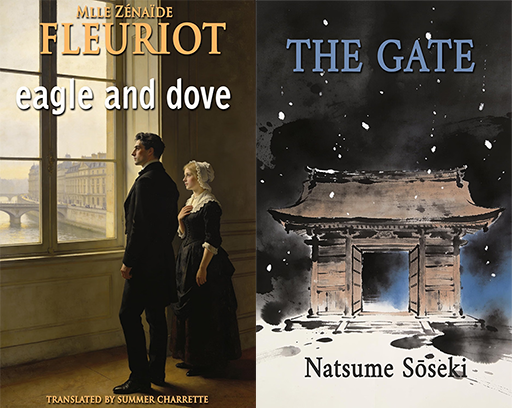
Castalia House has published an original new translation of Botchan by Natsume Sōseki, in case Japanese literature happens to be of any interest to you.

“I have been reckless since the day I was born…”

So begins one of the funniest and most beloved novels in Japanese literature. Published in 1906, Natsume Soseki’s Botchan has never gone out of print, never lost its bite, and never stopped making readers laugh.

Fresh out of school with no ambitions, no money, and no talent for diplomacy, Botchan accepts a teaching post at a middle school in rural Shikoku and immediately regrets it. The students are savages. The headmaster is a windbag. His colleagues are a gallery of petty conspirators he can only keep straight by the nicknames he invents for them: Red Shirt, Clown, Porcupine, the Pale Squash. The only person in the world who believes in him is Kiyo, the old family servant back in Tokyo who still calls him “Botchan” (young master) and waits for him to come home.

Botchan has no filter, no patience, and no reverse gear. He says what he thinks, picks fights he can’t win, and keeps a running tally of every slight. He is also, beneath the bluster, deeply loyal, quietly heartbroken, and funnier than he knows.

This new translation by Kenji Weaver, whose acclaimed translation of Soseki’s Kokoro introduced a new generation of English readers to Japan’s greatest novelist of the Meiji era, captures the novel’s headlong energy and deadpan comedy in crisp, natural English.

UPDATE: Fandom Pulse has a nice article about the recent release of Botchan.

DISCUSS ON SG


The Farmer’s Almanac is Dead

Long live The Old Farmer’s Almanac:

The news of The Farmer’s Almanac shuttering sent shockwaves through readers, as the information was announced earlier in November 2025. The closing came as a surprise to many, as the publication has been in print since 1818, with 208 years of service.

The Farmer’s Almanac is a two-century-old Maine-based outlet that began as a print publication, detailing information about gardening, cooking, preservation, and more. In recent decades, the outlet has also become a digital resource, where curious outdoorspeople can visit their website for information similar to that in their annual booklet.

The Old Farmer’s Almanac is a similar, older publication, based in New Hampshire, that’s been around since 1792. Both almanacs cover similar topics, ranging from long-range weather predictions to gardening tips. The Old Farmer’s Almanac can be easily identified by its familiar yellow cover, which has been used since 1851. This is the Almanac we reference most in our coverage of Farmer’s Almanac stories here at Good Housekeeping. The print booklet, as well as the digital site, will remain up and unaffected despite the news of The Farmer’s Almanac’s closure.

I’m not going to lie, I felt genuine distress about the idea of The Farmer’s Almanac shutting down after all this time. But now that I realize that it’s just the younger imitation from Maine, and not the older New Hampshire version to which I was accustomed to read in my youth, I’m perfectly fine with it.

And they probably should do leatherbound editions anyhow, right?

DISCUSS ON SG