College: the bad investment

A college student explains why college is often a waste of money:

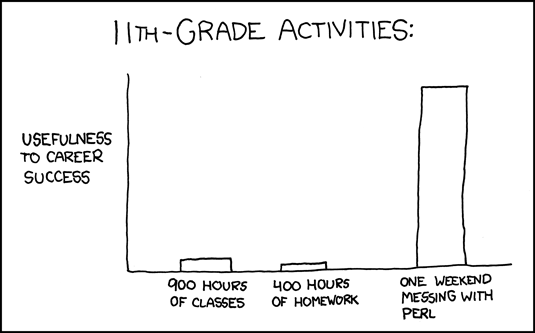
Government figures show that of students who entered four-year colleges in 1997, just 54% had earned a degree six years later. A professor wrote about this issue in The Atlantic earlier this year, arguing that it’s immoral to tell all students they can go to college, then crush their dreams by failing half of them. But the problem has deeper effects than hurt feelings: the 54% graduation rate means that around 46% of all money used to finance college tuition results in no degree.

Which means that financially speaking, the spectacularly high dropout rate boils down to a spectacularly bad investment.

This isn’t quite right. Since dropouts don’t pay for their non-attendance, the true amount of college finance being wasted is probably closer to 33 percent. Still, a one-in-three chance of blowing a significant portion of a family’s net worth means that a degree is a much riskier “investment” than it’s usually portrayed. And this doesn’t even factor in the large number of college graduates who manage to get a degree without receiving anything that remotely resembles an actual education.

The long national nightmare begins

Yes, Virginia, there is a 2008 VPFL champion!

84 Burns Redbeards
51 Alamo City Spartans

Congratulations to Nate, who took the Redbeards from 3-11 basement dwellers to league champions on the strength of a rookie quarterback and the Tennessee defense. Those interested in playing next year will be pleased to know that because the title was claimed by a permanent league member, there will be 7 open spots next year in addition to Mounds View, Greenfield, and Burns.


Religion causes charity

It doesn’t cause war, but it is clearly correlated in a causal sense with charitable giving. And yet, these statistical facts somehow never seem to find their way into any of the equations concerning the value of religion to society:

Arthur Brooks, the author of a book on donors to charity, “Who Really Cares,” cites data that households headed by conservatives give 30 percent more to charity than households headed by liberals. A study by Google found an even greater disproportion: average annual contributions reported by conservatives were almost double those of liberals….

Americans give sums to charity equivalent to 1.67 percent of G.N.P., according to a terrific new book, “Philanthrocapitalism,” by Matthew Bishop and Michael Green. The British are second, with 0.73 percent, while the stingiest people on the list are the French, at 0.14 percent.

Kristof’s column is an admirable attempt to shame liberals into giving more… and not just in the form of self-serving contributions to college endowments either. Of course, it’s not likely to be successful, because it’s not possible to shame the shameless.


Another banker bites the dust

On the economic winter watch:

A leading City banker was found hanged in a five-star hotel in an apparent suicide, police said yesterday. Christen Schnor, 49, was discovered by a hotel worker naked with a belt around his neck in the cupboard of his £500 a night suite.

It kind of reminds me of watching the first ducks fly south for the winter. Although in this case, the absence of clothing tends to indicate the possibility of a personal kink gone awry rather than an economic indicator.


NFL & VPFL

This is the post for today’s NFL and VPFL discussions. I can’t decide if I’m rooting for Alamo City or Burns, as it’s hard to tell if it will be more annoying or amusing if Nate manages to win a VPFL championship. That he’ll be obnoxious is, of course, a given. I’m a bit concerned about Adrian Peterson being overused and getting hit by The Curse of 370. He’s already had 320 carries this year and is projected for 366 which doesn’t include a playoff game. Considering that he’s already got an ankle injury, I’d just as soon see him sit and put the load on Chester Taylor’s back. What’s the point of having an excellent backup if you’re not going to use him when it matters?


At the Black Gate III

This week’s post at Black Gate may be of some interest even to those who don’t read fantasy fiction, as I underline the obvious link between a famous essay of Poul Anderson’s and the 2005 essay I wrote for the Revisiting Narnia anthology. I note that although “On Thud and Blunder” appears to have had an amount of impact on the field with regards to the need to pay more attention to realism, that obviously didn’t hold true for one particular area to which Anderson himself specifically drew attention.


America’s Great Depression section VII


Since Christmas is approaching and some of you read this stuff two weeks ago, I attempted to make this one a bit less challenging than usual. If you’ve been struggling, this may be your week! For next week, read Chapter 8. It’s only 30 pages, so you should be able to knock it down in between the eggnog and the hot buttered rum.


The trendsetter

The OC points out that once again, I am ahead of my time:

Overcapacity has been something generally acknowledged across the writing industry for at least 10 years. In a 2002 essay in The New York Times, the onetime best-selling novelist and story writer Ann Beattie mourned the situation of the modern writer, living in a world where people are more interested in “being a writer” than in writing itself. “There are too many of us, and M.F.A. programs graduate more every year, causing publishers to suffer snow-blindness, which has resulted in everyone getting lost,” she lamented. That Ann Beattie must now compete on Amazon with a self-published author named Ann Rothrock Beattie is proof of how enormous the blizzard has become.

So how would my big St. Bernard of a bailout dig the publishers out of their drifts? According to the industry tracker Bowker, about 275,000 new titles and editions are published in the United States each year. Let’s say we want to eliminate half of them. Assuming it takes about two years to write your average book, we would offer book writers two years of salary at the writers’ average annual income of $38,000 a year. Add it all up and you get a paltry $10.5 billion to dramatically reduce the book overcapacity.

I scorn. I scoff. I’ve been getting paid to not write books for YEARS now. In fact, my professional non-writing oeuvre is precisely half the size of my published output.


Oh, sweet Moses!

I find myself in agreement with a Paul Krugman column:

Yet surely I’m not the only person to ask the obvious question: How different, really, is Mr. Madoff’s tale from the story of the investment industry as a whole?

The financial services industry has claimed an ever-growing share of the nation’s income over the past generation, making the people who run the industry incredibly rich. Yet, at this point, it looks as if much of the industry has been destroying value, not creating it. And it’s not just a matter of money: the vast riches achieved by those who managed other people’s money have had a corrupting effect on our society as a whole.

One of the bigger lies in America is the idea that the stock market has anything to do with either capitalism or the free market. It’s not. It’s a complex institution designed to intercept the money that would otherwise go to successful and productive entrepeneurs and reroute it to the bankers.

Think about it. If an entrepeneur has an idea, or a technology, why shouldn’t he be able to seek investment and sell shares directly to interested parties via the Internet? Entrepeneurs appear to be figuring out that Wall Street is little more than a gang of bandits, as they’re increasingly preferring to pursue acquisitions rather than going public.