The Secret Weapon

You can’t make yourself smarter, but you can make yourself more prepared than everyone else. One of the ways I was able to break into the game industry was because I knew more about all of the people involved than anyone except a few of the deepest and most experienced insiders.

How did I do that despite being just out of college, with zero contacts in the industry, and never having attended a single industry event? I studied every single issue of Computer Gaming World like a seminary student performing exegesis on a single Bible verse, putting every single name I could find into a database with their position, company, and associated titles. So, when I finally attended CGDC for the first time, I knew most of the guys there and could speak intelligently with them about their past and present projects.

Not only that, but when they would recognize someone they knew, I’d be able to say something like “Carter… is that the Carter from SSI?” Which, almost inevitably, would lead to a friendly introduction from a trusted source. By my second conference, I was already acquainted with two-thirds of the devs there; by the third one, I was speaking at the conference, regarded by most as one of the old school, and was openly recognized a member of the CGW team, being the only active dev who was permitted to write reviews for the magazine.

I truly loved those days. Epic, Blizzard, Activision… the corporate monsters of today were just guys like everyone else. I’ve never felt a sense of unlimited possibility like that before or since.

Paul Pierce, the NBA champion, clearly knew the power of researching people. He was the Celtics’ longtime play-by-play announcer’s favorite, but there was more to their close relationship than mere mutual affection:

People used to say, ‘Boy, it’s great the relationship you have with Paul Pierce,’ because every time, second time through the layup line, Paul would come and give me a hug no matter where I was. People said that’s great. Well, what was happening was Paul would give me the hug and say, ‘Who we got tonight [officiating the game]?’ And I’d say, ‘It’s Chris, Danny’s the Black guy, and Joe is the white guy. He’s kind of bald.’ And then Paul would go through around the layup line, I’d see him go, ‘Hey, Danny, how are you tonight, Paul? What’s happening over there?’ And I swear it used to buy him one or two whistles every game at least.”

There is really no excuse for not bothering to put in the effort of truly knowing the field you’re in. It takes nothing but persistence and a little time. And yet, not one man in a thousand ever bothers to make even minimal efforts in this direction, despite the fact that it reliably pays off no matter what the industry or field.


DISCUSS ON SG


A Bold Beginning

Thanks to one of our international men of mystery, I’m able to bring you the opening remarks from the chairman of the 1966 Philadelphia symposium on the mathematical challenges to Neo-Darwinism that long preceded my own conclusive mathematical disproof of evolution by natural selection, regardless of the Dawkinsian “probably” that has recently been appended to what is now more formally known as the Theorum of Evolution by (probably) Natural Selection, Sexual Selection, Biased Mutation, Genetic Drift, and Gene Flow.

Ladies and gentlemen: I want to make just a few introductory remarks. I think it is the distin­guishing mark of all true biologists as opposed to mere sectarian specialists that they are deeply interested in the mechanism of evolution. As Dr. Kaplan has explained, the immediate cause of this conference is a pretty widespread sense of dissatisfaction about what has come to be thought of as the accepted evolutionary theory in the English-speaking world, the so-called neo-Darwinian Theory. This dissatisfaction has been expressed from three quarters and is not only scientific.

First of all, religious: Where once the complaint was that evolution happened at all, now the complaint generally is that it happens without Divine motivation. Many of you will have read with incredulous horror the kind of pious bunk written by Teilhard de Chardin on this subject, if Professor Schultzenberger will excuse my putting it that way.

Then, there are philosophical or methodological objections to evolutionary theory. They have been very well voiced by Professor Karl Popper — that the current neo-Darwinian Theory has the methodological defect of explaining too much. It is too difficult to imagine or envisage an evolutionary episode which could not be explained by the formulae of neo-Darwinism.

Finally — and these are really, I think, the only objections that should concern us — there are objections made by fellow scien­tists who feel that, in the current theory, something is missing, and we look forward to hearing their formulation of what, precisely, is missing. These objections to current neo-Darwinian theory are very widely held among biologists generally; and we must on no account, I think, make light of them. The very fact that we having this conference is evidence that we are not making light of them.

Sir Peter Medawar, National Institute for Medical Research, 24 April 1966

It’s rather remarkable that within ten years of these professional biologists publicly declaring that they must, no on account, make light of the mathematical objections to their pet theory, my high school biology teacher was telling me that the science was settled and no intelligent, educated person would even consider doubting the sacred Neo-Darwinian dogma.

How things change! Thanks to developments in genetic science, we now have conclusive mathematical evidence of the absolute impossibility of both Darwinian and Neo-Darwinian evolutions. The hoary old dragon of Darwin has been slain, once and for all. It may not have stopped twitching yet, and the faithful are still hoping against hope for a revisionist third coming, but any impartial and sufficiently numerate observer will admit that it is clearly pining for the fjords.

DISCUSS ON SG


Did Not See That Coming

Apparently the latest New Hitler is Israeli:

Israeli Finance Minister Bezalel Smotrich on Monday called for the “total annihilation” of Rafah and other cities in the Gaza Strip.

“There are no half measures. Rafah, Deir al-Balah, Nuseirat – total annihilation. ‘You will blot out the remembrance of Amalek from under heaven’ – there’s no place under heaven,” Smotrich said.

Smotrich’s reference to “Amalek” was from a line in Deuteronomy, a book in the Hebrew Bible. Amalek is a nation the ancient Israelites were commanded to destroy, and in the book of Samuel, the Israelites were told to “slay both man and woman, infant and suckling.”

Israeli Prime Minister Benjamin Netanyahu has previously compared Gaza to Amalek, which has been cited as evidence of genocidal rhetoric in South Africa’s genocide case against Israel at the International Court of Justice.

I’m not sure that “Putting the NAZI in Ashkenazi” is a particularly great campaign program, but then, I don’t know much about Israeli politics these days. Hitler’s rhetoric went over fairly well in his time, after all.

However, I think it’s bizarre to see conservatives, Boomers, and conservative Boomers to be complaining that American college students are protesting against the genocidal actions of the Israeli government when the IDF is literally killing tens of thousands of Palestinians while top Israeli government officials are openly calling for a literal genocide of an entire people.

The Gazacaust isn’t going to be forgotten any faster than the Holocaust was, so Israelis had better get used to the idea of paying reparations to the Palestinians and their descendants for at least another 70 years.

DISCUSS ON SG


The Carlson-Dugin Interview

A selection from the complete transcript of the interview:

Tucker Carlson: So what you’re describing is clearly happening and it’s horrifying. But it’s not the definition of liberalism I have in mind when I describe myself, as what we say the United States is a classical liberal. So you think of liberalism as individual freedom and choice from slavery. Right? So the options as we conceive them, as I was growing up, were the individual who can follow his conscience, say what he thinks, defend himself against the state versus the statism, the totalitarianism embodied in the government that you fought against: the Soviet government. And I think most Americans think of it that way. What’s the difference?

Aleksandr Dugin: Very interesting question. I think that the problem is in two definitions of liberalism. There is old liberalism, classical liberalism. And new liberalism. So classical liberalism was in favor of democracy. Democracy understood as the power of majority of consensus, of individual freedom. That should be combined somehow with the freedom of other. And now we have totally the next station already. Next phase: new liberalism. Now it is not about the rule of majority, but it is about the rule of minorities. It is not about individual freedom, but it is about wokism. So you should be so individualistic that you should criticize not only the state, but individual, the old understanding of individual. So you need now – you are invited to liberate yourself from individuality to go further in that direction. I have spoken once with Fukuyama, Francis Fukuyama on TV. And he has said, before, democracy has meant the rule of majority. And now it is about the rule of minorities against majority, because majority could choose Hitler or Putin. So we need to be very careful with majority, and majority should be taken under control and minorities should rule over majority. It is not democracy, it is already totalitarianism. And now we are not about defense of the individual of freedom, but about prescription to be woke, to be modern, to be progressive. It is not your right to be or not to be progressive. It is your duty to be progressive, to follow this agenda. So you are free to be a left liberal. You are no more free enough to be a right liberal. You should be a left liberal. And that is a kind of duty. It is prescription. So liberalism fought during its history against any kind of prescription. And now it at its turn became totalitarian, prescriptive, not free as it was.

Tucker Carlson: And do you believe that was inevitable, that process? That was always going to happen?

Aleksandr Dugin: I perceive here a kind of logic. So a kind of logic that is not just a reversion or deviation. You start with one thing. You want to liberate individual. When you arrive at the point when it is possible, it is realized. So you need to go further. And you start to liberate ourselves from this time from old understanding of individual in favor of more progressive concepts. So you could not stop here. That is my vision. So if you say “Oh, I prefer old liberalism,” they would say, the progressives, they would say, it is not about old liberalism. It is about fascism. You are defender of traditionalism, conservatism, fascism. So stop here. Either be progressive liberal or you are done, or we will cancel you. That is what we observe, I would say.

DISCUSS ON SG


The Arkhaven Substack

The Castalia Library substack has been so popular, and so useful in providing Library and History subscribers with updated information about the production process and necessary shipping news that it is obvious that we need the same thing for Arkhaven Comics, especially in light of the delays in shipping Ghost of the Badlands to the recent retail purchasers.

More about that soon, hopefully later today, but the TL;DR version is that the first printing of the retail editions had a problem, so we fixed it, sent out copies to Razorfist for approval, and we’re waiting for him to receive them and approve the revised editions for shipping out to everyone.

One can theorize as to the whys and wherefores all one likes, but the simple fact of the matter is that provably Substack works to keep a community informed in a timely manner much better than a blog, a mass-mailing service, a social media site, the post, or carrier pigeons.

So, if you are a) an Arkhaven buyer, b) an Arkhaven backer, c) an Arktoons reader, or d) an Arktoons creator, I would very strongly encourage you to subscribe to the Arkhaven substack in order to keep up on all the latest news related to our print and digital comics.

REBEL DEAD REVENGE Episode 112: I’ll Deal With You Later

CROSS+WORD Episode 8: Party Time

A MIND PROGRAMMED Episode 49: Expendable Tools

上嫁小鼠 Episode 37: 是好是坏

STONETOSS Episode 289: Lost Civilization

DISCUSS ON SG


The Decline of the Literary West

Reader’s Digest is shutting down in the UK:

Reader’s Digest’s UK edition has closed down after 86 years due to ‘financial pressures, as the iconic magazine’s editor-in-chief shares a touching tribute. In an honest and heartfelt tribute, the iconic magazine’s editor-in-chief Eva Mackevic said ‘the company just couldn’t withstand the financial pressures of today’s unforgiving magazine publishing landscape’.

The closure comes 14 years after it fell into administration because of a £125m pension fund deficit.

Founded in the the US in 1922, Reader’s Digest – whose motto was ‘Articles of enduring interest’ – was first published in the UK in 1938. Back in 2000 Reader’s Digest UK was selling more than one million copies a month.

I loved Reader’s Digest. My grandparents were subscribers, and whenever I visited them I would read several of those thick little magazines a day. Laughter the Best Medicine was all right, but I preferred the more subtle humor to be found in Life in These United States. And the abridged novels it contained often provided exposure to interesting authors to be explored more fully in the the future.

But diversity doesn’t read. And increasingly, neither does the three-second attention span crowd. Books are in the process of returning to the elite status they once held prior to the release of the dime novel and the mass market paperback, which is not a bad thing for deluxe leather book binders, but isn’t a healthy sign for society.

With more than 3 million subscribers in the USA, the original magazine should be around for a while. But the failure of the once-powerful UK edition is a good reminder of the vagaries of time. Yesterday’s success not only doesn’t guarantee success today, it often plants the seeds for tomorrow’s failure.

DISCUSS ON SG


Monday Arktoons

STONETOSS Episode 288: Malgorithm

THE SIDEWINDERS Episode 53: The Riders Strike

BEN GARRISON Episode 143: Let Them Eat Cake

三更战 Episode 30: 三更之统治者

INVASION ’55 Episode 2: TOne Hundred and Eighty Million Years Later

AESOPS FABLES Episode 40: The Horse and Groom

TREASURY OF TALES Episode 47: The Three Little Pigs

PAPER DOLL VERONIKA Episode 101: Downhill Tales

CHATEAU GRIEF Episode 325: Hush Puppy

GIVE MY REGARDS TO BLACK JACK Episode 55: Reality


Non-Competes are No More

The FTC eliminates a corporation’s ability to limit the employment prospects of its former employees:

Pursuant to sections 5 and 6(g) of the Federal Trade Commission Act (“FTC Act”), the Federal Trade Commission (“Commission”) is issuing the Non-Compete Clause Rule (“the final rule”). The final rule provides that it is an unfair method of competition—and therefore a violation of section 5—for persons to, among other things, enter into non-compete clauses (“non-competes”) with workers on or after the final rule’s effective date. With respect to existing non-competes—i.e., non-competes entered into before the effective date—the final rule adopts a different approach for senior executives than for other workers. For senior executives, existing non-competes can remain in force, while existing non-competes with other workers are not enforceable after the effective date.

This is definitely a positive development. The idea that a corporation should be able to coerce an employee into agreeing not to work for a competitor without compensation is one of the pernicious consequences of Clown World’s contract morality, in which everything is permissible so long as the victim can be coerced, forced, scammed, or otherwise convinced to agree to it.

DISCUSS ON SG


The Indictments are Blowing in the Wind

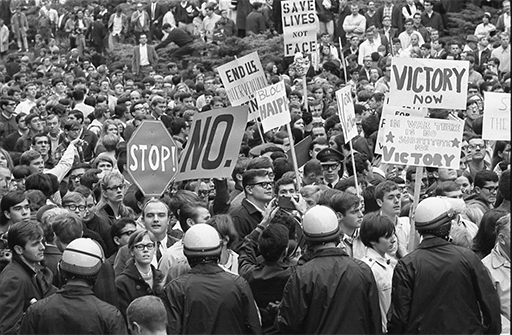
The Gazacaust has clearly changed the Boomers’ position about the intrinsic legitimacy and sanctity of student protests on college campuses. Yet there was a time when Boomers used to shut down campuses on a regular basis, a time that is still cited by them as evidence of their moral superiority to other generations.

The major movements of the 1960s were the Civil Rights Movement and the Student Movement. Both advocated for those who were discriminated against in various ways. The Student Movement also led the Free Speech Movement, starting on the University of California, Berkeley’s campus in 1964. Initially, college students protested against social injustices like poverty, the unfair treatment of African American citizens, and freedom of speech on college campuses. They later shifted their focus to opposing the Vietnam War.

Neither blacks in the USA nor the Vietnamese in Vietnam were being treated anywhere nearly as badly as the Palestinians are being treated by the Israelis, at least on a per capita basis in the case of the latter. And yet, at the behest of their “greatest ally”, the Boomers and their fellow travellers are determined to prevent Generation Z from speaking out about the Gazacaust.

Protests are roiling college campuses nationwide as administrators with graduation ceremonies next month face demands that schools cut financial ties to Israel against the backdrop of the Israel-Hamas war.

Many campuses were largely quiet by early afternoon Sunday but about 275 people were arrested on Saturday at campuses including Indiana University at Bloomington, Arizona State University and Washington University in St. Louis. Those have pushed the number of arrests nationwide to nearly 900 since New York police removed a pro-Palestinian protest encampment at Columbia University and arrested more than 100 demonstrators on April 18.

Since then, students have dug in at dozens of pro-Palestinian encampments around the country, prompting a range of responses from administrators — arrests and criminal charges, student suspensions or simply continued pleas to leave. The plight of students has become a central part of protests, with both the students and a growing number of faculty demanding amnesty. At issue is whether the suspensions and legal records will follow students through their adult lives.

Faculty members at universities in California, Georgia and Texas have initiated or passed largely symbolic votes of no confidence in their leadership.

It might be interesting to compare the number of people arrested for protesting the actions of a foreign government as opposed to those who were protesting the actions of their own government. Because, as we know, a foreign elite generally rules more harshly that a people’s own elite.

DISCUSS ON SG