The photos appeared in the state-run Rodong newspaper and were apparently taken at an “emergency meeting” early on Friday morning. They show Kim signing the order for North Korea’s strategic rocket forces to be on standby to fire at US targets, the paper said, with large-scale maps and diagrams in the background.
North Korean leader Kim Jong-un ordered strategic rocket forces to be on standby to strike US and South Korean targets at any time (EPA)
The images show a chart marked “US mainland strike plan” and missile trajectories that the NK News web site estimates terminate in Hawaii, Washington DC, Los Angeles and Austin, Texas.
What sort of complete lunatic plots an attack on the United States and leaves out New York City? Especially when he has sufficient insight to put Austin on the list. I mean, even the cartoon supervillains who kept the Justice League of America busy understood the importance of taking out New York City and the UN headquarters there.
We truly live in an age of tin. Even the quality of Man’s reclusive supervillains has declined. A missile launch at the USA by Kim is about as likely as the current Supreme Court overturning the judicial ban on Proposition 8.
The extent to which fantasy is in decline can be seen in this list of the 20 Best Paranormal Fantasy novels. If this is the best, one shudders to think what could be the worse:
3. Dead Beat by Jim Butcher (2005) Butcher’s Dead Beat—the seventh installment in his Dresden Files—was a blockbuster book when it was first released. Not only was it the first Dresden Files novel to be released in hardcover, it was a clear indication of just how much the series had expanded to embrace mainstream fiction readers. The first printing sold out in a just few days! The commercial success of the Dresden Files paved the way for countless other noteworthy protagonists, including Charlie Huston’s Joe Pitt and Mario Acevedo’s Felix Gomez.
2. Sandman Slim by Richard Kadrey (2009) An in-your-face fusion of fantasy, horror, and hard-boiled mystery. It’s Kadrey’s biting wit that makes this novel so unforgettable. His blunt and acerbic writing style makes for simply addictive reading. For example, here’s how he describes Los Angeles: “L.A. is what happens when a bunch of Lovecraftian elder gods and porn starlets spend a weekend locked up in the Chateau Marmont snorting lines of crank off Jim Morrison’s bones. If the Viagra and illegal Traci Lords videos don’t get you going, then the Japanese tentacle porn will.” Classic.
1. For a Few Demons More, by Kim Harrison (2007) The fifth installment of Harrison’s phenomenally popular Hollows saga featuring endearing gray witch Rachel Morgan and company, this novel was the first hardcover release in the series and, at least for me, heralded its ascension to elite series status. With only two novels to go until the series concludes, there is no doubt in my mind that the Hollows saga will go down as arguably the very best paranormal fantasy series ever written.
Now, I like the Dresden Files. They’re good. They were signed by my second editor at Pocket. But they are not great. Harry Dresden’s character development was apparently arrested at the age of 15; the ineptitude of his interactions with women have gone from clumsy and awkward to “I am so embarrassed for the author that it is seriously distracting from the story.” Kim Harrison’s books are not terrible, they are merely mediocre. I have to admit, the Kadrey sounds interesting, but I haven’t read it.
If the very best of the genre doesn’t rise to the level of Agatha Christie – and it does not – there is clearly a problem.
The coup de grace, though, is the fact that Cerulean Sins by Laurell K. Hamilton, (the K stands for Krazy), is actually listed in the top ten. I actually kind of liked the first Anita Blake book, back when she was a voodoo chick and vampire hunter, rather than the central figure in an ongoing interspecies orgy. There may be worse books out there than Hamilton’s, but if there are, I haven’t read them.
The fact is that paranormal fantasy is actually much worse, as a sub-genre, than the Regency romances that attempt to pass themselves off as science fiction in skirts. With a few notable exceptions, it is outright chick porn; the claim that it is fantasy literature in the same genre as Tolkien, Lewis, and even Alexander is about as convincing as asserting that Booty Pirates XII should have beaten out Argo for the Academy Award.
There are few things I enjoyed twenty years ago as much as spending my Friday evenings with Spacebunny, circulating through the shelves at Barnes and Noble armed with fifty bucks and a coffee. But considering that these are the sort of books they have been trying to push on the public for the last decade, even I have to conclude that the bookseller fully merits its incipient demise. It’s one thing to go out because technology has changed or because an increasingly vulgar market prefers television to books, it’s another thing to do so while trumpeting the merits of The Nymphos of Rocky Flats.
A lot of people are assuming that they’ll have sufficient warning of the next stage in the banking crisis to act to protect their savings, their pension funds, and their investments. But the recent events suggest you won’t, because as the following chart from Zerohedge makes clear, those who are managing the crises are very good at keeping things under wraps until they’ve gotten their own money out of danger, which requires making sure that everyone else is still doing business as usual. After all, the markets cannot be exited without the greater fools to be left holding the bag.
In looking at this chart of depositor outflows, remember that the news of the imminent banking collapse and subsequent deposit heists were a complete shock to most people earlier this month. But not, quite clearly, everyone.
The suggestions were right out in public a month before. “There have also been suggestions that private depositors with investments of more than 100,000 euros should be obliged to endure a “haircut”.” – BBC, Feb 15, 2013
But they won’t be sufficient to inspire most people to action, given that the suggestions will be viewed as nothing more than remote possibilities until they actually happen.
It has been interesting to see the diversity of reaction to the two stories that make up THE WARDOG’S COIN. One of the ebook’s first reviewers preferred the title story to its accompaniment, and he had some questions, particularly about “Qalabi Dawn”, that I think I can address without any spoilers:
The first story was so good that even the debatable defects of the second made the book merit 5 stars. And at least half the defects of the second may simply be in the intrinsic difficulty of creating understanding of something so radically different. Still: are these cat people merely different tribes? Or different species? I was reading some as tiger-people for quite a while, rather than lion-people. My bad reading? But ignore that; it’s trivial.
I admit I wondered more… you’ve got a Sergent who is pretty rough and tumble. And yet he uses the word “insomnia”? Is this Vox’s voice leaking through the character? Or are you hinting he’s a lot smarter than the average bear? Similarly, the Capitaine is almost too poncily polished. Intended? I assume so, and the diplomatic interaction with the Elven King + battlefield is interesting and beautifully done.
As I suspect many readers are beginning to understand, I’m not inclined to explain or portray things that the perspective characters don’t know or simply wouldn’t tend to think about. Just as it is said that fish don’t think about water, a Chiu chieftain is not inclined to think about the structure of his society when he has no reason to do so. That doesn’t mean the structure doesn’t exist, or that I’m not willing to discuss it, only that there are an amount of worldbuilding details that are never going to appear in any one story or novel. Selenoth is not as grand and finely detailed a structure as Middle Earth, but it is larger in scope and scale than many fictional universes, including Westeros/Essos.
In answer to the question about the catpeople, the Simba are lion people, the Duma are leopard people, and the Chiu are cheetah people. (This is confusing for Swahili speakers, as Chiu means leopard, but I figured that English was the primary concern.) All of the Khatuuli are descendants of Baasia; they are quite literally demonspawn. The three primary varieties of People are further divided into tribes with one dominant male, and they are further divided in that some of them, their elite, tend to be mchawe, or shapechangers, with three different shapes, mwana, mnyama, and the common sehumu form. Their priestly caste, the Neheb-Kau, are all shapechangers who have abandoned their tribes and given their allegience to the priesthood. And I’m pleased that the overall sense of the demonspawn is striking at least some readers as radically different; while I am opposed to reinventing wheels, (orcs, elves, dwarves, etc), I hope it is clear that this is not due to any dearth of imagination or creative capacity.
The story of the origins of the demonspawn are told in a novella entitled “The Last Witchking”, which will be published in the forthcoming Summa Elvetica hardcover.
I think it is naturally difficult to write characters of very different intelligence than the author possesses. Mediocre authors tend to make every perspective character into an idealized version of themselves; one always knows with whom a bad author identifies because there is that one character who is interminably witty and always verbally bests every other character with the perfect quip, obscure citation, or Bible verse. Some authors make me suspect that the dialogue in their books is chiefly a vehicle for retroactively winning every past verbal altercation in which they belatedly thought of a killer riposte long after it was over.
That being said, the sergent is intelligent, he simply isn’t educated. I’m not sure “insomnia” qualifies as an overly educated word, but I have no doubt there are numerous such slippages with regards to the sergent’s inner monologue. The capitaine, on the other hand, comes from an aristocratic family that has seen better days; his backstory would make for an interesting novella in its own right. But despite their observable differences, he and the sergent genuinely like and respect each other, which is important because the story revolves around their complicity. In some ways, The Wardog’s Coin is a very dark story, although I don’t know how many readers will see it in that light.
Since the events of TWC take place before ATOB, it is unlikely I will bring either of them back in the main series. However, there is one character who will certainly appear in Book Two, and as a full perspective character, no less. And don’t forget, if you haven’t picked up A MAGIC BROKEN yet, it is still free on Amazon today.
UPDATE: TWC debuted in Amazon’s Top 10 in the War category, which I have to say was rather unexpected. I consider it to be Epic Fantasy myself, but I can see where it might qualify, especially if one is going to count books like World War Z. It’s also #3 in Hot New War Fiction, behind Neal Stephenson’s third book in the Mongoliad, which I very much hope is better than the disappointing first one.
Oh hellz yes indeed! When I wondered what sort of individual would, of its own free will, elect to sport McRapewear, this is precisely the sort of ab-gendered creature I imagined. Notice that it is not only delighted with its XXXL purchase, into which it should just barely be able to squeeze its slugsome physique, but it also intends to share this fine apparel with its “hubby”. Zexxxy!
It is with no small amount of sadness that I must now face the fact that I am not going to get out of this debate without having to explain mal-investment. It appears in order to counter Vox’s deflation via credit reduction claim… it is absolutely necessary.
Ok so M1… TSM2… Z1… what is it?
As I stated before… you’ve already answered that question for yourself. Vox can write poetic and convincing lines about the esoteric nature of credit money… and he can explain how the paper just represents a claim on this or that… and none of it will change the fact that when you hear about what’s going on in Cyprus… you have a primal urge to run to the bank and get all of your cash out. You want the cash.
That’s because the cash you want is money. For now.
The debit card is very convenient. No question. But by now you are probably looking at it with much more cynical eye than you were a month or so ago. Good.
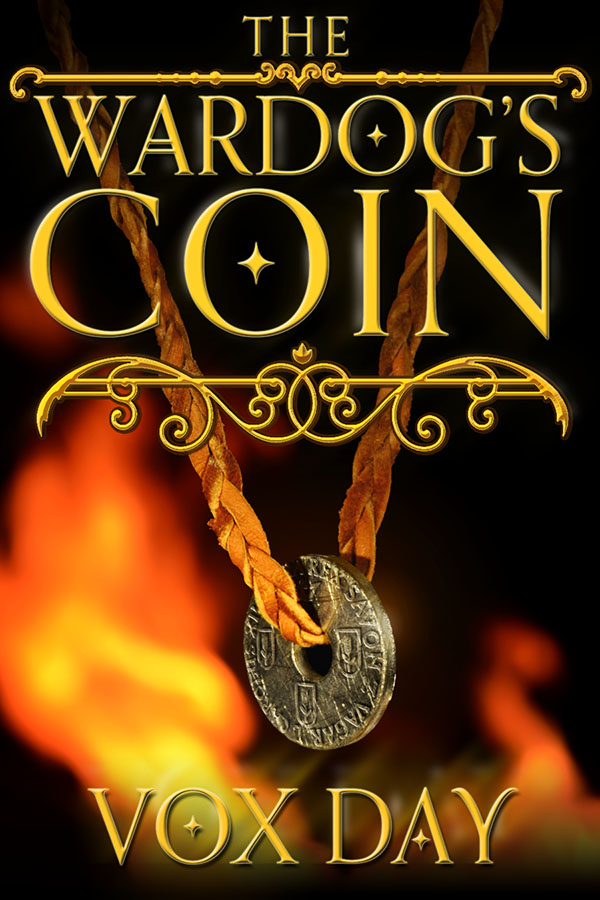
I am pleased to announce that Hinterlands has released THE WARDOG’S COIN, an 85-page ebook that consists of the title novella and a novelette, both of which are set in Selenoth, the world of A THRONE OF BONES. It is available on Amazon for $1.99.
The title story is about a human mercenary company which finds itself in the employ of an elf king. Outnumbered and under attack from an army of orcs and goblins, the Company discovers it is no longer fighting for pay, but for survival in an alien land. The second story, Qalabi Dawn, features a young tribal chieftain, Shabaka No-Tail, who seeks to find a way to unite the fractious tribes of The People before the implacable legions of the Dead God invade the desert to carry out their crusade of total extermination. In both stories, the borders of the world of Selenoth as it is known to the reader are expanded to some small extent.
Thanks to Jartstar, who did an excellent job on the cover. Look very closely at the coin; the level of detail there is remarkable. Thanks also to the four proofreaders; this ebook should be considerably cleaner from the get-go than its predecessors. Also, to celebrate the new publication, Hinterlands is giving away A Magic Broken for free on Amazon today.
To anyone paying attention, reality is now painfully obvious. These bankrupt, insolvent governments have just about run out of fingers to plug the dikes. And history shows that, once this happens, governments fall back on a very limited playbook:
Direct confiscation: As Cyprus showed us, bankrupt governments are quite happy to plunder people’s bank accounts, especially if it’s a wealthy minority. Aside from bank levies, though, this also includes things like seizing retirement accounts (Argentina), increases in civil asset forfeiture (United States), and gold criminalization.
Taxes: Just another form of confiscation, taxation plunders the hard work and talent of the citizenry. But thanks to decades of brainwashing, it’s more socially acceptable. We’ve come to regard taxes as a ‘necessary evil,’ not realizing that the country existed for decades, even centuries, without an income tax. Yet when bankrupt governments get desperate enough, they begin imposing new taxes… primarily WEALTH taxes (Argentina) or windfall profits taxes (United States in the 1970s).
Inflation: This is indirect confiscation– the slow, gradual plundering of people’s savings. Again, governments have been quite successful at inculcating a belief that inflation is also a necessary evil. They’re also adept at fooling people with phony inflation statistics.
Capital Controls: Governments can, do, and will restrict the free-flow of capital across borders. They’ll prevent you from moving your own money to a safer jurisdiction, forcing you to keep your hard earned savings at home where it can be plundered and devalued. We’re seeing this everywhere in the developed world… from withdrawal limits in Europe to cash-sniffing dogs at border checkpoints. And it certainly doesn’t help when everyone from the IMF to Nobel laureate Paul Krugman argue in favor of Capital Controls.
The thought strikes me that we truly live in a perverse world where “free trade” demands the free movement of labor and bars the free movement of capital. I don’t recall David Ricardo ever working through the implications of that arrangement. As for the inflation prediction, we’ll see about that. I have no doubt, of course, that the various governments will be doing their best to inflate, the question is whether they can actually manage to cut the link to credit or not.
Clearly I am debating the wrong person concerning the $56 trillion question. I shouldn’t be engaging Nate in dialectical discourse with regards to the global economy, but rather a genuine expert on global business and economics.
Kristin is a Global Business and Econ major. I want to make sure everyone understands that. After someone else brings up Austrian Economics… Kristin blows them away.. with this amazingly awesome retort… “And what does Austrian economics have to do with anything? But yes, in fact I do know some considering I was just there last year. I know a lot of the basics of the economies within the EU.“
And there you have it.
Kristin the Global Business and Econ major knows all about Austrian Economics… because she was in Europe just last year.
See friends? Put down that Milton Friedman. You don’t need to read all that. You just need to do some sight seeing in Chicago.
Oh Sweet Mises… I’d find it hard to believe, were it not for the fact that I once met an economics major from a large public university who had never heard of John Maynard Keynes.
It’s fascinating, is it not, how those who deny Jesus Christ, from Roman emperors to petty academic professors, are observably obsessed with forcing others to symbolically reject the name of Man’s Lord and Savior:
A professor at Florida Atlantic University (FAU) Davie campus named Deandre Poole teaches an “Intercultural Communication” class from a textbook by the same name. The textbook calls for an exercise where students write the name of Jesus in large letters on a piece of paper and then stomp on it.
Enter Ryan Rotela, a student in the class who happens to be a devout Mormon. Rotela refused to stomp and complained to Professor Poole, telling him, “Never do the assignment again because it’s offensive.” Rotela also told the professor that he was going to complain to the university. Then, according to Rotela, FAU responded by suspending him from Poole’s class.
It gets worse; the university is now going after the student, not the professor. That’s obviously questionable. But as the PJ Tatler rightly puts it, the more important question is this: “Why was there only one student in the class who found stomping on Jesus objectionable?”
Never forget, this is the sort of “tolerance” that the atheists and pagans grant to the Christians after successfully demanding respect and tolerance from Western Christian culture. It is becoming increasingly obvious that the genuine tolerance that was given to them may have been a serious mistake of cataclysmic proportions for everyone, including the atheists and pagans who have been granted free reign and are foolishly using their freedom to bring down a civilization more than a millennium in the making.