The decline of entrepreneurialism

Glenn Reynolds observes the current lack of startups with appropriate concern:

[T]he latest data indicate that start-ups are becoming rarer, not more common. A new report from JPMorgan economist Mike Feroli indicates that employment in start-ups is plunging. New jobs in the economy tend to come from new businesses, but we’re getting fewer new businesses. That doesn’t bode well.

In fact, it is yet another sign of a United States that is looking more like Europe: A society in which big businesses have cozy relationships with big government, while unemployment remains comparatively high. If you’re fortunate enough to have a job at one of those government-connected businesses, GE, for example, your situation is pretty good. If you’re a recent college graduate looking for work, your situation is not so great. If you’re a low-skilled worker, your situation is dreadful.

So what’s to blame for this change? A lot of things, probably. One reason, I suspect, for a job market that looks more like Europe is a regulatory and legal environment that looks more like Europe’s. High regulatory loads — the product of ObamaCare and numerous other laws — systematically harm small businesses, which can’t afford the personnel needed for compliance, to the benefit of large corporations, which can.

Likewise, higher taxes reduce the rewards for success, making people less likely to invest their money (or time) into new businesses. And local regulatory bodies, too, make starting new businesses harder.

But I wonder if the biggest problem isn’t cultural.

Reynolds is right to be concerned.  Entrepreneurialism is the engine of economic growth, technological advancement, and scientific progress. I suspect he is not only right, but that the cultural problem can be narrowed down considerably and connected to another recent phenomenon.  And, to be honest, I’m a little surprised that Reynolds didn’t make the connection, because that phenomenon is one of his primary bugaboos: the education bubble.

I started my first company when I was 23. It did rather well. But I would probably have been much more successful if I had followed the lead of Bill Gates, Michael Dell, and others and dropped out of school midway through my sophomore year.  With the considerable help of one of my father’s engineers, I’d designed an Ad Lib-compatible, stereo, CD-quality 16-bit, 16-channel sound board at a time when Ad Lib reigned supreme in the game’s industry with its MIDI card and Creative Labs had just introduced its first 8-bit, mono, 22 KHz Soundblaster.

We got two of the cards working over Christmas break, then I went back to school like a good little upper middle class worker bee and the project languished in a corporate bureaucracy that had no interest in game-related hardware until it died completely when the engineer who had worked on it left for another company before the summer.  Four and a half years later, Media Vision introduced its hugely successful Pro Audio Spectrum, which was almost exactly the same card we had built in the lab.

I’m not blaming anyone else for my failure to follow through on my ideas. It was my fault, no one else’s.  Let’s face it, if there is a theme to my life, that is it: once I have something working to my satisfaction, I tend to lose at least an amount of interest in it. But far from being encouraged to take advantage of the window of opportunity, I was actively discouraged from even the thought of dropping out of college.  I’d tentatively mentioned the possibility once we got the card working and it was greeted with what can only be described as unmitigated horror.  The idea that an intelligent individual from a good family would not be “educated” was simply not to be countenanced, and besides, I could always pursue the opportunity after I finished my degree in another two and a half years.

That seemed to make sense to me.  And indeed, it would have even been possible considering the timeline.  But opportunity doesn’t follow a nice orderly schedule, and as it happened, I never even looked at that sound card again.

The cult of the college degree is now even more widespread than it was back in the late 1980s, more people than ever are attending college, they are attending longer, and they are going into significant debt to do so.  This means that not only are more young men putting off their entrepreneurial activity for four to eight years during the most risk-friendly and most creative period of their lives, but they are far less able to afford to take risks once they graduate.

As a result, what we have now is young lawyers and MBAs in debt instead of young CEOs running their own startups.  Fortunately, the feminization of the university is beginning to cause young men to question the value of a college degree, so there may be a silver lining in the devolution of the academy.

The taxes and regulations aren’t helping either, of course. My father, for example, started three companies that employed hundreds of people and paid tens of millions in taxes.  He has spent the last six years living off the public dime, and in addition to the huge opportunity cost of locking him up, (which amounts to millions of dollars and scores of jobs), the actual cost of keeping him locked up in a Federal minimum-security prison amounts to about one-third of the amount he was charged with failing to pay.  Even if one is convinced he is the worst, most evil criminal of all time, from the macrosocietal perspective this is observably a case of society shooting itself in the foot.

So why should potential entrepreneurs bother?  It’s too much work combined with too much risk… and success only comes with even more risk. (My father’s imprisonment was the culmination of a battle with the IRS over an Irish subsidiary that began in 1992.) The younger versions of the best and brightest who once started companies are the most likely to see that it is now a better-paying, lower-risk option to get a glamor degree, join the parasitical class, and work up the hierarchy until reaching a position where one is able to use someone else’s organization to direct someone else’s money to one’s own pocket.  Why be an entrepreneur spending the next 10 years building a company when in the same amount of time you can expect to be an executive, or better yet, a consultant?

Why build when you can more easily and safely leech?

Now he’s just screwing with everyone

George Martin announces a new book in time for Christmas.  And a Westeros book, no less!

George R R Martin fans will have a new book for Christmas, with HarperVoyager releasing The Wit and Wisdom of Tyrion Lannister. The book was announced at HarperCollins’ showcase of autumn titles to retailers, held on Wednesday evening (1st May). The small, gift-format hardback title will gather together “clever and naughty quips” from the popular character from the A Song of Ice and Fire series, played in the HBO series by actor Peter Dinklage.

At this point, our best hope for ever seeing the series resolved may be for him to kick off sometime after Book Two is released, somehow leading to me being asked to finish the series by Harper Collins.  I’ll have to think about how I’d go about fixing all the unnecessary loose ends he created in tying the Mereen Knot, but I think the first thing I would do is kill off Reek and the Bastard of Bolton in an unfortunate accident involving chicken bones, a rich cheese sauce, and a sadistic feast-orgy.

The first fifty pages would make the Red Wedding look like a meeting of the small council to discuss regularizing the issuance of tax-farming licenses, as I methodically removed every tedious and extraneous perspective character added in the last two books from the mix.  Basically, I’d take the approach that David Brin took to the Second Foundation trilogy built upon the flimsy framework of the two Gregs, Benford and Bear, and do my best to quickly paper over the mess of the previous two books in order to get on with the story.


The blessings of diversity

In a previous post, the Responsible Puppet commented that one area where he agrees with John Piper and disagrees with me is on the subject of “Race: is Diversity good?”

I find the idea that diversity of race is considered a positive attribute for a society to be a fascinating argument, considering that it more or less flies in the face of the entire written history of humanity.  Regardless of whether one considers the relatively small Italian immigration into Constantinople, the larger scale Mongolian immigration into Russia and Eastern Europe, the European colonization of the Americas, or the much more recent immigration of the third world into Great Britain, the results are inevitably bad for the native population.

As this example from Brooklyn demonstrates, one can’t even count on the most rudimentary aspects of civilized society to be preserved once the demographic makeup of that society shifts beyond a certain point.  The mail was reliably delivered across a Wild and homogenous West when the technology was limited to horses, and yet this is nevertheless more than diverse 21st century Brooklyn can manage.

Snow, rain and gloom of night might not slow Brownsville mailmen down — but gangbangers sure will. Postmen are too scared to deliver letters and packages to one of Brooklyn’s most crime-ravaged neighborhoods, a US Postal Service worker told The Post yesterday….

“The postal workers have a right to fear for their life,” said Quantanya White, 38, a home health-care worker. “It doesn’t give them the right not to deliver the mail. Just because this place is bad, you’re not going to deliver the mail?

I should be very interested to hear the Puppet – or, for that matter, John Piper’s – explanation for why there is such a reliable correlation between the way in which a society functions and its demographic patterns.  Equality in Jesus Christ should not be confused with equality in anything else.  This should not be a difficult concept for anyone who isn’t willing to swap his heart surgeon for a fry cook with Down’s Syndrome on the basis of their mutual Christianity.


Fred Reed bites the Apple

His thought processes concerning his next computer are entertaining, if not, in my opinion, even remotely convincing:

I had no particular feelings about the Mac, for or against. I knew
that people who had them also had a peculiar emotional attachment to
them. It worried me, about the people, not the computer. I mean, a
carpenter doesn’t bond with his claw hammer. A friend once described
the MacIntosh as “a fashion accessory for the conforming
nonconformist.” Well, yeah. On the other hand, Mac-heads were usually
well on the bright side.

I was not interested in abnormal psychology, but in
computers, so I resolved to ask practical-minded friends, not
Mac-heards, about these fructiform machines. Actual Mac-users had the
chill objectivity I associate with Salafi terrorists. I started with a
buddy who does networking and data-base manage for medium-sized
companies. I knew he had a MacBook Pro. Did he like it?

He said, “It’s cute, well-designed, and I’d buy another one,
but when I have work to do, I need a PC.” Ah. Why? “Because the
network analysis software I need doesn’t exist for the Mac, and their
data-base and spread-sheet applications are toys.”

Hmmm. I didn’t want to analyze networks or fiddle with data
bases, which left “cute and well-designed.” Nothing wrong with that….

Meanwhile, I talked to a few more of the Salafi terrorists. It
didn’t help. If you want intelligent thoughts regarding the Mac, it is
better to talk to people who don’t have one. Attempts to probe the
consciousness of Mac-heads usually went like this:  Mac-head: “Mac is better.” Me: OK, how is it better? “It
just is.” Ah, I see. How is it just is? “It’s easier to use.” How is it
easier to use? “It just is.” “How is it just is?” Round and round the
mulberry bush.

They said things like “The Mac’s hardware is better than the
PC´s.” At this point I realized that most Apple cultists didn’t know
much about computers. For example, they didn’t understand that the
Macintosh is a product, while PC is a specification. Only Apple can
make a Mac. Anybody can make a PC. Thus on one hand you have
manufacturers on a level with back-alley abortionists who use cheap
power supplies that smoke like the audience at a Grateful Dead concert,
and hard drives with a Mean Time Between Failure of five minutes or
until next Wednesday, whichever comes first. On the other hand, you
have solidly built PCs such as Delll’s Latitudes, serious boxes aimed
at businessmen.

Give him six months and he’ll either be parroting the very cultists he mocked, or, like Spacebunny and a few others of my acquaintance, he’ll regard his brief period of Macintosh ownership as being the techno-analog of surviving cancer or a stint in a concentration camp.  But Fred is right in discerning that there is no one correct and objective answer, because it completely depends upon what one’s individual requirements and preferences are.

None of this should be in any way taken for a defense, much less endorsement, of Windows 8, you understand.


A tribute to John Piper

The Responsible Puppet writes a tribute to the old Calvinist:

On Easter Sunday John Piper preached his last sermon as pastor at my church, on April 21 we had a big Thanksgiving service for his retirement, and then last week the Gospel Coalition published an article that I wrote which expressed some of the reasons why I was glad he’d been my family’s pastor.  But closer to home for you, I thought I’d send my handy reference of areas where you and Pastor John disagree and agree: 

Six Things Vox and Pastor Piper Disagree On

  1. Calvinism: Is God a sparrow-slayer.
  2. Trinity: Is the historic definition Biblical.
  3. Race: Is Diversity good?
  4. Gentlemanliness: How should a woman be treated?
  5. Innerancy: Is the Bible we hold in our hand completely true?
  6. Harshness: What is good cause to be intentionally offensive 

Six Things Vox and Pastor Piper Agree About

  1. Abortion: Should it be legal? Is it always reprehensible?
  2. Male leadership in the church: Should women be pastors?
  3. Homosexuality: It is a sin?
  4. Rob Bell: Has he stepped away from the Gospel?
  5. Poetry: Is writing poems a worthwhile use of my time?
  6. Gospel: What is it?

I’ll just say that I’m in agreement with Pastor John on all twelve of these issues, which is a big reason why I’ve been at his church. But if you’re wondering if there’s anything that you and Pastor Piper are in agreement about, that I disagree with, it would be this:

  1. Cats: Are they worthwhile creatures, esp. as pets?

He refers, I believe, to my adherence to the one true apocrypha concerning the Creation of the Cat. Just to be clear, I have no doubt whatsoever that John Piper is a better man, and very little doubt that he is a better Christian, than I am.  This does not mean, however, that I am blind to what I see as his intellectual flaws or that I agree with what I view as his gibberingly mad positions on the murderous nature of God and the societal desirability of vibrancy.

I suppose we all have a tendency to attempt to remake God in our own image.  The difference between Piper’s harsh, judgmental vision of a red-handed god and my own more abstract, indifferent vision of a Creator who creates primarily for His own amusement much more likely reflects our personalities than an accurate portrait of God.  I suspect Piper himself would agree; I don’t think he is under any illusion concerning his ability to see through the glass that separates the material from the Divine more clearly than the Apostle Paul.

Since I don’t speak for God, I can’t say if John Piper was a faithful servant or even if he ran a good race. But what I can say, as an open and unrestrained critic of the man’s ideas, is that he did his best to be a faithful servant and to run the best race of which he was capable.  And if men are to be judged by their fruits, it would appear, at least to this very casual observer, that he has as little cause to fear as any man might hope to possess when facing judgment.


Mailvox: mea maxima culpa

Mudz isn’t terribly happy about one of my past blunders:

Does this mean what I think it means? I hope it doesn’t, because that means you have got a lot to answer for, and the questions ain’t pretty. I was scrolling through looking up some Stalin posts, and then I came across THIS:

“For example, was it the right thing to write The War in Heaven instead of Blizzard’s first Starcraft novel? Almost surely not.”

WANKER. That’s right, I said it.

Do you know how much I love Starcraft, and how much fail I credit Blizzard with, not just with the SC2 game, but with every single novel I’ve tried to read so far, despite the blood it tears from every pulsing artery to my brain?

For failing to inhibit such a great offense against the khala, I now charge you with the mission to at least tell those Blizzard goons not to fuck the Protoss up in LotV. No offense to them, but may they die in a thousand fires for what they did to Starcraft, Jim, Fenix, and all the others that got between them and their mad quest for money. And bullshit.

Just sayin’ man, you could have stopped a tragedy.

Yep. This is one of the many reasons why I laugh when people attempt to rub what they perceive as my failures in my face.  In every circumstance, the “failures” to which they point are so minor, so trivial, so miniscule in comparison with my more serious failures that it is simply amusing.

The Starcraft debacle was without question the worst judgment call of my writing career.  But the decision seemed sensible at the time.  What happened was that Pocket Books, who had successfully published Rebel Moon as a media tie-in novel and recently signed me to the two-book contract that resulted in The War in Heaven and The World in Shadow, called me up to see if I was interested in writing the first Starcraft novel.

I was, since I knew Allen Adham and Patrick Wyatt, both very good guys, and I was a fan of the Warcraft series.  I wasn’t quite as impressed with Starcraft, but there was enough there that I felt I could do something interesting with it.  For me, the Zerg presented the interesting challenge; what would affect a human woman like Kerrigan enough to cause her transformation into the Queen of Blades?  What would that transformation be like?  What was it like to be a member of the Zerg?

My angle, I decided, would be portraying the Zerg as existing in a sort of religious ecstasy, a joyous, quasi-sexual bonding with the Overmind that would serve as a counterpoint to the colder, more analytic element brought by the Protoss.  One thing that science fiction has never done well, in books, movies, or games, is to portray the experience of an element of a hive mind.  Mindless insects and a queen bee is the usual model, used by everyone from Orson Scott Card on down. I thought this would be a good opportunity to do something more intelligent and interesting.

My friend Scott at Pocket set up a call between me and the guy at Blizzard responsible for the books, and it was a disaster.  Not that we didn’t get along or anything, but the gulf between my ideas and his were, to put it mildly, vast.  After I explained what I was thinking, he yeah-yeah-yeahed the concept, and then added: “But you know what would be really cool?  If, at the end, Kerrigan reveals that she is the Queen of Blades and then, you know, vanishes with this really evil laugh!”

Right.  Now, these days, I know better.  These days, I would have said, “oh, that’s a great idea”, signed the contract, and proceeded to write what I was planning to write anyhow.  But back then, however, I was naive enough to take the opinion of mid-level functionaries without a creative bone in their bodies seriously.  I didn’t see any way to bridge the gap between what I wanted to do and the unrestrained cliched crap the Blizzard guy clearly wanted.

Also, at the time, I was aware that Pocket was in the running to nab the rights to the Star Wars books.  They already had Star Trek, and I was one of the writers slated to do one… but I couldn’t do my own books, the Starcraft book, and a Star Wars book at the same time.  And remember, back in the late 90’s, media tie-in novels were not the dominant force they are today.  They were really looked down upon; they were seen as a way to reach the point I had already reached.  So, the idea of putting my own books on hold in order to write both Starcraft and Star Wars never occurred to me, nor to Pocket, for that matter.

So, I turned down the Starcraft books with the expectation that I’d be doing a Star Wars novel or two instead.  Unfortunately, Pocket didn’t obtain the rights, so I didn’t get the chance to play in the Lucas universe.  I ended up writing the three Eternal Warriors novels for Pocket as well as providing an outline for Stalking the Beast, the first of two thrillers that one of their other novelists was to write.  But that is a story for another day.

Anyhow, I haven’t read the Starcraft novels.  But if they aren’t worthy of the game, it’s true, I do bear at least a modicum of responsibility for that.


Speaking of war

We can hardly have expected Japan’s post-WWII peacenik attitude to long survive the resurgence of Chinese military power.  The question is whether grass eater culture and demographic decline could potentially compete with the bushido tradition and the fear of an expansionary China.  From Zerohedge:

Reuters reports:  The draft [of the revised Constitution] deletes a guarantee of basic human rights and prescribes duties, such as submission to an undefined “public interest and public order.” The military would be empowered to maintain that “public order.”

This article will blow your mind.  Some key excerpts:

Shinzo Abe makes no secret of wanting to revise Japan’s constitution, which was drafted by the United States after World War Two, to formalize the country’s right to have a military – but critics say his plans go deeper and could return Japan to its socially conservative, authoritarian past.  Abe, 58, returned to office in December for a second term as prime minister and is enjoying sky-high support on the back of his “Abenomics” recipe for reviving the economy through hyper-easy monetary policy, big spending and structural reform. 

However, sweeping changes proposed by Abe’s Liberal Democratic Party (LDP) in a draft constitution would strike at the heart of the charter with an assault on basic civil rights that could muzzle the media, undermine gender equality and generally open the door to an authoritarian state, activists and scholars say.

The Japanese are distrustful of military authoritarianism, given what happened in the first half of the 20th century, but they are even more distrustful of China.  If they are faced with a choice between the two, they will choose authoritarianism every single time.  And if the LDP is openly attacking civil rights and muzzling the media, you can be certain there will soon be some sort of birthrate-boosting program in the works.


Israel bombs Syria

This news out of the Middle East doesn’t appear to bode terribly well for the supposedly nascent economic recovery, now in its fourth year:

The airstrike that Israeli warplanes carried out in Syria was directed at a shipment of advanced surface-to-surface missiles from Iran that Israel believed was intended for Hezbollah, the militant Lebanese organization, American officials said Saturday.

It was the second time in four months that Israel had carried out an
attack in foreign territory intended to disrupt the pipeline of weapons
from Iran to Hezbollah, and the raid was a vivid example of how regional
adversaries are looking after their own interests as Syria becomes more
chaotic.

Apparently the Israelis share some of my skepticism about the so-called “Arab Spring”.  The problem with democracies is that although they do tend to wage less war, the wars they wage tend to be of the “total” variety.  Given that there are now democracies on both sides of the Arab-Israeli conflict, any war would be more likely to continue to unconditional surrender than in the bad old days of the Middle East strongmen.


The irony is thick indeed

Karl Denninger points to Attorney General Eric Holder’s deeply ironic posturing:

U.S. Attorney General Eric Holder has told Kansas Gov. Sam Brownback that a new state law attempting to block federal regulation of some guns is unconstitutional and that the federal government is willing to go to court over the issue.

But Brownback replied in a letter Thursday that Kansans hold dear their right to bear arms and are protecting the state’s sovereignty. Secretary of State Kris Kobach, a former law professor who helped draft the law, accused the nation’s top law enforcement official of “blustering” over the issue.

“The people of Kansas have clearly expressed their sovereign will,” Brownback said at the conclusion of his letter. “It is my hope that upon further review, you will see their right to do so.”

To summarize:  The Executive Branch official responsible for upholding U.S. law is appealing to the U.S. Constitution in order to overturn a Kansas law meant to protect the people of Kansas from the federal government’s violation of the Second Amendment to the U.S. Constitution.

One can only conclude that the Red Americans aren’t merely lawless, they’re humorless and delusional


Science vs Science(TED)

Apparently science is not science unless it is approved by TED’s board:

After due diligence, including a survey of published scientific research and recommendations from our Science Board and our community, we have decided that Graham Hancock’s and Rupert Sheldrake’s talks from TEDxWhitechapel should be removed from distribution on the TEDx YouTube channel.

We’re not censoring the talks. Instead we’re placing them here, where they can be framed to highlight both their provocative ideas and the factual problems with their arguments. See both talks after the jump.

All talks on the TEDxTalks channel represent the opinion of the speaker, not of TED or TEDx, but we feel a responsibility not to provide a platform for talks which appear to have crossed the line into pseudoscience.

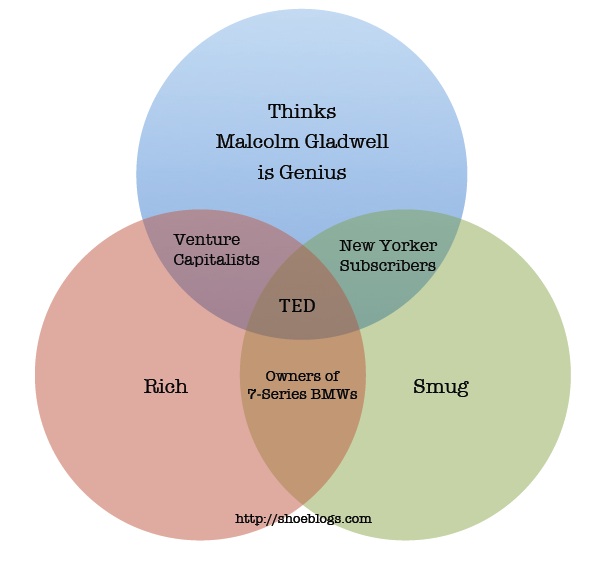
It is very difficult to try to consider the idea that most of the TED Talks are not pseudoscience with a straight face.  The entire purpose of the TED Talks is to make that which is not science look and feel like science for the benefit of the self-consciously mid-witted.  There is a reason the Ted Talks are eight-minute videos; it is a product targeted at people with short attention spans who are more inclined to watch television than read.

In the image on the left, Manolo the Shoe Blogger illustrates for whom these short, lightweight Talks are intended. TED Talks are really nothing more than video Cliff’s Notes. That is why the sort of people who specialize in dumbing things down for the wealthy, half-educated have to be very careful about what ideas they permit to be presented to their target audience.  They know perfectly well that their audience are the exact opposite of critical thinkers and therefore have a tendency to swallow everything presented to them as the pure truth of the sciencistic gospel.

The banned talk is below.  The fascinating thing is one of the reasons for the ban which is that Sheldrake “suggests that scientists reject the notion that animals have consciousness, despite the fact that it’s generally accepted that animals have some form of consciousness.” So, are we to understand that the scientific materialists now not only accept that consciousness exists, but regard it as the orthodox and enforceable scientific consensus?