Bomb-makers in Minneapolis

What used to be known as the Ghettos in the Sky are now the center of Mogadishu on the Mississippi. And the Somali population in Minneapolis has already contributed suicide bombers to Al-Shabab in Somalia as well as mall attackers to the same group in Kenya. So, the mysterious recent explosion in the heart of Somali Minneapolis should be a matter of more than a little concern to Minnesotans, as it indicates that the Somalis are likely to bring their jihad to the Mall of America or some other local target sooner or later.

A big explosion occurs next door to a mosque that has an unabashed
affection for the Muslim Brotherhood, in a Somali neighborhood where
terrorists are known to hang out — what could possibly be amiss with
that? Nothing, except possibly an Islamophobic hate crime, according to CAIR.

Zuhur Ahmed, a board member of the Minnesota chapter of
the Council on American-Islamic Relations, said the group was monitoring
the situation closely. “So far we don’t have any details,” she said. “But whenever there’s
an explosion, fire or anything of that sort by a mosque, there’s a
little bit of concern if the motive is a hate crime. We’re just
concerned and watching out for that.”

But then, CAIR always believes that the best defense is a good offense. If it were a gas explosion, the normal process would be for gas to
accumulate inside the building until a chance ignition detonated it.
Under those circumstances, the walls of the building would be blown
outwards, causing a sudden, catastrophic collapse of the structure and
filling the street and surrounding lots with bricks and rubble.

Nothing of the sort occurred. The earliest photos show an intense and
rapidly-spreading fire that looks like it originated on the second
floor, immediately above the grocery. This would be consistent with the
unexpected detonation of an explosive substance — say, ammonium nitrate,
just to pick a random example — which then distributed very flammable
material within an enclosed space, creating a flash-fire.

The explosion was subsequently blamed on a gas leak, which is interesting because the Star Tribune has been caught lying about its conversation with the gas company responsible.

I contacted CenterPoint and spoke with Rebecca Virden. I’m glad I did
because as you’ll see in a moment, there’s some very bad reporting
going on with this story.

“Our distribution system after we checked it — which runs
up to the meter, which is the distribution system’s responsibility, to
the meter — has no leak on it at all. We tested that system and it holds
its test. We even took it apart and tested it to make sure because it
had no leakage. It’s fully sound. As for our system, we had no leakage, no leak history, no leak calls
into our call centers prior to the incident before, during or after.”

Throw in the fact that Homeland Security was spotted on the scene and it points to the probability that the police and media are covering up the explosion of a Somali bomb-making factory in Minneapolis.


A lesson in rhetoric

In reading the responses to the Anti-Apologetics, SimplyTimothy observed: “Not stated, but now obvious, is that when you decide to bring the
rhetoric it is like bringing a swift kick to the balls to the
arm-wrestling contest. I like how you light the fuse of their ideas,
amplify them, then hand it back to them like a ticking time-bomb – then
you offer them a lit cigarette. It is very civilized of you.”

When writing on such disputative matters, I always attempt to do so with a tea service and one pinky extended. Anyhow, as a few people, mostly Tango, appear to be confused on the difference between a rhetorical response and a dialectical response, (which is legitimately confusing since technically, a rhetorical response IS a dialectical response), I think a brief refresher is worthwhile.

Remember that rhetoric is not limited to the laws of logic. Aristotle wrote: “Rhetorical study, in its strict sense, is concerned with the modes of persuasion. Persuasion
is clearly a sort of demonstration, since we are most fully persuaded when we consider a thing to have been
demonstrated. The orator’s demonstration is an enthymeme, and this is, in general, the most effective of the modes of
persuasion. The enthymeme is a sort of syllogism, and the consideration of syllogisms of all kinds, without
distinction, is the business of dialectic, either of dialectic as a whole or of one of its branches. It follows
plainly, therefore, that he who is best able to see how and from what elements a syllogism is produced will also be
best skilled in the enthymeme, when he has further learnt what its subject-matter is and in what respects it differs
from the syllogism of strict logic.”

In other words, when using rhetoric, one has to know when to utilize strict logical syllogisms and when to depart from them. And this totally depends on the audience. For, as I have frequently quoted him before, Aristotle observes: “Before some audiences not even the possession
of the exactest knowledge will make it easy for what we say to produce conviction. For argument based on knowledge
implies instruction, and there are people whom one cannot instruct.”

In rhetoric, it is perfectly legitimate to engage in all manner of logical fallacies. This is exactly what Peter Boghossian’s Street Epistemologists are taught to do, which is why they advance various arguments that are not only mutually contradictory, but blatantly flawed from a strict logical perspective. They engage in bait-and-switches, false definitions, and appeals to everything from authority to their own incredulity.

Now, because they claim to be faithful devotees of Science and Reason, this is why using scientific consensus and strict logic against them can be useful. But it is not our only weapon; they are woefully unprepared to see any sophisticated rhetoric arrayed against them. As one can see from the specific defenses they are being taught to attack, they are only being prepared for the lowest and crudest levels of rhetoric.

The rhetoric I am teaching you, on the other hand, is a much more sophisticated and deeper approach. Suppose, for example, the Street Epistemologist were to take Tango’s approach, retreat to the dialectic, and point out the difference between Boggie’s construction (1) and my own (2):

1) No faith is needed to POSTULATE that the universe may have always
existed.
2) No faith is needed to POSTULATE that the
universe always existed.

“Postulate (Subject One) versus Postulate (Subject One or Subject
Two). What you postulate is enclosed within the brackets, the subject of
the postulation. There is a world of difference when the subject allows
for alternatives compared to a straight out declaration with no choice.”

While it is true that the subjects postulated are modestly different, the differences are irrelevant and it is a huge mistake for the Street Epistemologist to try this line of retreat because it exposes an even bigger flaw in Boghossian’s attack. The fact is that no faith is needed to POSTULATE ANYTHING because a postulate is, by definition, “a defining”. A postulate, or a positing, is not a conclusion; it is the IF in the IF-THEN statement. The spearpoint of Anti-Apologetic #1 is nothing more than a statement of the obvious given rhetorical effect through specification.

So, it should be obvious that if one goes with a purely dialectical approach here, one gets no additional benefit from the perfectly analogous enthymeme. The postulates may be different, but the important thing to note is that there is no difference between the legitimacy of one postulate and another. Recall that the opponent is not going to be impressed with your dialectical precision; he has already shown that he is willing to say anything so long as it might be persuasive. But by responding in the rhetorical manner, with a slightly modified postulate, one gets the same benefit as well as the additional rhetorical benefit of the stronger statement and opening up the possibility of not one, but two effective new lines of attack if the Street Epistemologist is so foolish as to stubbornly attempt to salvage this particular attack by distinguishing between Postulate 1 and Postulate 2.

I’ve already pointed out the one line of attack that a retreat to a dialectical defense would expose the Street Epistemologist. See if you can correctly identify the second, and even more effective one, it also exposes.


The Huggening

Now that McRapey has finally claimed his Participation Hugo, the literary gods have declared that it is time for RAINBOW PUPPY LIGHTHOUSE THE HUGGENING. Which is to say, it’s Larry Correia’s turn to win Best Novel in 2014.

“The ugly truth is that the most prestigious award in sci-fi/fantasy is basically just a popularity contest, where the people who are popular with a tiny little group of WorldCon voters get nominated and thousands of other works are ignored. Books that tickle them are declared good and anybody who publically deviates from groupthink is bad. Over time this lame ass award process has become increasingly snooty and pretentious, and you can usually guess who all of the finalists are going to be that year before any of the books have actually come out or been read by anyone, entirely by how popular the author is with this tiny group. This is a leading cause of puppy related sadness.”

For just $40 you can register as a supporting member for WorldCon and nominate up to five works in every category. This year Warbound, the last book of the Grimnoir trilogy is eligible.Won’t you please help? Won’t you please put a smile on a sad puppy’s face?


The Fifth Horseman 4

This next anti-apologetic is particularly fascinating in light of the recent conversation I had on Twitter with one of Peter Boghossian’s Street Epistemologists named Blake. Blake staunchly defended the idea that there might have been an eternal universe consisting of Skittles, luminiferous aether, and highly compressed phlogiston prior to the Big Bang because, and I quote: “as far as what was before the Big Bang, (if that even makes sense), I just don’t know, and you don’t either.”

ANTI-APOLOGETIC #2 

“You can’t prove there’s not a God.”

I try to have patience when I hear this. What’s perpetually surprising about this defense is that I hear it from people all over the intellectual and educational spectrum. The basic idea is that because you can’t prove that there’s not a God, then God must exist. Of all of the defenses of faith, it is most difficult to comprehend how someone could actually offer this as a legitimate defense for faith or for belief in God.

To rebut this, I talk about little blue creatures living inside Venus. Clearly one cannot prove there are no little blue men living inside Venus. I then ask the question directly, “Do you believe there are little blue men living inside the planet Venus?”

There are basically three answers for this: yes, no, or I don’t know. If they say “yes,” then I change the color to yellow. I continue to change the color until they admit that not all the men I’ve described can physically live inside the planet. I then repeat the question and ask if they believe there are little blue men living inside Venus.

If they say “no,” I reply, “Why not? You can’t prove it not to be true.” Most people will get the point and then say there’s something different about God. That is, this line of argument works against everything except God. (Here I’m reminded of defenders of Anselm’s argument for the existence of God. Every time someone would bring up an objection, they’d state that the argument only works with God.) When the respondent says there is something special about God that makes this argument not work, then I always press them to know what’s different about God. I’ve yet to hear a coherent answer to this question.

If they respond, “I don’t know,” to the question of little blue men living inside Venus, I ask them why they don’t take the same stance with God and say, “I don’t know.”

Finally, I ask, “What evidence could I give you that would prove God doesn’t exist? Can you please give me a specific example of exactly what that evidence would look like?” Because it’s not possible to have a justified belief in God due to the fact that there’s insufficient evidence to warrant this belief, very few people have been able to cogently answer the question. I then use the discussion as a springboard to suggest that they don’t believe in God on the basis of the evidence. From here it’s a rocky but clear path to, “One ought not believe in something for which there’s insufficient evidence.”

Here Boghossian completely fails to understand the point of the defense he is trying to attack. He’s surprised because he is erroneously assuming that it is the basis for an assertion rather than the response to an attack which it obviously is. (This is more evidence of Boghossian’s social autism; it’s typical of many of the more socially awkward atheists that they cannot distinguish between an attack and a defense.) The basic idea is not that because you can’t prove that there’s not a God then God must exist, but rather because you can’t prove that there is not a God, then you cannot say there is not a God. And no faith is needed to posit that God exists and has always existed.

Which Boghossian should understand, given that in Anti-Apologetic #1, he stated: “The possibility that the universe always existed cannot be ruled out…. No faith is needed to posit that the universe may have always existed.”

VD RESPONSE: I don’t believe that little blue men live inside Venus. The human body, regardless of size or color, is incapable of surviving temperatures on the surface of Venus, let alone inside Venus’s iron core. Therefore, it should be readily apparent that little blue men cannot live there. Furthermore, there is no testimonial or documentary evidence of little blue men on Venus, whereas there is a vast quantity of testimonial and documentary evidence in favor of the existence of God.

I will be happy to tell you what evidence you could give me that would prove God doesn’t exist if you agree to tell me what evidence I could give you to prove that God does exist. Are we agreed? Very well. If the human race could collectively go one single 7-day period without committing any of the acts that God describes as sins in the Bible, I would agree that God doesn’t exist. If God does not exist and evil is nothing more than how we happen to describe certain human choices, then obviously it is possible for Man to not commit evil as it is described in the Bible as the violation of God’s Will. In fact, even if only 10 people could manage to go about their normal daily lives for a single week without sin, I think this would be a remarkable piece of evidence against the existence of God.

If, however, Man cannot refrain from committing evil despite consciously choosing to do so, then obviously the Biblical model of fallen Man is more in line with observable reality than the godless model, thereby indicating that Man’s morality is defined by the Will of an existent God.

So, what evidence are you willing to accept that you would consider conclusive regarding the existence of God?

ANTI-APOLOGETIC #14

Defense: “You should never say such things. You’ll offend people and they’ll think you’re a jerk.”

Response: “What people believe, and how they act, matter. They particularly matter in a democracy where people have a certain amount of influence over the lives of their fellow citizens. My intent is not to be a jerk. I don’t buy into the notion that criticizing an idea makes me a bad person. A criticism of an idea is not the same as a criticism of a person. We are not our ideas. Ideas don’t deserve dignity; people deserve dignity. I’m criticizing an idea because that idea is not true, and the fact that people think it is true has dangerous consequences.” 

VD RESPONSE: First of all, you don’t live in a democracy. You live in a corrupt imperial republic imposed by force and ruled by a bi-factional oligarchy, in which the people have absolutely no amount of influence over the lives of their fellow citizens regardless of how they vote. Your argument is based on a false premise. And more importantly, it doesn’t matter what your intent is, the observable fact is that you are acting like a jerk. You are violating basic social etiquette and the fact that you genuinely can’t see that your behavior is offensive indicates you may have a neurological abnormality that prevents you from grasping normal human socio-sexual relations. You know how you complain about women not liking you? Well, Sherlock, here’s your first clue.

Furthermore, Peter Boghossian wrote that “tolerance has been perverted into another value that undermines reason”. So, you’re not merely a jerk, you’re an intolerant jerk. You’re every bit as intolerant as the Saudi clerics who run around whipping girls who dress improperly, only you’re running around verbally abusing everyone you think believes improperly. And what’s more, you’re revealing yourself to be either dishonest or incredibly forgetful. You said it is wrong to pretend to know what you don’t know, you also said that we can’t know if God exists or not, and now you’re saying that you know that idea is not true. Are you even listening to yourself? Because you are speaking out of both sides of your mouth.

You said how people act matters. I suggest you look at your own actions! Is it really your intention to go through life with everyone correctly seeing you as a dishonest, intolerant jerk and avoiding you if they can? Is that really what reason dictates?


The fading First Amendment

Even the New York Times appears to be a little concerned about the incarceration of a blogger:

For over six years, Roger Shuler has hounded figures of the state legal and political establishment on his blog, Legal Schnauzer, a hothouse of furious but often fuzzily sourced allegations of deep corruption and wide-ranging conspiracy. Some of these allegations he has tested in court, having sued his neighbor, his neighbor’s lawyer, his former employer, the Police Department, the Sheriff’s Department, the Alabama State Bar and two county circuit judges, among others. Mostly, he has lost.

But even those who longed for his muzzling, and there are many, did not see it coming like this: with Mr. Shuler sitting in jail indefinitely, and now on the list of imprisoned journalists worldwide kept by the Committee to Protect Journalists. There, in the company of jailed reporters in China, Iran and Egypt, is Mr. Shuler, the only person on the list in the Western Hemisphere.

A former sports reporter and a former employee in a university’s
publications department, Mr. Shuler, 57, was arrested in late October on
a contempt charge in connection with a defamation lawsuit filed by the
son of a former governor. The circumstances surrounding that arrest,
including a judge’s order that many legal experts described as
unconstitutional and behavior by Mr. Shuler that some of the same
experts described as self-defeating posturing, have made for an
exceptionally messy test of constitutional law….

On Nov. 14, the judge held a hearing, and Mr. Shuler, who was
representing himself, took the stand, insisting that the court had no
jurisdiction over him and calling the court a joke. The judge decided
that the hearing had “served as a trial on the merits” and made his
final ruling: Mr. Shuler was forbidden to publish anything about Mr.
Riley or Ms. Duke involving an affair, an abortion or payoffs; was to
pay them nearly $34,000 for legal fees; and was to remove the offending
posts or remain in jail.

That didn’t take long. How long ago did the Left first start banging the drums about the need to ban “hate speech”. Ten years ago? And now we’re already seeing overtly political speech being banned in America. It’s only a judge’s action rather than a legislative act, but then, as we’ve learned from the examples of California and other states, it is the courts that now make the law, not the legislatures.

As per Barack Obama, the executive branch merely decides whether the government feels like implementing it or not.

The incarceration of Roger Shuler is merely one more example showing that there is not even the pretense of the rule of law in the USA anymore. The USA has devolved into a Maughamite state. Do what thou wilt is the whole of the law, with due regard for the federal agent around the corner.


Anti-apologetic to evangelism

On Twitter, Blake Seidler is attempting to defend one of Peter Boghossian’s many errors. It’s highly amusing and it demonstrates how most atheists simply are not prepared for rhetorical battle. Seeing them dip their toes into rhetoric and trying to figure it out in their quasi-aspie way is like watching monkeys try to figure out how to drive a car.

BS: Your accusation of science denial is false.

VD: He is indisputably denying science. He is appealing to the long-discredited idea of a Steady State universe.

BS: No he’s not, and that’s precisely the straw-man I’m referring to. He absolutely accepts the Big Bang model of the universe.

BS: You invoked the Steady State model, not Boghossian.

VD: He’s the one who denies the scientific consensus for the age of the universe, Blake.

VD:  “The possibility that the universe always existed cannot be ruled out.” – Peter Boghossian. There’s your science denial.

VD: “The possibility that the Earth is only six thousand years old cannot be ruled out.” – Peter Boghossian (paraphrased)

VD: “The possibility that God created the Heavens and the Earth cannot be ruled out.” – Peter Boghossian (paraphrased).

There is more of the same sort of thing, but the fact is that we all know Boghossian actually believes in the Big Bang and the scientific consensus concerning the age of the universe. He simply pretended that he didn’t in order to attack the possibility that God might have created the universe. But notice how the simple fact of answering rhetoric with rhetoric has immediately forced Blake, the Street Epistemologist, to beat a hasty retreat to scientific dialectic. Oh, of course Peter Boghossian isn’t a SCIENCE DENIER. Of course he ABSOLUTELY accepts the Big Bang model.

Forcing this retreat was, of course, precisely my intention, since now we can cheerfully cram the very words he was attempting to use to cast doubt on our faith right down his throat. Now Boghossian can’t even argue with someone claiming that there was nothing but Skittles and bubblegum before the Big Bang, or with someone who argues that Bishop Ussher’s 6,000 year old Earth can’t be ruled out without facing his own words. He is forced to choose between being hung by our rhetoric or accept that his arguments have been neutralized.

Hit them with rhetoric when they use rhetoric. Then, when they retreat and try to switch back to dialectic, recall their rhetoric and turn it against them. As I’ve noted, they are NEVER prepared to defend their beliefs or stand by the statements they make in attacking Christian beliefs. Ironically, the less intellectually honest they are, the easier it is to take them apart because they will always say something that contradicts an earlier statement. The more you do this, the easier it gets to spot the statement that will eventually be contradicted.

UPDATE: Boghossian’s tactics may be more self-destructive than I’d imagined.

VD: You say we can’t believe there was nothing before the Big Bang, but we can believe there were never any gods. You have faith!

BS: no, I withhold belief in God the same way I withhold belief in everything else that I don’t have evidence for.

VD: You appear to be pretending to know something you don’t. Do you admit there may be a Creator God?

BS: yes. I think a deistic god is impossible to disprove, and a truly omnipotent being could obviously conceal his existence.

VD: Good. You claim there may be something pre-Big Bang and there may be a Creator God. Do you also claim that Jesus Christ may be Lord?

BS: sure. I think the evidence is strongly against it, but if I am open to being shown that I am wrong about that.

And now we’re onto the Christian’s favored ground. Blake is presently trying to cite various forms of evidence against the Lordship of Jesus Christ, which should be an interesting enterprise. Notice that although he’s still repeating Boggie’s talking points, we’re no longer questioning the essential legitimacy of faith, but are instead discussing the evidence for and against Jesus Christ. I’ve asked him to focus, in particular, in the historical and textual evidence against Jesus Christ he cited.

So, you see, an unprovoked attack by a Street Epistemologist can be transformed into an opportunity to not only defend one’s faith, but share it. The anti-apologetic should be viewed as a potential opportunity for Christian evangelism. Just keep in mind that these are seldom individuals who are wired normally, so avoid any and all emotion-based appeals or personal testimonials and stick firmly to nothing but facts, reason, and logic.

UPDATE 2: A new tactical line occurs to me. When asked about the evidence AGAINST Jesus Christ, Blake surprised me by answering: “Historical, archeological, textual, philosophical, psychological, anthropological, cosmological, and experiential.”

Given that most atheists actively attempt to limit evidence to “scientific evidence”, it may be useful to encourage them to expand the limits of what they consider acceptable evidence by first asking them for their evidence against Jesus Christ. For example, most atheists would run screaming away from the idea that experiential evidence is legitimate in any circumstances. And archeological evidence has played into Christian hands since Nineveh was discovered. But Blake has manfully agreed that all these evidential grounds are fair game, “given sound logic and consistent definitions”, restrictions to which I can’t possibly object.

In any event, we’ve agreed that Twitter is too limited a medium for a detailed discussion, so he is going to write up his case for the evidence against the Lordship of Jesus Christ, which I will post here on the blog, unedited, in its entirety.


Diversity and the law

It will be interesting to see if the left-wing gay activists who are so enthusiastic about diversity and immigration will stop to rethink their enthusiasm in light of a series of new laws in various African countries:

Nigerian authorities today began arresting gay men after legislation was
quietly approved criminalising homosexuality and imposing prison terms up to
14 years for breaking the new law. Several gay couples were taken into custody in the country’s majority-Muslim
north, and rights groups feared that others would be targeted across the
West African country.

Goodluck Jonathan, Nigeria’s president, signed the Same Sex Marriage
Prohibition Act into law on January 7, but there was no public report of the
new law until journalists obtained a copy of the act on Monday. It prohibits homosexuals from even meeting in groups of two or more, bans
marriage or civil unions between people of the same sex, and criminalises
gay clubs and events.


Reuben Abati, the presidential spokesman, said Nigerians were happy with the
new law. It makes Nigeria the 38th African nation to enact legislation
persecuting gay people.

This is obviously wonderful news for left-liberals around the world, since as we all know, increased government intervention is an inevitable indication of social progress. And given the increased number of Africans in the USA, obviously it will be important for Americans to respect their cultural mores by permitting them to arrest any homosexuals who offend them.

It would, of course, be racist, xenophobic, and cultural imperialist to suggest that the newfound American enthusiasm for legal buggery should be forced upon Africans. I find it amazing to observe that 38 countries across Africa alone have criminalized homosexuality. It’s not something one often hears the American media mention despite their interminable sob stories about the Dark Continent.

Ten years ago, I would have seen such a law as an outrage. Not something to justify foreign intervention, you understand, but still, it would have been an outrage to my libertarian sensibilities. However, after seeing the increasingly fascist behavior of the gay rights activists, I’m not only indifferent towards Nigeria’s actions, but fully expecting similar laws to start taking effect in the West once the current Washington-Brussels axis collapses. After all, we’re already seeing them start to surface in Russia and Eastern Europe.

In an age of global communications, it’s simply not possible to make the same deceptive arguments over and over again. Other countries see what has happened in the USA and elsewhere and they don’t wish to experience the same consequences. “Some have suggested Nigeria’s
new law and a proposed one in Uganda were a backlash to Western pressure for
gay rights.”

From Big Government Republicans to drag queens, everyone feeling their political oats always seems to forget that social mood is a pendulum. But one of the best ways one can predict what is likely to happen in the future is to observe whose pendulum appears to be closest to peaking.


Mailvox: the distribution of atheist intelligence

As some of you have probably noted by now, I am not inclined to suffer fools gladly. And the fools I am least inclined to suffer are those who are prone to smugly offer erroneous corrections. Now, I have repeatedly pointed out that the small average atheist IQ advantage is small in comparison with the much larger number of highly intelligent theists and that most atheists have sub-100 IQs. These are all facts, easily verified by examining the GSS datafile.

Nevertheless, this did not prevent CLK from leaping in and attempting to correct me:

Now the unknown here is what is the data that you got #1 from —and
what does the distributions look like. The only way your statement #3
could possibly correct is if the two distributions are shaped
differently and the atheist one is much wider and shewed severely to a
low IQ .. which would seem very very unlikely… Its likely that
variance of the distribution of intellegence of theists will match the
general population variance and that the distribution of the atheists
will be in fact a subset of the theists….I do apologize for getting in the middle of the private conversation …
and for being right.. I will try to be less right in the future. 🙂

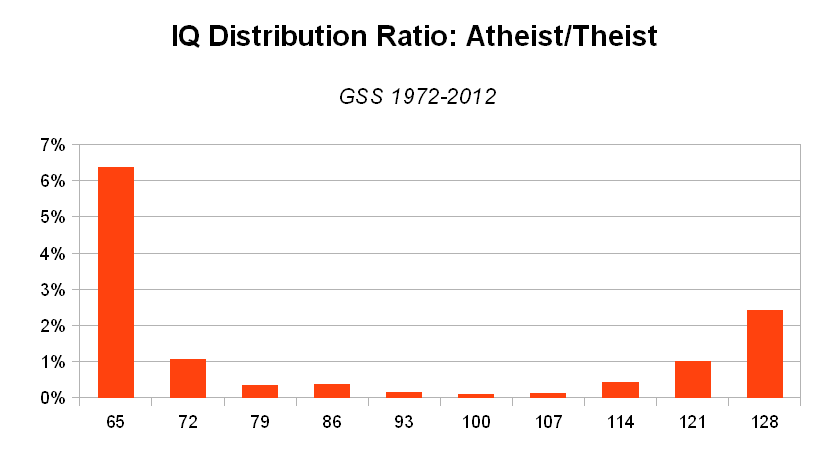
To which all the response needed is this graphic, taken from the latest 2012 General Social Survey and combined with the WORDSUM/IQ conversion table calculated by the estimable Aoli Pera. There is the explanation for the nonexistent dichotomy that CLK identified. The distributions are not only dissimilar, they are very nearly opposites. And note that as I predicted, the peak number of theists is precisely at 100 IQ.

As you can see, the two most common types of atheists are the High Church atheists with +2SD IQs (128+) and Low Church atheists with -2SD IQs (65-72). Note that the Low Church atheists actually outnumber the High Church atheists, 22.9 to 17.2 percent. This will surprise no one who has read TIA; as I noted there, we can observe a similar phenomenon at work in the Democratic Party membership.

Now, the statistically naive might look at this chart, note that the +2SD theists only account for 3.5 percent of the theistic population, and assume that this means there are more highly intelligent atheists than highly intelligent theists. This is not the case. As it happens, there are 11.4x more +2SD theists who either know God exists or believe God exists despite having the occasional doubt than there are +2SD atheists who don’t believe God exists.

The bad news for theists is that the overall number of those who know that God exists has declined from 63.8 to 62.6 percent from 2008. However, the number of those who believe, but are less certain has stayed the same. Interestingly enough, the increase in the agnostics (no way to know) and the spiritualists (higher power), has outpaced the increase in the number of atheists, with the spiritualists gaining the most, increasing from 8.1 percent of the populace to 8.8 percent. I’m not sure that’s quite what the anti-woo campaigners had in mind. Regardless, the chart below should put into perspective how mostly irrelevant atheists are to the population at large as it shows the percentage of atheists at the 10 different IQ levels in comparison to the most fervent categories of believers.

My guess is that most of the atheist trolls we see here from time to time are in the midwitted 114-121 category. In any event, I would think that most commenters here would understand by now that I don’t write anything here without having some evidential basis for it. I’m not saying that I’m always right, because that’s not the case. But I am saying that if you detect an apparent contradiction in what I’ve written, it would probably be a good idea to verify your assumptions before leaping in to correct me.

UPDATE: This amused me while playing around with the GSS. Of the dumbest strata of college graduates, nearly half, 46 percent, are atheists. That’s twice as many as all types of theists combined. We finally have an explanation for the Richard Dawkins fans.


Vikings hire Mike Zimmer

I’m cautiously optimistic about the hiring of Zimmer, which is more than I can say for every hire since Denny Green was hired after turning around Stanford. The proof is in the pudding, but hiring an experienced and respected defensive coordinator, who produced top 10 defenses three years in a row, is a big step forward for a franchise that hired third-rate coaches like Mike Tice and Brad Childress in succession. Dallas fans still miss him; he had the top defense in the league with them and they haven’t had one since.

Leslie Frazier might be a second-rate coach; jury is still out on him since his two primary problems were a) being too conservative, and b) Christian Ponder. He had to go, no question, but I’m not convinced he can’t be a successful head coach in the NFL if he learns from his failure with the Vikings. See: Bill Belichick.

When the whole coaching carousel kicked off, my preferences were Whisenhunt, followed by Zimmer. So, I’m pleased that the Vikings hired one of the sane candidates. And the fact that they didn’t hire Jim Caldwell AND get the benefit of playing against a Caldwell-coached team twice a year, is a bonus.


The 10 blocks of immigration

Paul Collier has an excellent article in the New Statesman summarizing what should be the beginning point for any rational discussion on immigration. And you will note that NONE of the points of evidence are in harmony with the assumptions that are taken for granted by most pro-immigrationists, whereas many of them are in-line with anti-immigration policies.

Block 1 Around 40 per cent of the population of
poor countries say that they would emigrate if they could. There is
evidence that suggests this figure is not a wild exaggeration of how
people would behave. If migration happened on anything approaching this
scale, the host societies would suffer substantial reductions in living
standards. Hence, in attractive countries, immigration controls are
essential.

Block 2 Diasporas accelerate migration. By
“diasporas”, I mean those immigrants and their descendants who have
retained strong links with their home societies, rather than cutting
loose and integrating into their host societies. These links cut the
costs of migration and so fuel it. As a result, while diasporas are
growing, migration is accelerating. Diasporas continue to increase until
immigration is matched by the rate at which immigrants and their
offspring are absorbed into the general population. A crucial
implication of this interconnection is that the policies for migration
and diasporas must be compatible.

Block 3 Most immigrants prefer to retain their own
culture and hence to cluster together. This reduces the speed at which
diasporas are absorbed into the general population. The slower the rate
at which they are absorbed, the lower the rate of immigration that is
compatible with stable diasporas and migration. By design, absorption is
slower with multicultural policies than with assimilative policies.

Block 4 Migration from poor countries to rich ones
is driven by the wide gap in income between them. This gap is the moral
horror story of our times. The difference in incomes is ultimately due
to differences in political and social structures: poor countries have
political and social systems that are less functional than those in rich
ones. Their dysfunctional systems persist in part because they are
embedded in the identities and narratives of local cultures. Migrants
are escaping the consequences of their systems but usually bring their
culture with them.

Block 5 In economic terms, migrants are the
principal beneficiaries of migration but many suffer a wrenching
psychological shock. As far as can be judged from the net effect on
happiness, the economic gains and psychological costs broadly offset
each other, although the evidence on this is currently sketchy.

Block 6 Because migration is costly, migrants are
not among the poorest people in their home countries. The effect on
those left behind depends ultimately on whether emigrants speed
political and social change back home or slow it down. A modest rate of
emigration, as experienced by China and India, helps, especially if many
migrants return home. However, an exodus of the young and skilled – as
suffered by Haiti, for example – causes a haemorrhage that traps the
society in poverty.

Block 7 In high-income societies, the effect of
immigration on the average incomes of the indigenous population is
trivial. Economies are not damaged by immigration; nor do they need it.
The distributional effects can be more substantial but they depend on
the composition of immigration. In Australia, which permits only the immigration of the skilled, the
working classes probably gain from having more skilled people to work
with. In Europe, which attracts many low-skilled migrants, the
indigenous poor probably lose out through competition for social
housing, welfare, training and work. The clearest effect on the jobs
market is that new migrants compete with existing migrants, who would
consequently be substantial beneficiaries of tighter controls.

Block 8 The social effects of immigration outweigh
the economic, so they should be the main criteria for policy. These
effects come from diversity. Diversity increases variety and this
widening of choices and horizons is a social gain. Yet diversity also potentially jeopardises co-operation and
generosity. Co-operation rests on co-ordination games that support both
the provision of public goods and myriad socially enforced conventions.
Generosity rests on a widespread sense of mutual regard that supports
welfare systems. Both public goods and welfare systems benefit the
indigenous poor, which means they are the group most at risk of loss. As
diversity increases, the additional benefits of variety get smaller,
whereas the risks to co-operation and generosity get greater. Each host
society has an ideal level of diversity and hence an ideal size of
diasporas.

Block 9 The control of immigration is a human
right. The group instinct to defend territory is common throughout the
animal kingdom; it is likely to be even more fundamental than the
individual right to property. The right to control immigration is
asserted by all societies. You do not have the automatic right to move
to Kuwait; nor do the Chinese have the automatic right to move to
Angola, although millions would if they could. Nor do Bangladeshis have
the automatic right to move to Britain and claim a share of its social
and economic capital. It sometimes makes sense to grant the right to migrate on a
reciprocal basis. Thousands of French people want to live in Britain,
while thousands of Britons want to live in France. Yet if flows become
too unbalanced, rights derived from mutual advantage can be withdrawn:
Australia, for instance, withdrew them from Britain. The expansion of
the EU has created these unbalanced situations and the original
reciprocal right may therefore need modification.

Block 10 Migration is not an inevitable consequence
of globalisation. The vast expansion in trade and capital flows among
developed countries has coincided with a decline in migration between
them.

Block 8 is partially incorrect, and even that quasi-error is mitigated by the fact that Collier points out that while the “widening of choices and horizons is a social gain”, diversity itself is not. Block 7, of course, is completely wrong, as evidenced by American post-1973 wage stagnation.

The biggest falsehood concerning immigration is that it is good for the economy. I’ll address this in a future post, but the TL;DR version can be understood by simply comparing GDP and immigration rates from 1900 to 2010.