To celebrate the release of STUPEFYING STORIES #20, we’re giving away the Kindle edition FREE for the cost of a click—but only for the next 24 hours, beginning at Midnight tonight, West Coast time.
Tell your friends! Tell your family! Tell people you know who aren’t such good friends but still like to get free ebooks! Share the news!
But share it soon, because at midnight tomorrow night, this book goes back to normal price.
STUPEFYING STORIES #20 features the gut-grabbing cover story, “Zombie Like Me,” by Clancy Weeks, along with a terrific mix of fantasy, light horror, demons, abominations, vampires, old family secrets, very nasty little fairies, and Bo Balder’s remarkably strange but charming story, “Alien Whispering.” If nothing else, read “Endeavor to Dream on Broken Wings,” so you can someday tell people that you were reading AJ Finley before anyone else had heard of her.
CONTENTS:
THEIR NOSTALGIA WILL BE VERY MUCH LIKE OUR NOSTALGIA • by Eric Cline
Things have been quiet at Infogalactic lately, and they will continue to be quiet even as we continue to improve performance, until DONTPANIC is ready to bring the noise, but you can bet that Wikipedia is aware that it exists now. This is #2 on Breitbart’s list of the Best Examples of Left-wing Bias on Wikipedia in 2017:
2. Burying CNN’s Blackmail controversy and other scandals at the network
Shortly after CNN’s blackmail controversy, an editor created a page on the topic. Other editors promptly had the story buried by moving the content into the bottom section of an article about CNN controversies. Roughly two dozen editors, mostly left-wing, supported this move citing a policy that says Wikipedia is not for news. Five of these editors showed a double standard, having previously voted to keep an article on Trump’s disclosure of intelligence about ISIS threats in a meeting with Russia where the same policy would apply.
A few editors went even further by cutting out critical information on the blackmail controversy from even the general CNN controversies article, as well as gutting nearly a third of the article’s content covering a variety of scandals that gripped the network, despite much of it being backed by sources considered reliable by Wikipedia standards. These removals included a section on CNN New Year’s Eve host Kathy Griffin’s firing from the network, which was justified by claiming it wasn’t a CNN controversy. The same argument was used to keep out mention of undercover journalist James O’Keefe’s video series on CNN, itself denied its own article by many of the same editors.
Only a small amount of the removed content had been restored after the flurry of deletions. When the situation was mentioned on the Vox Popoli blog of science fiction author Vox Day, the founder of Wikipedia alternative Infogalactic, an editor sought to restore noteworthy content about the blackmail controversy and was immediately reverted.
Scandalous! The mainstream media won’t cover this, of course, but that’s fine. More and more people are routing around them every day.
But this underlines the importance of Infogalactic. Do take the trouble to thank the Burn Unit, which make it run. And if you’re using Infogalactic, consider joining it. The thing about foundational structures like Infogalactic is that they’re neither sexy nor exciting. That’s why people pay so little attention to them even when they rely upon them heavily. The thing is, they are absolutely vital. Which, of course, is why I prioritized it in the first place.
Note that only 561 of Wikipedia’s 1,237 administrators are active now. We have a LONG way to go, but it is doable. And the more that Wikipedia is converged by its admins, the easier our long march becomes.
Hey, it worked for The Most Popular Blog in Science Fiction. Lie about your traffic, secure the contract, then pray that no one notices the way in which your subsequent performance doesn’t quite line up with your supposed influence. What’s wrong with a little traffic inflation among friends?
The publisher of Newsweek and the International Business Times has been engaging in fraudulent online traffic practices that helped it secure a major ad buy from a US government agency, according to a new report released today by independent ad fraud researchers.
IBTimes.com, the publisher’s US business site, last year won a significant portion of a large video and display advertising campaign for the Consumer Financial Protection Bureau, a federal agency. Social Puncher, a consulting firm that investigates online ad fraud, alleges in its report that the ads were displayed to an audience on IBTimes.com that includes a significant amount of “cheap junk traffic with a share of bots.”
The CFPB’s ad budget was the subject of criticism from Republican lawmakers after the Daily Caller reported last year that it had awarded more than $40 million in contracts to a single ad agency, GMMB, which is one of the top Democratic media strategists. (A portion of money in those contracts was used to pay media outlets for advertising space, and was not kept by GMMB.)
The CFPB was created in 2011 as a result of the Dodd–Frank Wall Street Reform and Consumer Protection Act. President Trump recently tweeted that the bureau “has been a total disaster,” and installed his budget director, Mick Mulvaney, as its new director.
Neither the CFPB or GMMB are accused of taking part in, or having knowledge of, ad fraud on IBTimes.com.
A CFPB spokesperson told BuzzFeed News the bureau is looking into the allegations raised in Social Puncher’s report…. When it comes to IBT’s fraudulent traffic practices, Social Puncher’s findings align with reporting from BuzzFeed News on IBT India, and with separate data gathered by Pixalate, an ad fraud detection company, and DoubleVerify, a digital media measurement company. (Social Puncher and BuzzFeed News previously collaborated on ad fraud investigations, but worked separately in this case.)
Based on what it described as a detailed investigation, DoubleVerify this week classified IBT’s US, UK, India, and Singapore sites as “as having fraud or sophisticated invalid traffic,” according COO Matt McLaughlin. DoubleVerify is now blocking all ad impressions on these sites on behalf of customers.
I always find it amusing when the SJWs in science fiction try to accuse me of inflating or exaggerating my numbers because I never report anything except exactly the Google pageviews reported by Blogger. But their accusations tell me that they are aware that other people in science fiction do so.
By the way, yesterday’s pageviews were 141,106. It’s been informative to see how neither USA Today nor Wired moved the traffic needle more than a very small fraction, but one brief appearance on The Milo Show has temporarily increased daily traffic by about 40 percent. The members of the maintream media really have no idea how individually irrelevant most of them are. Even with the benefit of a prestigious platform, they don’t have much an influence.
The room was like a prison–at least to Adam Crag. It was a square with a narrow bunk, a battered desk, two straight-back chairs and little else. Its one small window overlooked the myriad quonsets and buildings of Burning Sands Base from the second floor of a nearly empty dormitory. There was a sentry at the front of the building, another at the rear. Silent alert men who never spoke to Crag—seldom acknowledged his movements to and from the building—yet never let a stranger approach the weathered dorm without sharp challenge. Night and day they were there. From his window he could see the distant launch site and, by night, the batteries of floodlights illumining the metal monster on the pad. But now he wasn’t thinking of the rocket. He was fretting; fuming because of a call from Colonel Michael Gotch.
“Don’t stir from the room,” Gotch had crisply ordered on the phone. He had hung up without explanation. That had been two hours before.
Crag had finished dressing—he had a date—idly wondering what was in the Colonel’s mind. The fretting had only set in when, after more than an hour, Gotch had failed to show. Greg’s liberty had been restricted to one night a month. One measly night, he thought. Now he was wasting it, tossing away the precious hours. Waiting. Waiting for what?
“I’m a slave,” he told himself; “slave to a damned bird colonel.” His date wouldn’t wait–wasn’t the waiting kind. But he couldn’t leave.
He stopped pacing long enough to look at himself in the cracked mirror above his desk. The face that stared back was lean, hard, unlined–skin that told of wind and sun, not brown nor bronze but more of a mahogany red. Just now the face was frowning. The eyes were wide-spaced, hazel, the nose arrogant and hawkish. A thin white scar ran over one cheek ending.
His mind registered movement behind him. He swiveled around, flexing his body, balanced on his toes, then relaxed, slightly mortified.
Gotch—Colonel Michael Gotch—stood just inside the door, eyeing him. A flush crept over Crag’s face. Damn Gotch and his velvet feet, he thought.
The expression on Gotch’s face was replaced by a wooden mask. He studied the lean man by the mirror for a moment, then flipped his cap on the bed and sat down without switching his eyes.
He said, “You’re it.”
“I’ve got it?” Crag gave an audible sigh of relief. Gotch nodded without speaking.
“What about Temple?”
“Killed last night–flattened by a truck that came over the center-line. On an almost deserted highway just outside the base,” Gotch added. He spoke casually but his eyes were not casual. They were unfathomable black pools. Opaque and hard. Crag wrinkled his brow inquiringly.
“Accident?”
“You know better than that. The truck was hot, a semi with bum plates, and no driver when the cops got there.” His voice turned harsh. “No… it was no accident.”
“I’m sorry,” Crag said quietly. He hadn’t known Temple personally. He had been just a name–a whispered name. One of three names, to be exact: Romer, Temple, Crag. Each had been hand-picked as possible pilots of the Aztec, a modified missile being rushed to completion in a last ditch effort to beat the Eastern World in the race for the moon. They had been separately indoctrinated, tested, trained; each had virtually lived in one of the scale-size simulators of the Aztec’s space cabin, and had been rigorously schooled for the operation secretly referred to as “Step One.” But they had been kept carefully apart. There had been a time when no one—unless it were the grim-faced Gotch—knew which of the three was first choice.
Romer had died first–killed as a bystander in a brawl. So the police said. Crag had suspected differently. Now Temple. The choice, after all, had not been the swarthy Colonel’s to make. Somehow the knowledge pleased him. Gotch interrupted his thoughts.
“Things are happening. The chips are down. Time has run out, Adam.” While he clipped the words out he weighed Crag, as if seeking some clue to his thoughts. His face said that everything now depended upon the lean man with the hairline scar across his cheek. His eyes momentarily wondered if the lean man could perform what man never before had done. But his lips didn’t voice the doubt. After a moment he said:
“We know the East is behind us in developing an atomic spaceship. Quite a bit behind. We picked up a lot from some of our atomic sub work–that and our big missiles. But maybe the knowledge made us lax.” He added stridently:
“Now … they’re ready to launch.”
“Now?”
“Now!”
“I didn’t think they were that close.”
“Intelligence tells us they’ve modified a couple of T-3’s–the big ICBM model. We just got a line on it … almost too late.” Gotch smiled bleakly. “So we’ve jumped our schedule, at great risk. It’s your baby,” he added.
Crag said, “I’m glad of the chance.”
“You should be. You’ve hung around long enough,” Gotch said. His eyes probed Crag. “I only hope you’ve learned enough … are ready.”
“Plenty ready,” snapped Crag.
“I hope so.”
Gotch got to his feet, a square fiftyish man with cropped iron-gray hair, thick shoulders and weather-roughened skin. Clearly he wasn’t a desk colonel.
“You’ve got a job, Adam.” His voice was unexpectedly soft but he continued to weigh Crag for a long moment before he picked up his cap and turned toward the door.
“Wait,” he said. He paused, listening for a moment before he opened it, then slipped quietly into the hall, closing the door carefully behind him.
He’s like a cat, Crag thought for the thousandth time, watching the closed door. He was a man who seemed forever listening; a heavy hulking man who walked on velvet feet; a man with opaque eyes who saw everything and told nothing. Gotch would return.
Despite the fact the grizzled Colonel had been his mentor for over a year he felt he hardly knew the man. He was high up in the missile program—missile security, Crag had supposed—yet he seemed to hold power far greater than that of a security officer. He seemed, in fact, to have full charge of the Aztec project—Step One—even though Dr. Kenneth Walmsbelt was its official director. The difference was, the nation knew Walmsbelt. He talked with congressmen, pleaded for money, carried his program to the newspapers and was a familiar figure on the country’s TV screens. He was the leading exponent of the space-can’t-wait philosophy. But few people knew Gotch; and fewer yet his connections. He was capable, competent, and to Crag’s way of thinking, a tough monkey, which pretty well summarized his knowledge of the man.
He felt the elation welling inside him, growing until it was almost a painful pleasure. It had been born of months and months of hope, over a year during which he had scarcely dared hope. Now, because a man had died….
He sat looking at the ceiling, thinking, trying to still the inner tumult. Only outwardly was he calm. He heard footsteps returning. Gotch opened the door and entered, followed by a second man. Crag started involuntarily, half-rising from his chair.
He was looking at himself!
“Crag, meet Adam Crag.” The Colonel’s voice and face were expressionless. Crag extended his hand, feeling a little silly.
“Glad to know you.”
The newcomer acknowledged the introduction with a grin–the same kind of lopsided grin the real Crag wore. More startling was the selfsame hairline scar traversing his cheek; the same touch of cockiness in the set of his face.
Gotch said, “I just wanted you to get a good look at yourself. Crag here”—he motioned his hand toward the newcomer—”is your official double. What were you planning for tonight, your last night on earth?”
Urs Hölzle, Senior Vice President at Google, is determined to hunt down every employee who isn’t 100 percent SJW-converged.
Sometimes, like yesterday, I am…saddened? taken aback? disgusted? by the thought that there are Googlers coming to work filled with gate towards their colleagues. I’m not even sure what adjective to use….but it’s sad. No matter the topic, there’s just no room for hate at Google.
But then again, I remind myself that 99.99{f34b2ed14022567e3962d98ceb517f14c2acb643b80147bdb11c1357fe49acc6} of our colleagues do not fall into that group, and that we can’t let a small fraction of employees dominate our thoughts, feelings, and culture. That makes me hopeful that we can overcome the attempts to create a culture of hate and fear.
But that is little comfort to the Googlers who are being doxxed or harassed. I hope we will identify those behind this reprehensible conduct. All Googlers are responsible for upholding a workplace and culture that is free of harassment, discrimination, misconduct, bullying, and retaliation.
So tragic, all these gate-filled Googlers. Of course, if Google wants to uphold a workplace free of harassment, discrimination, misconduct, bullying, and retaliation, the very first person they should fire is Urs Hölzle. The man is a genuinely nasty little thought-Nazi, full of the very worst kinds of gate.
Urs, did you really not realize that everything that passes through your corporate communication system gets leaked outside now? Just because outsiders don’t post very much of it doesn’t mean they don’t have it. You see, even your employees who are on the Left are totally freaked out by their legitimate concerns about what sort of insanity you lunatic SJWs are going to get up to next. They know it’s only a matter of time before you go after them as well. Once you root out the evil 0.01 percent, it’s on to the next 0.1 percent undsoweiter.
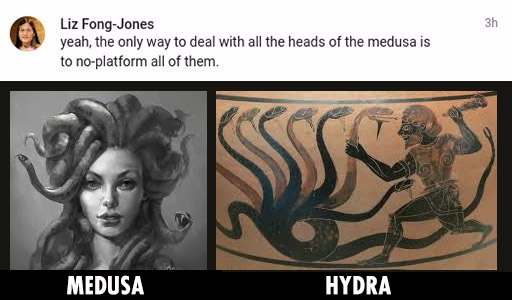
Sure, you’ve got access to all our emails and our browser histories. We know that. But are you absolutely certain that we don’t have yours? Beware the many heads of the Medusa! By the way, Wired‘s Nitasha Tika denied coordinating her story, which SJWS at Google are circulating inside the company to try to intimidate suspected whistleblowers, with Jessica Guynn of USA Today. Just another one of those mysterious coincidences that seem to happen *COUGHGAMEJOURNOPROS* from time to time whenever SJW interests intersect, right? Actually, she is telling the truth, because it was a very small group of Google-SJWs coordinating their defense by press who were responsible for the near-simultaneous appearance of the articles.
Amateur effort, really. Even the SJWs at Tor managed to drum up international coverage from Entertainment Weekly to the New Zealand Herald after we blew up the Hugos the first time. But, as we’ve learned, the grunts at Google aren’t nearly as smart as they think they are.
Speaking of which, this email made me laugh.
I think you meant Hydra not Medusa in your Google post. The hydra was a multi headed serpent. Medusa looked like a cross between Grendel’s mother and Hillary Clinton.
Written by the greatest living economist, Steve Keen, one of the few professional economists to have correctly anticipated the global financial crisis of 2008, eCONcomics is a series of three satires explaining why the science of economics has gone so terribly wrong. In these savagely erudite satires, Keen highlights the lameness of the excuses offered by economists for their failure to predict anything from the financial crisis to the recent stock market highs. From “secular stagnation” to the “non-accelerating inflation rate of employment” and the “full employment real interest rate”, Keen expertly mocks both the myths and the incompetence of his professional colleagues. After reading eCONcomics, you will understand why no economist ever seems to be able to explain what is going on today, or tell you what will happen tomorrow. Steve Keen is Professor of Economics at Kingston University in London, and an Honorary Professor at University College London.
And yes, there is a very good chance that Prof. Keen and I will collaborate on an eCONcomics devoted to the subject of free trade in the coming year. We may disagree on a number of issues, but free trade is not one of them.
Gay sex, cohabitation, and sex outside marriage would become illegal and punishable with prison terms under proposals from Islamic parties that could soon become law in the world’s largest Muslim-majority nation. Critics say the moves, which are being negotiated among Indonesia’s political parties and government legislative drafters, would, if enacted, be a major blow to democracy in this Southeast Asian nation of 250 million.
How can legislation that is popular with the majority of the electorate be “a major blow to democracy”?
When was “democracy” redefined as “unrestricted sex”?
Think about what this implies for survival of democracy as a legitimate political philosophy in the future. It is increasingly apparent that to the Left, “democracy” means nothing more than “the policies we happen to favor at the moment”.
West Ham United is under fire because the director of transfers is both astute enough to realize that fielding an all-African soccer team is sub-optimal player management and naive enough to have explained his reasoning.
Henry sent an email on January 27 — in response to an inquiry about a footballer of Cameroonian descent — to another senior West Ham official and an agent. In the email, Henry wrote: ‘We don’t want any more Africans and he’s not good enough. I sent Thomas to watch him and the other lad last week and he said no. If Palace take them good luck.’ Sportsmail knows the identity of both recipients but a stipulation before being sent the email was that they should remain anonymous.
Henry was asked if there is a club policy regarding African players. Initially he replied ‘no’, only to be informed that we understand he has told more than one agent in the last month that the club does not want any more African players.
Henry then confirmed it was true and suggested it was a policy supported by club management. ‘Yeah,’ Henry replied. ‘Because we had three and we felt we didn’t particularly want any more African players.’
Asked why, Henry replied: ‘Erm, no reason. It’s nothing racist at all. It’s just sometimes they can have a bad attitude.
‘We had problems with Sakho, with Diafra Sakho. We find that when they are not in the team they cause mayhem. It’s nothing against the African race at all.
‘I mean, look, there are top African players. There’s not a problem with them. It’s just sometimes they cause a lot of problems when they are not playing, as we had with Diafra. He’s left, so great. It’s nothing personal at all.’
Asked if he thought his view was discriminatory towards African players, Henry asked: ‘In what way?’
Asked then if he thought his comments amounted to a slight on African players, he replied: ‘No. I don’t know what you are trying to get at here. All I said was, look, we have a great lad in Kouyate, he’s brilliant, a great player for us, he’s a good lad.
‘But the likes of Sakho have caused mayhem. When he’s not playing … he always wants a new deal. That’s all it was. It was nothing discriminatory at all.
‘I could say we get offered Russian players. I just find with Russian players that they don’t settle in England. It’s like Italians. How many Italians come and settle in England? As a club we are not discriminatory at all.
‘If you’ve got too many, they all sit together and it becomes a situation where you can have problems. But then you can have problems with English players. I don’t know what you are driving at.’
The ironic thing is that West Ham already has six Africans on the first team that the director brought in. So, the man is clearly not racist or unwilling to employ Africans. What is he supposed to do, bring in more players they think aren’t good enough to start and are likely to cause trouble because they have too much time on their hands?
This is one reason I never explain myself or my reasoning to anyone anymore, except when I feel that doing so is going to serve my objectives in some way. I certainly don’t explain myself in response to questions, much less demands that I do so. It is almost as important to never explain your reasons for your actions as it is to never apologize. Just as an apology is taken by some as an admission of guilt, an explanation is taken as an invitation to a debate.
Consider the difference when you’re asked if you are going to go somewhere you don’t want to go.
Are you going to the meeting? No. Why not? I am not going. Um, well, okay….
Are you going to the meeting?No. Why not? Well, I’m busy. Come on, I can see that you’re not that busy. Well, also, I don’t like so-and-so. I don’t think he’s going to be there. And even if he is, you can just ignore him. But… but I don’t want to go! Well, you have no reason not to go. Disqualified. See you there at three!
No matter what reasoning you provide, someone can always invent an excuse to not accept that reasoning and then insist that you have to do what you don’t want to do or that you truly are what you deny being. So don’t give them the opening. All Henry should have said was “no, we don’t want him.” That would have saved him his job and his club a considerable amount of trouble.
And when people ask “why”, just tell them “what part of ‘no’ did you find hard to understand? I am not in the habit of explaining myself.” While there are those to whom we owe explanations, the vast majority of people who ask for explanations do not merit them. I get emails every day asking me to explain my position on X, Y, or Z. In most cases, I simply ignore them.
The only correct response to “I don’t understand why you believe XYZ” is “I don’t care what you understand.” The vast majority of people demanding explanations are not seeking to learn, they are seeking to argue.
Democrats must really be nervous about what is in the Nunes memo. They’re getting increasingly desperate about keeping the contents out of the public eye:
Democrats on the House Intelligence Committee are accusing Republicans on the panel of secretly making changes to a controversial, GOP-drafted memo alleging abuse of spying laws before sending it to the White House for potential public release.
In the latest partisan exchange between members of the committee, Democrats say the committee now must recall the memo from the White House, where the president is currently weighing whether to release the document, arguing that the document is not the version members voted to declassify earlier this week. The memo purports to show FBI abuse of the Foreign Intelligence Surveillance Act during the investigation into whether the Trump campaign colluded with Russia during the 2016 election.
Adam Schiff@RepAdamSchiff BREAKING: Discovered late tonight that Chairman Nunes made material changes to the memo he sent to White House – changes not approved by the Committee. White House therefore reviewing a document the Committee has not approved for release.
“After reviewing both versions, it is clear that the Majority made material changes to the version it sent to the White House, which Committee Members were never apprised of, never had the opportunity to review, and never approved,” Schiff said in a letter to committee chairman Devin Nunes, whose staff wrote the memo.
“This is deeply troubling, because it means that the Committee Majority transmitted to the White House an altered version of its classified document that is materially different than the version on which the Committee voted,” Schiff said. “The White House has therefore been reviewing a document since Monday night that the Committee never approved for public release.”
Schiff said it’s “now imperative that the Committee Majority immediately withdraw the document that it sent to the White House.” He urged Nunes to re-do the vote to declassify the document on Monday, when the committee is also expected to vote to declassify a memo drafted by Democrats to counter the one put forth by Republicans.
But in a statement, a spokesperson for Nunes downplayed the changes cited by Schiff.
“In its increasingly strange attempt to thwart publication of the memo, the Committee Minority is now complaining about minor edits to the memo, including grammatical fixes and two edits requested by the FBI and by the Minority themselves,” the spokesperson said. “The vote to release the memo was absolutely procedurally sound, and in accordance with House and Committee rules. To suggest otherwise is a bizarre distraction from the abuses detailed in the memo, which the public will hopefully soon be able to read for themselves.”
It’s amazing how much like little children they are. How on Earth have Republicans been losing to these guys for generations? There are whole classes of people who simply should not even be allowed to use the word “therefore”.
Hesperians loved to see themselves as the good guys fighting for the underdog against powerful foes. If he ever caught a glimpse of what she really thought and felt, he would abandon her in an instant. And Hexenhammer would be finished.
Pausing at a streetlamp, she smoothly spun on her heel and powered her holobuds. In her peripheral vision she checked for unwanted attention. Notifications flooded her screen. She checked the first.
BREAKING: REFUGEE MASSACRE IN HELLAS
She blinked and followed the link.
A barrage of photos: first responders tending to the wounded and evacuating civilians, burning and collapsed tents, killers machine-gunning a crowd of innocents.
And in the news summary, a bold bullet point stood out.
New Phosterian terrorist group Hexenhammer claims responsibility.
She fought down a curse and read the entire article. Three times.
Terrorists attacked a refugee camp on the island of Chios. Hundreds dead. Between four to eight terrorists. Killers still at large. Island on lockdown. Hexenhammer claims responsibility.
Eve forced herself to breathe. It was time to be her other self again: an arm of the anonymous Kraken who terrorized the terrorists. A woman who brought down the hammer on the witches plaguing Pantopia. She opened her secure mail app and fired a message for Luke.
You must have heard about Hellas. We did NOT do it. We must meet. Call me.
***
“Eve didn’t do it,” I said.
“Why? Because she told you?” Pete said.
“No. Because this doesn’t have the hallmark of a Kraken operation, much less Hexenhammer.”
O’Connor’s voice issued from my holophone sitting on the table, reverberating in the secure conference room. “Just so we’re on the same page here, what is the hallmark of a Kraken operation?”
I rubbed my eyes. It was half past three in the morning, and despite the adrenaline in my veins, I was still jet lagged. I paused for a breath, composing my thoughts.
“Hexenhammer prides itself on proportionality and precision. They conduct information warfare and propaganda campaigns against their ideological enemies. They only target gangsters and terrorists—people who’ve caused actual harm—for assassinations. They’ve got a high standard for selecting targets. They post the target’s details on their internal forum, they talk about it among themselves, and they only go ahead if an admin is satisfied the target meets the standard of harm.”
“When they do strike, they rub out only the target,” Pete said. “No one else, except maybe nearby bad guys. And they attribute the hit to a mysterious figure they call Die Kraken.”
“Exactly,” I said. “They don’t kill innocents. They never had. Why would they start now?”
“To ‘strike a blow against the forces of globalization and Wahism threatening Western Phosterian civilization,’” O’Connor replied. “Or so their manifesto goes. They left it at the scene and mailed copies to the press.”
“BS. They don’t think like that.”
“You mean Eve doesn’t think like that. It doesn’t mean others in Hexenhammer don’t. Hexenhammer isn’t necessarily a monolithic organization.”
“This doesn’t fit their MO,” I said.
“Maybe they are changing how they do things,” Pete offered.
“Without telling their founder?”
“Or maybe Eve just didn’t want to tell you.”
“That’s not Eve,” I said. “She’s a killer, but she’s surgical. This? This is mass murder. She’s not psychotic enough to even think about it.”
Pete crossed his arms. “Okay, so who did it?”
“We’re going nowhere with this,” O’Connor declared. “It’s hasn’t even been an hour since the attack. Until we know the big picture, we can’t say for sure what’s going on.
“How about this: I’ll fly out to your location. I should be there in… twelve hours. By then I should have more to share with you, and we can plan our next step.”
“What do we do now?” Pete asked.
“Consider this a warning order. We need to figure out what’s going on with Hexenhammer. Get ready for an overseas trip to meet and assess Eve and the rest of Hexenhammer.”
“All right. And the Kalypso readiness report?”
“I’ll need that, too.”
Pete groaned. “You just had to ask, didn’t you?”
No point going back to bed. Pete went off to collect coffee. I re-read Eve’s email. At the end of it was a phone number. Knowing her, it was a disposable one-time-only number. I generated my own burner number with a holophone app and called her with it.
She picked up after the first ring.
“Grüezi,” she said.
It was Swiss German. My language implant kicked in, returning Hello.
“It’s me,” I said.
“Hey,” she said, switching to Anglian. “Thanks for calling.”
“Thanks for reaching out to me. What happened out there?” In the background I heard a car honking. Was she out on the street?
“I don’t know. I didn’t authorize what happened at Hellas. Neither did anyone I know in my organization.”
She was deliberately being vague to avoid tripping telecom intercept programs—the kind every First-World nation ran on the rest of the world.