Why conservatives will lose a civil war

As the prospects for actual conflict grow, more and more right-wingers are beginning to realize that conservatives cannot be relied upon to fight for anything:

Would conservatives achieve an easy victory against the left if it came down to civil war?  The question seems less absurd by the day as tensions increase between the right and left.  Many conservative writers seem to think the left would fold quickly and the right would triumph. One has good reason to doubt that.  Consider basic issues like political bias in universities, or religious integrity.  After decades of exposés and outcries from conservatives over liberal tyranny, universities are as biased as they ever were….

I am nowhere near as confident as Kurt Schlichter that the right wing could trounce the left wing in battle.  We can’t even unite to keep Alex Jones on Facebook.  It is true that conservatives have more guns and are probably better street fighters.  But conservatives also cave in large numbers even when their most sacred cows are in danger – such as the First Amendment or Christian principles.  The two latter issues sit at the core of academic bias and debates on sexuality, respectively.  I have the war wounds from both battles and can attest to the repeating scenario: conservatives talk and talk about what they believe and how bad the left is.  Then they give up droves when it comes time to fight.

Take the question of defending the gospel.  We hear constant sermons from Christian preachers that speak of standing by God’s word even in the face of popular criticism.  In anticipation of the Southern Baptist Convention’s annual meeting, I spent months searching for people be willing to sign on to a resolution affirming Christian sexual ethics and supporting churches’ rights to offer counseling in defiance of laws like California’s “stay gay” bill.  Almost sixteen million Americans claim to be Southern Baptists.  I could not find a single person willing to back the resolution.  When I submitted it under my own name, it was killed in committee and never brought to the floor.

If you look at the history of ideologically-based civil wars, the odds most certainly do not favor the more conservative sides. The Spanish Civil War was one of the few in which the socialists were ultimately defeated, and yet, neither Franco nor the Phalange were ever embraced by the Right throughout the West.

I’ve been reading James Burnham’s Suicide of the West, and one of the things that is particularly shocking is his 39-question poll which divides the conservatives of 1965 from liberal-progressives. I’ll post it later today, as it shows very clearly that today’s conservatives are yesterday’s progressives.


Smells like tortious interference

Soros and David Brock appear to be behind the recent social media takedowns:

A confidential, 49-page memo for defeating Trump by working with the major social-media platforms to eliminate “right wing propaganda and fake news” was presented in January 2017  by Media Matters founder David Brock at a retreat in Florida with about 100 donors, the Washington Free Beacon reported at the time.

On Monday, the Gateway Pundit blog noted the memo’s relationship with recent moves by Silicon Valley tech giants to “shadow ban” conservative political candidates and pundits and remove content.

The Free Beacon obtained a copy of the memo, “Democracy Matters: Strategic Plan for Action,” by attending the retreat.

The memo spells out a four-year agenda that deployed Media Matters along with American Bridge, Shareblue and Citizens for Responsibility and Ethics in Washington (CREW) to attack Trump and Republicans. The strategies are impeachment, expanding Media Matters’ mission to combat “government misinformation,” ensuring Democratic control of the Senate in the 2018 midterm elections, filing lawsuits against the Trump administration, monetizing political advocacy, using a “digital attacker” to delegitimize Trump’s presidency and damage Republicans, and partnering with Facebook to combat “fake news.”

Quashing ‘fake news’ with ‘mathematical precision’

The Free Beacon in its January 2017 story said Brock sought to raise $40 million in 2017 for his organizations.

The document claims Media Matters and far-left groups have “access to raw data from Facebook, Twitter, and other social media sites” so they can “systemically monitor and analyze this unfiltered data.”

“The earlier we can identify a fake news story, the more effectively we can quash it,” the memo states. “With this new technology at our fingertips, researchers monitoring news in real time will be able to identify the origins of a lie with mathematical precision, creating an early warning system for fake news and disinformation.”

Media Matters met with Facebook, which boasts some 2 billion members worldwide, to discuss how to crack down on fake news, according to the memo.

The social media giant was provided with “a detailed map of the constellation of right-wing Facebook pages that had been the biggest purveyors of fake news.”

Brock’s memo also says Media Matters gave Google “the information necessary to identify 40 of the worst fake new sites” so they could be banned from Google’s advertising network.

The Gateway Pundit pointed out that in 2016, Google carried out that plan on the Gateway Pundit blog and other conservative sites, including Breitbart, the Drudge Report, Infowars, Zero Hedge and Conservative Treehouse.

Facebook, meanwhile has changed its newsfeed algorithm, ostensibly to combat “fake news,” causing a precipitous decline in traffic for many conservative sites.

Relying on the left-wing big social platforms is inherently fragile. Get off Twitter and Facebook, get on Oneway for public stuff and Idka for private groups. Edit Infogalactic instead of Wikipedia. Getting anti-fragile is the key to future success. I’d rather have 10k followers on BitChute than 100k on YouTube, but a 20k email list would be better than either.


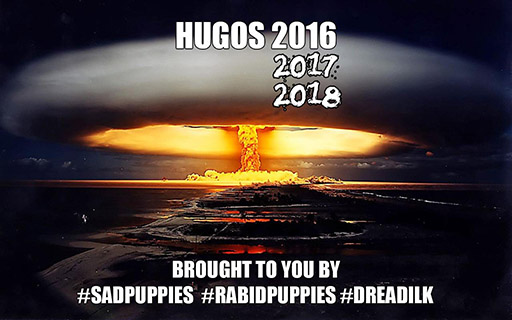
This is what victory looks like

Congratulations, Rabid Puppies! Thou hast conquered.

Last night’s Hugo Awards ceremony featured a significant first: Nora Jemisin became the first novelist in science fiction history to win three consecutive Best Novel Hugos, once for each volume in her Broken Earth trilogy (the concluding volume, The Stone Sky, won last night’s prize); in addition to the unprecedented honor, Jemisin had another first, with her acceptance speech, which may just be the best such speech in the field’s history.

Other works and creators honored last night include:

Best novella: All Systems Red, by Martha Wells (Tor.com Publishing)

Best novelette: “The Secret Life of Bots,” by Suzanne Palmer (Clarkesworld, September 2017)

Best short story: “Welcome to your Authentic Indian Experience™,” by Rebecca Roanhorse (Apex, August 2017)

Best related work: No Time to Spare: Thinking About What Matters, by Ursula K. Le Guin (Houghton Mifflin Harcourt)

Best Graphic Story: Monstress, Volume 2: The Blood, written by Marjorie M. Liu, illustrated by Sana Takeda (Image Comics)

Best Editor – Short Form: Lynne M. Thomas & Michael Damian Thomas

Best Editor – Long Form: Sheila E. Gilbert

Let’s consider the best speech in the science fiction field’s history by the greatest science fiction writer of all time.

oh um okay so I I had started developing this whole superstition where I only went Awards if I don’t show up and my friends are texting me so I can’t read my speech stop okay all right so let me get to the speech this has been a hard year hasn’t it a hard few years a hard century for some of us things have always been hard and I wrote the broken earth trilogy to speak to that struggle and what it takes to live let alone thrive in a world that seems determined to break you a world of people who constantly question your competence your relevance your very existence I get a lot of questions about where the themes of the broken earth trilogy come from I think it’s pretty obvious that I’m drawing on the human history of structural oppression as well as my feelings about this moment in American history what may be less obvious though is how much of the story derives from my feelings about science fiction and fantasy then again science fiction and fantasy are microcosms of the wider world in no way rarified from the world’s pettiness or prejudice but another thing that I tried to touch on with the broken earth trilogy is that life in a hard world is never just the struggle life is family blood and found life is those allies who prove themselves worthy by actions and not just talk life means celebrating every victory no matter how small so if I stand here before you beneath these lights I want you to remember that 2018 is also a good year this is a year in which records have been set a year in which even the most privileged blinder of us have been forced to acknowledge that the world is broken and needs fixing and that is a good thing stop texting me and that is because acknowledging the problem is the first step towards fixing it I looked at science fiction and fantasy as the aspirational Drive of the zeitgeist we creators are the engineers of possibility and as this genre finally however grudgingly acknowledges that the dreams of the marginalized matter and that all of us have a future so will go the world soon I hope fairies and yes there will be naysayers I know that I am here on this stage accepting this award for pretty much the same reason as every previous best novel winner because I work my ass off I have poured my pain onto paper when I could not afford therapy I have studied works of literature that range widely and dig deeply to learn when I could and refine my voice I have written a million words of crap and probably a million more of me and beyond that I have smiled and nodded while well-meaning magazine editors advised me to tone down my allegories and my anger I didn’t I have gritted my teeth while an established professional writer went on a 10-minute tirade at me and basically as a proxy for all black people for mentioning under-representation in the sciences I’ve kept writing even though my first novel The Killing Moon was initially rejected on the assumption that only black people would ever possibly want to read the work of a black writer I have raised my voice to talkback over fellow panelists who tried to talk over me about my own damn life I have fought myself in the little voice inside me that constantly still whispers that I should just keep my head down and shut up and let the real writers talk but this is the year in which I get to smile at all of those naysayers every single mediocre insecure wannabe who fixes their mouth to suggest that I do not belong on this stage but people like me cannot possibly have earned such an honor and that when they win its meritocracy but when we win its identity politics I get to smile at this people and lift a massive shining rocket-shaped finger in their direction I’m understand so how many of you all saw like Panther okay probably my favorite part of it is actually Kendrick Lamar theme song all the stars the chorus of it is this maybe the night that my dreams might let me know all the stars are closer let 2018 be the year that the stars came closer for all of us the stars are ours thank you

Moving. Deeply moving. (wipes a solitary tear away) You lift that massive shining rocket-shaped finger to the sky, you inspiring token for the savagely untalented! No one can ever take away those unprecedented three consecutive Best Novel Awards from you, although they’re desperately going to want to do so once they realize just how completely they have destroyed the credibility of their own awards.

You see, my dear SF-SJWs, this is what a smoking hole looks like.

A legitimate award-winning science fiction writer, Robert Silverberg, begins to grok.

I have not read the Jemison books.  Perhaps they are wonderful works of science fiction deserving of Hugos every year from now on. But in her graceless and vulgar acceptance speech last night, she insisted that she had not won because of ‘identity politics,’ and proceeded to disprove her own point by rehearsing the grievances of her people and describing her latest Hugo as a middle finger aimed at all those who had created those grievances.

But that’s what the Hugo Award is now. And that is all it is. Which is exactly what I told the Rabid Puppies would happen. Our actions could never have sufficed, but their reactions did.

South Africa schedules bad luck

This should end well for everyone in South Africa:

The South African government has begun the process of seizing land from white farmers.

Local newspaper City Press reports two game farms in the northern province of Limpopo are the first to be targeted for unilateral seizure after negotiations with the owners to purchase the properties stalled.

While the government says it intends to pay, owners Akkerland Boerdery wanted 200 million rand ($18.7 million) for the land — they’re being offered just 20 million rand ($1.87 million).

“Notice is hereby given that a terrain inspection will be held on the farms on April 5, 2018 at 10am in order to conduct an audit of the assets and a handover of the farm’s keys to the state,” a letter sent to the owners earlier this year said.

Farm seizures today, mass starvation tomorrow.

Throughout history, poverty is the normal condition of man. Advances which permit this norm to be exceeded — here and there, now and then — are the work of an extremely small minority, frequently despised, often condemned, and almost always opposed by all right-thinking people. Whenever this tiny minority is kept from creating, or (as sometimes happens) is driven out of a society, the people then slip back into abject poverty. This is known as “bad luck.
– Robert Heinlein


DARKSTREAM: Pedantry and intelligence

From the transcript of the Darkstream:

At some point in time, and I’m not sure exactly when, but some at some point in time after the early 1990s, and I don’t know exactly when it started, at some point in time, people began to act as if failing to understand the obvious was somehow a indicator of intelligence. And we see this all the time. I see it a lot myself on on the blog and so forth. I find it befuddling, you know, I don’t understand what the reasoning is. As far as I can tell, it seems to be striking a superior pose and implying that the other person cannot effectively communicate what they’re saying. I can’t really find an explanation for it that isn’t just based on pointless attention-seeking, or frankly,  an obnoxious sort of implied insult.

I find it very frustrating to deal with this sort of thing over and over and over, every time you say anything. Now I can go ahead and get as pedantic as you like, yeah, if you want to go deeply down and get very, very specific and that sort of thing, I can do that, but I don’t want to. And I especially don’t want to do it every single time I open my mouth. So there seems to be this belief that if you can somehow come up with some possible interpretation that allows you to pretend to be confused as to what the person says, this is somehow a sign of your intelligence.

It’s not. It’s a sign that you’re a jackass. It’s actually a sign that you’re not very intelligent because clearly you’re not able to understand the context. Now, I’m not saying that if you are genuinely confused that you shouldn’t ask, obviously, but the correct question is, the correct way to pose such a question is, to assume the obvious then ask to confirm that. That’s the way you do it. That’s the way intelligent people do it. I mean one of the signs of intelligence is to understand things when you’re only given partial clues. One of the reasons why C. Auguste Dupin, one of the reasons why Sherlock Holmes,  were considered to be highly intelligent detectives is because they were able to ascertain the truth from incomplete information in a way that most people couldn’t. So, if you want to demonstrate your intelligence, don’t pretend not to understand what the person is almost certainly talking about.


The myth of the Blue Wave

The wishful thinking by the enemies of the people notwithstanding, the professional pollsters are not betting on it:

Salvanto’s polling currently indicates that few House seats will change hands in November — and that the GOP could very well hold its majority in the House. “In this era, a district’s voting patterns from the past tend to stay that way,” Salvanto said. “Not as many partisans today are willing to cross party lines.” Of the nation’s 435 House districts, fully 85 percent will almost certainly stick with its current party affiliation come November, Salvanto projects….

“Right now I think this election looks like a toss-up,” Salvanto said. “We see a Democrat pickup in the House of Representatives in the 20-odd seat range, but Republicans could certainly hold on to the House.” The GOP holds a slim 43-seat House majority, with six vacancies.

“Even though Republicans have not fared well in special elections so far this cycle, it does look like they will be turning out for the midterms,” Salvanto said. “So far we do not see a large number of Republicans saying they will flip and vote for a Democrat.”

GOP voters in the past have been much more likely than Democrats to turn up and cast ballots in midterm elections, regardless of each party’s enthusiasm level ahead of Election Day.

So Democrats are literally betting the House on their ability to capture large numbers of voters who don’t normally vote in midterm elections.

I wouldn’t be at all surprised if the Republicans only lose single-digit seats. To be honest, I wouldn’t even be shocked if the GOP wound up picking up seats if the God-Emperor delivers another positive surprise or two before November.

The 2018 midterms are when the Democrats begin to understand that the 2020 Trumpslide is coming. Call the shot, sport the shirt, and demoralize them now.


A tribute to the small god

This is one of the few rock songs that I consider to be genuinely great, the perfect combination of music, voice, instruments, and lyrics. Babymetal pulled out all the stops for this performance in Hiroshima, complete with live piano and strings.

But what makes it particularly meaningful is the tribute that is paid to the late Mikio Fujioka, who is shown playing here in what is usually Leda’s place. Notice that he is first singled out just as Su begins the third verse.

Nidoto ae-nai kedo, wasure-naide itai yo.

We shall never meet again but I will never forget you.

I have to admit, I haven’t been listening to nearly as much Babymetal since I was introduced to Band-Maid. But I think you’ll admit that is excusable, considering how the girls of Band-Maid have been upping and re-upping their game. So much so that it wouldn’t be entirely shocking if Kanami was to one day appear on stage playing with the Kamis. One thing both bands have in common is that they are heavier and more energetic live than in studio.


Darkstream: Ages of Discord and America

From the transcript of the Darkstream:

I’m going to talk about Civil War 2.0 and I’m going to talk about the book Ages of Discord by Peter Turchin and what it has to do with the situation that the United States is presently facing. Now this is not a book that I would recommend to everyone, although it’s an important book, unless you’re someone who regularly reads history for fun, unless you’ve got an IQ in the 120 and up range,  this isn’t going to be the book for you. It’s an academic book it’s written in a very academic research style. The author, Peter Turchin, is very intelligent, but he is also very caught up in the mainstream narrative and so you need to be aware of that and not get too carried away by it. You know, not take it as gospel truth.

The way that it’s interesting, what’s interesting about it,  is that it gives you some new tools with which you can analyze the current situation. The thing that I thought was particularly striking about it, and what I’d liked about it, is that Turchin makes a real effort to put things in a proper historical context. He doesn’t just come up with a thesis and apply it solely, or even primarily, to the situation right now, but he also applies it to other historical situations. I believe he had a recent blog post, the one that I linked to today, where he talks about how he applied his calculations to thirty different historical situations, and that is taking a really intelligent approach to it. Instead of just saying, “well I think X is going to happen” and taking shots in the dark, what he did was he looked at the thirty historical situations and then measured their outcomes, and what he came up with should be disturbing to those who think that things are always going to work out just fine is that in ninety percent of the high-stress societal crises there was what he considers to be a negative outcome.

So what he is projecting, using his own metrics, his own tools, is a situation that he considers to be mid to high-level severity, and that ranges from serious societal disruption to full-blown civil war. Now I personally don’t subscribe to the full-blown civil war theory simply because there are no two obvious sides. I think that we’re much more likely to see a breakup and a collapse of the central government as well as the basic societal narrative rather than two discrete sides like we had with the North and the South during the U.S. Civil War of 1861-1865, but what’s particularly interesting about Turchin’s work is that it’s based on the concept of measuring societal stress.

The level of stress in the United States in 2016 was roughly comparable to the level of societal stress seen in 1860, and that’s very, very consistent with observations that you’ve seen from other students of history and military history, where it’s been said everything that’s happening in the United States – I
woud actually push that further and I would say everything that’s happening across the West – is essentially positioning for civil war.


Big Social put on notice

The God-Emperor will not stand idly by as his most loyal supporters are silenced, one by one:

President Trump on Saturday issued a tweet-storm following the removal of conspiracy theorist Alex Jones and his InfoWars shows from most major social media platforms earlier this month.

“Social Media is totally discriminating against Republican/Conservative voices,” the president wrote in the first of several tweets. “Speaking loudly and clearly for the Trump Administration, we won’t let that happen.”

The president did not indicate what steps his administration might take to prevent private companies from setting up and enforcing terms of service that have allowed them to discipline or shut down accounts for reported abuses.

Fortunately, we are informed that despite being Leftist, Twitter, at least, does not act on the basis of beliefs or political ideology.

Twitter CEO Jack Dorsey said on Saturday that he “fully admit[s]” Twitter employees share a largely left-leaning bias after facing accusations that conservatives are discriminated against on the social media platform. In an interview that aired Saturday on CNN, Dorsey said his company has a responsibility to be open about its political viewpoints, but to operate without bias when applying content policies to users.

“We need to constantly show that we are not adding our own bias, which I fully admit is…is more left-leaning,” Dorsey says. “But the real question behind the question is, are we doing something according to political ideology or viewpoints? And we are not. Period,” he added.

Dorsey went on to insist that his company only polices behavior on the platform, not content.

Well, that’s certainly nice to know, Jack. So when can I expect my Twitter account to be restored?


The greatest generals

An interesting experiment in applying WAR to war. Which is to say, Wins Above Replacement:

Among all generals, Napoleon had the highest WAR (16.679) by a large margin. In fact, the next highest performer, Julius Caesar (7.445 WAR), had less than half the WAR accumulated by Napoleon across his battles. Napoleon benefited from the large number of battles in which he led forces. Among his 43 listed battles, he won 38 and lost only 5. Napoleon overcame difficult odds in 17 of his victories, and commanded at a disadvantage in all 5 of his losses. No other general came close to Napoleon in total battles. While Napoleon commanded forces in 43 battles, the next most prolific general was Robert E. Lee, with 27 battles (the average battle count was 1.5). Napoleon’s large battle count allowed him more opportunities to demonstrate his tactical prowess. Alexander the Great, despite winning all 9 of his battles, accumulated fewer WAR largely because of his shorter and less prolific career.

However, outside of Napoleon’s outlying success, the generals’ WARs largely adhere to a normal distribution. This suggests his success is attributable to command talent, rather than an anomaly in the model’s findings. In fact, Napoleon’s total WAR was nearly 23 standard deviations above the mean WAR accumulated by generals in the dataset.

There were also generals that had surprisingly low total WAR despite a reputation as master tacticians. Robert E. Lee, commander of the Confederate States Army, finished with a negative WAR (-1.89), suggesting an average general would have had more success than Lee leading the Confederacy’s armies. Lee was saddled with considerable disadvantages, including a large deficit in the size of his military and available resources. Still, his reputation as an adept tactician is likely undeserved, and his WAR supports the historians who have criticized his overall strategy and handling of key battles, such as ordering the disastrous ‘Pickett’s Charge’ on the last day of the Battle of Gettysburg. In the words of University of South Carolina professor Thomas Connely, “One ponders whether the South may not have fared better had it possessed no Robert E. Lee.”

German field marshal Erwin Rommel, nicknamed the ‘Desert Fox’ for his successes in North Africa during World War II, also performed poorly in this model, finishing with -1.953 WAR. This finding disputes the praise Rommel has received as a tactician from modern generals, including Norman Schwarzkopf and Ariel Sharon. However, like Lee, Rommel has been the subject of considerable historical debate. In particular, critics have attributed much of his reputation as a tactical genius to both German and Allied propaganda. British generals reportedly exaggerated Rommel’s tactical abilities in order to minimize disapproval regarding their defeats.

Modern generals performed relatively poorly in the model. American general George S. Patton, described by historian Terry Brighton as “among the greatest generals of [World War II],” accumulated only .9 WAR. The failure of modern generals to perform well in WAR may be attributable to changes in warfare which have prevented individual generals from participating in a large number of battles.

Among post-World War II generals, Israeli commanders stood out. Israeli military leader Moshe Dayan finished with 2.109 WAR (60th overall), an impressive amount for a modern general but relatively modest compared to pre-20th Century tacticians. Similarly, former Israeli Prime Minister Ariel Sharon accumulated 2.171 WAR (58th overall) for his battlefield successes in the Suez Crisis, Six-Day War, and Yom Kippur War.

It’s more an entertaining experiment than a serious statistical analysis, but I suspect the incredible tactical success it assigns to Napoleon is much more reflective of the French general’s strategic brilliance than anything else. In like manner, the Israeli generals appear to be overrated due to the low quality of their opposition; if I recall correctly, it was Dayan himself who said that the key to his military success was the fact that he was fighting Arabs.

Napoleon, on the other hand, fought the military creme de la creme of Europe, was often outnumbered, and usually won anyhow. But when you analyse his career, it tends to be his strategic actions that are the more striking and decisive.