Mr. Denninger is not optimistic

So much for Mr. Bernanke’s magic printing press:

Now we’re really in trouble:

The ECB failed to auction the €55bn in fixed term deposits it had planned to, and what it did auction (€31.86bn) was at a much-higher rate (0.54 per cent) than what it offered at the start of its Securities Markets Programme (SMP). The market seems to be holding tight to liquidity.

The wall has been hit.

This is a clear warning to the money-printing screamers (of which there are many adherents) and the “we can do this without impacting aggregates” crowd (commonly known as Central Banks with God complexes.) Sadly, as I have repeatedly pointed out, all Ponzi Schemes fail, and they fail at the most inopportune time, after you have spent the proceeds of your previous scamming and thus lack the ability to deal with the failure to sell your latest batch of whatever it is you’re attempting to do.

Oh, and by the way, it gets better. Much better.

See, the ECB has a rollover problem coming, in that they need to roll a significant amount of term liquidity deposits Thursday. If those rolls fail, the markets will crash. Both credit and equity.

As I have repeatedly paraphrased Bob Prechter, the problem with the Whiskey Zulu scenario is that neither Europe nor the USA have a paper money system. The debt money system requires that each new note find a borrower. But when the limits of demand for debt are reached, it’s not possible to continue to issuing more money. Furthermore, most money is created through the fractional reserve banking system, not the central bank, and creating that money also requires a constantly growing demand for credit.

Now, it’s true, the national governments could convert to a paper money system and this is one of the legitimate possibilities, but they cannot possibly do so fast enough to avoid a period of deflationary crash, especially when the politicians who would be responsible for the switch would have to brave the wrath of the financial powers who would be ruined by such a move.

Which is why it’s not going to happen. My best guess is that Plan A was another attempt to solve the problem through more centralization; devaluing the current currencies as they are converted to a regional or global currency. However, given that the global public is already furious with the banking establishment, this probably isn’t viable now. The stimulus plans were supposed to work well enough to give them time to smoothly transition to the next stage of monetary harmonization, but due to their reliance on a bad economic model, that obviously hasn’t happened.

Interesting times indeed.

Mailvox: And yet they wonder….

JH writes what I am apparently supposed to regard as what passes for a rebuttal to yesterday’s WND column. The amazing thing is that there will be people who genuinely regard this as not only a coherent reply, but a decisive one:

If men are so much more moral than women, why is it that 96% of the people in jail in the U.S. are male? And are you really suggesting that men self-sacrifice more than women? Have you ever known a mother? One last thing: when I was in the 5th grade, my teacher informed me that “boys are just smarter at math” and that was the reason there were only boys in the accelerated math group in my class. There was no testing – that would’ve been too fair – she had just picked 3 boys that she thought were “smart at math.” All of us have to deal with bad attitudes in our lives at some time; it’s not just boys. Did someone just break up with you?

First, I never claimed that men are more moral than women. Second, even if I had, JH is confusing legality with morality. Yes, I really do believe that men are more self-sacrificing than women; how many female Medal of Honor winners are there? How many women have ever been known to act by the motto “men and children first”? It pains me to have to point out the obvious, but most women who are mothers very much want to be mothers. Self-sacrifice is about sacrificing your desires, not fulfilling them, and it is no more inherently self-sacrificing for the average woman to be a mother than it is for the average man who enjoys the clean lines of the unadorned female form to contribute to the college fund of a young, sartorially-challenged woman.

And since I attempt to make it my habit to answer even the most ridiculous questions, yes, I have been acquainted with the occasional mother. I did not, as it is often held, spring fully armored from the black helmet of Darth Vader. But we have to thank JH for not only demonstrating my point about women and logic with her deeply compelling tale of her fifth grade math class which apparently overturns decades of standardized math tests, but also the way in which few women are capable of considering an issue without making it personal. But no, no one broke up with me, I am not bitter about anything except last season’s NFC championship game, and I am totally indifferent your willingness or unwillingness to perform sexually for me.


Above the law

Apparently the big banks aren’t just too big to fail, they’re too big to be prosecuted for breaking all of those invasive laws that require you to turn over fingerprint, blood, and DNA samples in order to open a checking account or buy a cell phone, just in case you might be a Mexican money launderer:

Oh, so the banks don’t just bilk investors and rip off municipalities, they also help Mexican Gangs run drugs?

This was no isolated incident. Wachovia, it turns out, had made a habit of helping move money for Mexican drug smugglers. Wells Fargo & Co., which bought Wachovia in 2008, has admitted in court that its unit failed to monitor and report suspected money laundering by narcotics traffickers — including the cash used to buy four planes that shipped a total of 22 tons of cocaine. The admission came in an agreement that Charlotte, North Carolina-based Wachovia struck with federal prosecutors in March, and it sheds light on the largely undocumented role of U.S. banks in contributing to the violent drug trade that has convulsed Mexico for the past four years.

That’s nice. Guns and ammunition cost money – lots of it. Getting that money requires some means of transporting it and “laundering” it. For that, we turn to the largest financial institutions in the world, who, it turns out, have never been prosecuted for these felonious acts.

This is the salient quote: “No big U.S. bank — Wells Fargo included — has ever been indicted for violating the Bank Secrecy Act or any other federal law. Instead, the Justice Department settles criminal charges by using deferred-prosecution agreements, in which a bank pays a fine and promises not to break the law again.”

It is completely obvious that there is no longer any rule of law in the USA. There increasingly isn’t even any pretense at it. It is no longer a republic, but a financial aristocracy divided into a thousand corporate fiefdoms. Given human nature, how long can it be before the executives begin granting themselves titles like the Archduke of Wells Fargo and the Grand Count of Google?


Demographic decline

The pace of American decline and fall picks up:

An analysis of census data by the Pew Research Center, being released Friday, documents the changes in fertility rates that are driving government projections that U.S. minorities will become the majority by midcentury. The figures show that among all women ages 40-44, about 18 percent, or 1.9 million, were childless in 2008. That’s up from 10 percent, or nearly 580,000 in 1976. Broken down by race, roughly 20 percent of white women are childless, compared with 17 percent of blacks and of Hispanics and 16 percent of Asians.

20 percent of white American women are childless, and 28 percent of the children who are born to them are illegitimate. Assuming an equal distribution of childbirths among women who have children for simplicity’s sake, this suggests that white American women have around a 42% probability of being either childless or a single mother. And since both the childless and illegitimacy rates are rising rapidly, it’s probably more like a one-in-two chance for the average young woman today.

Needless to say, that is not the hallmark of a self-sustaining society. Unfortunately, there have been no winners in the long-running American war against men, and it is children who have been the biggest losers. And from the economic perspective, these demographic patterns strengthen the probability of debt-default, as children who were never born, fatherless criminals, and immigrants of non-Western heritage are not likely to be willing to pay for the massive debts incurred by aging white people.


Guns are an individual right

So saith the Supreme Court:

OKAY, having quickly skimmed the McDonald opinion, a few thoughts.

First, it’s 5-4. Though a pro-gun-rights opinion may pacify the gun-rights crowd to a degree, the closeness of these decisions is likely to keep them active in upcoming elections.

Second, it shows how little influence legal academics have. Virtually all of us have been saying that Slaughter House is lousy and that privileges and immunities should be far more significant, but only Justice Thomas was willing to go that far.

Third, it really is interesting how much emphasis the majority, and Justice Thomas’s concurrence, put on the racist roots of gun control. See this article and this one by Bob Cottrol and Ray Diamond for more background. And isn’t it interesting that this is happening on the same day the Senate’s last Klansman went to his reward?

On the one hand, I am all for whatever puts more guns in the hands of individuals. Or tactical nukes, for that matter. I will never understand why people who understand the many and manifest evils of the DMV think that only government employees should have weapons of mass destruction. Today’s decision didn’t go nearly far enough to return the many laws of the land on the matter to a reasonably Constitutional state.

On the other, I am opposed to increased federalization even in a good cause. Although since the States haven’t been sovereign since the political debate was settled by mass slaughter, I suppose it’s a bit late to worry about that now. And since the federal government isn’t about to stop ruling over the state and local governments with an iron hand, this is a better decision than the most likely alternative.

And much respect to the liberal law professors whose intellectual integrity played a major role in this case. Remember them when you find yourself tempted to think all liberals are inconsistent and hypocritical charlatans. Integrity and honesty are not part of the political spectrum.


One year on, Krugman concedes

“Due to the sizeable bear market rally that began in March 2009, many, if not most, economic observers are presently convinced that the global economic difficulties of last autumn are largely behind us now, courtesy of the aggressive, expansionary actions of the monetary and political authorities. They are wrong. It is not over. It has only begun. I believe that what we have witnessed to date is merely the first act in what will eventually be recognized as another Great Depression.”
– Vox Day, The Return of the Great Depression, June 29, 2009

“We are now, I fear, in the early stages of a third depression. It will probably look more like the Long Depression than the much more severe Great Depression. But the cost — to the world economy and, above all, to the millions of lives blighted by the absence of jobs — will nonetheless be immense.”
– Paul Krugman, The Third Depression, June 28, 2010

It looks like my predictions are running a little ahead of schedule again. RGD readers will recall that I didn’t have the mainstream economists starting to whisper about the possibility of a Great Depression 2.0 until the end of 2010. This is supposed to be the time for talking Double-Dip and W-shaped Recovery. But then, Krugman has always been rather more dyspeptic than the rest of his colleagues. I await with interest for all of those who said that my forecast was incorrect because I dared to contradict a FAMOUS ACADEMIC and NOBEL-PRIZE WINNER to explain this mysterious failure of credentialism.

Krugman is wrong about the historical use of the term depression, of course, (depression was synonymous with recession until after the Great Depression ended), just as he is wrong about the reason the global economy is sliding further into contraction. Fame and credentials are no substitute for the knowledge of history combined with a reliable theoretical model. Longtime readers who are investors may recall that my 2002 recommendation to buy gold and avoid real estate has worked out just a little better than Krugman’s 2002 recommendation to buy real estate and avoid gold.


WND column

Winning the War Against Men

There is a relentless war being waged against American men that literally spans the entire extent of their lives. From the womb, in which a woman’s “right” to abort a male baby for being male is defended but a similar right to abort a female baby for being female is vehemently opposed, to the grave, wherein the disparate impact of old age is ignored despite women living 5.2 years longer than men on the average, men are systematically, structurally and unstintingly under assault.

Most men understand this on some level, but like the nice dependable man who can’t figure out why attractive women repeatedly reject him in favor of unemployed losers with criminal records, they are incapable of doing anything about it because they simply can’t believe that women truly do not think or behave like men. Because they want to believe that women are “the civilizing force,” their “better halves” or “the fair sex,” they are constitutionally incapable of seeing what is, from a rational male perspective, the seething cauldron of amoral solipsism behind the collective pretty face.


Alpha disease

The divergent rate with which venereal disease affects the sexes is evidence in support of the Game perspective in which larger numbers of women are attracted to a smaller group of men:

About 16 percent of Americans between the ages of 14 and 49 are infected with genital herpes, making it one of the most common sexually transmitted diseases, U.S. health officials said on Tuesday… women were nearly twice likely as men to be infected, according to an analysis by the U.S. Centers for Disease Control and Prevention. About 21 percent of women were infected with genital herpes, compared to only 11.5 percent of men.

I wouldn’t trust the politically correct explanations attempting to explain away the gargantuan difference in black and white infection rates. Of course, as with illegitimate births, we can expect the white infection rate to eventually rise to approach the black level as white society increasingly mimics matriarchal black society.


That was a goal!

Great game between England and Germany, well-worth the overwrought build-up. Germany is slashing through the English defense, but England was brutally robbed of a very clear goal by Lampard that was remniscent of the 1966 game-winner. I didn’t expect England to give Germany this much of a game, but it’s a really good one although without a solid performance by David James Germany would be leading 4-2… assuming that FIFA would stop disallowing goals scored.

More about the first round games later. The US loss was disappointing, but they played okay and Ghana well-merited the win.


The Atlanta Journal/Constitution of Econ

It’s illuminating to see what small readerships are possessed by the most popular economics blogs. Because I read Mike Shedlock and Calculated Risk, I always assumed that a number of the long list of blogs on their blogrolls were similarly well patronized. But apparently that’s not so much the case, although the omission of sites like Karl Denninger’s Market Ticker indicates that around half of the bigger fish are missing from this survey. But if EconDirectory’s list of top economics blogs is to be trusted, then this would appear to be the 11th most trafficked economics-related blog, in between #10 VoxEU’s 12,405 daily pageviews and #11 TaxProfs 8,041. It’s the same when it comes to visits, although if one adds the 1,400 feed readers – this is one of the few blogs to provide full-text feeds that negate the need to come here to read the posts – that would bump VP up to #9.

This is both scary and heartening. It’s scary, because if even the most popular econ blog only attracts 56k daily readers, it’s not hard to understand the level of economic ignorance on the part of the elite and the electorate alike. And it’s heartening, because this indicates it is feasible to reach a substantial percentage of the people who are sufficiently interested in the subject to follow it.

While we’re on the subject, it’s interesting to note that the Wall Street Journal has finally begun to wake up to the intellectual bankruptcy of the Neo-Keynesian response to the initial stages of the Great Depression 2.0:

Today’s G-20 meeting has been advertised as a showdown between the U.S. and Europe over more spending “stimulus,” and so it is. But the larger story is the end of the neo-Keynesian economic moment, and perhaps the start of a healthier policy turn. For going on three years, the developed world’s economic policy has been dominated by the revival of the old idea that vast amounts of public spending could prevent deflation, cure a recession, and ignite a new era of government-led prosperity. It hasn’t turned out that way….

Like many bad ideas, the current Keynesian revival began under George W. Bush. Larry Summers, then a private economist, told Congress that a “timely, targeted and temporary” spending program of $150 billion was urgently needed to boost consumer “demand.” Democrats who had retaken Congress adopted the idea—they love an excuse to spend—and the politically tapped-out Mr. Bush went along with $168 billion in spending and one-time tax rebates.

The cash did produce a statistical blip in GDP growth in mid-2008, but it didn’t stop the financial panic and second phase of recession. So enter Stimulus II, with Mr. Summers again leading the intellectual charge, this time as President Obama’s adviser and this time suggesting upwards of $500 billion. When Congress was done two months later, in February 2009, the amount was $862 billion. A pair of White House economists famously promised that this spending would keep the unemployment rate below 8%. Seventeen months later, and despite historically easy monetary policy for that entire period, the jobless rate is still 9.7%….

The response at the White House and among Congressional leaders has been . . . Stimulus III. While talking about the need for “fiscal discipline” some time in the future, President Obama wants more spending today to again boost “demand.” Thirty months after Mr. Summers won his first victory, we are back at the same policy stand.

RGD readers may recall that I predicted not only the failure of Stimulus II, but the failures of Stimuli III and IV as well. I expect they’ll finally give up on the fruitless endeavor sometime between V and VII. The problem, which even the new-found Neo-Keynesian skeptics don’t understand, is that these failed stimulus packages not only haven’t worked, but they are going to exacerbate the next phase of the contraction that is even now gathering steam. Although they appear to have a glimmer of concern in that regard; consider how the WSJ is ineptly attempting to construct an ex post facto cover for its backside.

“With the economy in recession in 2008 and 2009, we argued that some stimulus was justified and an increase in the deficit was understandable and inevitable. However, we also argued that permanent tax cuts aimed at marginal individual and corporate tax rates would have done far more to revive animal spirits, and in our view would have led to a far more robust recovery.”

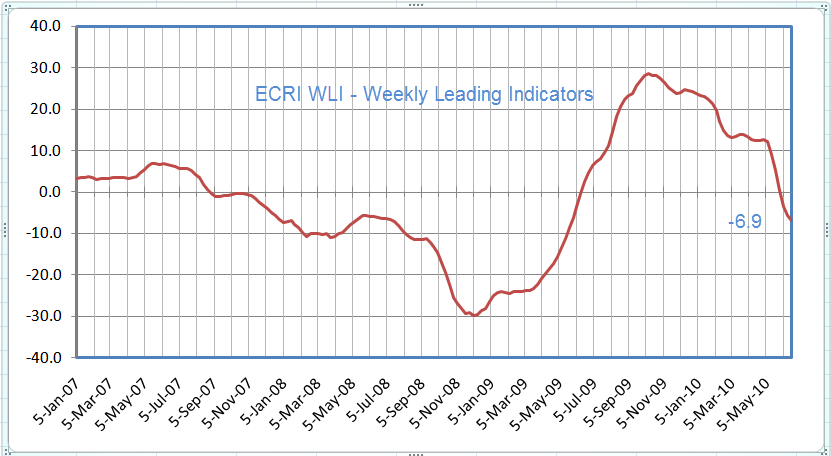
In other words, the WSJ still subscribes to the very economic idiocy they are describing as a dead end. It’s not that the magical incantation doesn’t work, it merely wasn’t chanted in precisely the correct manner prescribed in the Keynesian grimoire. This means that we can confidently expect the decision-making elite to continue digging and making the hole deeper as the situation worsens. Note that the average weekly leading indicators are now at -6.9, a decline last seen in July 2008.