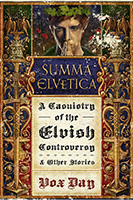
 Marcher Lord’s preorder page for the forthcoming hardcover edition of Summa Elvetica: A Casuistry of the Elvish Controversy is now live. You can preorder the ~450-page book for $17.99, which is a discount from the retail price of $24.99. As I mentioned before, those preordering will also receive a free ebook copy of The Last Witchking. The preorder offer will be available until April 30th.
Category: Uncategorized
The War on You

I suspect a connection
Ed Trimnell observes that not only are atheists far more inclined to attack Christianity than Islam, but some are even willing to publicly declare that Islam should be off-limits to atheist criticism:
“It seems that a writer at Salon.com is upset because the so-called “New Atheists” have been rather unkind to Islam of late. In a piece entitled “Dawkins, Harris, Hitchens: New Atheists flirt with Islamophobia” Nathan Lean suggests that these New Atheists should simply shut up about terrorism, sharia courts ordering death sentences for apostates, and honor killings in the Muslim world. Then they can go back to doing what atheists in the post-modern West are supposed to do: talk about the threat that evangelical Christianity poses to humanity. (After all, some of those hillbilly reactionary Christians still haven’t fully embraced same-sex marriage!)”
I suspect that this sort of thing might have something to do with the atheist hypocrisy:
“Hundreds of thousands of people have held protests in Bangladesh to
demand that the government introduce an anti-blasphemy law that would
include the death penalty for bloggers who insult Islam…. Supporters of Hefazat-e-Islam, an Islamist group which draws support
from tens of thousands of religious seminaries [and that has the backing
of country’s largest party, Jamaat-e-Islami], converged on Dhaka’s main
commercial hub to protest against what they said were blasphemous
writings by atheist bloggers, shouting “God is great — hang the atheist
bloggers”.”
Apparently the old chestnut about there being no atheists in foxholes isn’t all that far from the truth. Christians are holding to their faith even as they are murdered for it by Muslims in Nigeria and Egypt and by atheists in China and North Korea. Atheists, meanwhile, are showing that they don’t have the courage of their lack of conviction, thus proving my point that post-Christianity in the West is unlikely to look any different than post-Christianity in the Middle East.
A post-Christian West will be pagan, not secular. It will be in the form of dark gods like Santa Muerte and Damballah Wedo, and it will be rooted in death and cruelty. It should be recalled that whereas there never was any medieval “Dark Ages”, there is a very good reason why Jesus Christ was considered “the Light of the World” by civilized and scholarly men who were familiar with the darkness of pagan cultures that preceded Christian society. Merely having to compete with that Christian society considerably improved paganism, as even Julian the Apostate implicitly admitted in his futile attempt to build a paganism capable of rivaling it.
“Julian’s heart was set on a civil and religious reformation. He longed for amendment in law and administration, above all for a remodelling of the old cult and the winning of converts to the cause of the gods. He himself was to be the head of the new state church of Paganism; the hierarchy of the Christians was to be adopted — the country priests subordinated to the high priest of the province, the high priest to be responsible to the Emperor, the pontifex maximus. A new spirit was to inspire the Pagan clergy; the priest himself was to be no longer a mere performer of public rites, let him take up the work of preacher, expound the deeper sense which underlay the old mythology and be at once shepherd of souls and an ensample to his flock in holy living. What Maximin Daza had attempted to achieve in ruder fashion by forged acts of Pilate, Julian’s writings against the Galilaeans should effect: as Maximin had bidden cities ask what they would of his royal bounty, did they but petition that the Christians might be removed from their midst, so Julian was ready to assist and favour towns which were loyal to the old faith. Maximin had created a new priesthood recruited from men who had won distinction in public careers. his dream had been to fashion an organisation which might successfully withstand the Christian clergy; here too Julian was his disciple.
“When pest and famine had desolated the Roman East in Maximia’s days, the helpfulness and liberality of Christians towards the starving and the plague-stricken had forced men to confess that true piety and religion had made their home with the persecuted heretics: it was Julian’s will that Paganism should boast its public charity and that an all-embracing service of humanity should be reasserted as a vital part of the ancient creed. If only the worshippers of the gods of Hellas were once quickened with a spiritual enthusiasm, the lost ground would be recovered. It was indeed to this call that Paganism could not respond. There were men who clung to the old belief, but theirs was no longer a victorious faith, for the fire had died upon the altar. Resignation to Christian intolerance was bitter, but the passion which inspires martyrs was nowhere to be found. Julian made converts — the Christian writers mournfully testify to their numbers —but he made them by imperial gold, by promises of advancement or fear of dismissal. They were not the stuff of which missionaries could be fashonied. The citizens were disappointed of their pageants, while the royal enthusiast found his hopes to be illusions. Mutual embitterment was the natural result.”
– The Cambridge Medieval History Vol. I, pp 362-363
That was 1,650 years ago. There is truly nothing new under the sun. Even today, we see “the passion which inspires martyrs was nowhere to be found.” The reason Richard Dawkins’s attempt to set up an atheist charity will ultimately be no more successful than the Emperor Julian’s efforts is because the Christian customs they seek to imitate are not inspired and encouraged for their own sake, but by the particular religious impulse. Both history and observation clearly indicate that it is no more possible to maintain the tenets and various aspects of Christian civilization considered desirable by non-Christians without the Christian faith to support them than it is to maintain intellectual function without a beating heart.
Such efforts can be maintained, for a short time, by extraordinary artificial measures. But they will fail soon enough. And then the true nature of pagan darkness will reveal itself again.
A review of The Wardog’s Coin
Jonathan Moeller, Pulp Writer, reviews The Wardog’s Coin:
Last year, I read A THRONE OF BONES by Vox Day, and thought it was one of the more interesting new epic fantasy novels I’ve read. The author was kind enough to send me an advance copy of THE WARDOG’S COIN, a pair of short stories set in THRONE’s setting of Selenoth – specifically THE WARDOG’S COIN and QALABI DAWN.
In THE WARDOG’S COIN, the protagonist is the sergeant in a human mercenary company fighting for an elven kingdom against a horde of goblins and orcs. (The story’s name comes from the coin necklace each of the mercenaries bears – they act as sort of a dog tag.) What is supposed to be an easy assignment quickly turns into a death trap once the mercenaries realize the orcs are far more formidable than they expected – and that the elves are not unduly concerned if their hirelings survive or not. The mercenaries’ only hope of survival is through an audacious and risky plan. THE WARDOG’S COIN reminded me a great deal of Glen Cook’s better BLACK COMPANY books, and also had some moments of surprising hilarity – the sergeant’s attempt to get a recalcitrant pig to move is one of them. I did not care for the sergeant’s dialect (it reminded me of the farmer’s final monologue in HP Lovecraft’s THE COLOUR OUT OF SPACE, alas), but that was only a minor flaw in an otherwise good story.
The first story was good, but I think the second, QALABI DAWN, was more interesting…. I rather liked the depiction of the cat-people – their perspectives were truly alien, which is a hard trick for a writer to pull off.
This is just an excerpt, so be sure to read the entire review at Jonathan’s site. In related news, I am pleased to announce that Marcher Lord Hinterlands will be publishing the hardcover version of Summa Elvetica: A Casuistry of the Elvish Controversy, in May. The book will be priced at $24.99 and will be approximately 450 pages, as it will not only include the short novel, (modestly updated for the purposes of harmonization with A Throne of Bones), but eight other stories set in Selenoth.
The stories included are: “A Magic Broken”, “The Wardog’s Coin”, “Qalabi Dawn”, “Master of Cats”, “Birth of an Order”, “The Last Witchking”, “The Hoblets of Wiccam Fensboro”, and “Opera Vita Aeterna”.
Those who wish to preorder from Marcher Lord can do so at a price of $17.99. Preorders will also come with a free ebook copy of The Last Witchking, which will be published in May at a price of $1.99; please specify if your preference is epub or mobi. The Last Witchking will consist of the title story and the two other stories not previously available in ebook format.
RIP Margaret Thatcher
The Iron Lady is dead at 87:
Baroness Thatcher, Britain’s first woman prime minster, has died after suffering a stroke at the age of 87. Her children Mark and Carol Thatcher announced that their mother Baroness had died peacefully following a stroke this morning.
I had the privilege of meeting her once. In my youth, I considered her a great and courageous leader of a nation in decline. I now consider her to be one of history’s tragic figures, who through naïvety and an inclination to take words at face value, betrayed the country she loved and sold its sovereignty for nothing more than empty economic promises. In light of how the European Common Market has finally revealed itself to be the fascistic, anti-democratic union the skeptics always believed it would become, one will read few sadder words in an autobiography of a world leader than these:
“We had to learn the hard way that by agreement to what were
apparently empty generalizations or vague aspirations we were later held
to have committed ourselves to political structures which were contrary
to our interests.”
– Lady Margaret Thatcher, “The Downing Street Years”
Dr. Sean Gabb, a UK libertarian, has more on Thatcher’s legacy, which is considerably different than you will likely glean from the conservative paeans you will be seeing in the Republican media today.
Inflation vs Deflation IX
Nate begins the eighth installment in the series by getting some things factually incorrect. To begin with, Z1 did not begin to decline in July 2008, as it peaked at $52.9 trillion in Q1 2009, a figure it did not reach again until Q3 2011, when it hit $53.8 trillion. 2008 merely served as the warning sign, as total credit growth ceased to keep pace with its 60-year historical rate, thus triggering two quarters of 10 percent growth in the federal debt sector in the latter part of the year. Gold and silver prices certainly did rise during that time, as did the stock market, but this was the result of the near-unprecedented increase in federal spending which was taking place at that time; even as the Household and Financial sectors contracted, the Federal sector expanded by $3.3 trillion.
Merely that Federal expansion, you will note, is considerably greater than the increase in savings over the same period. In fact, it is $1.2 trillion more than the total amount of extant currency plus demand deposits. And note that the government economists appear to have been keenly aware of the warning provided by the debt disinflation, (which you may recall was characterized as the “credit crunch” at the time), as the massive increase in government borrowing preceded the actual debt deflation by three quarters.
As Mises and others have remarked, inflation does not affect every sector of the economy at once. That is the whole reason it is desired by certain economic actors; they expect to benefit disproportionately from being able to spend less expensive money at its previous value. Nate’s tangent into malinvestment isn’t completely irrelevant, as real estate was certainly one of the primary areas of malinvestment, along with the health care and higher education sectors, but isn’t of particular importance because my case is not dependent upon housing prices. I have merely pointed it out because it shows that the inflation, despite massive reinflationary efforts, hasn’t been enough to counteract four years of ongoing credit contraction across the economy.
Nate is looking at Z1 – or to be more precise, L1 – as a whole rather than in its component parts. This is not unreasonable, but unless one looks at the component parts, one cannot understand the importance or the consequences of the shift in the nature of the credit market that has seen the federal element double from 10.3 percent of the entire credit market to the current 20.6 percent.
What Nate sees as evidence of inflation, the modestly higher prices in the gold, silver, and equity markets, is largely limited to the areas of direct federal intervention. This is why health care and higher education prices are still rising to new heights, while real estate prices are struggling to get back to where they were. The areas that are reaching new heights are where the outstanding $11.6 trillion in government credit is flowing. That is where the malinvestment is still being directed.
I will not dig further into Nate’s answers. I don’t know the answer to them either, the point was to direct attention to what Nate sees as significant, which is the total amount of savings and the cash in the various banks. What Cyprus should have sufficed to demonstrate was that the greater part of the “savings” he cites do not exist in any material capacity except as debt claims. As has been repeatedly pointed out here, deposits are legally defined as debts owed by the bank to the depositor and therefore qualify as credit money even before they are subsequently loaned out, and “multiplied”.
Now, Nate concludes with citing the 56 recorded historical incidents of hyperinflation. It is true that hyperinflation is possible within a nominal credit money system, (especially in the broader sense in which Mises and I question the existence of true fiat money), but that is not to say that all credit money systems are created alike.
I note that each of these hyperinflationary scenarios were very short-lived and tended to be closely tied to serious political upheaval. The longest period is two years, which happened twice in China during the 1940s. Note, however, that these hyperinflations tended to take place AFTER the wars or major political upheavals; the frequency with which they take place after independence is gained by a nation is reminiscent of the high inflation that plagued the American colonial currencies and the Continental Dollar. If any hyperinflation were to take place, history suggests it would likely take place after the collapse and political chaos; it would be a result of it, not a cause.
What Nate omits to mention is that there have been even more sovereign defaults, which he concedes are deflationary, than hyperinflations since the first hyperinflation on his list took place in 1919.
Nate is correct to say that one must be careful not to mistake “can’t” with “won’t”. But his flight analogy fails, because I am not claiming that something must be lighter than air to fly in defiance of the 56 airplanes soaring overhead, but rather, pointing to a particular vehicle, constructed from empty shipping containers and bound together with string, chewing gum, and tefillin straps, watching the pilot repeatedly taxi up and down the tarmac, and expressing my doubts that it is going to take flight.
We have seen massive increases in virtual every monetary measure. We have been told to expect considerably inflation. And yet, we are still not seeing a rise in general prices concomitant with the size of the expansion. Ben and Mario are monetizing the debt like mad. Kuroda is acting even more aggressively. To the extent their efforts to expand the limited amount of inflation they have created in the financial markets and move money out of the bank reserves and into the general economy have failed, the situation appears to be more “can’t” than “won’t”.
Remember, it’s not enough to merely print the money. The amount printed and distributed has to be greater than the continuing contraction of private credit and the evaporation of bank deposits. And keep in mind that the combined $4.2 trillion decline in outstanding Household and Financial sector credit since 2009 alone exceeds, by a factor of nearly four, the ENTIRE AMOUNT of U.S. currency presently in circulation.
The amount of credit outstanding is simply too great for helicopter dropping of actual cash and coins to be able to compensate for much of it. And simply flipping an electronic switch and adding a zero to everyone’s bank account isn’t going to change anything at all because the entire financial system depends upon inflation working its way gradually through it.
Nate is correct to note that people are becoming increasingly drawn to holding cash in the hand, but he is forgetting that when cash becomes more valuable in this manner, it is strongly indicative of a deflationary environment, not an inflationary one. In an inflationary environment, one wants to take on more debt and hold less cash. In a deflationary environment, one wants to avoid debt and hold more cash. The intellectual gymnastics notwithstanding, one’s true position on this matter can be ascertained by one’s material preferences and actions.
“In fact, a money that is continually depreciating becomes useless even for cash transactions. Everybody attempts to minimize his cash reserves, which are a source of continual loss. Incoming money is spent as quickly as possible, and in the purchases that are made in order to obtain goods with a stable value in place of the depreciating money even higher prices will be agreed to than would otherwise be in accordance with market conditions at the time. When commodities that are not needed at all or at least not at the moment are purchased in order to avoid the holding of notes, then the process of extrusion of the notes from use as a general medium of exchange has already begun. It is the beginning of the ‘demonetization’ of the notes.”
– Mises, The Theory of Money and Credit, p. 227
Debt is cash
We’re not talking monetary theory anymore. We’re talking actual government wages:
“”The Portuguese government is considering a plan to pay
public workers and pensioners one month of their salary in treasury
bills rather than cash after a high court ruled out wage cuts, a person
familiar with the situation said Sunday.
“This is one of the ideas being considered,” the person said.
By paying one month of salary in T-bills to public workers and
pensioners, the government would save an estimated €1.1 billion in
expenses, narrowing the budget gap significantly.”Incidentally, this plan makes perfect sense: with every central bank
openly monetizing its debt, it has effectively made debt and cash
equivalent.
Things are rapidly getting very weird in the economic sense. Cyprus. Ireland. Portugal. And having driven away its high-income earners, France is showing signs of attempting to expand its tax reach beyond its borders. Paul Krugman is praising capital controls.
And, as Karl Denninger points out, it probably won’t be long before the federal government uses the insolvency of the state and local pension plans to make a play for seizing all those luscious, previously untaxed assets in millions of retirement plans.
Education is important
But degrees, particularly advanced degrees, are increasingly less so thanks to the magic of technology and the Law of Supply and Demand. Dr. Helen points us to Slate:
I deeply regret going to graduate school, but not, Ron Rosenbaum, because my doctorate ruined books and made me obnoxious. (Granted, maybe it did: My dissertation involved subjecting the work of Franz Kafka to first-order logic.) No, I now realize graduate school was a terrible idea because the full-time, tenure-track literature professorship is extinct. After four years of trying, I’ve finally gotten it through my thick head that I will not get a job—and if you go to graduate school, neither will you.
You might think your circumstances will be different. So did I. There’s a little fable from Kafka, appropriately called “A Little Fable,” that speaks to why this was very stupid:
“Alas,” said the mouse, “the world gets smaller every day. At first it was so wide that I ran along and was happy to see walls appearing to my right and left, but these high walls converged so quickly that I’m already in the last room, and there in the corner is the trap into which I must run.”
“But you’ve only got to run the other way,” said the cat, and ate it.
The mouse wasn’t going in the wrong direction so much as it was walking cat food the entire time. A graduate career is just like this, only worse, because “A Little Fable” lasts three sentences and is made up, while graduate school lasts at least six years and will ruin your life in a very real way.
Staying in school in order to avoid facing the economic environment isn’t merely cowardly, it is self-defeating. It shouldn’t be as hard as it seems to be for people with 16+ years of “education” to figure out that the more there is of something, the less everyone else tends to value it. And just because a decision made sense in your parents’ day, or your grandparents’ day, doesn’t mean that it still makes sense now.
The frightening thing is that far from learning from all the warnings, young Americans are going ever more heavily into student loan debt.
Educated White Woman: the VIP credit card
I’ve been thinking of a way to explain to educated white women how life works for them, without invoking the dreaded phrase “female imperative” to which they react like vampires being slipped into a Hervé Léger bandage dress woven from silver thread. It’s not that the concept of “female imperative” is incorrect, it’s that it’s not their word. When confronted with “female imperative” they point their fingers and shriek “misogynist”, start crying about how they were once near-raped in college, then threaten not to have sex with anyone in the near vicinity.
So, the challenge: how to get across the ideas bound up in the word “privilege,” in a way that your average educated white woman will get, without freaking out about it?
Ladies. Imagine life here in the US — or indeed, pretty much anywhere in the Western world — is a massive department store, like Macy’s or Saks. Let’s call it The Real World. You have entered The Real World and are about to start shopping, but first you go have to decide what credit card you are going to use while you are shopping. Got it?
Okay: In the department store known as The Real World, Educated White Woman is the VIP credit card. It is an American Express Centurion card with an unlimited credit limit.
This means that almost all the employees in the store are more deferential to you than they would be to anyone else. They carry your bags for you. The prices are lower and you’re given discounts without even asking for them. You don’t have to stand in line at the register. You are simply given entry to some departments that others have to wait to get into, or are simply denied access. The store is easier to walk through, automatically, you don’t have to wait for a changing room, and when you need help, by default it’s easier to get.
Now, once you’ve chosen the “Educated White Woman” card, you still have to decide how much you’re going to spend, and on what you’re going to spend it, and that will make a difference. If you only spend $250, and you spend it all on a big-screen TV as soon as you walk in the store, well, then you may be kind of screwed. If you spend $2,500 on earrings in the jewelry department, well, then you’re probably fine.
As your shopping trip progresses, your object is to buy stuff, figure out a way to carry it, and move on to the next department. If you spend all your time trying on swimsuits, or choose poorly and buy bulky things you can’t easily carry, then you probably won’t end up with much. But because you’re shopping with the “Educated White Woman” card, buying things and bypassing the lines at the register will still by default be easier for you, all other things being equal, than for another shopper using a less elite card.
Likewise, it’s certainly possible someone shopping with a lesser card is buying more, and more valuable, stuff than you are, because they know where everything is, or they are the perfect size 4, or they have an employee discount, or simply because they don’t spend half an hour dithering over every decision. It doesn’t change the fact you are still shopping with the VIP card.
You can end up buying nothing with the VIP card, but the VIP card still lets you buy more, and better, stuff than anyone else can possibly buy. The shopper who chose the “Straight White Male” card? That’s not even a proper credit card, that’s a Sam’s Club membership! If Straight White Male gets caught in the lingerie department trying on a pretty little thong, they’re not going to sell it to him, they’re going to call security.
And maybe at this point you say, hey, I’m not greedy, I don’t want a massive credit card bill at the end of the month and I don’t need any special treatment, I can make do with a regular VISA or Mastercard with a sensible limit. Well, here’s the thing: In The Real World, you don’t ever have to pay off your balance! And you only get to shop there once. So why not make the most of it while you’re there? Your goal is to get as much of the best stuff as you can, not economize.
Oh, and one other thing. Remember when I said that you could choose what credit card you use in The Real World? Well, I lied. In fact, the store chooses what card you’re going to get when you walk in. You don’t get a choice; you just get the card given to you at the start of the game, and then you have to deal with it.
So that’s “Educated White Woman” for you in The Real World (and also, in the real world): The ultimate VIP treatment. All things being equal, and even when they are not, if the department store — or life — assigns you the “Educated White Woman” card, then sister, you’ve caught a break.
Of course, there is just one little problem with the “Educated White Woman” card. It expires and you never know exactly when. Just be sure that you’re done with your shopping before the employees start ignoring you, you have to stand in line at the registers, and no one is willing to carry your bags for you anymore.
Evolution raciss
I always find it amusing when people have fainting fits over my references to various human sub-species, when, as Steve Sailer demonstrates, that is precisely the conclusion reached by Mr. Charles Darwin himself. Not only did Darwin never doubt that, to him, the question was whether Man was divided into various subspecies or entirely different and distinct species. Note that Darwin reached his conclusions without the benefit of the DNA evidence which has demonstrated that humans are genetically divided into different sub-species.
We will first consider the arguments which may be advanced in favour of classing the races of man as distinct species, and then the arguments on the other side. If a naturalist, who had never before seen a Negro, Hottentot, Australian, or Mongolian, were to compare them, he would at once perceive that they differed in a multitude of characters, some of slight and some of considerable importance. On enquiry he would find that they were adapted to live under widely different climates, and that they differed somewhat in bodily constitution and mental disposition. If he were then told that hundreds of similar specimens could be brought from the same countries, he would assuredly declare that they were as good species as many to which he had been in the habit of affixing specific names. This conclusion would be greatly strengthened as soon as he had ascertained that these forms had all retained the same character for many centuries; and that negroes, apparently identical with existing negroes, had lived at least 4000 years ago.* He would also hear, on the authority of an excellent observer, Dr. Lund,*(2) that the human skulls found in the caves of Brazil entombed with many extinct mammals, belonged to the same type as that now prevailing throughout the American continent.
Our naturalist would then perhaps turn to geographical distribution, and he would probably declare that those forms must be distinct species, which differ not only in appearance, but are fitted for hot, as well as damp or dry countries, and for the arctic regions. He might appeal to the fact that no species in the group next to man- namely, the Quadrumana, can resist a low temperature, or any considerable change of climate; and that the species which come nearest to man have never been reared to maturity, even under the temperate climate of Europe. He would be deeply impressed with the fact, first noticed by Agassiz,* that the different races of man are distributed over the world in the same zoological provinces, as those inhabited by undoubtedly distinct species and genera of mammals. This is manifestly the case with the Australian, Mongolian, and Negro races of man; in a less well-marked manner with the Hottentots; but plainly with the Papuans and Malays, who are separated, as Mr. Wallace has shewn, by nearly the same line which divides the great Malayan and Australian zoological provinces. The aborigines of America range throughout the continent; and this at first appears opposed to the above rule, for most of the productions of the Southern and Northern halves differ widely: yet some few living forms, as the opossum, range from the one into the other, as did formerly some of the gigantic Edentata. The Esquimaux, like other arctic animals, extend round the whole polar regions. It should be observed that the amount of difference between the mammals of the several zoological provinces does not correspond with the degree of separation between the latter; so that it can hardly be considered as an anomaly that the Negro differs more, and the American much less from the other races of man, than do the mammals of the African and American continents from the mammals of the other provinces. Man, it may be added, does not appear to have aboriginally inhabited any oceanic island; and in this respect, he resembles the other members of his class. …