Diversity and the law

It will be interesting to see if the left-wing gay activists who are so enthusiastic about diversity and immigration will stop to rethink their enthusiasm in light of a series of new laws in various African countries:

Nigerian authorities today began arresting gay men after legislation was
quietly approved criminalising homosexuality and imposing prison terms up to
14 years for breaking the new law. Several gay couples were taken into custody in the country’s majority-Muslim
north, and rights groups feared that others would be targeted across the
West African country.

Goodluck Jonathan, Nigeria’s president, signed the Same Sex Marriage
Prohibition Act into law on January 7, but there was no public report of the
new law until journalists obtained a copy of the act on Monday. It prohibits homosexuals from even meeting in groups of two or more, bans
marriage or civil unions between people of the same sex, and criminalises
gay clubs and events.


Reuben Abati, the presidential spokesman, said Nigerians were happy with the
new law. It makes Nigeria the 38th African nation to enact legislation
persecuting gay people.

This is obviously wonderful news for left-liberals around the world, since as we all know, increased government intervention is an inevitable indication of social progress. And given the increased number of Africans in the USA, obviously it will be important for Americans to respect their cultural mores by permitting them to arrest any homosexuals who offend them.

It would, of course, be racist, xenophobic, and cultural imperialist to suggest that the newfound American enthusiasm for legal buggery should be forced upon Africans. I find it amazing to observe that 38 countries across Africa alone have criminalized homosexuality. It’s not something one often hears the American media mention despite their interminable sob stories about the Dark Continent.

Ten years ago, I would have seen such a law as an outrage. Not something to justify foreign intervention, you understand, but still, it would have been an outrage to my libertarian sensibilities. However, after seeing the increasingly fascist behavior of the gay rights activists, I’m not only indifferent towards Nigeria’s actions, but fully expecting similar laws to start taking effect in the West once the current Washington-Brussels axis collapses. After all, we’re already seeing them start to surface in Russia and Eastern Europe.

In an age of global communications, it’s simply not possible to make the same deceptive arguments over and over again. Other countries see what has happened in the USA and elsewhere and they don’t wish to experience the same consequences. “Some have suggested Nigeria’s
new law and a proposed one in Uganda were a backlash to Western pressure for
gay rights.”

From Big Government Republicans to drag queens, everyone feeling their political oats always seems to forget that social mood is a pendulum. But one of the best ways one can predict what is likely to happen in the future is to observe whose pendulum appears to be closest to peaking.


Mailvox: the distribution of atheist intelligence

As some of you have probably noted by now, I am not inclined to suffer fools gladly. And the fools I am least inclined to suffer are those who are prone to smugly offer erroneous corrections. Now, I have repeatedly pointed out that the small average atheist IQ advantage is small in comparison with the much larger number of highly intelligent theists and that most atheists have sub-100 IQs. These are all facts, easily verified by examining the GSS datafile.

Nevertheless, this did not prevent CLK from leaping in and attempting to correct me:

Now the unknown here is what is the data that you got #1 from —and
what does the distributions look like. The only way your statement #3
could possibly correct is if the two distributions are shaped
differently and the atheist one is much wider and shewed severely to a
low IQ .. which would seem very very unlikely… Its likely that
variance of the distribution of intellegence of theists will match the
general population variance and that the distribution of the atheists
will be in fact a subset of the theists….I do apologize for getting in the middle of the private conversation …
and for being right.. I will try to be less right in the future. 🙂

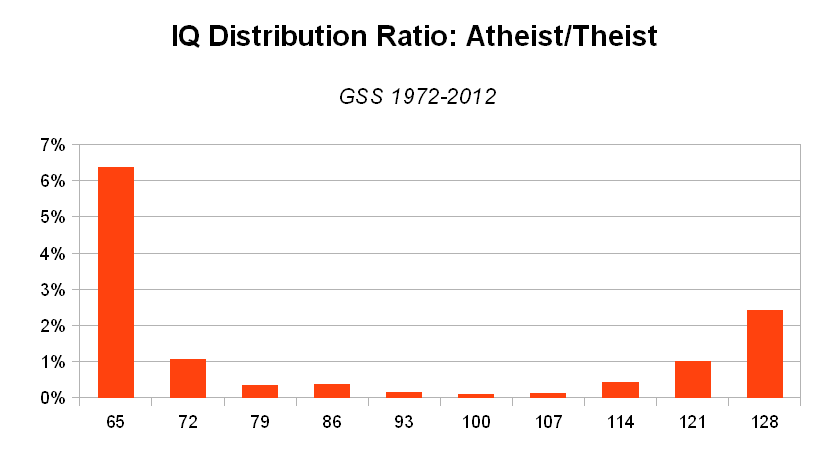
To which all the response needed is this graphic, taken from the latest 2012 General Social Survey and combined with the WORDSUM/IQ conversion table calculated by the estimable Aoli Pera. There is the explanation for the nonexistent dichotomy that CLK identified. The distributions are not only dissimilar, they are very nearly opposites. And note that as I predicted, the peak number of theists is precisely at 100 IQ.

As you can see, the two most common types of atheists are the High Church atheists with +2SD IQs (128+) and Low Church atheists with -2SD IQs (65-72). Note that the Low Church atheists actually outnumber the High Church atheists, 22.9 to 17.2 percent. This will surprise no one who has read TIA; as I noted there, we can observe a similar phenomenon at work in the Democratic Party membership.

Now, the statistically naive might look at this chart, note that the +2SD theists only account for 3.5 percent of the theistic population, and assume that this means there are more highly intelligent atheists than highly intelligent theists. This is not the case. As it happens, there are 11.4x more +2SD theists who either know God exists or believe God exists despite having the occasional doubt than there are +2SD atheists who don’t believe God exists.

The bad news for theists is that the overall number of those who know that God exists has declined from 63.8 to 62.6 percent from 2008. However, the number of those who believe, but are less certain has stayed the same. Interestingly enough, the increase in the agnostics (no way to know) and the spiritualists (higher power), has outpaced the increase in the number of atheists, with the spiritualists gaining the most, increasing from 8.1 percent of the populace to 8.8 percent. I’m not sure that’s quite what the anti-woo campaigners had in mind. Regardless, the chart below should put into perspective how mostly irrelevant atheists are to the population at large as it shows the percentage of atheists at the 10 different IQ levels in comparison to the most fervent categories of believers.

My guess is that most of the atheist trolls we see here from time to time are in the midwitted 114-121 category. In any event, I would think that most commenters here would understand by now that I don’t write anything here without having some evidential basis for it. I’m not saying that I’m always right, because that’s not the case. But I am saying that if you detect an apparent contradiction in what I’ve written, it would probably be a good idea to verify your assumptions before leaping in to correct me.

UPDATE: This amused me while playing around with the GSS. Of the dumbest strata of college graduates, nearly half, 46 percent, are atheists. That’s twice as many as all types of theists combined. We finally have an explanation for the Richard Dawkins fans.


Vikings hire Mike Zimmer

I’m cautiously optimistic about the hiring of Zimmer, which is more than I can say for every hire since Denny Green was hired after turning around Stanford. The proof is in the pudding, but hiring an experienced and respected defensive coordinator, who produced top 10 defenses three years in a row, is a big step forward for a franchise that hired third-rate coaches like Mike Tice and Brad Childress in succession. Dallas fans still miss him; he had the top defense in the league with them and they haven’t had one since.

Leslie Frazier might be a second-rate coach; jury is still out on him since his two primary problems were a) being too conservative, and b) Christian Ponder. He had to go, no question, but I’m not convinced he can’t be a successful head coach in the NFL if he learns from his failure with the Vikings. See: Bill Belichick.

When the whole coaching carousel kicked off, my preferences were Whisenhunt, followed by Zimmer. So, I’m pleased that the Vikings hired one of the sane candidates. And the fact that they didn’t hire Jim Caldwell AND get the benefit of playing against a Caldwell-coached team twice a year, is a bonus.


The 10 blocks of immigration

Paul Collier has an excellent article in the New Statesman summarizing what should be the beginning point for any rational discussion on immigration. And you will note that NONE of the points of evidence are in harmony with the assumptions that are taken for granted by most pro-immigrationists, whereas many of them are in-line with anti-immigration policies.

Block 1 Around 40 per cent of the population of
poor countries say that they would emigrate if they could. There is
evidence that suggests this figure is not a wild exaggeration of how
people would behave. If migration happened on anything approaching this
scale, the host societies would suffer substantial reductions in living
standards. Hence, in attractive countries, immigration controls are
essential.

Block 2 Diasporas accelerate migration. By
“diasporas”, I mean those immigrants and their descendants who have
retained strong links with their home societies, rather than cutting
loose and integrating into their host societies. These links cut the
costs of migration and so fuel it. As a result, while diasporas are
growing, migration is accelerating. Diasporas continue to increase until
immigration is matched by the rate at which immigrants and their
offspring are absorbed into the general population. A crucial
implication of this interconnection is that the policies for migration
and diasporas must be compatible.

Block 3 Most immigrants prefer to retain their own
culture and hence to cluster together. This reduces the speed at which
diasporas are absorbed into the general population. The slower the rate
at which they are absorbed, the lower the rate of immigration that is
compatible with stable diasporas and migration. By design, absorption is
slower with multicultural policies than with assimilative policies.

Block 4 Migration from poor countries to rich ones
is driven by the wide gap in income between them. This gap is the moral
horror story of our times. The difference in incomes is ultimately due
to differences in political and social structures: poor countries have
political and social systems that are less functional than those in rich
ones. Their dysfunctional systems persist in part because they are
embedded in the identities and narratives of local cultures. Migrants
are escaping the consequences of their systems but usually bring their
culture with them.

Block 5 In economic terms, migrants are the
principal beneficiaries of migration but many suffer a wrenching
psychological shock. As far as can be judged from the net effect on
happiness, the economic gains and psychological costs broadly offset
each other, although the evidence on this is currently sketchy.

Block 6 Because migration is costly, migrants are
not among the poorest people in their home countries. The effect on
those left behind depends ultimately on whether emigrants speed
political and social change back home or slow it down. A modest rate of
emigration, as experienced by China and India, helps, especially if many
migrants return home. However, an exodus of the young and skilled – as
suffered by Haiti, for example – causes a haemorrhage that traps the
society in poverty.

Block 7 In high-income societies, the effect of
immigration on the average incomes of the indigenous population is
trivial. Economies are not damaged by immigration; nor do they need it.
The distributional effects can be more substantial but they depend on
the composition of immigration. In Australia, which permits only the immigration of the skilled, the
working classes probably gain from having more skilled people to work
with. In Europe, which attracts many low-skilled migrants, the
indigenous poor probably lose out through competition for social
housing, welfare, training and work. The clearest effect on the jobs
market is that new migrants compete with existing migrants, who would
consequently be substantial beneficiaries of tighter controls.

Block 8 The social effects of immigration outweigh
the economic, so they should be the main criteria for policy. These
effects come from diversity. Diversity increases variety and this
widening of choices and horizons is a social gain. Yet diversity also potentially jeopardises co-operation and
generosity. Co-operation rests on co-ordination games that support both
the provision of public goods and myriad socially enforced conventions.
Generosity rests on a widespread sense of mutual regard that supports
welfare systems. Both public goods and welfare systems benefit the
indigenous poor, which means they are the group most at risk of loss. As
diversity increases, the additional benefits of variety get smaller,
whereas the risks to co-operation and generosity get greater. Each host
society has an ideal level of diversity and hence an ideal size of
diasporas.

Block 9 The control of immigration is a human
right. The group instinct to defend territory is common throughout the
animal kingdom; it is likely to be even more fundamental than the
individual right to property. The right to control immigration is
asserted by all societies. You do not have the automatic right to move
to Kuwait; nor do the Chinese have the automatic right to move to
Angola, although millions would if they could. Nor do Bangladeshis have
the automatic right to move to Britain and claim a share of its social
and economic capital. It sometimes makes sense to grant the right to migrate on a
reciprocal basis. Thousands of French people want to live in Britain,
while thousands of Britons want to live in France. Yet if flows become
too unbalanced, rights derived from mutual advantage can be withdrawn:
Australia, for instance, withdrew them from Britain. The expansion of
the EU has created these unbalanced situations and the original
reciprocal right may therefore need modification.

Block 10 Migration is not an inevitable consequence
of globalisation. The vast expansion in trade and capital flows among
developed countries has coincided with a decline in migration between
them.

Block 8 is partially incorrect, and even that quasi-error is mitigated by the fact that Collier points out that while the “widening of choices and horizons is a social gain”, diversity itself is not. Block 7, of course, is completely wrong, as evidenced by American post-1973 wage stagnation.

The biggest falsehood concerning immigration is that it is good for the economy. I’ll address this in a future post, but the TL;DR version can be understood by simply comparing GDP and immigration rates from 1900 to 2010.


The Fifth Horseman 3

In which responses to two more of the 16 anti-apologetics offered in Peter Boghossian’s A Manual to Creating Atheists are provided. The juxtaposition of the two anti-apologetics is particularly effective, as it illustrates the intrinsic lack of integrity, indeed, one should say the lack of good faith, of the Street Epistemologist.

ANTI-APOLOGETIC #1 

FAITH IS TRUE

“Why is there something rather than nothing? You have faith that there was no Creator.”

“Bear in mind that an atheist believes that all these miraculous coincidences took place by chance. But he doesn’t just believe that man and woman came into being without a Creator, but that all of creation did—amazing flowers, massive trees, succulent fruits, beautiful birds, the animal kingdom, the sea, fish, natural laws, etc. His faith is much greater than mine.”
—Ray Comfort, You Can Lead an Atheist to Evidence, but You Can’t Make Him Think (2009, p. 2)

This is the best argument I’ve heard for the existence of God. It’s the trump card played by believers. However, it doesn’t work.

There are several related ways to respond to why there’s something rather than nothing: “Why assume nothing is the default?” This is a question that has no answer. As prolific German philosopher Adolf Grünbaum states, “Why be astonished at being at all? To marvel at existence is to assume that nothingness is somehow more natural, more restful. But why? The ancients started with matter, not the void; perhaps nothingness is stranger than being” (Holt, 2012).

Similarly, “How do you know the universe didn’t always exist?” Even if appeals are made to the Big Bang, one can never know either that reality is one endless time loop with Big Bangs strung together for eternity, or that à la American theoretical physicist Brian Greene, we’re part of a larger multiverse with an infinite number of Big Bangs constantly occurring.

Why isn’t there nothing rather than something? On what basis can one claim nothing is the default position for existence? Couldn’t something be the default position, with nothing being the truly extraordinary thing? And even if we do accept by fiat, given our limited knowledge, that something rather than nothing is extraordinary, does that give license to make up answers as to why this is the case? It begs the question: is it better to pretend we know an answer to something we don’t actually know, or is it better to simply be honest and say, “I don’t know?”

The possibility that the universe always existed cannot be ruled out. This by definition casts doubt on a creator. No faith is needed to posit that the universe may have always existed.

The quality of Peter Boghossian’s education can be easily summarized by pointing out that of all the various intellectual arguments concerning God’s existence that have been concocted by Christendom over the centuries, the best one that he has ever heard was presented by Ray Comfort. This isn’t merely embarrassing for him, it should be so humiliating for him that he never again opines in public on the subject.

VD RESPONSE: Why assume nothing is the default? Because Scripture, Science, and Reason all point to nothing having preceded the universe as we presently observe and experience it. How do I know the universe didn’t always exist? Because Fred Hoyle’s Steady-State Universe theory, which was inspired by a freaking B-grade British horror movie, is contradicted by the theory of general relativity, the discovery of cosmic microwave background radiation, Hubble’s observation that the universe was expanding, and both the First and Second Laws of Thermodynamics, just to name a few things. You might as reasonably believe in a magic perpetual motion machine as an eternal universe.

As for your appeal to the multiverse hypothesis, if you are going to insist upon an infinite number of universes, then you must admit that at least one of those universes would have to contain a Creator God, in which case the evidence suggests that this happens to be that particular universe. Even if we are assured that in none of them does Sheldon dance.

As to WHY there is something rather than nothing, that is irrelevant. This is not a question of why, it is a question of what. Do you believe that the Earth is older than 6,000 years old? Then you cannot appeal to the current scientific consensus that calculates the age of the Earth to be 4.54 ± 0.05 billion years while simultaneously rejecting its calculation that the age of the Universe is 13.798±0.037 billion years.

The possibility that the universe has always existed was ruled out by scientists decades ago. It is true that no faith is needed to posit that the universe has always existed, just as no faith is needed to posit that you are a clown made out of candy. But you have to be a science denier to claim that either of those things are a legitimate possibility in this particular universe. Now, are you really prepared to deny science and declare your disbelief in what Newton, Einstein, Hawking, and Hubble, just to name a few, have established scientifically?

Or do you have faith in those men and their conclusions? Because I know, I am not merely “pretending to know”, that you don’t understand the math involved.

ANTI-APOLOGETIC #13

Defense: “Much of modern science and practical mathematics is based upon mere ‘native preference,’ not on any rational proof. Faith is the same.”

Response: “Science has a built-in corrective mechanism that faith does not have. There’s been convergence across all fields of science on virtually all scientific theories since the eighteenth century. At any point in the future, do you ever think there will be convergence on specific faith propositions? I don’t, because those propositions are arbitrary.”

VD RESPONSE: You attacked science by denigrating its consensus concerning the age of the universe and now you’re appealing to it? Why, I find myself beginning to doubt your integrity and your intellectual honesty! And your statement is false: science does not have a built-in corrective mechanism. As Thomas Kuhn demonstrated, scientists work within paradigmatic assumptions that they do not question and the so-called “corrective mechanism” to which you appeal is no different than it is in accounting or any other human activity where sufficient divergence from observed reality eventually tends to draw someone’s attention. Including, you will note, organized religion.

As for your question about convergence on specific faith propositions, you are quite clearly wrong. We have already observed what you claim to be impossible. History shows a considerable degree of convergence on specific faith propositions; 2,000 years ago, there were a plethora of pagan religions and only 11 Christian apostles. Now most of those pagan religions are defunct and there are 2.2 billion Christians around the world, accounting for more than one-quarter of the global population. In fact, the Bible itself describes the process of this inevitable convergence. One day EVERY knee shall bow, and one day EVERY tongue will confess that Jesus Christ is Lord.

Including yours. You can do it now. Or you can do it later. But you will do it.

PREVIOUS IN THE SERIES: The Fifth Horseman 2


Getting away with murder

Even on the rare occasions the police are ever charged with murder after killing someone, they get away with it:

Two California police officers who were videotaped in a violent struggle
with a homeless man during an arrest were acquitted Monday of killing
him. It was a rare case in which police officers were charged in a death involving actions on duty….

The video began with Ramos stopping Thomas on July 5, 2011, after the
officer answered a call about a disheveled man jiggling the handles of
car doors in a busy transit center parking lot. Ramos grew frustrated with Thomas, who wasn’t following orders to sit on a curb with his hands on his knees.

Just before the altercation began, Ramos snapped on plastic gloves, made
two fists and then held them in front of Thomas’ face as he said, “Now
see these fists? They’re going to (expletive) you up.”

Cicinelli, who arrived a few moments later, jolted Thomas several times
with an electric stun gun and used the butt end to hit Thomas in the
head and face, breaking bones.

Thomas was taken off life support five days later.

Well, that settles it. If the police are involved, you will get no justice from the legal system. It’s not as if this is a one-time event. It is dangerous to even call the police for help.

A Boiling Springs Lakes, North Carolina family is looking for answers
after local police shot and killed their mentally ill teenage son while
responding to a call for help….Wilsey said
that Vidal had been subdued until the third officer walked in and
the boy became agitated.

“Then all of a sudden, this Southport cop came, walked in the
house [and said]: ‘I don’t have time for this. Tase him. Let’s
get him out of here,'” Wilsey told NBC. After the stun gun
was used on Vidal, Wilsey said the third officer shot him, saying
he was protecting his officers.

“He reached right up, shot this kid point-blank, with all
intent to kill,” Wilsey added. “He just murdered him
flat out.”

It is increasingly looking as if the police in America have declared war on the mentally disturbed.


Optimistic

It would appear that Spengler, for one, has been listening to the Learned Elders of Wye. His article makes it appear as if the precious golden geese who have healed America with prosperity are in the early stages of preparing to take flight once more. David Goldman has what strikes me as a remarkably optimistic article on how much the Chinese like and admire the Jews because they have so much in common.

There is no greater compliment to any culture than to be admired by Chinese, who with some justification regard their civilization as the
world’s most ancient and, in the long run, most successful. The high
regard that the Chinese have for Jews should be a source of pride to the
latter. In fact, it is very pleasant indeed for a Jew to spend time in
China. The sad history of Jew-hatred has left scars on every European
nation, but it is entirely absent in the world’s largest country. On the
contrary, to the extent that Chinese people know something of the Jews,
their response to us is instinctively sympathetic.

“I am always surprised by the expressions of affection that the
Chinese show for the Jews. Both cultures, the Chinese emphasize, share
respect for family, learning and, yes, money,” wrote the journalist
Clarissa Sebag-Montefiore last year. ‘”Most Chinese will think Jews are
smart, clever or good at making money, and that they have achieved a
great deal,’ Professor Xu Xin, director of the Institute of Jewish
Studies at Nanjing University (one of over half a dozen centers in China
dedicated to studying Judaism) told me last week,” she wrote. “This
logic — that the Jews are admired for their success despite their small
numbers and historical oppression — has also led to a burgeoning
industry of self-help books that use Jewish culture and the Talmud to
preach business tips.”

Family, learning, respect for tradition, business acumen: these are
Jewish traits that the Chinese also consider to be their virtues. All
this is true as far as it goes. One might also mention that China never
has had reason to view the Jews as competitors for legitimacy.

Christianity began as a Jewish sect and has vacillated between the
claim that is has superseded Judaism and the view that it is a daughter
religion that should honor its parent. Islam claims that Jews and
Christians falsified the revelations given to them and that their
scriptures are a perversion of God’s true message, which Mohammed
restored to its original integrity. But by no stretch of the imagination
could China view the Jews as a threat to the legitimacy of its
civilization.

The Chinese, in short, have no reasons to dislike or fear the Jews,
and a number of reasons to admire them simply because Jews display
traits that Chinese admire among themselves.

Now, it’s possible that Goldman is correct. I’m an East Asian Studies major, I’m not Chinese. Perhaps the Chinese will welcome the Jewish people with more or less open arms the way the American people did following the large-scale Jewish retreat from the European continent. On the other hand, there is also the possibility that the Chinese will look at the historical track record of the Jewish people, see what they have done to the United States of America during the post-WWII period, and view them as a parasitical threat.

Perhaps Goldman doesn’t view the financial rape of the USA or the fact that China is sitting on $1.304 trillion in U.S. Treasury bonds that could be rendered worthless overnight as a reason for the Chinese to dislike or fear the Jews, but I am a little less sanguine on the prospect. I also think Goldman underestimates the ruthlessness of the Chinese in matters tribal and nepotistic.

The survival strategy that worked so well in the Middle Ages, where the Jews would be expelled from a country, then quietly return until they were banished once more, doesn’t seem likely to work quite as well in an age of global communication. Hitler’s complaints about the Jews sounded entirely mad to Americans. They sound mad, and manufactured, even today. But in the event of the sort of economic catastrophe and political breakdown that so concerns the Elders of Wye, I tend to suspect the Chinese will take the accusations of President Dwayne Elizondo Mountain Dew Herbert
Camacho a little more seriously.

Especially considering that the Chinese would like nothing better than to see a US political breakdown that would free them to claim the regional supremacy and world leadership they believe to be their civilizational birthright. I agree with Goldman that China does not view the Jews as a threat to the legitimacy of its
civilization; my understanding is that the Chinese already view them as a rival.


The scientific benefits of faith

Tangentially related to the day’s earlier post comes this news that there are material differences between the brains of religious individuals and those of the irreligious:

They say religion is a matter of the heart – but it seems the shape of our brains could also have a role to play. Believers or those with a spiritual side have ‘thicker’ sections of brain tissue than other people, a study suggests. And in welcome news for the faithful, the researchers think that this thickening could also help to stave off depression.

‘Our beliefs and our moods are reflected in our brain and with new imaging techniques we can begin to see this,’ Dr Myrna Weissman, a professor of psychiatry and epidemiology at Columbia University, told Reuters Health.

As I mentioned in the previous comments, I think it might be informative to see a study done on the frontal lobes of atheists. My scientific hypothesis, based on the observation that adult atheists tend to exhibit a variety of reasoning patterns more commonly observed in teenagers, is that the brains of atheists will show signs of their frontal lobes not being fully developed.

And before you deny the science, keep in mind that not one, but two scientific studies at two different universities have already found evidence supporting my hypothesis concerning a connection between mild forms of autism and atheism. It looks increasingly likely that Sam Harris’s attempt to bring neuroscience into religious matters is going to backfire on atheists in a big way.

But this should have been obvious from the start, as who is more likely to be aneurotypical, a small and poorly behaved minority or the overwhelming majority? As economists have learned over the last 80 years, Sigmund Freud’s ideas are a very poor basis upon which to build one’s scientific hypotheses.

Of course, it’s entirely possible that Mr. Harris’s frontal lobes are, at least in part, to blame for his inability to correctly reason through the probable connection between brain development and religious belief, assuming that there is one in the first place.

UPDATE: Gara complained that I didn’t mention the fact that atheists have higher average IQs than theists. So, I’m rectifying that by quoting myself on the subject of superior average atheist intelligence:

“I have readily conceded that religious individuals are less intelligent on average than non-believers in general and atheists in particular for years.  However, what the midwits who get very excited about this
statistical fact never seem to keep in mind is that because there are so
many more religious people, there are considerably more highly
intelligent religious people than there are highly intelligent
non-believers.

In fact, the ratio of theists to atheists with Mensa+ level IQs is more than 10 to one.”


The Fifth Horseman 2

I finished Peter Boghossian’s A Manual for Creating Atheists yesterday. Needless to say, it did not succeed in creating one. In fact, I suspect Dominic, TGM, and some of the other intelligent atheists here will tend to be mildly embarrassed by it, in much the same way that intelligent Christians are embarrassed by a Kirk Cameron attempt at apologetics. The difference is that Cameron means well, while Boghossian is, quite literally, the sort of person who will kick out a crutch from under a cripple’s arm because he doesn’t believe the individual is truly crippled. Nor will he likely apologize when he learns, after the fact, that he was wrong.

It is readily observable that Boghossian almost certainly ranks higher on the Aspie scale, or whatever they are calling it these days, than Sam Harris or even Richard Dawkins. He’s simply clueless about what (silence) in a conversation means, inevitably assuming that what the dialogue tends to indicate means: (I can’t talk to this idiot, he’s hopeless) is actually: (oh my goodness, I am struck dumb by the irrefutable reasoning of your beautiful mind). And that is giving Boggie the benefit of the doubt and assuming that he is accurately recalling the dialogues rather than inventing them out of whole cloth.

The funniest part of the book is without question the following conversation with his father. I have a strong suspicion that his father regards Boghossian with mixed embarrassment and pride, the latter over his minor celebrity, the former over the fact that Boggie is the picture of what Bruce Charlton describes as a clever silly.

(Not that these particular sillies are especially clever. The second funniest part of the book comes in the Introduction by the ever-hapless John Loftus:“I thanked God for everything, from getting me into the Christian-based Pepperdine University (my grades and SAT scores were unspectacular) to finding a parking place at theaters and restaurants.”)

Unspectacular grades, mediocre SATs, and barely getting into a third-rate university. And these guys are constantly appealing to their intelligence? But back to the two Boghossians and the book’s best dialogue:

When I told my father that K–12 educational systems should promote the value of epistemological rigor, he replied incredulously, “Are you kidding me? High school dropout rates are hovering around 33 percent in most [U.S.] cities. We can’t even teach kids how to read. What makes you think we’d be any more successful with instilling ‘epistemological rigor?’”

Whether or not we can be successful in helping people see value in epistemological rigor is an empirical question. I have my own speculation that this can be accomplished through pop culture—for example, comic books and TV shows for children that personify new heroes, Epistemic Knights, and new villains, Faith Monsters.

Didn’t even slow him down. Yes, it is an empirical question, but the point that Boghossian the Younger simply ignores is that the question has been answered! As you can see, we’re not exactly dealing with a godless genius here.

Boghossian the Elder made precisely the same point that I have repeatedly made concerning the teaching of evolution in the public schools. Both the evangelical evolutionists and Boghossian the Younger are so removed from reality that they are not only wrong, they are making a fundamental category error. How are the children at schools like this one in Queens, where the children have no books, going to develop epistemological vigor even if they spend all day watching what sounds like a bad version of Captain Planet? The total impossibility of the task is only underlined as one reads the book, as one observes that even though the younger Boghossian values the idea of epistemological rigor, he does not actually practice it.

The entire book reads rather like it was written by Otto from A Fish Called Wanda. Aristotle was not Belgian. The definition of faith is not “pretending to know things you don’t know”. The central message of Scepticism is not “Ecrasez l’infame”. More than one argument for the existence of God has withstood scrutiny and many of them have done so for centuries. I should very much like to see Boghossian personally attempt to address my preferred argumentum e maleficus; it would be certain to provide an amount of hilarity.

In any event, now that I’ve read the manual, I’m not going to go through it on a page by page basis because most of my posts would consist of long quotes followed by short one- or two-word summaries: “exhortation” and “naked assertion”. Instead, I’m will begin with critiquing each of the 17 tactical anti-apologetics he presents, after which I will address certain other aspects of the book when I am finished with it. If there are specific sections or assertions you would like to see me address in a post, please download the book from the readily available torrent Pirate Bay and let me know. Even if you are an IP enthusiast, you can do so in good conscience, as Boghossian writes in Chapter 9:

“To prevent doxastic closure it’s also important to read the work of noted apologists. The only two I’d suggest are Alvin Plantinga and William Lane Craig, though I’d urge you not to buy their books; their projects don’t need your support.”

It is entirely possible that Boghossian not familiar with The Irrational Atheist, but even if he was, I am confident he would not recommend reading it to prevent doxastic closure because TIA is exactly the sort of thing that Boghossian recommends his Street Epistemologists avoid at all costs: the questioning of atheist assumptions and the criticism of their arguments. The Manual may be intended to be inoffensive, but it is all offense and offers very little in the way of anticipated defense. And therein, as I will demonstrate in this series of posts, lies the tactical Christian response.

Since this has already been a long post, I will begin with one of the shorter anti-apologetics from Chapter 7:

ANTI-APOLOGETIC #12


Defense: “Atheism is just another religion. You have faith in atheism.”

Response: “Atheism is a conclusion one comes to as a result of being rational and honest. Atheism is a conclusion that’s based on the best available evidence for the existence of God—which is that there is none. Atheism is not a religion. Atheism is not a belief. Atheism is, basically, the lack of belief in God(s). Atheists follow no creeds or doctrines. They engage in no particular set of behaviors.”

VD RESPONSE: How old were you when you became an atheist? Most atheists declare themselves to be atheists before they are old enough to be considered mature enough to legally drink, so reason indicates that it is less a conclusion based on reason and honesty than on teenage hormones and temptation. There is considerable documentary and testimonial evidence for the existence of God, the kind of evidence that is legally admissible in a court of law. You are deceptively substituting the subset of scientific evidence for the entire set of evidence, which calls into doubt your evidence-free assertion that atheism is based on being honest.

As for your other claims about atheism, do you believe in ghosts? Do you believe in Feng Shui? Do you believe in evolution by natural selection? Do you believe in abiogenesis? What do any of those things have to do with a lack of belief in God? Your definition of atheism is clearly incomplete, at best.

Finally, the atheist Peter Boghossian declared that an evangelical atheist “offers a humanistic vision”. He wrote that his atheist Street Epistemology “offers a humanism that’s taken some hits and gained from experience. This isn’t Pollyanna humanism, but a humanism that’s been slapped around and won’t fall apart.” So, how can you say that atheists follow no creeds or doctrines when they are going around actively trying to sell a specific type of humanism? Is that what you are offering to me? A humanistic vision? Then you obviously have faith in humanism! And given what you’ve been saying about the evils of faith, shouldn’t you be addressing that log in your own eye before worrying about any splinters in mine?

PREVIOUS IN THE SERIES: The Fifth Horseman 1


A sacrifice for nothing

The fall of Fallujah, met with complete indifference in the very neocon circles that endlessly proclaimed the supreme importance of the Iraqi Adventure, sickens the Marines who fought there:

“I don’t think anyone had the grand illusion that Falluja or Ramadi was going to turn into Disneyland, but none of us thought it was going to fall back to a jihadist insurgency,” he said. “It made me sick to my stomach to have that thrown in our face, everything we fought for so blatantly taken away.”

The bloody mission to wrest Falluja from insurgents in November 2004 meant more to the Marines than almost any other battle in the 12 years of war in Iraq and Afghanistan. Many consider it the corps’ biggest and most iconic fight since Vietnam, with nearly 100 Marines and soldiers killed in action and hundreds more wounded.

“Lives were wasted, and now everyone back home sees that,” said James Cathcart. He fought as a private first class in the Marines in Falluja in 2004, and was discharged with post-traumatic stress disorder. For many veterans of that battle — most now working in jobs long removed from combat — watching insurgents running roughshod through the streets they once fought to secure, often in brutal close-quarters combat, has shaken their faith in what their mission achieved.

It shouldn’t shake their faith in what their mission achieved, because one can’t have faith in nothing. It should shake their faith in the US political system and the commanders-in-chief who are abusing the trust of the American military.

Let’s hope they remember this the next time the usual suspects are beating the war drums for attacking Serbia Iraq Afghanistan Syria Iran.