Post-Partum Abortion

We told them not to vaxx their children. Some of us literally begged them not to vaxx their children. And yet, the retards not only vaxxed themselves, they even vaxxed their kids despite there being absolutely no reason whatsoever for them to do so. And now they are harvesting the bitter fruit of their retardery.

Nov 11, 2021
After an hour and a half of screaming both girls have their first dose of the vaccine. Anna got it without any problems. Caitlin screamed and cried for an hour and a half. Then didn’t she’d a tear when the pharmacist was able to do the shot.

Jan 04, 2022

Covid booster side effects were worse than the second shot for me. Bad headache, 101 temp, bad body aches. They were really bad for about 6-8 hours. I’m mostly better now but still have a slight temp and headache. Even with the side effects the vaccine is worth it. On a good note. My girls had no side effects from the second shot besides a sore arm.

Jan 26, 2023

Anastasia M. Weaver, 6, passed away unexpectedly Wednesday, Jan. 25. 2023, in the emergency room at Akron Children’s Hospital in Boardman. with her loving family by her side.

I’m sure one can make a eugenics-based case for this being a positive outcome as gullible retardery is evolutionarily excised from the species. But I just can’t see it that way. The sheer stupidity of these unnecessary tragedies wounds the spirit and numbs the soul.

DISCUSS ON SG


So Many Unanswered Questions

A new study finds a vast increase in heart attacks across all age groups in 2022. Scientists, as we have come to expect in the post-vaxx era, are totally befuddled and can’t think of anything that might possibly have been able to affect tens of millions of people since 2020.

A new study has been published that links the increase in heart attacks amongst adults between the ages of 25 and 44 to COVID-19. The study was conducted by the Smidt Heart Institute at Cedars-Sinai Medical Center and published in the Journal of Medical Virology. Researchers discovered that overall heart attacks increased for all age groups since the onset of the pandemic by 14 percent.

By the second year of the pandemic [2022], heart attacks for the 45-64 age group increased by 19.6% and for the 65 and older group had increased by 13.7%. However, it was the youngest age group [25-44] that had the highest increase of nearly 30%.

“There are several potential explanations for the rapid rise in cardiac deaths in patients with COVID-19, yet still many unanswered questions,” said Yee Hui Yeo, MD, first author of the study and a Cedars-Sinai physician-scientist. “Importantly, our results highlight disparities in mortality that have emerged from the COVID-19 pandemic and that are persisting even through the Omicron era,” added Yeo.

Researchers said that prior to the pandemic, world statistics on heart attacks were decreasing but the pandemic had interrupted that progress.

Heart attacks on dramatic rise for 25-44 age group, 30 January 2023

I wonder when scientists are going to get tired of pretending to be retarded. I mean, it can’t be easy on the average individual with a 110+ IQ to consistently act as if they’re genuinely this stupid.

DISCUSS ON SG


Reconsidering Vaccines

Ron Unz, a former skeptic of vaccine critics, is forced to reconsider his instinctive pro-vaccine position:

A central theme of anti-vaxxers has been that many of the vaccines they criticize actually have serious adverse side effects, sometimes doing more harm than good, and I’d always been quite skeptical of this claim. After all, I’d known that prior to their general release new vaccines must typically go through a long period of clinical trials, in which they are matched in randomized, blinded large-scale tests against placebos. But the very first chapter of Turtles claimed that this was mostly a myth and a deception.

According to the authors, such vaccine trials are not conducted against true placebos such as saline solutions, but only against previously approved vaccines. So a new treatment is considered safe if its rate of harmful side-effects is no worse than those of previously approved versions rather than no treatment at all, an illogical approach that seems to make little sense. Thus, the supposed safety and efficacy of current vaccines has only been established relative to a long series of their predecessors, often stretching back decades, and this constitutes the “Turtles All the Way Down” metaphor of the book’s title. This sort of very simple factual claim seems unlikely to have been made unless it were actually true.

Surprisingly enough, the tested rate of adverse vaccine side-effects is sometimes quite significant. For example, during the clinical trials of the Prevnar vaccine, about 6% of the 17,000 infants tested needed emergency room visits and 3% required hospitalization. But because the previous vaccine used for comparison purposes had similarly high rates of negative side-effects, Prevnar was judged safe and effective, a shocking verdict.

There are also cases in which no previously approved version of the vaccine existed for use in such a comparison trial, and one might naturally assume that the only possible choice would be to use a true placebo such a saline solution. Yet as Turtles reveals, in that situation a deliberately crippled version of the vaccine itself is given to the other half of the trial population, a compound which could not provide any benefits but would still probably produce all the same adverse side-effects. The most plausible reason for this strange methodology would be to mask the existence of those adverse side-effects, thereby ensuring the vaccine’s approval.

Turtles summarizes this outrageous situation by stating that each year tens of millions of vaccine doses are administered to infants and toddlers in America, and not a single one of them has ever been tested in clinical trials against an inert placebo. None of this proves that any of these vaccines are dangerous, but it certainly raises that serious possibility. Pilots who fly blind may not necessarily crash, but they probably have a much greater chance of doing so…

The easiest and most convincing means of demonstrating that vaccines are actually safe and beneficial with few serious side-effects, would obviously be to conduct a large randomized trial study comparing the total health consequences of vaccinated and unvaccinated individuals, what they call a “Vaccinated vs. Unvaccinated” (VU) study. Yet according to Turtles, no such study has ever been conducted: “It seems inexplicable that VU studies have not been initiated by the vaccine establishment for so many years.”

It’s a very long article and delves deeply into the actual history and science of the development of vaccine technology. Read the whole thing. It may well convert you from being a vaccine skeptic to being an outright denier. Although how anyone can seriously attempt to defend vaccines in the post-vaxx era is a mystery.

DISCUSS ON SG


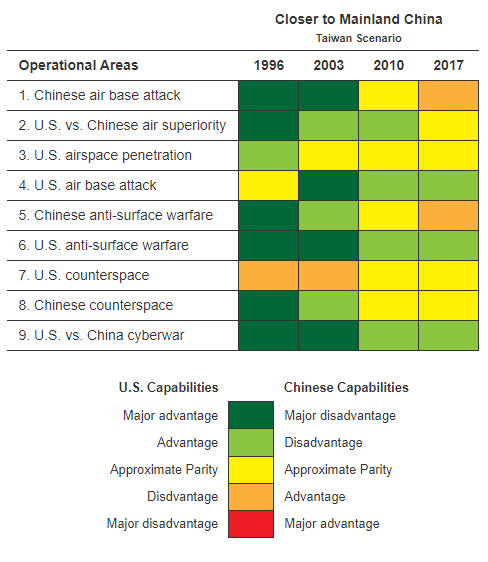
Advantage: China

Extrapolating from a 2015 US think tank report, China has now almost certainly surpassed parity with US air and sea forces in the South China Sea and now possesses a military advantage in the region. While the most recent reports are moderately more favorable to the US military, they are based in part on weapons systems and stocks that are not even available to the US forces yet, so for the purposes of comparing the capabilities of the two sides, it is more reasonable to extrapolate from the past analyses than utilize the current one.

Also, neither the past nor the present analysis takes into account the possibility of the US military being simultaneously involved in a war with Russia, which is currently the case. The point here is not to determine whether this is likely to be a positive development or a negative one for any particular party, but rather, to ascertain what the actual military situation happens to be at what is an obvious historical nexus.

Remember, it doesn’t matter what you think of the CCP, Clown World, Old Glory, or the US Marines, or what you want to believe. The material facts, and the military capabilities, are what they actually are.

Over the past two decades, China’s People’s Liberation Army has transformed itself from a large but antiquated force into a capable, modern military. Its technology and operational proficiency still lag behind those of the United States, but it has rapidly narrowed the gap. Moreover, China enjoys the advantage of proximity in most plausible conflict scenarios, and geographical advantage would likely neutralize many U.S. military strengths. A sound understanding of regional military issues — including forces, geography, and the evolving balance of power — will be essential for establishing appropriate U.S. political and military policies in Asia. This RAND study analyzes the development of respective Chinese and U.S. military capabilities in ten categories of military operations across two scenarios, one centered on Taiwan and one on the Spratly Islands. The analysis is presented in ten scorecards that assess military capabilities as they have evolved over four snapshot years: 1996, 2003, 2010, and 2017. The results show that China is not close to catching up to the United States in terms of aggregate capabilities, but also that it does not need to catch up to challenge the United States on its immediate periphery. Furthermore, although China’s ability to project power to more distant locations remains limited, its reach is growing, and in the future U.S. military dominance is likely to be challenged at greater distances from China’s coast. To maintain robust defense and deterrence capabilities in an era of fiscal constraints, the United States will need to ensure that its own operational concepts, procurement, and diplomacy anticipate future developments in Chinese military capabilities.

The U.S.-China Military Scorecard, RAND, 2015

DISCUSS ON SG


Monday Arktoons

The return of REBEL DEAD REVENGE!

REBEL DEAD REVENGE Episode 50: Infiltrated by the Dead

FULL OF EYES Episode 21: Beyond Forever

CHATEAU GRIEF Episode 198: Nomad

EVIL MONKEY MEMES Episode 75: Whatcha Got To Eat

THE BLOODSTAINED DEFILE Episode 4: Flag of Truce

INVASION ’55 Episode 29: Trouble Down Below

BEN GARRISON CLASSICS Episode 80: Debate Souvenir

THE WISE OF HEART Episode 7: A Private Moment

VEGFOLK FABLES Episode 186: Run

And a note from the Production Team:

Proofreaders Needed

The Arktoons production team are looking for new proofreaders to join us. You’ll be proofreading the episodes we create before they are released, reading short stories/comics to see if they are suitable for us to adapt, and other tasks related to reading. You’ll need no technical skills or programs, all you’ll need is some time each week to help out and a desire to take part in the culture war. Please email: ArkhavenComics-AT-outlook-DOT-com.


The Thumb on the Scale

While I stopped subscribing to NFL Game Pass and playing fantasy football after the NFL went woke, I still watch all the playoff games. But one thing that made it easier to invest considerably less time in the sport that I’ve followed since childhood was the observation I’d made around the same time, which is that the NFL Commissioner’s office appears to have gotten more aggressively involved in influencing the end results than in previous decades.

While there were a few plays over the years that struck me as highly questionable, for the most part they appeared to be sporadic and generally free of any larger pattern. (See: Drew Pearson a) catching the ball out of bounds, b) pushing off in the 1975 Minnesota – Dallas game, and c) the two non-holding calls on both plays.) The approach has definitely changed, because it’s now become regularly recognizable which team the league would prefer to win the game by the end of the first drive by each team. Note that I said “drive”, not “possession”, because it’s usually impossible to learn anything from an initial three-and-out.

A lot of this year’s playoff games were really good. And the NFL isn’t dictating or scripting the games, it appears to be content to simply put a thumb on the scale, giving the preferred team a small advantage that is worth somewhere between 3 and 7 points in the end. This is an advantage that can be overcome fairly easily by a superior or very well-coached team, but in contests in which the “game of inches” description is apt, it tends to make the crucial difference. The usual reason for assigning the advantage is to help the inferior team and keep the games close, except in those cases when the league has a larger narrative to protect.

For example, in the conference championship games, it was immediately clear that the refs were favoring Philadelphia and Kansas City. I didn’t initially understand why, since the “Andy Reid Bowl” story didn’t seem to justify it, until I read this line from Peter King’s regular Monday morning column.

Historic game: It’s the first of the 57 Super Bowls with two starting Black quarterbacks facing off. Mahomes plays in his third for Kansas City, Jalen Hurts in his first for Philadelphia

And there’s the missing piece. The narrative drives everything.

Philadelphia had absolutely no need of the assistance, as even an excellent 49ers team couldn’t hope to overcome the loss of both its quarterbacks to injury. (The NFL really should go back to 14 game regular seasons and 10 teams in the playoffs. They won’t, but they should in the interest of the quality of the games.) But Kansas City needed every bit of the thumb-on-the-scale in order to eke out a 23-20 win over Cincinnati; the Chiefs also required a failed two-minute drive by the Bengals offense plus an incredibly dumb but 100-percent legitimate penalty by a Bengals linebacker in order to kick the winning field goal in regular time.

As strange as it might sound, recognizing this pattern of subtle intervention tends to make the sport a little more interesting to me, not less. Now it all makes more sense, and I find myself particularly interested in the first two drives, just so I can work out which team is going to get the benefit of the dubious calls at the important moments. Because it’s also observable that the referees attempt to cover what I presume is their league-ordered bias by making a dubious call or two in favor of the disadvantaged team late in the game if that will help make the game closer. See: the ridiculous roughing-the-passer call against the Giants at the end of the Minnesota – New York game.

Now, I can understand if die-hard fans of the game find this hard to believe. But so far, the hypothesis has not been falsified.

UPDATE: These penalty statistics are interesting, especially the comparison with the two previous games between Cincinnati and Kansas City.

  • 4-30, 2-11
  • 6-55, 4-35
  • 9-71, 4-55

The statistics are similar for the NFC Championship game between San Francisco and Philadelphia.

  • 11-81, 4-34

These discrepancies are particularly intriguing given the fact that the Bengals were the 2nd least penalized team in terms of yardage whereas the 49ers were the 12th least penalized team. The Eagles were 8th and the Chiefs were 20th.

DISCUSS ON SG

When the Plan Fails

A Rand report published in April 2019 laid out US strategy vis-a-vis Russia, which as you can see in hindsight, was followed fairly closely to the letter. Note that “extending” Russia is shorthand for “causing the Russians to overextend and unbalance themselves”.

This report examines a range of possible means to extend Russia. As the 2018 National Defense Strategy recognized, the United States is currently locked in a great-power competition with Russia. This report seeks to define areas where the United States can compete to its own advantage. Drawing on quantitative and qualitative data from Western and Russian sources, this report examines Russia’s economic, political, and military vulnerabilities and anxieties. It then analyzes potential policy options to exploit them — ideologically, economically, geopolitically, and militarily (including air and space, maritime, land, and multidomain options). After describing each measure, this report assesses the associated benefits, costs, and risks, as well as the likelihood that measure could be successfully implemented and actually extend Russia. Most of the steps covered in this report are in some sense escalatory, and most would likely prompt some Russian counter-escalation. Some of these policies, however, also might prompt adverse reactions from other U.S. adversaries — most notably, China — that could, in turn, stress the United States. Ultimately, this report concludes that the most attractive U.S. policy options to extend Russia — with the greatest benefits, highest likelihood of success, and least risk — are in the economic domain, featuring a combination of boosting U.S. energy production and sanctions, providing the latter are multilateral. In contrast, geopolitical measures to bait Russia into overextending itself and ideological measures to undermine the regime’s stability carry significant risks. Finally, many military options — including force posture changes and development of new capabilities — could enhance U.S. deterrence and reassure U.S. allies, but only a few are likely to extend Russia, as Moscow is not seeking parity with the United States in most domains.

Key Findings

Russia’s weaknesses lie in the economic domains

  • Russia’s greatest vulnerability, in any competition with the United States, is its economy, which is comparatively small and highly dependent on energy exports.
  • The Russian leadership’s greatest anxiety stems from the stability and durability of the regime.

The most promising measures to stress Russia are in the realms of energy production and international pressure

  • Continuing to expand U.S. energy production in all forms, including renewables, and encouraging other countries to do the same would maximize pressure on Russia’s export receipts and thus on its national and defense budgets. Alone among the many measures looked at in this report, this one comes with the least cost or risk.
  • Sanctions can also limit Russia’s economic potential. To be effective, however, these need to be multilateral, involving (at a minimum) the European Union, which is Russia’s largest customer and greatest source of technology and capital, larger in all these respects than the United States.

Geopolitical measures to bait Russia into overextending itself are likely impractical, or they risk second-order consequences

  • Many geopolitical measures would force the United States to operate in areas that are closer to Russia and where it is thus cheaper and easier for Russia than the United States to exert influence.

Ideological measures to undermine the regime’s stability carry significant risks of counter escalation

  • Many military options — including force posture changes and development of new capabilities — could enhance U.S. deterrence and reassure U.S. allies, but only a few are likely to extend Russia, as Moscow is not seeking parity with the United States in most domains.
Extending Russia: Competing from Advantageous Ground, RAND, 24 April 2019

This was followed up by a report five months later, which provided specific actions intended to achieve the objectives identified in the initial report, entitled Overextending and Unbalancing Russia: Assessing the Impact of Cost-Imposing Options.

Insert deep movie trailer voice: They did not correctly assess the impact of the cost-imposed options.

What’s fascinating is that now RAND is rapidly backtracking on the idea of extending Russia, because the US attempts to extend Russia have turned out to extend the USA, its NATO proxies, the other European states, and Clown World itself. Remember what I said in the previous post about NATO needing to win fast? That’s why Rand wants to pull a Vietnam/Afghanistan, call it a win, and get the US military out of Eastern Europe as quickly as possible.

The Andrew Anglin committee has correctly assessed the situation.

Here’s the deal: everyone understands that Russia is only a power capable of competing with the US because it is backed by a much larger and much wealthier country called “China.” Russia needs their economy to survive. India wouldn’t be standing up to the US, nor would Saudi or any of the other former allies pushing back, if they weren’t getting cover from China.

The think tanks were all pushing for China to be the target of the next US war.

However, Pentagon people said Russia is much weaker, so they went with that. Now it’s a boondoggle. The West is destroying its economy, they are alienating the whole world, and they’re accomplishing what exactly? Russia can keep fighting indefinitely. It’s not costing them anything…

The US can’t possibly open up the China front while the Ukraine is ongoing, and time is on China’s side over there.

This is why RAND is mad.

However, wars do not take place in a vacuum and they have a way of creating a new reality that is unforeseen even by the architects of the best-laid warplans. There is no reason for Russia to let NATO and the US military off the hook just because it suits RAND, and there is absolutely zero chance that Xi Xinping and the extremely astute Chinese warplanners are going to be blind to the advantages of making sure that the first front stays active until the second one is opened by one of the two parties concerned.

Remember, the failure of a plan doesn’t mean it never existed, it simply means it didn’t work.

DISCUSS ON SG


NATO Calls the Shots

The Chairman of NATO’s Military Committee pulls the curtain away and reveals that the “alliance” is in fact the military bureaucracy of the US empire.

NATO is prepared to fight Russia if a direct conflict erupts between the two, Rob Bauer, the chairman of the alliance’s Military Committee, said on Saturday. In an interview with Portuguese RTP TV, when asked whether the US-led military block is ready for a direct confrontation with Russia, Bauer unequivocally stated, “We are.”

The official noted that when the hostilities broke out in Ukraine in February 2022, NATO already had a number of battle groups along its eastern flank. During a summit in Madrid which took place in June 2022, the alliance’s leaders decided to create four more battle groups in Slovakia, Hungary, Romania, and Bulgaria, Bauer said.

Bauer went on to say that for decades, many NATO nations thought they were the ones who decide when and where to deploy their forces, but the Ukraine conflict was a gamechanger.

If a nation isn’t able to decide when and where to deploy its own military forces, it isn’t a sovereign nation anymore. This is why signing up for all of these supranational organizations was always short-sighted and foolish, as they intrinsically necessitate giving up sovereignty and democracy.

The Russian generals get more of a vote where the NATO generals establish their forces than the elected leaders or the people of any of the NATO nations.

As for whether NATO is ready for direct war with the Russian military, well, its proxies haven’t fared very well against the Russian proxies. I suppose they’re about as ready as they’re ever going to be, I just don’t think “readiness” should be confused with “having a snowball’s chance in Hell of winning”.

Remember, we’re talking about a military that can’t even defend its own borders.

UPDATE: The US empire is apparently not ready to fight China, however.

A four-star US air force general predicted that the US and China will be at war in two years, most likely over the Taiwan region, and called on troops under his command to pursue battle readiness in a recently disclosed memo, a move Chinese experts on Saturday decried as a reckless and provocative hyping of “China threats,” which would inflame tensions and deepen strategic mistrust between the US and China when ties are already at a low ebb.

It cannot be ruled out that the move may serve as a way of putting pressure on China to gain more leverage ahead of a potential China trip by US Secretary of State Antony Blinken, analysts said.

In the memo, first obtained by NBC News on Friday but dated February 1, General Michael Minihan, head of Air Mobility Command (AMC), said that “my gut tells me will fight in 2025,” as both US and Taiwan regional authorities will have elections in 2024, and the US will be “distracted,” which gives the Chinese mainland an opportunity.

Minihan listed his goals of military preparation for a “fight with China” to his soldiers in the AMC, including building “a fortified, ready, integrated, and agile Joint Force Maneuver Team ready to fight and win inside the first island chain,” according to an NBC report.

Better beat those Russians fast…

DISCUSS ON SG