This is what diversity looks like

As usual, we’re seeing most of the usual suspects telling the usual taqiyya, claiming that murdering people is against Islam, that it’s just a few bad apples, that Christians do it too, that Charlie Hebdo had it coming, and so forth.

They are all lies. Islam is a religion of the sword and has been since its inception.

Christian popes are given names like Pius and Benedictus and Clemens. Islamic caliphs were proud to bear names such as al-Mansur “the victorious”, which the Caliph of Cordoba assumed after his victory at the Battle of Torrevicente in 981. Furthermore, if it is reasonable to hold Christians today responsible for the actions of other Christians during the Crusades nearly one thousand years ago, how is it unreasonable to hold Muslims today responsible for the action of other Muslims yesterday?

As I have repeatedly observed, we are about fifty years into the third great wave of Islamic expansion in the West. It was previously turned back at Tours, and again at Vienna. Given the delusions that still persist among the Western governments and the left side of the West’s electorates, it seems unlikely that the murderous assault on the Charlie Hebdo offices mark the high water mark of the third wave of Islamic aggression.

But the first shots in Reconquista 2.0 have already been fired; they were fired in Norway by Anders Breivik. And that is the terrible point to which multiculturalism and diversity and tolerance has brought the West: the choice between Breivik and Hebdo. Many have embraced the hashtag #JeSuiCharlie, but as Iowahawk wisely noted, never bring a candlelight vigil to a gunfight.

It will, of course, take time for people to understand that there is no third option, that reinforcing not only decades of failure, but irrational ideological dogma, is absolutely and utterly doomed to even more cataclysmic failure. It will take more attacks by the invaders, more innocent deaths, more dead Westerners, before the people throw out their traitorous governments and their ridiculous pleas for “unity” and true national leaderships arise to expel the invaders.

This pattern of Quislingesque behavior on the part of the Western elite is nothing new. A reader, JS, notes:

I’ve been reading Kissinger’s Diplomacy, and noted that in the lead-up
to WW2, many leaders in Europe and England were much more favorably
disposed towards a hostile and rearming Germany than they were to the Right
in their own countries. Like the Left today, their tactic in response to a
challenge was to attempt to cover themselves in ‘moar’ humiliation,
abase themselves even further. According to Kissinger,
they received grand accolades from other world leaders while betraying
their own peoples and increasing the death toll of WW2 by orders of
magnitude by disarming when they should have been attacking Hitler’s
Germany before Germany was prepared for offensive warfare.

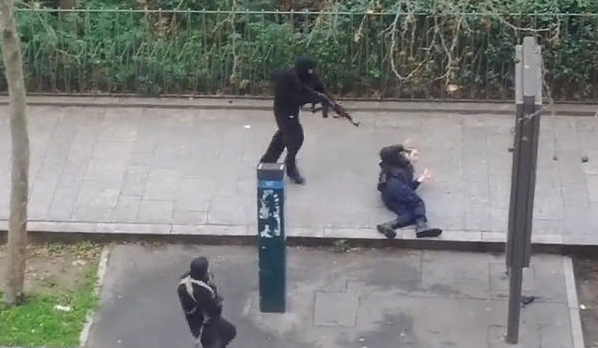
Look at the picture above. Look at the terror and helplessness of the French policeman in his last moments. Look at what his surrender and willingness to appease his Muslim killer accomplished. That is what diversity looks like. That is what diversity means.

Then again, in the end, it may be that #JeSuiCharlie will turn out to be an appropriate slogan. After all, there was once another Frenchman named Charlie who was not afraid to confront the Islamic invader, Charlie Martel.

UPDATE: More blessings of diversity in Paris today:

Terrified workers in Paris’s business district were warned not to leave their office after a gunmen was seen outside – just hours after a female police officer was shot dead by a ‘North African wielding an assault rifle’. 


Mailvox: is war in decline?

CED asks about The Remnants of War and the idea that war is in decline:

Are you aware of the book The Remnants of War by John Mueller? It was published back in 2004, with a paperback edition in 2007. The book argues that contrary to popular belief, war is on its way out, and the only people still engaging in it are opportunistic criminals easily scared off by competent, disciplined troops from developed countries.

Its main thrust is that developed countries, which used to get into frequent wars with each other, no longer did due to the harrowing experience of World War I, and that World War II was an aberration caused by Hitler’s personal charisma. The book states that changing cultural attitudes toward organized violence, not trade links or new military technologies like nukes, ended war as a possibility among developed states.

Furthermore, even in undeveloped states, much of the “war” is caused by roving yet cowardly criminal gangs that seek easy targets, not disciplined soldiers or even guerrillas (he emphasizes the Yugoslav wars as Exhibit A) — and that this is the main form of warfare that remains. According to Mueller, this form of war can only be handled by competent native governments with disciplined police and military forces. Once this is done, war, like slavery and dueling before it, will recede as a human institution. A related point he makes is that ethnic conflict need not explode into civil war if there is a competent government in place.

Now, it has been a long time since this book was published. I see a few problems with his thesis:

Chinese saber-rattling. In the South and East China Sea, China has been building up its navy in preparation for a war. This has driven countries like Vietnam closer to the US and forced Japan to begin its own military buildup. Of course, there’s also Taiwan. While Mueller is careful to say that war between disciplined, developed states is still possible, it cuts against another claim he makes — that the Cold War’s losers see the world the same way as the winners and thus don’t want to upset the international order.

Russia’s interference in Ukraine
. Russia was the principal loser in the Cold War, and there is very little evidence that they see the world the “same way” as the US and the EU. The interference in the Ukraine, as well as the sanctions imposed in response, to say nothing of Putin’s domestic policies that are at odds with Western promotion of homosexuality and godlessness, show fundamental differences. The only reason there has been no war is because it would inevitably go nuclear.

The Iraq debacle. Take note of when The Remnants of War was published — 2004, a mere one year after the Iraq invasion. Disciplined US troops displaced Saddam’s government and occupied the country, policing it to get rid of opportunistic predators that wanted to profit from the social chaos. Things still looked hopeful for the occupation at the time. Eleven years later, The US has withdrawn and the Islamic State has risen. Either the Muslim fundamentalists have proven more disciplined, or war isn’t declining as much as Mueller would have us believe. In his schema, something like the Islamic State shouldn’t even be possible.

Fourth-generation war. To Mueller, “war” is a battle between disciplined armies for control of a government or territory, or between a government and disciplined guerrilla forces. He waves off notions of 4GW (though he never uses the term) by saying that war has been reduced to its dregs — mere predation by criminal packs in areas without effective governments. To Mueller, what appears to be a “new form of war” is just the death rattle of war, and once those areas could be competently policed, even criminal “war” will disappear. In contrast, William S. Lind says that 4GW is the wave of the future and has been defeating the state wherever it has arisen. This complicates Mueller’s conclusions about the inevitable end of war, though he does mention that a government has to be effective to end war. Lind also says that 4GW comes from a state’s crisis of legitimacy, so maybe both Mueller and Lind are making the same point in a different way.

Anyway, do you have any thoughts on John Mueller’s idea that war is on the decline and soon to disappear as a human institution?

I was not aware of the book, but if CED has fairly represented Mueller’s views, I think his core idea is conventional, outdated, short-sighted, and ahistorical, and temporally biased. There have always been periods of relative peace. During such periods, it is common for the more foolish sort of thinkers to believe that those periods have somehow magically become established as the permanent human norm. Considering that the world has been in one of the longer periods of economic growth, technological advancement, and population growth since 1950, and it should be no surprise that even after 9/11 and the dot com crash, there were still those who thought that this time, it would be different.

I’ve been reading World Order by Henry Kissinger, and it is clear that one reason the global elite is attempting to tighten its grasp these days is because it fears the world declining into the sort of disorder that makes it difficult to milk. But it will fail, order will decline into disorder, and low-grade war will cover most of the planet because the centers of order are no longer homogenous and stable.

The one genuinely mitigating factor is the way in which nuclear weapons tend to prevent the major state militaries from engaging each other. But this too creates problems, as it forces them to fight on the 4GW non-battlefield where their every action tends to foster more of the very disorder they are attempting to destroy.

We are fortunate to have lived in such peaceful times. It is unlikely that our children and our grandchildren will be similarly fortunate. So, my answer is no. War is not in decline. As I wrote in the preface to RIDING THE RED HORSE:

[T]he end of the Pax Americana is rapidly approaching and it is readily apparent to every well-informed observer that War is preparing to mount his steed, and he will soon be once more riding that terrible red horse over the nations of men.

It is no accident that the THERE WILL BE WAR series came to an end in 1989, in harmony with the end of the Cold War. Nor is it an accident that there is an increased interest for military fiction, or that we launched RIDING THE RED HORSE this month.

Henry Kissinger writes in World Order:

In the world of geopolitics, the order established and proclaimed as universal by the Western countries stands at a turning point. Its nostrums are understood globally, but there is no consensus about their application; indeed, concepts such as democracy, human rights, and international law are given such divergent interpretations that warring parties regularly invoke them against each other as battle cries. The system’s rules have been promulgated but have proven ineffective absent active enforcement. The pledge of partnership and community has in some regions been replaced, or at least accompanied, by a harder-edged testing of limits.

A quarter century of political and economic crises perceived as produced, or at least abetted, by Western admonitions and practices—along with imploding regional orders, sectarian bloodbaths, terrorism, and wars ended on terms short of victory—has thrown into question the optimistic assumptions of the immediate post–Cold War era: that the spread of democracy and free markets would automatically create a just, peaceful, and inclusive world.

Translation: don’t count on the end of history. And mark this: “A struggle between regions could be even more debilitating than the struggle between nations has been.”

Female intelligence

 It appears the Female Imperative now takes precedence over national security:

For the past eight months, there has
been a furious battle raging behind closed doors at the White House,
the C.I.A., and in Congress. The question has been whether the Senate
Select Committee on Intelligence would be allowed to use pseudonyms as a
means of identifying characters in the devastating report
it released last week on the C.I.A.’s abusive interrogation and
detention program. Ultimately, the committee was not allowed to, and now
we know one reason why.

The NBC News investigative reporter Matthew Cole has pieced together a remarkable story
revealing that a single senior officer, who is still in a position of
high authority over counterterrorism at the C.I.A.—a woman who he does
not name—appears to have been a source of years’ worth of terrible
judgment, with tragic consequences for the United States. Her story runs
through the entire report. She dropped the ball when the C.I.A. was
given information that might very well have prevented the 9/11 attacks;
she gleefully participated in torture sessions afterward; she
misinterpreted intelligence in such a way that it sent the C.I.A. on an
absurd chase for Al Qaeda sleeper cells in Montana. And then she falsely
told congressional overseers that the torture worked.

Had the Senate Intelligence Committee been permitted to use pseudonyms for
the central characters in its report, as all previous congressional
studies of intelligence failures, including the widely heralded Church
Committee report in 1975, have done, it might not have taken a
painstaking, and still somewhat cryptic, investigation after the fact in
order for the American public to hold this senior official accountable.
Many people who have worked with her over the years expressed shock to
NBC that she has been entrusted with so much power. A former
intelligence officer who worked directly with her is quoted by NBC, on
background, as saying that she bears so much responsibility for so many
intelligence failures that “she should be put on trial and put in jail
for what she has done.”

Instead, however, she has
been promoted to the rank of a general in the military, most recently
working as the head of the C.I.A.’s global-jihad unit. In that perch,
she oversees the targeting of terror suspects around the world. (She was
also, in part, the model for the lead character in “Zero Dark Thirty.”)

This is an example of another reason not to permit women in the military. Women are not considered to be fully accountable in modern American society, and soldiers who are unaccountable to civilian leadership are not desirable in anything that still pretends to be a free society.


The hope for world order

If you’re having trouble seeing things from the globalist perspective and wondering how they can possibly justify their ruthless attacks on national and individual sovereignty, it can be helpful to read their doctrines. Henry Kissinger puts forth his global vision in World Order:

The issue of peace in the Middle East has, in recent years, focused on the highly technical subject of nuclear weapons in Iran. There is no shortcut around the imperative of preventing their appearance. But it is well to recall periods when other seemingly intractable crises in the Middle East were given a new dimension by fortitude and vision.

Between 1967 and 1973, there had been two Arab-Israeli wars, two American military alerts, an invasion of Jordan by Syria, a massive American airlift into a war zone, multiple hijackings of airliners, and the breaking of diplomatic relations with the United States by most Arab countries. Yet it was followed by a peace process that yielded three Egyptian-Israeli agreements (culminating in a peace treaty in 1979); a disengagement agreement with Syria in 1974 (which has lasted four decades, despite the Syrian civil war); the Madrid Conference in 1991, which restarted the peace process; the Oslo agreement between the PLO and Israel in 1993; and a peace treaty between Jordan and Israel in 1994.

These goals were reached because three conditions were met: an active American policy; the thwarting of designs seeking to establish a regional order by imposing universalist principles through violence; and the emergence of leaders with a vision of peace…. Once again, doctrines of violent intimidation challenge the hopes for world order. But when they are thwarted—and nothing less will do—there may come a moment similar to what led to the breakthroughs recounted here, when vision overcame reality.

Kissinger is a clear and lucid writer. His historical knowledge is deep and impressive. But he makes no case for his vision, he simply assumes the reader will share it; and it is easy to understand why America finds itself caught up in a convoluted web of international intrigue given the political influence of the author. The arrogance and hypocrisy in that open tacit claim that “nothing less will do” than the imposition of universalist principles through violence by leaders with a vision of peace is astonishing. And more than a little ironic in light of Kissinger’s criticism of the “remarkable arrogance” of the European colonial powers.

The pamphlets and treatises of the colonial powers from the dawn of the twentieth century reveal a remarkable arrogance, to the effect that they were entitled to shape a world order by their maxims. Accounts of China or India condescendingly defined a European mission to educate traditional cultures to higher levels of civilization.

What is truly remarkable is the complete lack of self-awareness demonstrated here. The globalists are doing EXACTLY the same thing they complain about the colonial powers having done, and what Kissinger correctly observes the Iranians to be doing: asserting their entitlement to shape a world order by their maxims. But precisely how is Kissinger’s “vision of peace” any more rationally justified or globally authoritative than Mahmound Ahmadinejad’s publicly proclaimed “promise of God”?

And what is the globalist hope for world order if not a doctrine of violent intimidation?


Counterparty risk

Robert Prechter warned of this. It doesn’t matter if you traded right, if you can’t cash in your nominal winnings:

Dear Client,

Please be advised that that most Western Banks have stopped pricing USD/RUB. As such, FXCM can no longer offer this instrument to our clients and will begin closing any existing client trades in USD/RUB effective at Noon EST today, December 16th, 2014, 

So for those curious why there appears to be a collapse in Ruble volatility in the past few hours which in turn has sent both stocks and crude soaring, the answer is simple: nobody is trading it! 

And this is what happened following the post: as soon as all those
short the RUB (long USDRUB) realized they have to take profits, the USDRUB tumbled some 500 pips (!) in the process sending stocks surging.

We appear to have a full-blown financial war underway. I wonder how long it will take Putin to put the ruble on the gold standard. That’s always been his trump card; it eliminates Russia’s ability to play the money multiplication game, but in the end, will provide Russia with a sounder currency than the so-called currency of last resort.


They’re not the good guys

The Senate report on the useless brutality and deception involved in the CIA’s interrogation program tends to support what those of us who opposed torture from the start have been saying all along:

In January 2003, 10 months into the Central Intelligence Agency’s secret prison program, the agency’s chief of interrogations sent an email to colleagues saying that the relentlessly brutal treatment of prisoners was a train wreck “waiting to happen and I intend to get the hell off the train before it happens.” He said he had told his bosses he had “serious reservations” about the program and no longer wanted to be associated with it “in any way.”

The bitter infighting in the C.I.A. interrogation program was only one symptom of the dysfunction, disorganization, incompetence, greed and deception described in a summary of the Senate Intelligence Committee’s report. In more than 500 pages, the summary, released on Tuesday, paints a devastating picture of an agency that was ill equipped to take on the task of questioning Al Qaeda suspects, bungled the job and then misrepresented the results….

The report said the agency had evidently forgotten its own conclusion, sent to Congress in 1989, that “inhumane physical or psychological techniques are counterproductive because they do not produce intelligence and will probably result in false answers.” The Democratic Senate staff members who studied the post-Sept. 11 program came up with an identical assessment: that waterboarding, wall-slamming, nudity, cold and other ill treatment produced little information of value in preventing terrorism.

The report spends little time condemning torture on moral or legal grounds. Instead, it addresses mainly a practical question: Did torture accomplish anything of value? Looking at case after case, the report answers with an unqualified no.

I’m not exactly surprised. You may recall I wrote the following on WND back in 2006:

Consider the words of Winston Churchill, a man not well-known for shirking confrontation or combat, written after World War I while he was secretary of state for war:

All the horrors of all the ages were brought together, and not only armies but whole populations were thrust into the midst of them. The mighty educated States involved conceived – not without reason – that their very existence was at stake. Neither peoples nor rulers drew the line at any deed which they thought could help them to win. Germany, having let hell loose, kept well in the van of terror; but she was followed step by step by the desperate and ultimately avenging nations she had assailed. … When it was all over, Torture and Cannibalism were the only two expedients that the civilized, scientific, Christian States had been able to deny themselves: and they were of doubtful utility.

It is those last words that most completely damn the Bush administration as barbarians unfit for leadership of the free world. Few would find appeals to national security very compelling if the president insisted that victory in the War That Dare Not Speak Its Name required feeding the armed forces on the flesh of fallen Iraqis, and yet there is very little evidence, historic or current, that indicates torture will be of any use in turning back the forces of expansionist Islam.

Enthusiastic use of the most brutal torture did not help the French hold Algeria against Islamic rebels, nor did it bring victory to the Soviet Union in Afghanistan. Debates about whether “water boarding” is more acceptable than the rack or thumbscrews are meaningless; the point is that civilized societies do not indulge in such activities since they are evil and effectively useless.


Fertilizer is not prevention

I very much enjoy reading VDH’s historical works, but I’ve never seen a better historian so completely unable to correctly apply the lessons of history to current events:

The ancient ingredients of war are all on the horizon. An old postwar order crumbles amid American indifference. Hopes for true democracy in post-Soviet Russia, newly capitalist China or ascendant Turkey long ago were dashed. Tribalism, fundamentalism and terrorism are the norms in the Middle East as the nation-state disappears.

Under such conditions, history’s wars usually start when some opportunistic — but often relatively weaker — power does something unwise on the gamble that the perceived benefits outweigh the risks. That belligerence is only prevented when more powerful countries collectively make it clear to the aggressor that it would be suicidal to start a war that would end in the aggressor’s sure defeat.

What is scary in these unstable times is that a powerful United States either thinks that it is weak or believes that its past oversight of the postwar order was either wrong or too costly — or that after Afghanistan, Iraq and Libya, America is no longer a force for positive change.

A large war is looming, one that will be far more costly than the preventative vigilance that might have stopped it.

He’s correct that a large war is looming. Where exactly it will start, or which sides the various parties will take, is presently unknown. But VDH appears to have completely ignored the lessons of the Athenian adventure at Syracuse about which he wrote so informatively, and to have ignored that the collapse of the “nation-state” in the Levant was always inevitable due to the artificial and externally imposed nature of their creations; they were never nations in the first place.

That is why we can safely assume that the “nation-states” in Africa will continue to collapse as well. And, of course, that is why the “powerful” United States has been rendered increasingly impotent; it is no longer a homogenous white Christian nation committed to Anglo-Saxon ideals. Indeed, one cannot truly consider it a nation at all, it is best described as an imperial multi-national, multi-ethnic state akin to the Byzantine, Roman, and Austro-Hungarian empires.


The economic imperative of Asteroid Wars

This sudden push for asteroid defenses seems a little out of left field:

Asteroids could wipe out humanity unless more effort is made to track and destroy them, a leading body of scientists and astronauts has warned. Lord Martin Rees, the Astronomer Royal, Brian Cox, and Richard Dawkins are among more than 100 experts calling for the creation of a huge asteroid detection system to prevent a doomsday scenario.

At an event at London’s science museum on Wednesday night, Lord Rees read out a declaration resolving to “solve humanity’s greatest challenges to safeguard our families and quality of life on Earth in the future.”

The dire threat of asteroids producing an urgent need for space-based defense systems. Now, where have I heard something like that before? As it happens, in the testimony of a woman who was an associate of Werner von Braun back in the 1970s, which dates back 14 years.

He said the strategy that was being used to educate the public and decision makers was to use scare tactics. That was how we identify an enemy. The strategy that Werner Von Braun taught me was that first the Russians are going to be considered the enemy. In fact, in 1974, they were the enemy, the identified enemy. We were told that they had “killer satellites”. We were told that they were coming to get us and control us—that they were the “Commies”.

Then terrorists would be identified, and that was soon to follow. We heard a lot about terrorism. Then we were going to identify third-world country “crazies”. We now call them Nations of Concern. But he said that would be the third enemy against whom we would build space-based weapons.

The next enemy was asteroids. Now, at this point he kind of chuckled the first time he said it, “Asteroids—against asteroids, we are going to build space-based weapons.”

And the funniest one of all was what he called aliens, extraterrestrials. That would be the final scare. And over and over during the four years that I knew him and was giving speeches for him, he would bring up that last card: “And remember Carol, the last card is the alien card. We are going to have to build space-based weapons against aliens, and all of it is a lie.”

I think I was too naïve at that time to know the seriousness of the nature of the spin that was being put on the system. And now, the pieces are starting to fall into place. We are building a space-based weapons system on a premise that is a lie, a spin. Wernher Von Braun was trying to hint that to me back in the early 70’s and right up until the moment when he died in 1977.

Of course, since we know the military-industrial complex is going to manufacture wars in order to keep its system of income distribution running smoothly, I would think it is eminently desirable for the wars to be waged against space rocks and entirely imaginary. It makes for an interesting investment plan, anyhow.

And is there not an even darker possibility? What if the whistleblower who is warning about these manufactured wars is actually an agent for the aliens who wants to see Earth disarmed? Wheels within wheels, my friends. Wheels within wheels.

Anyhow, it’s nice to see that the AGW/CC alarmists have a new toy with which to play.


Speed bumps

Apparently the USA learned nothing from the Cold War:

The new Army commander in Europe plans to bolster the U.S. armored presence in Poland and the Baltic states and keep rotations of U.S. troops there through next year and possibly beyond to counter Russia. Lt. Gen. Frederick “Ben” Hodges, who replaced Lt. Gen. Donald M. Campbell  earlier this month as commander of U.S. Army Europe, said the Army was looking to add about 100 Abrams tanks and Bradley Fighting Vehicles to the forces in Eastern Europe.

Since taking command, Hodges has made clear his concerns about
Russia, which annexed Crimea last March and has supported the
separatists in eastern Ukraine. U.S. Army Europe, which had 280,000
troops at the height of the Cold War, now has 31,000.

The rotations of U.S. troops on training missions in Eastern Europe
would provide “deterrence against Russian aggression,” Hodges said. “I don’t think that Russia has any intention of some sort of a
conventional attack into NATO territory because they know that would
generate an Article 5 response.”

Translation: We know from the old Fulda Gap that 100 tanks won’t actually do anything militarily except provide a speed bump, but having ground troops there would provide the US with an excuse to get further involved if the Russians elect to follow the US lead in Ukraine and arrange for a “regime change” in Poland or the Baltic states.

One thing many Americans don’t understand is that they are the bad guys in Ukraine. The USA is the evil aggressor that overthrew a flawed but democratically elected government and installed a puppet leadership against which a portion of the country is literally up in arms. This, in addition to the failed US-supported “Arab Spring”, is another reason why anti-Americanism is on the rise in Europe and Asia.

To put it in perspective, imagine if Russia orchestrated the overthrow of the Mexican government (which is every bit as corrupt and shady as the former Ukrainian government was) and installed a pro-Russian puppet who promptly sent all of Mexico’s gold reserves to Moscow and placed Russians on the corporate boards of its oil companies? Do you think the USA would respond in as limited a fashion as Russia has?

Remember, Putin does not have to be a good guy in order for Obama to be the bad guy. The recent warning about ISIS targeting US soldiers in America is apt, as the increase in the amount and extent of US interventions abroad is infuriating more and more people around the world. If the USA won’t leave other sovereign countries alone, it seems likely that sooner or later, someone is going to return the favor.


Operation Arab Sea Lion

Surge in Arabic names this year with Omar, Ali and Ibrahim all in top 100.  For girls, Maryam has shot to number 35, while Nur is new entry. And Muhammad rose astonishing 27 places to claim the number-one spot.

In England.

“Fourth Generation war is also marked by a return to a world of cultures, not merely states, in conflict. We now find ourselves facing the Christian West’s oldest and most steadfast opponent, Islam. After about three centuries on the strategic defensive, following the failure of the second Turkish siege of Vienna in 1683, Islam has resumed the strategic offensive expanding outward in every direction. In Fourth Generation war, invasion by immigration can be at least as dangerous as invasion by a state army.”
– William S. Lind, “Understanding 4th Generation War”, 1989