Re-reporting

That must be one of the things they learn in journalism school. Despite being a three-times nationally syndicated columnist with Chronicle Features and Universal Press Syndicate, I am unfamiliar with the term:

Kathryn Hendley, Alex Stock and Ryan Duffin—the three friends of Jackie’s who Sabrina Rubin Erdely falsely claimed discouraged from her calling the authorities—now tell the AP that they have all been contacted by Sabrina Rubin Erdely, who is “re-reporting” her original story.

This is a bizarre idea for a number of reasons.

First, Rubin Erdely herself continues to refuse to talk to the press—or, as she said of the UVa administration, she is “stonewalling.” So she is a hypocrite.

And second—why on earth would anyone talk to her? (The AP story does not disclose whether the three friends agreed to be re-interviewed interviewed.) She revealed her profound political bias in her first article, as well as a fatal lack of professionalism. She might improve on the second part, but she’s unlikely to change the first. In fact, she might be even more invested in proving the point that, whatever happened to Jackie, there is a larger “rape culture” at the University of Virginia.

Question: how does this woman still have a job at Rolling Stone? How is it possible that they haven’t fired her yet?


UVA rape hoax gets even weirder

The hoaxette’s friends have come forward to explain that Rolling Stone did not cover their story accurately:

The college students described as friends of the alleged rape victim Jackie in an explosive Rolling Stone article revealed their identities to ABC News today, and said that some of the magazine’s story is false.

“The text was so divergent from what we said that evening,” said Alex Stock, who said he’s identified as “Andy” in the article.

The magazine article describes a violent, three-hour gang rape that left a University of Virginia student identified as Jackie bruised and bloody when she escaped a house on fraternity row, right near the university president’s office.

When her friends, identified by Rolling Stone as “Randall,” “Andy” and “Cindy,” arrived that night, the article says they urged Jackie to keep quiet to keep their social lives intact.

That is not the scene described by Jackie’s friends to ABC News. They said at the time they believed a “traumatic” sex assault had occurred. But the two males friends said they were told that night — Sept. 28, 2012 — that Jackie was forced to perform oral sex on five men while a sixth stood by.

But their story is just the tip of the iceberg; it’s becoming apparent that they don’t believe her anymore either. Mostly because she appears to have been MAKING UP the very fraternity guy she was pretending to be seeing the night of the “rape”. One of Dalrock’s commenters summarizes the apparent sequence of events:

1) Jackie falls in crush with Randall.
2) Randall LJBFs Jackie
3) Jackie doesn’t understand that “no means no”
4) Jackie invents an imaginary boyfriend “chem guy” , complete with fake photos and phone number
5) Jackie boasts with chem guy in front of Randall to make him jealous. She even gives “chem guy’s phone number” to Randall, Andy and Cindy and, impersonating chem guy, insinuates to Randall that she loves him.
6) Randall remains unimpressed.
7) Jackie goes to date with chem guy.
8) Few hours later Jackie gives Randall a “damsel in distress” call.
9) Randall arrives and she hysterically tells him that chem guy lured her into a gang rape of clinton-levinsky variety.
10) Instead of falling in love with her, Randall calls reinforcements: Andy and Cindy.
11) They try to console her and convince her to go to police, but she refuses.
12) After that night chem guy still sends texts to Randall singing praise to Jackie.
13) Randall still doesn’t want to fall in love with Jackie.
14) Jackie is heartbroken and gets depressed.
15) Jackie finds out campus anti-rape activists and activities. Here she get attention, she didn’t get from Randall.
16) In next two years Jackie gets obsessed with anti-rape activism. Her story of that night gets newer and newer juicy details.
17) Two years later, Rolling Stone femipropagandist Sabrina Rubin Ederly is combing campuses nationwide to find THE perfect person for “campus rape culture awareness poster girl”.

In other words, the Rolling Stone article was based on a gang rape that didn’t happen at a fraternity party that never took place, orchestrated by a college student who doesn’t exist.

Forget rape. This story is grounds for never believing a single word that comes out of a college girl’s mouth.


The media turns on the Dunham Horror

All right, granted, it’s Volokh and not some scion of the Post’s left-wing elite, but it’s still remarkable to see an institution of the liberal Left finally turn on the self-admitted child molester, Lena Dunham, due to her publisher belatedly admitting that her parts of her “memoir” are fictitious:

Appalling. The book wasn’t a novel; it was a memoir, offered to readers as such. The copyright page, which I suspect few people read, does say that “Some names and identifying details have been changed,” but it certainly doesn’t tell people which ones.

Indeed, early in the book, when she mentions a boyfriend of hers and labels him Jonah, she adds a footnote: “Name changed to protect the truly innocent.” Reasonable readers, it seems to me, reading the rest of the memoir, would assume that “Barry” — whose name wasn’t accompanied with any such footnote — was actually named Barry. Even if not all readers would so conclude, many would, and quite understandably so.

How could Dunham and Random House do this? How could an author and a publisher — again, of a self-described memoir, not a work of fiction — describe a supposed rape by a person, give a (relatively rare) first name and enough identifying details that readers could easily track the person down, and not even mention that “Barry” wasn’t this person’s real name?

Say even that Dunham had forgotten that there really was a prominent Oberlin conservative named Barry back then. Surely it was obviously possible that, if one makes up a first name, someone real, who matches the other easily Google-findable characteristics, might have that name. Given the gravity of the charge, how can one possibly rely on a statement on the copyright page as the only hint that this particular item in the memoir is inaccurate?

The most amusing part is the addendum: “Folks, I think Lena Dunham acted badly here — but some commenters’ view
that she’s ugly or too fat or what have you seems to me to have little
to do with the merits of the matter.”

Actually, it has almost everything to do with them. Let’s face it, if the Dunham Horror wasn’t a creature being aggressively pushed on America by the media because she is fat, ugly, Jewish, and of the ideological Left, no one would have paid any attention to her rape fantasies in the first place. She is what a small, but influential group within the media wanted Americans to take for “the voice of her generation”.

And America collectively said: “yeah, not so much.”


That’s a feature, not a bug

In what Ross Douthat laments, I see cause for celebration:

“The eulogy that needs to be written,” Klein argued, is actually for an entire kind of publication — the “ambitious policy magazine,” whether on the left or right, that once set the terms of Washington’s debates.

With the emergence of the Internet, those magazines lost their monopolies, and the debate “spilled online, beyond their pages, outside their borders,” with both new competitors and specific voices (Klein kindly cites my own) becoming more important than before.

As Klein correctly implies, this shift has produced a deeper policy conversation than print journalism ever sustained. Indeed, the oceans of space online, the easy availability of studies and reports, the ability to go endless rounds on topics — plus the willingness of many experts to blog and bicker for the sheer fun of it! — has made the Internet era a golden age for technocratic argument and data-driven debate.

But there is a price to be paid as well. That price, Klein suggests, is the loss of the older magazines’ ability to be idiosyncratic and nonpandering and just tell their readers what they should care about…. The New Republic as-it-was, the magazine I and others grew up reading, was emphatically not just a “policy magazine.” It was, instead, a publication that deliberately integrated its policy writing with often-extraordinary coverage of literature, philosophy, history, religion, music, fine art.

It wasn’t just a liberal magazine, in other words; it was a liberal-arts magazine.

In other words, a small group of people will no longer enjoy the stranglehold they once possessed over politics, literature, philosophy, history, religion, music, and fine art, to “set the terms of Washington’s debates” and tell readers “what they should care about”.

This is supposed to be a bad thing? Are you kidding me?

The New Republic is gone. It would be a good thing for the American Right if National Review followed suit.


You got your gay technoculture in my propaganda!

The displacement of liberal New York Jews by liberal Silicon Valley gays is probably a positive sign if it truly indicates that the post-WWII left-wing Jewish establishment is on the decline.

The majority of The New Republic’s masthead resigned en masse on Friday following the owner’s decision to force out the editorial leadership, move the magazine to New York, and rebrand the venerable, century-old publication as a “digital media company.”

Nine of the magazine’s twelve senior editors submitted letters of resignation to owner Chris Hughes and chief executive Guy Vidra, as did two executive editors, the digital media editor, the legislative affairs editor, and two arts editors. At least twenty of the magazine’s contributing editors also requested that their names be removed from the magazine’s masthead.

The mass departure came one day after a shakeup that saw the resignation of top editor Franklin Foer and veteran literary editor Leon Wieseltier, both of whom resigned due to differences of vision with Hughes, a 31-year-old Facebook co-founder who bought the magazine in 2012. Foer announced his resignation on Thursday after discovering that Hughes had already hired his replacement, Gabriel Snyder, a Bloomberg Media editor who formerly ran The Atlantic Wire blog….

Those who resigned are senior editors Jonathan Cohn, Isaac Chotiner, Julia Ioffe, John Judis, Adam Kirsch, Alec MacGillis, Noam Scheiber, Judith Shulevitz and Jason Zengerle; executive editors Rachel Morris and Greg Veis; digital media editor Hillary Kelly (who resigned from her honeymoon in Africa); legal affairs editor Jeffrey Rosen; and poetry editor Henri Cole and dance editor Jennifer Homans. Contributing editors Anne Applebaum, Paul Berman, Christopher Benfey, Jonathan Chait, William Deresiewicz, Justin Driver, TA Frank, Ruth Franklin, Jack Goldsmith, Anthony Grafton, David Grann, David Greenberg, Robert Kagan, Enrique Krauze, Damon Linker, Ryan Lizza, John McWhorter, Sacha Z. Scoblic, Cass Sunstein, Alan Taylor, Helen Vendler and Sean Wilentz.

Many of those who resigned on Friday believe that Hughes and Vidra now intend to turn TNR into a click-focused digital media company, at the expense of the magazine’s strong editorial traditions and venerable brand, according to sources who attended the gathering at Foer’s house.

Whatever will Americans do without this landmark of the neocon establishment telling them what to think and which wars to wage? And wherever will we go for our poetry and dance criticism? It’s good to see some of these old propaganda centers being disrupted and demolished; it’s absolutely ridiculous how much political influence The New Republic had considering that it only had 50,000 subscribers.

The antiwar site Mondoweiss notes: “This is a landmark in the era of the Jewish establishment. It’s petering out in an elite generation of far greater diversity.” Given that Holocaustianity and Hollywood are much more influential in the USA than in Europe, my guess is that it will take at least one more generation before America’s Jews begin following the lead of French Jewry, of whom more than one percent of the total population are expected to have moved to Israel by the end of 2014. What is interesting is the way these developmens indicate that six decades of diligent work to break down European and American homogenuity has gone somewhat agley; it appears that a constant power struggle of all against all may not actually be safer than a single well-disposed majority ruling over diverse minorities with benign disregard.

Having recently read Martin van Creveld’s The Land of Blood and Honey, I suspect there will be some fairly serious cultural clashes in the future between American Jews, who believe they are the center of the Jewish world, and the Israelis, who understandably feel very differently. Those who see “Israeli” and “Jew” as being entirely synonymous really don’t know what they’re talking about; the amusing thing is that Israelis tend to speak more dismissively of American Jews than most Americans would dare.

One important difference that I see is that Israelis are heading rapidly towards a homogenous ethno-cultural state, while American Jews are terrified of Israeli people’s “heartbreaking” embrace of nationalism because they know they are no more a part of the American ethno-cultural state than Israel’s Arab citizens are part of Israel’s, and they have no more desire to move to Israel than the average Israeli Arab has in moving to Egypt or Syria. But their “national homogeneity for me, but not for thee” argument is unlikely to hold water with anyone.


A misguided manifesto

Nearly 20 years ago, the national media was abuzz with the publication of the Unabomber’s manifesto. The editors at the St. Paul Pioneer Press wanted someone to read and analyze it, but the task proved to be beyond the ability of its columnists and journalists. Then the Technology Editor had the bright idea of having their twenty-something games columnist have a look at it, thereby resulting in the only time my name appeared on the Pioneer Press Op/Ed page.

I found this when I was digging through some of my old game review columns that I’ve been gradually scanning and putting up at Recommend. I thought perhaps it might be of interest to the sort of hardcore readers who will swing by today as well as those who used to read my WND column to see how my thought processes have been fairly consistent over the years.

Unabomber misses how technology aids freedom
St. Paul Pioneer Press
October 4, 1995

While the Washington Post’s publication of the Unabomber’s treatise, “Industrial Society and its Future,” has attracted much attention and commentary, it is unfortunate that most of the discussion has revolved around the question of publication rather than the manifesto itself.

The publication issue is not only of little interest to anyone outside the newsrooms, but also will resolve itself soon, as Unabomber imitators will either begin to crawl out from under their rocks, or they will not.

But the treatise is not worthy of attention so much for the macabre means through which it reached the mainstream media as for the concepts it contains. The Unabomber’s discussion of modern leftist psychology is not only thought-provoking but insightful, while his indictment of the evils brought about by industrial society carry more weight than the critiques put forth by latter-day Marxists. Nevertheless, when it comes to the issue of technology and human freedom, the Unabomber goes astray.

The manifesto traces many of the psycho-social problems of modern society to the Industrial Revolution. Since technology has made it unnecessary or impossible for humans to support themselves independently, it prevents them from exercising the natural Power Process of goal setting and attainment. (The “Power Process” is a concept that psychologists say is necessary for human mental health. The “Power Process” is the natural need of humans to exert some degree of control over their own destiny.) This inability to exercise the Power Process leads inevitably to the loss of dignity and human autonomy. The central point of the treatise thus revolves around the inherent conflict between technological development and individual freedom.

The Unabomber sees the seductive nature of technology as a more powerful social force than the aspiration for freedom. While each new technology appears desirable by itself, the totality of societal-technological advance slowly envelops us, whether we actively choose to accept it or not. As we become dependent on the new technologies, government steps in and regulates access to them, removing even limited opportunity to exercise the Power Process and eventually resulting in the reduction of human beings to engineered products and mere cogs in the social machine.

What this theory ignores is that technology is a double-edged sword. Far from being the inevitable tool of government repression, technology has historically shown itself to be a primary force in providing freedom and power to the people. The monopolistic power of the medieval Catholic Church could not have been broken without the printing press, just as the omnipresent television cameras recently helped Boris Yeltsin and the infant Russian democracy movement survive the last reaction of the Soviet hardliners.

Governments and other would-be oppressors may use technology, but they are also afraid of it in the people’s hands. Witness our own government’s fear of high-level encryption software and its tawdry attempts to force the Clipper encryption chip on us. The Clipper chip would have allowed the FBI and other government agencies to read any data supposedly encrypted by the public. God forbid that we should send e-mail without the FBI being able to read it!

And the Chinese government has a tiger by the tail as it learns how difficult it is to allow free technological development and still keep the masses under control. The point is that technology can be a force for freedom as well as a weapon against it.

To prevent us from being turned into cogs in the techno-industrial machine, the Unabomber’s manifesto prescribes a return to a more natural state where our time would be spent exercising the Power Process by surviving via primitive methods, so we would no longer need to find surrogate means of exercising the Process. By “surrogate means,” he meant art, science, sports and anything not immediately related to survival. One wonders where the dignity and autonomy are to be found in the primitive life that Hobbes once characterized as nasty, brutish and short.

This regressive longing for a return to the natural state is nothing new. At the very least it echoes back 200 years to Rousseau. But human nature is very much a part of nature too, and like the Left he disdains, the Unabomber argues his way into the totalitarian corner of making choices for people in order to preserve their freedom to choose. George Orwell would have been proud.

But truly autonomous freedom, the freedom to choose and to exercise the Power Process also means the freedom to choose poorly. If Americans are working harder and longer than before, it is not because technology forces them to do so, but because many of us have decided to work more in order to pursue the larger TV, the BMW or the second home. These decisions to pursue things we do not need may well be foolish, but they are not the Unabomber’s to make. They are ours.

Day writes a Sunday technology column for the Pioneer Press.

Banning “feminist”

Men loathe them. Women are embarrassed by them. Civilized people despise them so much that TIME Magazine had to withdraw “feminist” from its “words to ban in 2015 poll” because so many people were voting for it and that made the feminists at the magazine experience the dread feelbad.

TIME apologizes for the execution of this poll; the word ‘feminist’ should not have been included in a list of words to ban. While we meant to invite debate about some ways the word was used this year, that nuance was lost, and we regret that its inclusion has become a distraction from the important debate over equality and justice.

In other words, “the important debate over equality and justice” should not involve any actual criticism of the beliefs of one side. Forget banning the word “feminist”, what would be better is to ban all feminists from the Western Civilization they are trying to destroy.

Feminism is the one ideology that makes National Socialism look merciful and Communism look viable by comparison. Regard its adherents accordingly.


What we can do

That’s what I was asked in the comments yesterday. I came up with one solution, which I’m pleased to see that about 100 of you implemented right away. But that’s just a start. First, I think it is important to take Cailcorishev’s observation into account of why the SJWs are so often successful with their entryist tactics and how they so regularly obtain positions of power in an organization or an industry.

They’re able to take over the things they do because normal people just don’t care that much. It’s how they run all the committees in a school: no one else wants to. People who create games and play games don’t care much about the incidental stuff like reviewing. We don’t need that to exist at all, so when someone emerges to do that, we figure “Better her than me.” Most of us don’t realize until too late how much power that concedes to them, because what they do looks so irrelevant from our ends.

This is true. I know the power of what he’s saying, because I entered into the industry via reviewing games myself. I started out as a contributor to the St. Paul Pioneer Press, then was syndicated by Chronicle Features, and before long was appearing in papers from the North Bay Nugget to the Boston Globe and the Atlanta Journal/Constitution. Within 18 months, I was personally acquainted many of the major game developers, guys like John Carmack, Richard Garriott, and Chris Roberts, as well as important media and publishing figures like Johnny Wilson and Scott Shannon.

How? It was easy. No one at the Pioneer Press seriously played computer games. They didn’t have anyone to do it, and they even started to rely upon me to do things like analyze the Unabomber’s manifesto for the editorial page. Of course, the Left polices itself much more carefully than the Right. When there was a vacancy on the op/ed page, I asked for the spot. The editor met with me – I was only the sixth columnist in the paper’s history to be nationally syndicated, so he couldn’t just blow me off – and politely made it clear there wasn’t a chance in hell he was going to put a libertarian extremist on the page every week. But the tactic works.

Now, I have to go for the time being. Work takes priority over the Cause. It might, however, be worthwhile to consider this until I’m able to finish this post and provide some concrete suggestions. Everyone knows that I don’t get paid for blogging. But what many people don’t know is that I never took any money to write eleven years worth of columns on WND. (Hence my amusement when people talk about Daddy getting me the “job”.) They couldn’t afford it when I first started, but I supported the alternative media that the Farahs were attempting to build.

That’s why the Left is progressing. Because they are willing to invest the time.


Never rely on a moderate

@totalbiscuit is one of the #GamerGate guys whose heart is more or less in the right place, but has never grasped the underlying issue. He released a joint statement with some other guy with whom he has been sparring. Most of the points are banal enough, but two require comment:

Diversity is important among game creators, players, and characters, and this is an important conversation that must be encouraged, not punished. Diversity leads to better stories, better stories lead to better games. If someone posts an article or video that you disagree with, the correct response is to write a comment, write to the editor, or create your own opposing article or video. It is not appropriate to threaten his or her safety, family, or anything else along those lines.

No. Diversity is not even remotely important among any of these people. Nor is it an important conversation that must be encouraged. It is simple SJW entryism and Totalbiscuit has fallen for it. If Diversity led to better stories, then SF/F would be better than the SF/F of 30 years ago. It’s not. It is considerably worse, by virtually every standard.

But yes, it is not appropriate to threaten people simply because you disagree with them. Or to spend hundreds of hours trying to hack their server; we are still seeing the hacker bounce off our security.

Gamers have endured attacks from the mainstream media for decades and we should be doing everything we can to bring that ignorance to an end, not further fuel it with incendiary rhetoric.

Again, @totalbiscuit is wrong. Only rhetoric can fight rhetoric. I cite Aristotle: “Before some audiences not even the possession of the exactest
knowledge will make it easy for what we say to produce conviction. For
argument based on knowledge implies instruction, and there are people
one cannot instruct.”

In other words, you cannot use dialectic to convince anyone who cannot be instructed of anything. It will not work. Only rhetoric will suffice.

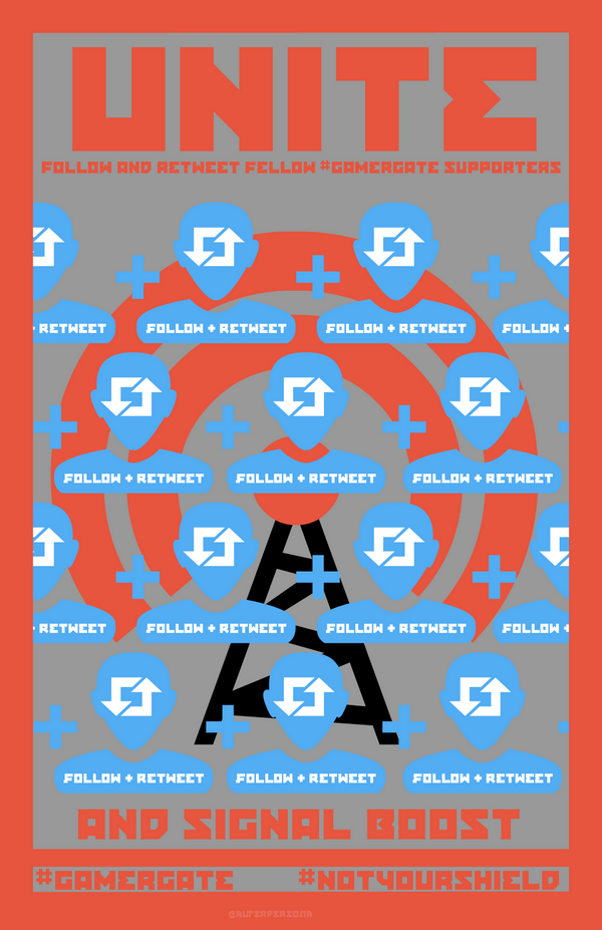
PS: Do to some various distractions, I will be posting my answer to “what can I do” tomorrow. In the meantime: join Twitter, follow, 1 #GamerGate retweet, 1 #GamerGate favorite. That’s a 10-second daily commitment. If you can’t do that, you can’t do anything.


50,000 readers a day

From the 2012 New York Times:

Handily demolishing the burger that he had chosen over a Midtown restaurant’s fancier Mediterranean fare, Mr. Scalzi was anything but grim; he smiled readily and giggled heartily. He is comfortable with the business of promotion: An affable speaker, he is familiar with the patois of fandom and is adept at generating buzz through the nerd mafia of like-minded collaborators. He already reaches up to 50,000 readers a day through his popular blog, “Whatever.”

So with the end of October, the three-month daily traffic average, in direct apples-to-apples terms of WordPress pageviews, has now reached 50,504. In other words, for the last three months, I’ve been genuinely averaging the sort of traffic that McRapey used to lie about having. The fact is that in July 2012, Whatever averaged 21,102 pageviews per day, up from 16,356 the month before.

As it happens, I could claim “up to 65,000 readers a day” on the same basis, but I don’t, because that would be ludicrously untruthful. First, pageviews are not readers. Second, there is no reasonable justification for using an extreme outlier when an accurate average is available. It is knowingly deceptive, even if it is common in “the busines of promotion”.

SJWs always lie. Never forget that. Never take anything they say about anyone, especially themselves, for granted. They deceive, exaggerate, and spin. They will say anything they think will make themselves look better and make their rivals and enemies look worse. They are the sort of people who habitually pretend “everybody thinks” is synonymous with “I think” and try to influence others through nonexistent peer pressure. They repeatedly appeal to nonexistent consensuses. Even when they tell the literal truth, it is usually presented in a manner intended to deceive in some way.

But they are very comfortable with the business of promotion. It’s not hard to be, when you are equally comfortable with saying things that are misleading, deceptive, and outright false. So always – always – run their numbers.

The truth is that Whatever has actually reached over 100,000 pageviews in a single day thanks to some helpful external links on three or four occasions, but McRapey did not dare tell the New York Times “up to 100,000 pageviews per day” even though he could have truthfully done so because it would have sounded ridiculous considering his actual daily traffic. But he thought, correctly, that he could get away with the misleading “up to 50,000” claim. It’s worth noting that within five months, he dropped the true, but deceptive “up to” part of the claim and was directly lying about his traffic again. Just as he had previously done in 2010, when he was interviewed by Lightspeed.  

“Scalzi himself quotes it at over 45,000 unique visitors daily and more than two million page views monthly.”   

Two million monthly? That’s a claim of more than 64,516 average daily pageviews… and at a time when he was actually seeing 12,860 per day.