Vol. 4: A Roland for an Oliver

My favorite story from JUNIOR CLASSICS VOL. 4: HEROES OF CHIVALRY

Guerin de Montglave held the lordship of Vienne, subject to Charlemagne. He had quarrelled with his sovereign, and Charles laid siege to his city, having ravaged the neighboring country. Guerin was an aged warrior, but relied for his defence upon his four sons and two grandsons, who were among the bravest knights of the age. After the siege had continued two months, Charlemagne received tidings that Marsilius, King of Spain, had invaded France and, finding himself unopposed, was advancing rapidly in the Southern provinces. At this intelligence, Charles listened to the counsel of his peers, and consented to put the quarrel with Guerin to the decision of Heaven, by single combat between two knights, one of each party, selected by lot. The proposal was acceptable to Guerin and his sons. The names of the four, together with Guerin’s own, who would not be excused, and of the two grandsons, who claimed their lot, being put into a helmet, Oliver’s was drawn forth, and to him, the youngest of the grandsons, was assigned the honor and the peril of the combat. He accepted the award with delight, exulting in being thought worthy to maintain the cause of his family. On Charlemagne’s side Roland was the designated champion, and neither he nor Oliver knew who his antagonist was to be.

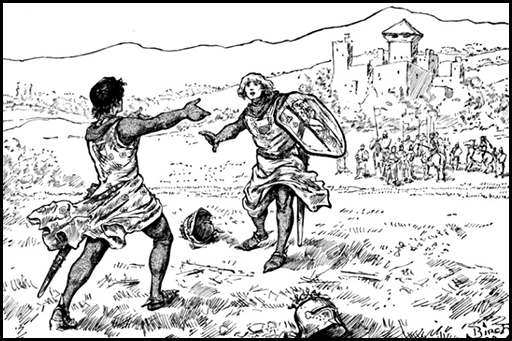
They met on an island in the river Rhone, and the warriors of both camps were ranged on either shore, spectators of the battle. At the first encounter both lances were shivered, but both riders kept their seats, immovable. They dismounted, and drew their swords. Then ensued a combat which seemed so equal, that the spectators could not form an opinion as to the probable result. Two hours and more the knights continued to strike and parry, to thrust and ward, neither showing any sign of weariness, nor ever being taken at unawares. At length Roland struck furiously upon Oliver’s shield, burying Durendal in its edge so deeply that he could not draw it back, and Oliver, almost at the same moment, thrust so vigorously upon Roland’s breastplate that his sword snapped off at the handle. Thus were the two warriors left weaponless.

Scarcely pausing a moment, they rushed upon one another, each striving to throw his adversary to the ground, and failing in that, each snatched at the other’s helmet to tear it away. Both succeeded, and at the same moment they stood bareheaded face to face, and Roland recognized Oliver, and Oliver, Roland. For a moment they stood still, and the next, with open arms, rushed into one another’s embrace.

“I am conquered,” said Roland.

“I yield me,” said Oliver.

The people on the shore knew not what to make of all this. Presently they saw the two late antagonists standing hand in hand, and it was evident the battle was at an end. The knights crowded round them, and with one voice hailed them as equals in glory. If there were any who felt disposed to murmur that the battle was left undecided, they were silenced by the voice of Ogier the Dane, who proclaimed aloud that all had been done that honor required, and declared that he would maintain that award against all gainsayers.

The quarrel with Guerin and his sons being left undecided, a truce was made for four days, and in that time, by the efforts of Duke Namo on the one side, and of Oliver on the other, a reconciliation was effected. Charlemagne, accompanied by Guerin and his valiant family, marched to meet Marsilius, who hastened to retreat across the frontier.

DISCUSS ON SG


Vol. 3: Hector and Ajax

FYI: we’re rapidly approaching the last few hours of the Thanksgiving Junior Classics sale. The sets will still be available going forward at the following links, and via Amazon, Barnes & Noble, and other booksellers, but the price will be the retail price $349.99 instead of the sale price of $249.99

And remember, if you’re having any trouble ordering from Arkhaven, please don’t hesitate to use NDM Express. They’re two entirely different systems, so if one doesn’t work, the other usually will.

HECTOR AND AJAX, from Tales of Greece and Rome

The Greeks went forward to the battle, as the waves that curl themselves and then dash upon the shore, throwing high the foam. In order they went after their chiefs; you had thought them dumb, so silent were they. But the Trojans were like a flock of ewes which wait to be milked, and bleat hearing the voice of their lambs, so confused a cry went out from their army, for there were men of many tongues gathered together. And on either side the gods urged them on, but chiefly Minerva the Greeks and Mars the sons of Troy. Then, as two streams in flood meet in some chasm, so the armies dashed together, shield on shield and spear on spear.

Now when Minerva saw that the Greeks were perishing by the hand of Hector and his companions, it grieved her sore. So she came down from the heights of Olympus, if happily she might help them. And Apollo met her and said, “Art thou come, Minerva, to help the Greeks whom thou lovest? Well, let us stay the battle for this day; hereafter they shall fight till the doom of Troy be accomplished.”

But Minerva answered, “How shall we stay it?”

And Apollo said, “We will set on Hector to challenge the bravest of the Greeks to fight with him, man to man.”

So they two put the matter into the mind of Helenus the seer. Then Helenus went near to Hector, “Listen to me, for I am thy brother. Cause the rest of the sons of Troy and of the Greeks to sit down, and do thou challenge the bravest of the Greeks to fight with thee, man to man. And be sure thou shalt not fall in the battle, for the will of the immortal gods is so.”

Then Hector greatly rejoiced, and passed to the front of the army, holding his spear by the middle, and kept back the sons of Troy, and King Agamemnon did likewise with his own people. Then Hector spake:

“Hear me, sons of Troy, and ye men of Greece. The covenant that we made one with another hath been broken, for Jupiter would have it so, purposing evil to both, till either you shall take our high-walled city or we shall conquer you by your ships. But let one of you who call yourselves champions of the Greeks come forth and fight with me, man to man. And let it be so that if he vanquish me he shall spoil me of my arms but give my body to my people, that they may burn it with fire, and if I vanquish him, I will spoil him of his arms but give his body to the Greeks, that they may bury him and raise a great mound above him by the broad salt river of Hellespont. And so men of after days shall see it, sailing by, and say, `This is the tomb of the bravest of the Greeks, whom Hector slew.’ So shall my name live forever.”

But all the Greeks kept silence, fearing to meet him in battle, but shamed to hold back. Then at last Menelaus leapt forward and spake, “Surely now ye are women and not men. Foul shame it were should there be no man to stand up against this Hector. Lo! I will fight with him my own self, for the issues of battle are with the immortal gods.”

So he spake in his rage rashly, courting death, for Hector was much stronger than he. Then King Agamemnon answered, “Nay, but this is folly, my brother. Seek not in thy anger to fight with one that is stronger than thou; for as for this Hector, even Achilles was loth to meet him. Sit thou down among thy comrades, and the Greeks will find some champion who shall fight with him.”

And Menelaus hearkened to his brother’s words, and sat down. Then Nestor rose in the midst and said, “Woe is me today for Greece! How would the old Peleus grieve to hear such a tale! Well I remember how he rejoiced when I told him of the house and lineage of all chieftains of the Greeks, and now he would hear that they cower before Hector, and are sore afraid when he calls them to the battle. Surely he would pray this day that he might die! O that I were such as I was in the old days, when the men of Pylos fought with the Arcadians! I, who was the youngest of all, stood forth, and Minerva gave me glory that day, for I slew their leader, though he was the strongest and tallest among the sons of men. Would that I were such today! Right soon would I meet this mighty Hector.”

Then rose up nine chiefs of fame. First of all, King Agamemnon, lord of many nations, and next to him Diomed, and Ajax the Greater and Ajax the Less, and then Idomeneus and Meriones, and Eurypylus, and Thoas, son of Andraemon, and the wise Ulysses.

Then Nestor said, “Let us cast lots who shall do battle with the mighty Hector.”

So they threw the lots into the helmet of King Agamemnon, a lot for each. And the people prayed, “Grant, ye gods, that the lot of Ajax the Greater may leap forth, or the lot of Diomed, or the lot of King Agamemnon.”

Then Nestor shook the lots in the helmet, and the one which they most wished leapt forth. For the herald took it through the ranks and showed it to the chiefs, but none knew it for his own till he came to where Ajax the Greater stood among his comrades. But Ajax had marked it with his mark, and put forth his hand for it, and claimed it, right glad at heart. On the ground by his feet he threw it, and said:

“Mine is the lot, my friends, and right glad I am, for I think that I shall prevail over the mighty Hector, but come, let me don my arms, and pray ye to Jupiter, but silently, lest the Trojans hear, or aloud, if ye will, for no fear have we. Not by force or craft shall any one vanquish me, for not such are the men whom Salamis breeds.”

So he armed himself and moved forwards, smiling with grim face. With mighty strides he came, brandishing his long-shafted spear. The Greeks were glad to behold him, but the knees of the Trojans were loosened with fear and great Hector’s heart beat fast, but he trembled not, nor gave place, seeing that he had himself called him to battle. So Ajax came near, holding before the great shield, like a wall, which Tychius, best of craftsmen, had made for him. Seven folds of bull’s hide it had, and an eighth of bronze. Threateningly he spake:

“Now shalt thou know, Hector, what manner of men there are yet among our chiefs, though Achilles the lion-hearted is far away, sitting idly in his tent, in great wrath with King Agamemnon. Do thou, then, begin the battle.”

“Speak not to me, Jupiter-descended Ajax,” said Hector, “as though I were a woman or a child knowing nothing of war. Well I know all the arts of battle, to ply my shield this way and that, to guide my car through the tumult of steeds, and to stand fighting hand to hand. But I would not smite so stout a foe by stealth, but openly.”

As he spake he hurled his long-shafted spear, and smote the great shield on the rim of the eighth fold, that was of bronze. Through six folds it passed, but in the seventh it was stayed. Then Ajax hurled his spear, striking Hector’s shield. Through shield it passed and corslet, and cut the tunic close against the loin, but Hector shrank away and escaped the doom of death. Then, each with a fresh spear, they rushed together like lions or wild boars of the wood.

First Hector smote the middle of the shield of Ajax, but pierced it not, for the spear-point was bent back; then Ajax, with a great bound, drove his spear at Hector’s shield and pierced it, forcing him back, and grazing his neck so that the blood welled out. Yet did not Hector cease from the combat. He caught up a great stone from the ground, and hurled it at the boss of the sevenfold shield. Loud rang the bronze, but the shield broke not. Then Ajax took a stone heavier by far, and threw it with all his might. It broke the shield of Hector, and bore him backwards, so that he fell at length with his shield above him. But Apollo raised him up. Then did both draw their swords, but ere they could join in close battle the heralds came and held their scepters between them, and Idaeus, the herald of Troy, spake.

“Fight no more, my sons; Jupiter loves you both, and ye are both mighty warriors. That we all know right well. But now the night bids you cease, and it is well to heed its bidding.”

Then said Ajax, “Nay, Idaeus, but it is for Hector to speak, for he called the bravest of the Greeks to battle. And as he wills it, so will I.”

And Hector said, “O Ajax, the gods have given thee stature and strength and skill, nor is there any better warrior among the Greeks. Let us cease then from the battle; we may yet meet again, till the gods give the victory to me or thee. And now let us give gifts the one to the other, so that Trojans and Greeks may say—Hector and Ajax met in fierce fight and parted in friendship.”

So Hector gave to Ajax a silver-studded sword with the scabbard and the sword-belt, and Ajax gave to Hector a buckler splendid with purple. So they parted. Right glad were the sons of Troy when they saw Hector returning safe. Glad also were the Greeks, as they led Ajax rejoicing in his victory to King Agamemnon. Whereupon the king called the chiefs to banquet together, and bade slay an ox of five years old, and Ajax he honored most of all. When the feast was ended Nestor said:

“It were well that we should cease awhile from war and burn the dead, for many, in truth, are fallen. And we will build a great wall and dig a trench about it, and we will make wide gates that a chariot may pass through, so that our ships may be safe, if the sons of Troy should press us hard.”

But the next morning came a herald from Troy to the chiefs as they sat in council by the ship of King Agamemnon, and said:

“This is the word of Priam and the men of Troy; Paris will give back all the treasures of the fair Helen, and many more besides, but the fair Helen herself he will not give. But if this please you not, grant us a truce, that we may bury our dead.”

Then Diomed spake, “Nay, we will not take the fair Helen’s self, for a man may know even though he be a fool, that the doom of Troy is come.”

And King Agamemnon said, “Herald, thou hast heard the word of the Greeks, but as for the truce, be it as you will.”

So the next day they burnt their dead, and the Greeks made a wall with gates and dug a trench about it. And when it was finished, even at sunset, they made ready a meal, and lo! There came ships from Lemnos bringing wine, and Greeks bought thereof, some with bronze, and some with iron, and some with shields of ox hide. All night they feasted right joyously. The sons of Troy also feasted in their city. But the dreadful thunder rolled through the night, for Jupiter was counselling evil against them.

DISCUSS ON SG

Vol. 1: Manabozho, the Mischief-Maker

As we’ve finally finished the last two volumes required to complete the set of the 10-volume Castalia Junior Classics, I thought I’d share my favorite work from each volume, starting today. One of the things that I found truly startling about the stories from the 1919 edition that did not survive to the 1958 edition that I grew up reading were the tales of the American Indians. They are a little harsher and more cruel than one might tend to expect of children’s tales, especially these days. And the historical difficulties that the rival Indian tribes faced in uniting to oppose the flood of settlers from Europe become a little easier to understand when one realizes that the Indians were perhaps a little too competitive with each other, as evidenced by the behavior of their cultural heroes.

Four of the five stories of the American Indians that we chose to include feature Manabozho, the Algonquin and Ojibwe trickster demigod who is a little more human than the better-known Coyote of the Lakota, the Navajo and the Sioux. What follows is just one of the 89 stories presented in Volume I: Fairy Tales & Fables.

In the tales of the American Indians, Manabozho, or more commonly Nanabozho, figures prominently in their storytelling, including the story of the world’s creation. Nanabozho is the Ojibwe trickster figure and culture hero. Nanabozho can take the shape of male or female animals or humans in storytelling. Most commonly it is an animal such as a raven or coyote which lives near the tribe and which is cunning enough to make capture difficult.

And remember, if you’re having any trouble ordering from Arkhaven, please use NDM Express. They’re two entirely different systems, so if one doesn’t work, the other usually will.

Manabozho, the Mischief-Maker

There was never in the whole world a more mischievous busybody than that notorious giant Manabozho. He was everywhere, in season and out of season, running about, and putting his hand in whatever was going forward.

To carry on his game he could take almost any shape he pleased. He could be very foolish or very wise, very weak or very strong, very rich or very poor—just as happened to suit his humor best. Whatever anyone else could do, he would attempt without a moment’s reflection. He was a match for any man he met, and there were few manitou that could get the better of him. By turns he would be very kind or very cruel, an animal or a bird, a man or a spirit, and yet, in spite of all these gifts, Manabozho was always getting himself involved in all sorts of troubles. More than once, in the course of his adventures, was this great maker of mischief driven to his wits’ ends to come off with his life.

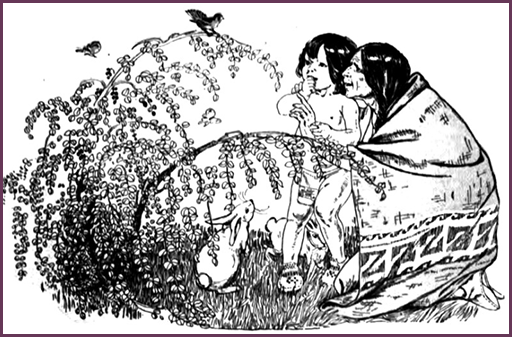
To begin at the beginning, Manabozho, while yet a youngster, was living with his grandmother near the edge of a great prairie. It was on this prairie that he first saw animals and birds of every kind; he also there made first acquaintance with thunder and lightning. He would sit by the hour watching the clouds as they rolled by, musing on the shades of light and darkness as the day rose and fell.

For a stripling, Manabozho was uncommonly wide-awake. Every sight he beheld in the heavens was a subject of remark, every new animal or bird an object of deep interest, and every sound was like a new lesson which he was expected to learn. He often trembled at what he heard and saw.

The first sound he heard was that of the owl, at which he was greatly terrified, and, quickly descending the tree he had climbed, he ran with alarm to the lodge. “Noko! Noko! Grandmother!” he cried. “I have heard a monedo.”

She laughed at his fears, and asked him what kind of a noise it made. He answered. “It makes a noise like this: ko-ko-ko-ho!” His grandmother told him he was young and foolish; that what he heard was only a bird which derived its name from the peculiar noise it made.

He returned to the prairie and continued his watch. As he stood there looking at the clouds he thought to himself, “It is singular that I am so simple and my grandmother so wise; and that I have neither father nor mother. I have never heard a word about them. I must ask and find out.”

He went home and sat down, silent and dejected. Finding that this did not attract the notice of his grandmother, he began a loud lamentation, which he kept increasing, louder and louder, till it shook the lodge and nearly deafened the old grandmother.

“Manabozho, what is the matter with you?” she said. “You are making a great deal of noise.”

Manabozho started off again with his doleful hubbub, but succeeded in jerking out between his big sobs, “I haven’t got any father nor mother, I haven’t.”

Knowing that he was of a wicked and revengeful nature, his grandmother dreaded to tell him the story of his parentage, as she knew he would make trouble of it.

Manabozho renewed his cries and managed to throw out for a third or fourth time, his sorrowful lament that he was a poor unfortunate who had no parents or relatives.

At last she said to him, to quiet him, “Yes, you have a father and three brothers living. Your mother is dead. She was taken for a wife by your father, the West, without the consent of her parents. Your brothers are the North, East, and South; and being older than you your father has given them great power with the winds, according to their names. You are the youngest of his children. I have nursed you from your infancy, for your mother died when you were born.”

“I am glad my father is living,” said Manabozho, “I shall set out in the morning to visit him.”

His grandmother would have discouraged him, saying it was a long distance to the place where his father, Ningabinn, or the West, lived.

This information seemed rather to please than to discourage Manabozho, for by this time he had grown to such a size and strength that he had been compelled to leave the narrow shelter of his grandmother’s lodge and live out of doors. He was so tall that, if he had been so disposed, he could have snapped off the heads of the birds roosting on the topmost branches of the highest trees, as he stood up, without being at the trouble to climb. And if he had at any time taken a fancy to one of the same trees for a walking stick, he would have had no more to do than to pluck it up with his thumb and finger and strip down the leaves and twigs with the palm of his hand.

Bidding goodbye to his old grandmother, who pulled a very long face over his departure, Manabozho set out at a great pace, for he was able to stride from one side of a prairie to the other at a single step.

He found his father on a high mountain far in the west. His father espied his approach at a great distance, and bounded down the mountainside several miles to give him welcome. Apparently delighted with each other, they reached in two or three of their giant paces the lodge of the West which stood high up near the clouds.

They spent some days in talking with each other—for these two great persons did nothing on a small scale, and a whole day to deliver a single sentence, such was the immensity of their discourse, was quite an ordinary affair.

One evening Manabozho asked his father what he was most afraid of on earth.

He replied, “Nothing.”

“But is there nothing you dread here—nothing that would hurt you if you took too much of it? Come, tell me.”

Manabozho was very urgent, so at last his father said, “Yes, there is a black stone to be found a couple of hundred miles from here, over that way,” pointing as he spoke. “It is the only thing on earth I am afraid of, for if it should happen to hit me on any part of my body it would hurt me very much.” The West made this important circumstance known to Manabozho in the strictest confidence.

“Now you will not tell anyone, Manabozho, that the black stone is bad medicine for your father, will you?” he added. “You are a good son, and I know you will keep it to yourself. Now tell me, my darling boy, is there not something that you don’t like?”

Manabozho answered promptly, “Nothing.”

His father, who was of a steady and persevering nature, put the same question to him seventeen times, and each time Manabozho made the same answer, “Nothing.”

But the West insisted, “There must be something you are afraid of.”

“Well, I will tell you,” said Manabozho, “what it is.”

He made an effort to speak, but it seemed to be too much for him.

“Out with it,” said the West, fetching Manabozho such a blow on the back as shook the mountain with its echo.

“Je-ee, je-ee-it is,” said Manabozho, apparently in great pain. “Yes, yes! I cannot name it, I tremble so.”

The West told him to banish his fears, and to speak up; no one would hurt him. Manabozho began again, and he would have gone over the same make-believe of pain, had not his father, whose strength he knew was more than a match for his own, threatened to pitch him into a river about five miles off. At last he cried out, “Father, since you will know, it is the root of the bulrush.” He who could with perfect ease spin a sentence a whole day long, seemed to be exhausted by the effort of pronouncing that one word, “bulrush.”

Some time after Manabozho observed, “I will get some of the black rock, merely to see how it looks.”

“Well,” said the father, “I will also get a little of the bulrush root, to learn how it tastes.”

They were both double-dealing with each other, and in their hearts getting ready for some desperate work. They had no sooner separated for the evening than Manabozho was striding off the couple of hundred miles necessary to bring him to the place where the black rock was to be procured, while down the other side of the mountain hurried Ningabinn, the West.

At the break of day they each appeared at the great level on the mountaintop, Manabozho with twenty loads, at least, of the black stone, on one side, and on the other the West, with a whole meadow of bulrush in his arms.

Manabozho was the first to strike—hurling a great piece of the black rock, which struck the West directly between the eyes, and he returned the favor with a blow of bulrush that rung over the shoulders of Manabozho, far and wide, like the long lash of the lightning among the clouds.

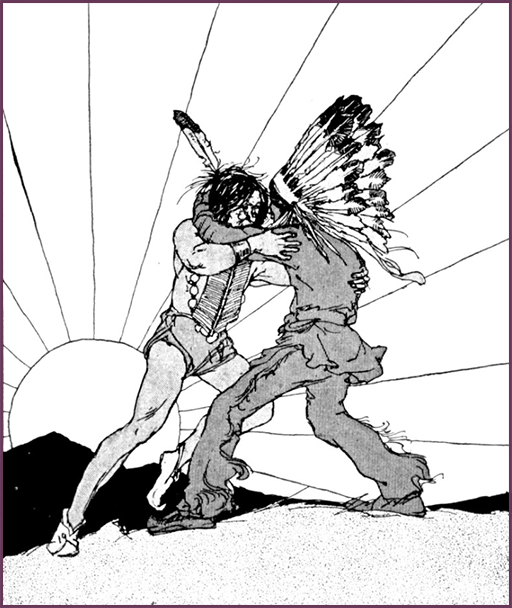
First one and then the other, Manabozho poured in a tempest of black rock, while the West discharged a shower of bulrush. Blow upon blow, thwack upon thwack—they fought hand to hand until black rock and bulrush were all gone. Then they betook themselves to hurling crags at each other, cudgeling with huge oak trees, and defying each other from one mountain top to another; while at times they shot enormous boulders of granite across at each other’s heads, as though they had been mere jackstones. The battle, which had commenced on the mountains, had extended far west. The West was forced to give ground. Manabozho pressing on, drove him across rivers and mountains, ridges and lakes, till at last he got him to the very brink of the world.

“Hold!” cried the West. “My son, you know my power, and although I allow I am now fairly out of breath, it is impossible to kill me. Stop where you are, and I will also portion you out with as much power as your brothers. The four quarters of the globe are already occupied, but you can go and do a great deal of good to the people of the earth, which is beset with serpents, beasts and monsters, who make great havoc of human life. Go and do good, and if you put forth half the strength you have today, you will acquire a name that will last forever. When you have finished your work I will have a place provided for you. You will then go and sit with your brother, Kabinocca, in the north.”

Manabozho gave his father his hand upon this agreement. And parting from him, he returned to his own grounds, where he lay for some time sore of his wounds.

DISCUSS ON SG


The Junior Classics are Complete

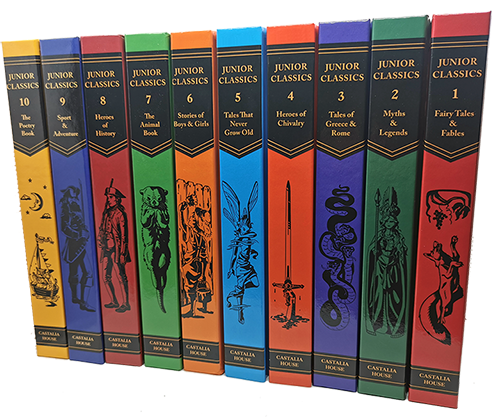
Six years ago, we embarked upon a massive project. I don’t think we quite realized just how massive it would be, since instead of simply replicating the original 1919 set published one century before, which had been our original intention, we ended up recreating all ten volumes from scratch, complete with original spine and cover illustrations from Lacey Fairchild. In assembling the set, we published more than 1.2 million words and literally hundreds of illustrations all carefully curated for content and quality; the time it took us to finish the task may make more sense when the size of the project is taken into account.

The campaign was a huge success, as 1,781 backers supported it, and waited patiently as the years passed and we only managed to get out one or two volumes each year on average. But now we’re very pleased to be able to say that we have finished the final two volumes and present the first picture of the entire set assembled together. The books have already been ordered for the backers of the royale editions (the demys will ship in January), and we expect them to reach the warehouse the second week of December.

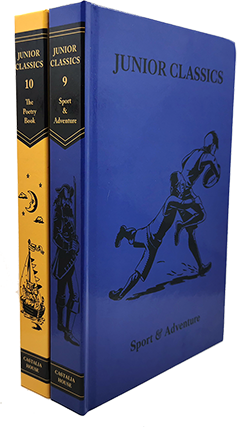
Since it’s Thanksgiving time and we have a substantial leather book sale on, we thought we should go ahead and make these excellent books available as part of it. Which is why, until the end of the month, you can purchase the entire set for $249.99, which is a discount of $100 from the retail price. And if you’ve already purchased the previous eight volumes, you can buy the two new volumes together for a sale price of $59.99, discounted from $69.99. There is no need for backers to do anything except confirm their shipping addresses when NDM sends out the shipping notifications, unless, of course, you’re looking for a second set to give as a gift.

The publication of Volumes 9 and 10 marks the completion of Castalia House’s first major project, and while it took us a lot longer than we’d ever imagined it would, we have arrived with a level of quality that I believe the backers have found satisfactory despite the wait. We’re already working on completing the deluxe leather set, and we will be introducing a special subscription in January for those who are interested in acquiring one next year.

Please note that the complete 10-volume set can also be purchased for the same Thanksgiving sale price of $249.99 at NDM Express. If, for some reason, you’re having trouble with your card at our European store, please try NDM.

DISCUSS ON SG