Navies in space

Foreign Policy interviews a naval analyst concerning what science fiction gets right and what it gets wrong about warfare, especially from the naval perspective upon which so much fictional space war is based.

FP: The United States is in the midst of a major
debate on what our defense policy, especially given shrinking budgets and the
rise of China as Pacific sea power.  Does
sci-fi offer lessons on how the United States can resolve this?

CW: Fiction does not replace policy analysis.  But science fiction is the literature of
“what if?”  Not just “what
if X happens?” but also “what if we continue what we’re doing?”  In that way, science fiction can inform
policy making directly, and it can inform those who build scenarios for
wargames and exercises and the like. One of the great strengths of science
fiction is that it allows you have a conversation about something that you
otherwise couldn’t talk about because it’s too politically charged. It allows
you to create the universe you need in order to have the conversation you want
to have. Battlestar Galactica spent a lot of time talking about the war in
Iraq. There were lots of things on that show about how you treat prisoners.
They never came out and said that directly. They didn’t have to. At the Naval
War College, one of the core courses on strategy and policy had a section on
the Peloponnesian War. It was added to the curriculum in the mid-1970s because
the Vietnam War was too close, so they couldn’t talk about it, except by going
back to 400 BC. 

I’m a big believer in the martial utility of wargaming, but as the article notes, most wargames and all science fiction tend to completely omit the more tedious elements of war, especially logistics and bureaucracy.  Unsurprisingly, wargames tend to do a better job of addressing strategic assumptions and strategic goals than other entertainment media, although even the wargaming implimentation are usually built into the game design rather than left up to the player.


On this day

I understand there are various events of note occurring around the world today. But surely the most momentous is this: the greatest goal in the history of Tip Kick. It occurred today, June 28, 2012, from a goal kick. It inscribed a perfect arc, right into the upper corner of the net, actually knocking aside the outstretched hands of the surprised keeper. GOOOOOOOOOOOOLLLLL!!!!!!

There will be other goals today, but none, I think, so magnificent.

UPDATE: Avanti Azzurri! 2-1 and it probably should have been 5-1.


The deadly tarpit

Curt Schilling is only the latest lover of games with money to learn that game development isn’t anywhere nearly as easy as it looks:

After remaining silent as his video game company collapsed around him, Curt Schilling is finally speaking out — and he’s not happy. The former Red Sox pitcher responded to critics, pointing out that he stands to lose as much as $50 million dollars if his troubled 38 Studios can’t be saved…. 38 Studios laid off all 379 of its employees last week. The workers, who received no warning about the cuts, also reportedly have seen their health benefits expire. The tolls of the shutdown have affected Schilling as well, as the former All-Star has lost 33 lbs. in the past 45 days. The company’s woes stem from a $75 million loan acquired from the state of Rhode Island in 2010, a move by the state to lure the then-promising company away from its home base in Massachusetts. In February of 2012, 38 Studios shipped its first game, Kingdoms of Amalur: Reckoning. While the game was a mid-level hit, selling over 1 million copies, it was unable to help the company stay afloat.

What a nightmare. I always expected it to end this way, only I had no idea 38 Studios had been conceived on so large a scale. Being an ASL player, I’m very remotely acquainted with Curt, and I even sent him an email offering to give him some advice on either development or design when I first heard that he’d set it up. He sent back a friendly email thanking me for my good wishes, but it was clear that he felt he’d put an all-star team together and everything was well under control. But when I looked at the names involved, I didn’t recognize any of them as producers I would trust to finish a project and it looked very much like a repeat of Ion Storm, with more money and celebrity involved than good sense or productivity.

I absolutely hate seeing this sort of thing. I’ve seen it happen too many times now, to too many good and smart people who simply fail to understand how difficult it is to build a successful game, let alone a successful game company. If you look at the successful ones, even the ones that seem to come from nowhere, they’ve almost always got a long track record of creating and completing a whole host of little games you’ve never heard of. You simply don’t do a WoW, or even an Angry Birds, the first time out of the gate. How is it that people are still wasting $25 million, $50 million, even $100 million in developing nothing while a proven developer like Tarn Adams has been releasing brilliant, innovative games on a shoestring for years?

There are tremendous dangers on every side in the game development process, and worst of all, you’re constantly working against a ticking clock. Just a few weeks ago, someone sent me a link to this page, with some screen shots of our never-released Traveller RPG game that was cancelled by Sega of Japan when they closed their Sega of America operations and ended all US-based Katana (Dreamcast) development. I don’t know if we got out at the right time or not; sometimes I wish we’d gone ahead and done what was essentially CoD/MoH – or as we called it, first-person ASL – five years before the first WWII shooters came out. But we were burned out, we’d already done very well out of the Rebel Moon games, and the industry was becoming more about the business and less about the games. But when I see one successful guy after another crash and burn while trying to shoot directly for the Moon, it makes me want to set up shop as a consultant, telling these people to spend a lot less money, hire a lot fewer people, and directing their focus on making entertaining games and not failing to even release what is supposed to be the next CoD/WoW/AB.


A failure in condescension

In which SFWA President-for-Life John Scalzi’s misguided attempt to curry favor with the non-white, non-male portion of the population is shown to be conclusively wrong by his very own selected metrics:

I’ve been thinking of a way to explain to straight white men how life works for them, without invoking the dreaded word “privilege,” to which they react like vampires being fed a garlic tart at high noon. It’s not that the word “privilege” is incorrect, it’s that it’s not their word. When confronted with “privilege,” they fiddle with the word itself, and haul out the dictionaries and find every possible way to talk about the word but not any of the things the word signifies.

So, the challenge: how to get across the ideas bound up in the word “privilege,” in a way that your average straight white man will get, without freaking out about it?

Being a white guy who likes women, here’s how I would do it:

Dudes. Imagine life here in the US — or indeed, pretty much anywhere in the Western world — is a massive role playing game, like World of Warcraft except appallingly mundane, where most quests involve the acquisition of money, cell phones and donuts, although not always at the same time. Let’s call it The Real World. You have installed The Real World on your computer and are about to start playing, but first you go to the settings tab to bind your keys, fiddle with your defaults, and choose the difficulty setting for the game. Got it?

Okay: In the role playing game known as The Real World, “Straight White Male” is the lowest difficulty setting there is.

This means that the default behaviors for almost all the non-player characters in the game are easier on you than they would be otherwise. The default barriers for completions of quests are lower. Your leveling-up thresholds come more quickly. You automatically gain entry to some parts of the map that others have to work for. The game is easier to play, automatically, and when you need help, by default it’s easier to get.

Now, let me first point out that John is not a bad guy. He’s actually remarkably low on the obnoxious left-liberal scale for a science fiction writer, much less a successful one, and there is no question that he means well. That being said, he’s about as socio-sexually Gamma as it is possible to be and still be straight, and for someone whose communication skills are quite high, he’s uncharacteristically oblivious to what a condescending little fuck this post makes him appear to be. But it’s only an illusion, as the reality is that Scalzi is actually engaging in a brilliant subversion.

This will, of course, escape most readers. I suspect the average straight white man who actually works for a living rather than sitting around making up stories primarily for the benefit of obese middle-aged women aren’t terribly inclined to be lectured by an overweight, educated, soft-handed little man about how easy they have it. Let’s look at his metaphor of the difficulty setting, which as a gamer, game producer, and game designer I am rather well suited to examine.

First, I note that he is clearly referring to a snapshot in time. Straight white men didn’t have it any easier than, for example, straight brown men back in the age of the Pharoahs, nor will they have it easier should China defeat the USA in 2050. So, the metrics have to refer to today, now, not what life was like in 500 BC, 1850, or 2050. Having established that, let’s look at the measures he specifically notes and see how many of them are true:

1. The default barriers for completions of quests are lower.
2. Your leveling-up thresholds come more quickly.
3. You automatically gain entry to some parts of the map that others have to work for.
4. The game is easier to play, automatically
5. When you need help, by default it’s easier to get.

1. This is clearly false. There is copious evidence showing that Scalzi has it completely wrong here. Who is permitted to graduate from high school or college while doing sub-standard work, a black individual or a white one? Who is permitted to skate in the workplace more often, men or women? For whom are the standards reduced more often, white men or non-white men?

2. This is also generally false; Scalzi’s perspective here is likely skewed from his professional involvement in the literary and Hollywood worlds, where connections matter far more than experience or achievement. But unless your father owns the cleaning company, the average white male janitor or white male sales guy is not going to level up any more quickly than anyone else, in fact, there is considerable statistical evidence that proves women are promoted much more quickly than men in corporate America. One need only look at news broadcasts to see an example of this; one never sees a twenty-two year old man reading the news. Note that the median age of female newscasters is 26, six years younger than male newscasters.

3. This is true, but irrelevant and misleading. Scalzi simply ignores that white men created the desirable parts of the map where everyone wants to go. There is no straight white male privilege in Zimbabwe because their existence is strongly frowned upon… and what was once the wealthy colony of Rhodesia is now a third-world hellhole. Scalzi has his causation backwards here, it would be more relevant and historically correct to say that white men create more desirable parts of the map than others. If he seriously wishes to dispute this, I suggest he move away from his lily-white Midwestern exurbia into a more vibrant community such as South-Central Los Angeles, downtown Detroit, or post-Apartheid Yeoville. It should come as no surprise that straight white men happen to be better at playing the game of Western Civilization than anyone else. They’re probably less naturally accomplished at the Grass Hut Game, the Aesthetic Stasis Game, or the Naked Savage Orgy Game.

4. Is the game easier to play or are the players intrinsically more skilled? Scalzi simply makes a naked assertion without offering any support for it. Since the game is the same and the rules are the same, logic favors the idea that any quantitative advantage to the straight white male in this regard stems from the way in which the characters points are distributed more efficiently rather than the game setting.

5. This is obviously untrue. The research on the male inclination to ask for, and accept, help clearly demonstrates that it is women who find help much easier to get. The ease with which women and minorities are permitted to exercise free association while white men are not proves that help is much harder for them to get than for others.

So, ironically enough, subversively enough, Scalzi not only fails to make his case, but by his own chosen metrics, winds up demonstrating that it is women who are playing on the lowest difficulty setting, not men. One would think that was obvious, given how they live longer, work less, and have far more options open to them. As for the straight question, that’s not even relevant, since homosexuality is not the equivalent of a difficulty setting, but rather, being left-handed and choosing to play with your left hand on a right-handed controller. It’s understandable why someone might make that decision, but the controller is what it is and it works a lot better if you simply use your non-dominant hand.

Reclaiming the crown

It was looking pretty grim there for a while. I took control of the center with my knights, but then launched an attempt on Ender’s king that was thwarted by quick action on the part of his rook. I fell behind by a rook and a knight, but managed to put enough pressure on with the threat of queening a pawn until I could restore the balance and get back in control of the game. He eventually took the pawn, but with my original queen behind his defenses, I managed to force a checkmate with the help of my last rook and an advancing pawn.

This could be getting ugly sooner than I thought, as he asked if I could find him any books on chess strategy. I think tomorrow I’ll insist that we finish our current ASL scenario, which I’ve already got in the bag. It’s hard to take too much satisfaction in winning at chess when your intrepid opponent spends the next hour fighting a space battle in the living room with the X-wings and TIE fighters that serve as pawns.


Still INTJ

Some of the folks at Susan Walsh’s appear to have discovered Meyers-Briggs for the first time. So, I took the test given at the site they’ve been using and the result wasn’t exactly the biggest surprise.

67 Introverted
88 Intuitive
62 Thinking
78 Judging

However, this wasn’t enough to prevent Ender from beating me at chess for the first time. His knight held the center, he first nabbed one of my rooks when I got a little careless in setting up an exchange of bishops, then managed to use his one-rook advantage to queen a pawn while holding off my desperate attempt to do the same. My rook was too occupied defending my own advancing pawn to make an attempt on his castled king, so three moves later, it was checkmate.


Chess mastery

I’ve never been much of a chess player, which may seem strange considering that I’m a reasonably formidable ASL player. I suspect it has to do with the spatial relations aspect of the game; the ability to quickly adapt and improvise is less important than the ability to accurately foresee the chain of consequences from each move.

Anyhow, Ender has a new Star Wars chess set that doubles as toy X-wing and TIE fighter squadrons and we’ve been playing a game every night. He’s improving fast; last night he managed to take the offensive twice and stretched the game out twice as long as they’d previously been taking. My guess is that within a month, he’ll be beating me on occasion and within a year, he’ll be expecting to win. I taught him how to play several years ago, but he didn’t express any real interest in playing it until last week.

Anyhow, I’m curious to know if there is anyone here who plays in tournaments and has a legitimate Elo rating. I’d be interested in determining what level I’m at for comparative purposes. I tried one of the online calculators, but I’m extremely skeptical of the estimates produced. I scored a 1380 when I put in my moves, but putting in complete nonsense moves produced an 1120. If it’s correct, however, I expect to soon find myself outmatched, as Ender scored 1645, which considerably exceeds the 1,000 that Wikipedia claims is the level of a bright beginner.

Anyhow, for those who aren’t chess masters, it might be interesting to know how you scored on the ten-move online test. And for anyone who is a master, I’d be interested in playing a game of chess by email in order to experience the difference between a proper chess player and a neophyte.


A lesson in alternative logic

Let’s play He or She.

What’s that?

Say it’s a he or a she.

What’s a he or she?

An animal.

Um, okay. He.

Is it white?

No.

Is it blue?

No.

Is it red?

No.

Is it golden?

Yes.

Is it money?

No. Doesn’t it have to be an animal?

Oh yeah…. Is it a clown?

No! It’s an animal, remember? A he.

Is it a hippo? Is it pink?

No, it’s not a hippo. He’s golden, golden brown.

Is it a princess?


This is kind of cool

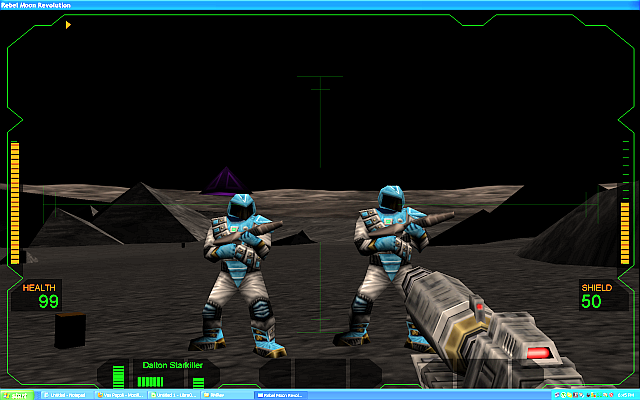
A Russian programmer who was a fan of the Rebel Moon series hit me up with some questions about Rebel Moon Revolution a few weeks ago – I still have to get back to him – and in the process of digging for some information I came across a bunch of demo files. I sent them off to him and he managed to get everything working under Windows XP complete with a mission launcher he sent back to me, so it’s been fun to see what we did back then. It was remarkable to see how advanced the AI was, as it’s 15 years later and I still haven’t seen NPC-squads showing much in the way of overwatch movement. Actually, for that matter, I don’t see it very often when playing multiplayer.


BF3: the joys of recon

After acquiring a PS/3 mike, I am quite pleased with the results, although I’m not entirely sure I’m actually communicating with anyone. In Operation Firestorm, I hopped a lift in a tank, then ditched at the Gas Station and headed high into the hills. I set up the SOFLAM on a rock overlooking the battlefield, then ran up still higher to operate it remotely.

No one did anything right away, but it was clear that simply laser-targeting the enemy tanks and planes was making them skittish. I kept reporting various vehicles and encouraging someone in my squad to Engineer up and loadout a Javelin; finally someone did and promptly took out two helicopters and a tank that was advancing on the Gas Station. That was close enough to my position that I put away the remote, broke out the rifle, and took out the tank gunner who had exited the vehicle before it brewed up.

I took out four more enemies who were in a building near the Offices before someone managed to figure out where I was, climbed the hills, and took me out while I was busy spotting. That wouldn’t have happened if I had a squadmate guarding my back, but c’est la guerre video. Regardless, by this time few enemy planes or helicopters dared fly anymore and even the tanks were cautious about advancing very far past the Docks. A few jeeps were tearing around with impunity, but when one stopped to capture the Gas Station, I took out the gunner with a 262 meter headshot, thus allowing two guys who’d been pinned down by him to kill the driver as well.

This must have been the final straw, as I saw in the camera that two jeeps and a man on foot were heading for my position with obvious ill intent. I decided discretion was the better part of valor and headed further into the hills without trying to engage them. They finally located and blew up my SOFLAM camera, so I headed into the combat area and attacked a flag or two in more conventional style. I didn’t score as many personal points playing this way as I usually do when I’m attacking flags, but since it was a close and hard-fought battle that we won by 20 tickets, I’m pretty sure that my recon action made the difference between victory and defeat. And, as a side bonus, my k/d ratio increased to 3.0.