Mailvox: a correction on Hazlitt

I finally banned the highly unpleasant Unger a few days ago, after first forcing him to back up his claim about my supposed errors on the subject of free trade, then examining those claims and determining them to be almost entirely false. I don’t mind being criticized in the slightest, but the mistakes have to be genuine and the corrections not only correct, but substantive, otherwise the criticism is actually worse than worthless because it reduces the amount of attention that can be paid to more significant matters.

I value substantive criticism, which is why I am willing to tolerate highly critical jerks so long as their criticism is dialectical and correct, or at least reasonably founded. On the other hand, I’m not the least bit interested in rhetorical critics or permitting dogmatic ideologues to litter the comments with their emotional incontinence here on a regular basis.

That being said, Unger did point out one legitimate mistake when I wrote “Here Hazlitt ironically forgets that as a champion of free trade, he cannot assume an increased tariff of $5 on sweaters means five cents less spent on 100 other American products.” I should have written “an increased price of $5 on sweaters”. Of course, he promptly revealed his customary intellectual dishonesty by making the ludicrous claim that this mistake not only rendered Hazlitt’s original point correct – it did not – but somehow invalidated everything I had written about the flaws in Hazlitt’s chapter on free trade.

In which I demonstrate a gross misreading and consequent misrepresentation of Hazlitt, which you’ve ignored for the better part of a week now, because I’m unarguably right and the point is critical enough to where the whole essay now needs to be scrapped.

The essay was more crap, and proof that Vox is singularly incapable of understanding an argument. I haven’t the time to go point by point, but Vox’s reasoning, or lack thereof, with regard to point 3, is typical of the piece, and since most of the other points depend in one way or another on the validity of that point’s reasoning, it make an excellent target. And since Vox didn’t even bother reading what Hazlitt actually said, it makes a very easy target.

First, Hazlitt said nothing about a $5 tariff on anything at all, least of all sweaters. Hazlitt wrote – emphasis added for the benefit of the semiliterate: “We can perhaps make this last point clearer by an exaggerated example. Suppose we make our tariff wall so high that it becomes absolutely prohibitive, and no imports come in from the outside world at all. Suppose, as a result of this, that the price of sweaters in America goes up only $5.”

Just to make absolutely sure that there’s no excuse for anyone to misunderstand what Hazlitt wrote – not that there was any excuse before, and not that it will stop some of you publik-skuled clowns from continuing to misunderstand: Hazlitt presents an hypothetical example of America isolating itself from the world. It once traded; henceforth it will not import anything. The country is not imposing a $5 tariff on sweaters or any other doodads. The actual tariff amount is left unspecified. It could be ten gazillion dollars per item for all anyone cares. The point is that it is prohibitive and completely effective. And the $5 figure Hazlitt gives is something else entirely – namely, the effect of this prohibition is to raise the price of sweaters $5.

Now you should see, immediately, that historical data like ‘imports presently represent 17.3 percent of GDP’ are irrelevant. If you do not, you’re a walking argument for eugenics, and I address myself solely to your intellectual betters. Under Hazlitt’s hypothetical example, imports represent precisely 0% of GDP, along with 0% of every other possible economic metric, and, while I don’t want to spoil anyone’s fun with any complicated math shit, I have to say that this likely has something to do with them not existing.

Shit. I said I was going to limit myself to (point) 3, but I can’t help but poke some fun at (point) 6, too. Yes, tariffs and the lack thereof are totally irrelevant to the question of employment. Barring legal restrictions, former steel workers can flip burgers, do laundry, or even sell their affectionate manly embraces for coin, and whether they will do any of those things or hold out for other employment has nothing whatsoever to do with trade theory. Any evidence purporting to show a link between trade policy and long-term unemployment is nonsensical, for the same reason any evidence purporting to show a link between trade policy and Martian ice cap expansion is nonsensical: the causes are elsewhere.

First, let me admit to my misreading. Unger was correct to point out that Hazlitt does not, as I had said, postulate the imposition of a $5 tariff on imported sweaters, but rather a complete ban on imports that has the effect of raising the prices of domestic sweaters by $5. So far, so good. Mea culpa.

However, Unger is completely wrong to claim that this mistake invalidated, or even altered in the slightest, my correction of Hazlitt and that this additional $5 now spent on sweaters means that 100 other domestic producers are not robbed of 5 cents each, but rather 4.14 cents apiece. His claim about the irrelevance of previous imports is not only incorrect, but underlines how his ability to reason is demonstrably lower than that of those he asserted were “a walking argument for eugenics”.

Unger himself admits that the tariff wall did not previously exist, but is a change from the previous situation. He writes of the nation-state: “It once traded; henceforth it will not import anything.” This means that of the additional $5 now being spent on the sweaters due to the unspecified tariff wall, 17.3 percent of it was previously being spent abroad, just as stated in the case of the erroneous $5 sweater tariff. The 100 other domestic producers cannot be losing the entire $5 amount to the sweater manufacturers because they were only receiving a maximum of the $4.14 cents that was being spent domestically anyway.

So, despite the misreading, my correction of Hazlitt stands. Moreoever, it should be readily apparent that because the erroneous substitution of a specific $5 tariff for an unspecified tariff wall with a $5 effect didn’t alter the correctness of my critique on that point, it is not critical enough to require the scrapping of the other 22 identifications of Hazlitt’s errors. This is little more than wishful thinking and blatant dishonesty on Unger’s part.

While I genuinely value honest criticism, this sort of exaggerated rhetoric is simply ridiculous, adds nothing to the debate, and in fact detracts significantly from it by wasting time on nonexistent and insubstantial matters rather than genuine ones. It would have been perfectly reasonable to simply point out the misreading without attempting to use the mistake as a foundation upon which to build a fictitious case in defense of Hazlitt. Some mistakes are critical, others are not, and the honest critic will always be careful to distinguish between the two. Note that I did not claim that Hazlitt’s 86-cent error in any way invalidated his entire case for free trade, it merely happened to be a minor mistake which tends to illustrate the careless and outdated nature of his reasoning.

UPDATE: Just to underline Unger’s unusual combination of ineptitude and dishonesty, he popped up here to complain about how I initially omitted the part now seen above in italics.

“How nice of you to ‘selectively quote’ (read: lie about) what I wrote. You left out a paragraph, which explained what Hazlitt said and why he was right. I said a few days ago that you weren’t a fraud, but it looks like I was wrong.”

Of course, I omitted it because it was irrelevant, neither helping his case nor hindering mine. In fact, I probably should have left it in, since “most of the other points depend in one way or another on the validity of that point’s reasoning” is obviously a false assertion. This sort of thing is precisely why I ban incompetent but energetic critics like Unger; it doesn’t matter how many times you show them to be wrong, they will just keep swinging wildly and ineffectively at you. Leaving out irrelevant elements of an argument is selectively quoting, but it is most certainly not lying about anything. Selective quoting can be dishonest but it is not, in itself, an indication of dishonesty by the person quoting.

Avert your eyes

In which I publicly engage in the practice of the Ricardian Vice:

Unit Labor Costs

Britain 100 cloth 110 wine
Portugal 90 cloth 80 wine

In the absence of transportation costs, it is efficient for Britain to produce cloth, and Portugal to produce wine, as, assuming that these trade at equal price (1 unit of cloth for 1 unit of wine) Britain can then obtain wine at a cost of 100 labor units by producing cloth and trading, rather than 110 units by producing the wine itself, and Portugal can obtain cloth at a cost of 80 units by trade rather than 90 by production.

Now let’s do this Ricardo-style and assume the perfect mobility of labor, maintaining, as Ricardo does, the perfect immobility of capital. We will likewise assume that Britain and Portugal have equally-sized labor forces. We will also follow Ricardo in leaving time and transport costs out of the equation. So, what are the consequences?

Obviously the wine and cloth laborers will move to Britain, since they will receive an 11 percent raise and a 38 percent raise respectively. However, once they get there, the doubling of the labor supply in Britain this causes will cause the price of labor to be cut in two. Britain can now produce the same amount of cloth for the cost of what was previously 50 units of labor and the same amount of wine for 55, thereby obtaining both wine and cloth for a much lower unit labor cost than what it used to cost to produce the wine alone. Portugal doesn’t get anything out of it, but that doesn’t matter because they’ve got no ability to retain their laborers without resorting to badges and guns.

Therefore, open immigration is not only desirable, but is vastly preferable to comparative advantage by a factor of 105/200 and autarky by a factor of 105/210. QED. What else can we conclude?

1. Ricardo implicitly postulated the immobility of labor.
2. The mobility of labor not only fails to disprove comparative advantage, but actually strengthens the case for even freer trade… at least if you’re in the higher labor cost country and you only look at the labor costs.
3. The mobility of labor will eliminate international trade since everyone will be living in Britain.
4. The mobility of labor operates to the detriment of labor.
5. Ricardo’s logic is remarkably stupid.


Mailvox: the best defense

In which the self-appointed champion of free trade doctrine, Unger, demonstrates that he literally does not know what he is defending:

Free trade does not require the free movement of labor, dumbass. If I buy a hamburger, I don’t have to move in with the cook, or vice versa. Maybe it works differently on Planet Stupid, where the Superintelligent natives can’t so much as buy a stick of gum without inviting comparisons to U-haul-driving lesbians; here on Earth, it thankfully ain’t so.

Free trade most certainly does require the free movement of labor. This is self-evident because it does so by its very definition. An immigration limitation is, quite obviously, a restraint on trade every bit as restrictive as a tariff or a control on capital. Unger here demonstrates that he knows absolutely nothing about the doctrine he is so dogmatically and so ineptly defending. I don’t mind being called childish names by such an interlocutor, indeed, I would be more concerned if anyone so intellectually hapless claimed to follow my reasoning, let alone agree with it.

Contra his illogical and incorrect insistence that free trade does not require open immigration, I cite Ludwig von Mises in Liberalism: “Under a system of completely free trade, capital and labor would be employed wherever conditions are most favorable for production…. Capital and labor tend to move from areas where conditions are less favorable for production to those in which they are more favorable. But the migration of capital and labor presupposes not only complete freedom of trade, but also the complete absence of obstacles to their movement from one country to another.”

Once more, we see that the defenders of free trade aren’t merely anti-American, they are either ignorant of their own doctrine or astonishingly intellectually dishonest. And it is beyond irony to see a free trader present an appeal to how things work on Earth in the real world.


Free trade is anti-property rights

In the comments, PG constructed an interesting and effective logical argument against free trade, which I have organized thusly:

1. Free traders insist upon the existence of property rights and the sovereign exercise of those rights as axiomatic. From this foundation, they argue that all actions concerning with whom one will trade, regardless of their location or nation, are protected by those property rights and cannot be morally infringed.

2. If a group of people happen to share the rights to a property in an ownership group, they must decide together on how those rights are exercised. No single individual can sell the property or permit its use by others without the agreement of the other rights holders. The ownership group collectively has the right to decide who and what are permitted to enter their property. It is not an infringement of any one owner’s property right if the greater part of the ownership group does not wish to sell the property or to permit entry to certain parties or items.

3. A nation is a group of people who share a common property that is delineated by the national borders. This group of people must therefore decide in some consensus manner how the rights to that property are exercised. They can therefore decide who and what are permitted to enter the national property in precisely the same manner that a house-owning group decide who and what are permitted to enter their house. It is not an infringement of any one individual’s property right if the greater part of the nation does not wish to sell the land possessed by the nation or permit entry to certain parties or items.

4. To deny a nation the property right to enact tariffs or refuse permission for goods, capital, or labor to cross its borders, is tantamount to either denying a) property rights or b) the nation’s existence.

5. However, denying the existence of nations is not only empirically false, it creates a logical contradiction for the free trader because it requires denying the individual property-owner the right to form collective property-ownership groups from which nations are made. The free trade position depends upon the idea that individuals possess property rights, but groups of more than one individual cannot.

6. Therefore, free trade doctrine requires the denial of the very property rights upon which it is founded. As PG correctly concludes, “their whole argument is an outright logical contradiction”.

As evidence in support of PG’s logical construction, I offer the following statements concerning the existence of nations from two champions of the dogma, Mr. Gary North and our own Unger.

North: “Defenders of tariffs present themselves as defenders of the nation, when in fact the nation, from the point of view of economics, is not a collective entity. The nation, from an economic standpoint, is simply a convenient name that we give to people inside invisible judicial lines known as national borders.”

Unger: “I do not consider myself an ‘American’, except as a verbal convenience, or have any care at all for ‘America’.”

Now, it can certainly be pointed out that the mere existence of a nation does not mean that all of its members are voluntary members of it and it cannot be denied that the legitimate property rights of the nation can be abused or ignored just as they are in the case of individual property rights. But PG’s logic suffices to demonstrate that the property rights argument upon which many free traders heavily rely is far from the conclusive one that they believe it to be.


Mailvox: the Hazlitt international trade challenge III

In which my critique of Chapter 11 of Henry Hazlitt’s Economics in One Lesson is completed. It has been just over a year since I wrote the first two parts of it, so if your memory requires refreshing, you may find it helpful to refer to part one and part two of the critique. In order to make the errors in his argument easier to locate when reading my explications of them, I have taken the liberty of identifiying them with numbers (N) in the text.

In concluding his chapter on free trade, Hazlitt writes: For the erection of tariff walls has the same effect as the erection of real walls. It is significant that the protectionists habitually use the language of warfare. They talk of “repelling an invasion” of foreign products. And the means they suggest in the fiscal field are like those of the battlefield. The tariff barriers that are put up to repel this invasion are like the tank traps, trenches and barbed-wire entanglements created to repel or slow down attempted invasion by a foreign army.(1)

And just as the foreign army is compelled to employ more expensive means to surmount those obstacles — bigger tanks, mine detectors, engineer corps to cut wires, ford streams and build bridges—so more expensive and efficient transportation means must be developed to surmount tariff obstacles. On the one hand, we try to reduce the cost of transportation between England and America, or Canada and the United States, by developing faster and more efficient planes and ships, better roads and bridges, better locomotives and motor trucks. On the other hand, we offset this investment in efficient transportation by a tariff that makes it commercially even more difficult to transport goods than it was before. We make it a dollar cheaper to ship the sweaters, and then increase the tariff by two dollars to prevent the sweaters from being shipped. By reducing the freight that can be profitably carried, we reduce the value of the investment in transport efficiency.

The tariff has been described as a means of benefiting the producer at the expense of the consumer. In a sense this is correct. Those who favor it think only of the interests of the producers immediately benefited by the particular duties involved. They forget the interests of the consumers who are immediately injured by being forced to pay these duties. But it is wrong to think of the tariff issue as if it represented a conflict between the interests of producers as a unit against those of consumers as a unit. It is true that the tariff hurts all consumers as such.(2) It is not true that it benefits all producers as such. On the contrary, as we have just seen, it helps the protected producers at the expense of all other American producers, and particularly of those who have a comparatively large potential export market. We can perhaps make this last point clearer by an exaggerated example. Suppose we make our tariff wall so high that it becomes absolutely prohibitive, and no imports come in from the outside world at all. Suppose, as a result of this, that the price of sweaters in America goes up only $5. Then American consumers, because they have to pay $5 more for a sweater, will spend on the average five cents less in each of a hundred other American industries.(3) (The figures are chosen merely to illustrate a principle: there will, of course, be no such symmetrical distribution of the loss; moreover, the sweater industry itself will doubtless be hurt because of protection of still other industries. But these complications may be put aside for the moment.)

Now because foreign industries will find their market in America totally cut off, they will get no dollar exchange, and therefore they will be unable to buy any American goods at all.(4) As a result of this, American industries will suffer in direct proportion to the percentage of their sales previously made abroad.(5) Those that will be most injured, in the first instance, will be such industries as raw cotton producers, copper producers, makers of sewing machines, agricultural machinery, typewriters, commercial airplanes, and so on.

A higher tariff wall, which, however, is not prohibitive, will produce the same kind of results as this, but merely to a smaller degree.

The effect of a tariff, therefore, is to change the structure of American production. It changes the number of occupations, the kind of occupations, and the relative size of one industry as compared with another. It makes the industries in which we are comparatively inefficient larger, and the industries in which we are comparatively efficient smaller. Its net effect, therefore, is to reduce American efficiency, as well as to reduce efficiency in the countries with which we would otherwise have traded more largely.
In the long run, notwithstanding the mountains of argument pro and con, a tariff is irrelevant to the question of employment.(6) (True, sudden changes in the tariff, either upward or downward, can create temporary unemployment, as they force corresponding changes in the structure of production. Such sudden changes can even cause a depression.) But a tariff is not irrelevant to the question of wages. In the long run it always reduces real wages, because it reduces efficiency, production and wealth.(7)
Thus all the chief tariff fallacies stem from the central fallacy with which this book is concerned. They are the result of looking only at the immediate effects of a single tariff rate on one group of producers, and forgetting the long-run effects both on consumers as a whole and on all other producers.(8)

(I hear some reader asking: “Why not solve this by giving tariff protection to all producers?” But the fallacy here is that this cannot help producers uniformly, and cannot help at all domestic producers who already “outsell” foreign producers: these efficient producers must necessarily suffer from the diversion of purchasing power brought about by the tariff.)

On the subject of the tariff we must keep in mind one final precaution. It is the same precaution that we found necessary in examining the effects of machinery. It is useless to deny that a tariff does benefit—or at least can benefit—special interests. True, it benefits them at the expense of every one else. But it does benefit them. If one industry alone could get protection, while its owners and workers enjoyed the benefits of free trade in everything else they bought, that industry would benefit, even on net balance. As an attempt is made to extend the tariff blessings, however, even people in the protected industries, both as producers and consumers, begin to suffer from other people’s protection, and may finally be worse off even on net balance than if neither they nor anybody else had protection.(9)

But we should not deny, as enthusiastic free traders have so often done, the possibility of these tariff benefits to special groups. We should not pretend, for example, that a reduction of the tariff would help everybody and hurt nobody. It is true that its reduction would help the country on net balance. But somebody would be hurt. Groups previously enjoying high protection would be hurt. That in fact is one reason why it is not good to bring such protected interests into existence in the first place. But clarity and candor of thinking compel us to see and acknowledge that some industries are right when they say that a removal of the tariff on their product would throw them out of business and throw their workers (at least temporarily) out of jobs. And if their workers have developed specialized skills, they may even suffer permanently, or until they have at long last learnt equal skills. In tracing the effects of tariffs, as in tracing the effects of machinery, we should endeavor to see all the chief effects, in both the short run and the long run, on all groups.

As a postscript to this chapter I should add that its argument is not directed against all tariffs, including duties collected mainly for revenue, or to keep alive industries needed for war; nor is it directed against all arguments for tariffs. It is merely directed against the fallacy that a tariff on net balance “provides employment,” “raises wages,” or “protects the American standard of living.” It does none of these things; and so far as wages and the standard of living are concerned, it does the precise opposite.(10) But an examination of duties imposed for other purposes would carry us beyond our present subject. Nor need we here examine the effect of import quotas, exchange controls, bilateralism and other means of reducing, diverting or preventing international trade. Such devices have, in general, the same effects as high or prohibitive tariffs, and often worse effects. They present more complicated issues, but their net results can be traced through the same kind of reasoning that we have just applied to tariff barriers.

In this third section of the chapter, Hazlitt commits ten errors while offering the observant reader a foreshadowing of anti-free trade arguments to come. Indeed, in his careless failure to think through some of his own statements, he very nearly lays the groundwork for some of the more effective modern arguments against free trade.

1. Hazlitt fails to realize that the reason for the habitual use of the language of warfare by protectionists is because free trade in its labor and services aspect is a literal form of invasion. The Mexican invasion of the United States is ten times larger in scope than Operation Barbarossa, and especially in a quasi-democracy where voting rights are quickly and readily granted, a free trade-led invasion and occupation will lead to the political subjugation of the invaded that will last longer and can be more oppressive than an actual military occupation. Most of the 3.9 million Axis soldiers who invaded the Soviet Union in 1941 never fired a shot and the only substantive difference between a military invasion and a labor invasion is the failure to react by the government of the invaded nation. Support for this statement can be seen in the way defenders of immigration claim these peaceful immigrants will not leave the invaded nation without the use of lethal state-sanctioned violence.

2. Hazlitt correctly notes that it is wrong to consider the effects of a tariff from a crude perspective that lumps all producers and consumers into separate units of competing interests. But he is manifestly wrong to claim that tariffs harm all consumers, because consumers are also workers and the small cost of the tariff to the consumer-worker is more than mitigated by its benefit to him. The root of his error here is revealed in a subsequent error.

3. Here Hazlitt ironically forgets that as a champion of free trade, he cannot assume an increased tariffprice of $5 on sweaters means five cents less spent on 100 other American products. Since imports previously represented 17.3 percent of GDP, the increased $5 tariffprice actually means about 4.14 cents less spent on other American products. Since he also leaves debt and savings out of the equation, it is entirely possible that the imposition of a ban on imports will not shift the domestic consumption pattern in the way he envisions. And finally, he also ignores the law of supply and demand, which suggests that the increased price will reduce the demand for sweaters, thereby indicating no net effect on other American goods at all.

4. This is a massive and major blunder. Perhaps it is not Hazlitt’s fault that he didn’t understand the global reserve currency effect at the time he was writing his book in 1946, (although as an advocate of the gold standard, he should have at least been aware of the obvious implications), but that doesn’t change the fact that his conclusion is simply false. Barring retaliatory protectionist measures that actually ban the purchase of American goods, it is absolutely ludicrous to claim that foreigners will be unable to purchase American goods due to a lack of dollar exchange. Forget the trillions in Eurodollars already floating around outside US borders and the hundreds of trillions in derivatives, the creative magnitude of various financial devices means that foreign markets will always be able to acquire American goods even they cannot trade in dollars. This also erroneously assumes that American manufacturers would not accept foreign currencies or debt instruments in exchange for their goods. And if we take the Eurodollars into account, they are the largest source of global finance, accounting for more than 90 percent of international loans according to Wikipedia.

5. Hazlitt’s fifth error in this section follows directly from his fourth. Since American industries will not necessarily suffer at all, they obviously will not suffer in direct proportion to the percentage of their sales previously made abroad.

6. This is a brutal mistake. It is simply laughable, to assert as nakedly as Hazlitt does, that “a tariff is irrelevant to the question of employment”. History has clearly demonstrated is that the effects on employment are not merely temporary ones that result from sudden changes in the tariff, and indeed, the negative long-term effects of free trade on employment has become one of the primary economic arguments for protectionism. Both the logic and the empirical evidence weigh heavily against Hazlitt here.

7. Hazlitt errs when he states that tariffs always reduces real wages because they reduces efficiency, production and wealth. Even if we accept his statements about reducing efficiency, production, and wealth at face value, we have repeatedly seen that it is freer trade, not tariffs, that reduces real wages, because the first-order reduction in the demand for domestic labor outweighs the proposed second-order effects of reductions in efficiency, production, and wealth. It was inexcusable for Hazlitt to miss this, since the shift of production to lower-wage countries is one of the core mechanisms of free trade and is one of the primary causes of capital movement.

8. This is such a monstrously hypocritical statement that it amazes me Hazlitt could have made it. To accuse the advocates of tariffs of “forgetting the long-run effects both on consumers as a whole and on all other producers” might be apt when considering centuries-old arguments against free trade, but simply cannot be reasonably applied in any way to modern critics, whose arguments are very broad-based and primarily focused on the harm to producers brought about be free trade. As those who have followed this ongoing discourse will recognize, it is the protectionists who are looking at the societal effects and the free traders who are not only ignoring them, but openly stating their indifference to them.

9. Hazlitt extends his flawed arguments into the realm of fiction by proposing a fictional scenario where the second- and third-order costs of protectionism outweigh the first-order benefits of having one’s industry protected. It’s not entirely absurd, however, as one can envision the inutility of having a profitable business in a protected market that has grown technologically stagnant. However, in doing so, he neatly anticipates, in reverse, the modern protectionist argument, which points out that the benefits to corporations of sending their capital and labor abroad come at a severe cost to the society in which the shareholders in that corporation have to live, potentially so severe that it will outweigh their greater profits.

10. Hazlitt not only fails to provide any support for his claim that tariffs do not provide employment, raise wages or protect the American standard of living, his claim is demonstrably false in economic, logical and empirical terms. His argument is outdated, is based primarily on naked assertions, and is undermined by more than sixty years of historical evidence directly contradicting the lofty promises of the free trade doctrine he champions here.

Thus concludes my critique of Hazlitt’s argument for free trade, which identifies 23 specific errors in his argument, all of which will have to be defended by the true believers in free trade doctrine without resort to irrelevant tangents such as Mr. North’s uneconomic “guns and badges” defense before it can be appealed to again. Next up: Mises and his defense of free trade as presented in Liberalism.


The Globalist Propositions of Free Trade

If the free-traders cannot understand how one nation can grow rich at the expense of another, we need not wonder, since these same gentlemen also refuse to understand how within one country one class can enrich itself at the expense of another…. But, in general, the protective system of our day is conservative, while the free trade system is destructive. It breaks up old nationalities and pushes the antagonism of the proletariat and the bourgeoisie to the extreme point. In a word, the free trade system hastens the social revolution. It is in this revolutionary sense alone, gentlemen, that I vote in favor of free trade.
On the Question of Free Trade, Karl Marx, 1848

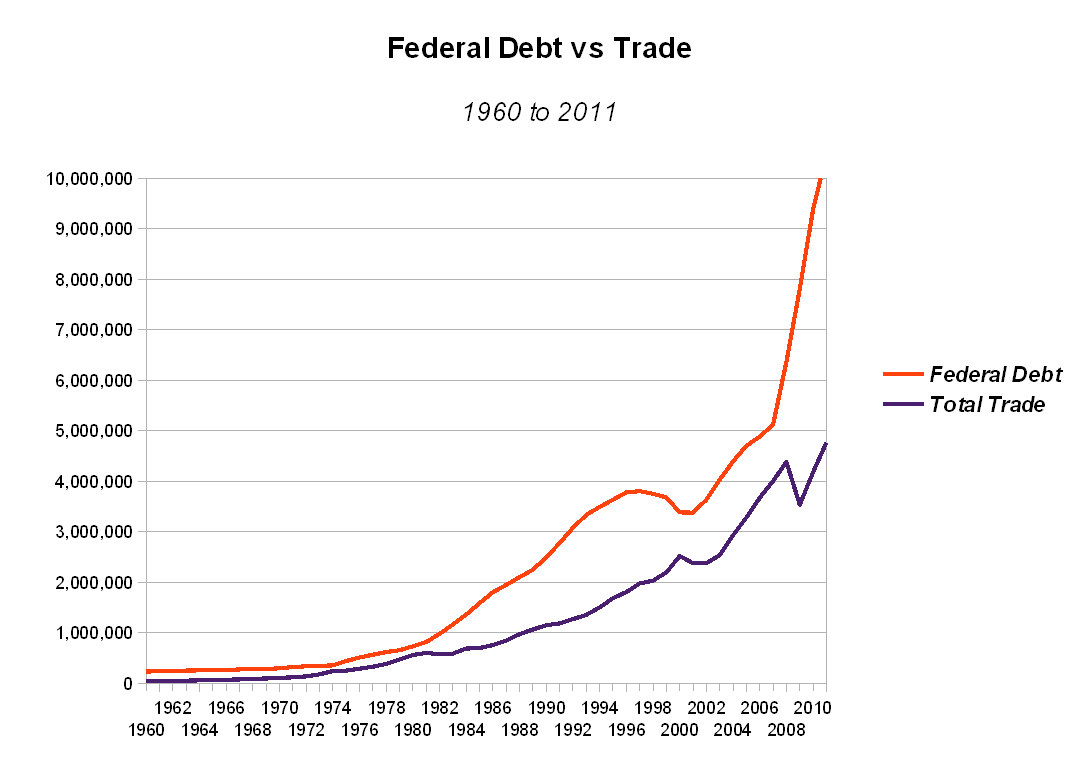
Mises may have never wavered from the view that free trade is a crucial economic policy in the program to restrict the growth of socialism. This does not alter the easily demonstrated fact that Mises was completely wrong on this particular issue, as can be seen by taking the position of Karl Marx into account, or examining the following chart, which shows the very strong statistical correlation, 0.95, between the increasing volume of international trade and the increase in the debt owed by the U.S. federal government.

It doesn’t matter if one prefers to utilize different measures of the expansion of the power of the central state, as they will show much the same result.  What this chart shows is a five-decade refutation of the Misean assertion that an increase in trade intrinsically inhibits the expansion of the scale and scope of state power, and particularly after 1994, it shows that a reduction of protectionism does not reduce the continued growth of the state in the slightest. To the extent that any claim of causation can be made, (and I am not making one here), we must conclude that it is arguments and policies in favor of free trade that “help to expand the power of the state” and “move in the direction of central economic planning.”

This should also not be mistaken for a claim that an increase in international trade, or even an increase in the trade deficit, is responsible for all, or even for most, of the growing amount of public and private debt. That would be impossible, since the $738 million in new debt required to pay for the 2011 balance of payments deficit in goods would barely cover two quarters worth of new federal debt alone, and obviously the federal government is neither purchasing nor financing the purchase of all foreign imports.

Mr. North claims that the central economic issue dividing the right wing movement is the issue of protectionism. This may well be true, I have no opinion on the matter except to say that I believe there is a much stronger right wing case against free trade than can be made for it. After all, the political right generally considers concepts such as national identity, culture, and tradition to be matters of serious and even vital import whereas the political left disdains them, and in some cases even denies their existence. So when Mr. North refers to “invisible lines known as borders”, it should be clear that although he is a man of the right, he is addressing this issue from a distinctly leftward position.

Where Mr. North appears to go fundamentally awry on this issue is his inability to distinguish between the state and the nation. He claims, correctly enough, that the statist equates the state and society and sees the state as the one true agent of the nation. He notes that some statists actually believe that the state is the same as the nation, and this is true. However, although North appears to understand that the state is not the nation, he clearly fails to appreciate that his arguments against the state do not necessarily apply to the nation. Indeed, the use of the term nation-state in a non-ironic manner is to reveal an outdated mindset that fails to recognize the way the laws and goverments of most Western states are openly anti-nationalistic.

North asserts the collectivist begins with the concept of the state as the final authority, while libertarian theory begins with the concept of the individual as the final authority. But as a Christian who claims that his view of economics begins with God as the final authority, North not only shows that he is no libertarian, but should recognize that nations do exist, that they are more than mere invisible lines, and that they are neither states nor individuals. A nation can be a state, but in most cases, nations are spread across two or more states, and many states encompass multiple nations. This adds a complicating factor to North’s case that he simply ignores in his attempt to create a false dichotomy between the libertarian free trader and the protectionist collectivist.

North clearly recognizes he has a problem here, as he acknowledges that conservatives say they don’t equate the state with the nation, but then promptly conflates the two into “the nation-state” before attempting to distract the reader by waving the red herring of mercantilism, which was a coherent historical system that has very little to do with modern protectionism except for also favoring the use of tariffs. He offers nothing but misleading  rhetoric combined with inept logic here, and promptly goes back to complaining about the state again without ever dealing with the legitimate problems raised concerning the material difference between the state and the nation. And in the end, he finally gives up and throws in the towel by attempting to deny the existence of nations.

“There is a true bait-and-switch operation going on here. Defenders of tariffs present themselves as defenders of the nation, when in fact the nation, from the point of view of economics, is not a collective entity. The nation, from an economic standpoint, is simply a convenient name that we give to people inside invisible judicial lines known as national borders.”

But the only bait-and-switch taking place here is by North, who is substituting “nation” for “state” and attempting to hide this by claiming that this substitution is justified “from an economic standpoint”. But the bulk of North’s case and most his complaints about protectionism, such as the oft-repeated “badges and guns” argument, have nothing to do with economics at all. This substitution leads North into a totally false claim about how the “entire concept of protectionism” depends upon a series of propositions that no protectionist needs to hold. North’s simplistic approach simply cannot account for the possibility that anyone might be aware of the potential divergence between the interest of the nation and the interests of the state, and favor the former without promoting the latter. And it is truly ironic that he accuses protectionists of “welfare statism” when his free trade argument amounts to nothing more than international welfare and the distribution of wealth from societies with high living standards to those with lower ones.

Of course, it should not be surprising that in what increasingly appears to be his dotage, North is incapable of grasping complex issues.  He even seems to have completely forgotten that 12 years ago he himself advocated the use of tariffs, with all those terrible badges and guns, in the interests of liberty. He complains that those who start their analysis with the nation and still seek to defend the free market suffer from intellectual schizophrenia and do not know how to think straight, but in doing so, only demonstrates his failure to understand that the nationalist argument includes economic elements but is not limited to them.

I strongly suspect that North’s refusal to recognize the link between free trade and revolutionary globalism identified by Marx is because, as a post-millenialist, he himself is a utopian globalist who favors the destruction of nations. This also explains his callous indifference towards not only the wealth of nations, but even their existence, as like Marx, he anticipates the Worker’s Paradiseliteral Heaven on Earth.

The Globalist Propositions of Free Trade are as follows:

  • The nation does not exist.
  • The state is defined by invisible lines.
  • The individual has no responsibility to anyone beside himself.
  • Everyone has the right to work and live anywhere in the world they want.
  • Free Trade organizations and agreements have nothing to do with free trade, even if they lower tariffs and result in increased international trade.
  • The state does not require funding.
  • All government is unnecessary and illegitimate.

WND column

The Religion of Free Trade

Let us suppose I told you of a certain doctrine in which millions of people believe without ever having read the book in which it is contained, which is predicated upon a situation that has never existed, and promises positive consequences that not only have never been delivered, but we are told cannot even be measured and cannot be realized without achieving something that has never been done before in the history of man. Furthermore, the doctrine was developed by a successful gambler and politician with absolutely no credentials or qualifications on the subject, which he had never even encountered before the age of 27, in tandem with a related theory that is so obviously insane that barely anyone has ever even heard of it.

So long as we are careful to set aside any reliance upon the genetic fallacy, does this sound like a doctrine that is not only infallible, but one that it would be crazy to even consider questioning? And yet, the fervor with which the advocates of the free-trade doctrine defend David Ricardo’s outdated, disproven theory of comparative advantage and decry those who question it is so ferocious as to indicate the nature of a belief that can only be described as religious.


Free trade: the outstanding questions

Since some of you appeared to mistake my very limited offerings on the topic of free trade and Gary North’s defense of it for a complete and comprehensive analysis of the theoretical, moral, practical, and political aspects of the free trade doctrine as well as a coherent Austrian case for US protectionism, I thought it might be useful if the various questions raised by the various free trade supporters were gathered in one place rather than strewn throughout the comments on various posts so that I can be certain to address all of the substantive ones when I do present that coherent, comprehensive, and perhaps even conclusive case.

So, if there is a question from the comments you feel has not yet been answered, (and I am not claiming to have answered them all), or if you have a new question that is related to the subject, please ask it here. I’m not going to be responding to them in the comments, but rather, in the post when I eventually present the anti-free trade case. And please note that I asked for questions, not vacuous, grand-standing assertions claiming “you need to prove X”, as the comment history here suggests the chances are high that there is no need to do anything of the sort.


Mailvox: free trade and automation

JC has a question concerning the different consequences of free trade versus automation:

Interesting discussion on free trade on your blog. Im still going thru the comments on the last one. I have to admit this discussion is all new to me and I have a lot of homework to do to keep up. But I have a question which I shall preface thus:

If for example an American manufacturer moves to another country with lower labor costs, etc., and sells products to American consumers at a lower price than they would have had they stayed in America and hired American workers, the lower priced consumer goods would not really help them since they wouldnt have jobs to take advantage of the lower prices.

I’m thinking this is just the same as a manufacturer deciding to automate production and laying off workers because it’s cheaper to use machines, which is what is happening in America where manufacturing output continues to grow because of American ingenuity in technology but unemployment remains high. It would be like the manufacturer moving the factory overseas because it would be cheaper to produce there. My question is: How is free trade bad, while automation is good in the example I gave above? (I’m assuming you think technological advances in manufacturing is good of course.)

Im looking forward to spending more time over at Vox Popoli. I know you put it up mainly for yourself, but Im sure you are aware that a lot of people are getting a real education reading the posts there and participating in the discussions.

There are several ways that job losses through automation is preferable to job losses through free trade, but JC is right to point out that there are still some material problems presented by it. This is something that has concerned me for some time, and I’ve been contemplating a post about it ever since Chateau Heartiste brought up the issue a few weeks ago.

First, when jobs are lost to automation rather than free trade, the capital and the profits remain in the domestic market. Second, it’s much easier to prevent free trade than technological progress because in the one case the national interest is in line with the domestic producer, in the other it opposes the producers interest. Third, (and this is a consequence of the first thing), the transition of labor from an automated industry to a new one remains viable when the capital and profits remain within the domestic market, otherwise, labor has no choice but to move where the capital investment is taking place.

This is why dishonest advocates of free trade falsely attempt to claim that the free movement of labor is not part of the free trade doctrine. They know that no one will support free trade once the understand that it intrinsically necessitates the large-scale export of their friends, relatives, and neighbors to other markets, and quite possibly their own expatriation. In the case of automation, on the other hand, there is a reasonable expectation that the capital will be reinvested in the domestic market, thereby creating new jobs in that market. That doesn’t mean the process won’t be painful, or as increasingly concerns me, because there is no real productive need for the excess labor, it will be mopped up using a combination of makework private sector jobs, public sector sinecures, and welfare payments.

Of course, in the case of automation, such a solution is possible because the profits have increased and remain within the country. In the case of free trade, not only have the jobs disappeared, but so have the capital and the profits that would pay for either jobs in a new industry as well as the social safety net.


Losing it on free trade

Gary North now demonstrates that he’s not only logically inept, but even appears to be willing to lie about his opponents in defense of his free trade dogma. I found this to be more than a little remarkable since I had previously considered him to be short-sighted and misguided on the topic, as well as rather lazy since he couldn’t be bothered to read the material on which he was commenting, but I never imagined that he would also be intellectually dishonest:

I have found over the years that when I debate with people who promote tariffs, meaning sales taxes on imported goods that are enforced by people with badges and guns, they always adopt arguments that apply only to America’s side of the border. They refuse to adopt those very same arguments for people on the other side of the border.

I challenge defenders of tariffs to state their arguments in terms of both of the people who want to trade, not just the American. The ethics and economics of restricted trade surely apply to the person who wants to trade on the other side of the invisible line known as a national border. If the arguments for restricted trade apply to the American economy, then surely they apply to the other nation’s economy. Logic and ethics do not change just because we cross an invisible judicial line. I take this position because I want the pro-tariff person to face the implications of his position.

It never ceases to amaze me that I am almost never able to persuade a person who defends tariffs to follow the logic of his argument. Without exception, the person insists that the invisible line dividing two jurisdictions called nations is economically significant, and therefore sales taxes on imported goods on the American side of the border are legitimate, wise, and beneficial to the vast majority of Americans. Yet, when I ask him to make exactly the same case with respect to the people on the other side of the border, which means either Canadians or Mexicans, the person has enormous difficulty in making his case. What seems utterly clear to him with respect to Americans on their side of the border seems ridiculous when he tries to state the case from the point of view of the Mexican or the Canadian on the other side of the border.

Why is this? Why is it that an argument that sounds utterly logical and utterly ethical from the point of view of an American who defends American tariffs on imported goods should not feel equally logical and equally ethical from the point of view of the Mexican or Canadian on the other side of the border?

There is a reason for this. His argument is ludicrous. When he applies it to people across the border, the argument becomes far more obviously ludicrous. So, he prefers not to consider what happens on the other side of the border.

I’ll type this very slow so that Mr. North can understand it because the argument isn’t ludicrous at all. National interests diverge. Nations compete. At times their interests run in parallel, at other times they are in direct opposition. It is in the American national interest that Americans prosper. It may or may not be in the American national interest that Mexico, China, or Russia prosper. Logic and ethics do not change depending upon the judicial line, but the objective pursued does. Just as it is not intrinsically unethical for an American to act in accordance with the American national interest, it is not automatically unethical for the Mexican to act in accordance with the interest of the Mexican people, even when both actions happen to oppose each other.

This really isn’t difficult to understand. The Minnesota Vikings and the Green Bay Packers play by the same rules of the game, and yet the Vikings’ objective is to get the football in the Green Bay end zone and the Packers’ objective is to keep it out. No one claims it is unethical for the Vikings to attempt to score or for the Packers to attempt to keep them from scoring. If we apply North’s hapless reasoning to NFL football instead of international trade, we’d have to conclude that both teams are acting illogically and unethically by simply playing the game.

North appears to be confusing the anti-free trade argument with the fair trade argument, which accepts free trade doctrine but argues it should only be applied on a reciprocal basis. I should be very curious to see Mr. North identify these “protectionist for me, but not for three” folks. I’ve certainly never read Ian Fletcher write anything about this unbalanced and hypocritical doctrine nor does it describe my own anti-free trade position.

Furthermore, I note that North isn’t discussing economics anymore, but the ethics and morality of free trade. But if we’re going to discuss the ethics and morality of free trade instead the economics, then it is necessary to consider whether it is moral for an American to place his own interests above every other American’s, and if it is ethical for a Mexican to place higher priority on the prosperity of the people of Peru above the prosperity of the people of Mexico. Is it right for Mr. North to starve his children in order to feed the children of Chile? Does he have no more responsibility to his relatives or to his neighbors than to the people of Argentina or Andorra?

And would it truly have been in the interests of either the American or the Russian people, or interests of the many nations under the Soviet heel, for the USA to prop up the Soviet economy through free trade? And if Mr. North is going to claim that there are no legitimate national interests or barriers to trade, does he understand that necessitates free international trade in plutonium, the smallpox virus, and armed drones, as well as granting green cards to as many members of the Red Army that China wishes to transport to the United States?

The foolish utopianism of North and his kind is usefully revealed in terms such as “the invisible line known as a national border”. The significant line isn’t geography, but rather people, and when the lines are not drawn in accordance with the population, trouble begins. Germany unified despite being divided into two different states because the Germans are one nation. Yugoslavia and Czechoslovakia broke up because multiple nations were trapped together in one state. The European Union was founded on the principles North espouses and it is foundering because it refused to take those “invisible lines” into account. Nations are more than mere jurisdictions.

The observable fact is that if you scratch a free trader, you reveal the globalist underneath. And since there is no greater risk to human freedom than that posed by a central global state, they are working to bring about precisely that which they fear most. And in their myopic disregard for nations, societies, and civilization, they reveal themselves to be barbarians as well.

North’s perspective isn’t so much wrong as it is simple and short-sighted. After a decade of the disastrous Bush wars, most sensible people now understand that it is not in America’s interest nor is it America’s responsibility to police the world or bring democracy to the world. North’s objective is even more problematic, as he wants America to enrich the world at the expense of the American people.

One reason the free trade doctrine is so inherently untrustworthy is that its supporters reliably fail to understand that they are presenting various aspects of multiple different arguments as if they were one coherent case, which they quite clearly are not. Moreover, North is simply lying – yes, I am accusing him outright of lying – when he writes: “The difference between the defender of tariffs and the defender of market liberty is this: the defender of tariffs does not believe, nor does he go public, with a systematic defense of the legitimacy of tariffs on the other side of the border. What he wants is a no-tariff situation on the other side of the border, and a tariff law on this side of the border. He wants Americans to be able to sell whatever they want at the best possible price to people on the other side of the border. But he does not want to have people on the other side of the border to be legally allowed to sell at the best possible price for people on this side of the border.”

I am calling Mr. North out on this blatant lie and shameless misrepresentation of those advocating barriers to international trade. It is completely and blatantly false. I do believe, and I am quite willing to go public with a systematic defense of the legitimacy of tariffs on both sides of every international border. Every nation has the right to defend its own interests as its people see fit. The same logic in defense of American interests applies to the defense of Mexican, Canadian, and Chinese interests. Other nations have the same right, and indeed, the same responsibility, to utilize tariffs to protect their native industries and domestic markets. Now, due to the smaller size of many nations, logic may dictate that their tariff laws be different than the USA’s; there is no sense in protecting jobs that don’t exist in nonexistent industries, after all. But that doesn’t change the fact that North’s accusation is completely false.