Contra Nietzsche and Mises

I don’t think atheists who strive to argue in support of the existence of non-religious objective values, regardless of whether they are based on philosophy or science, have any idea how weak their case is from the atheist perspective:

“There are no such things as absolute values, independent of the subjective preferences of erring men. Judgments of values are the outcome of human arbitrariness. They reflect all the shortcomings and weaknesses of their authors.”
– Ludwig von Mises, Bureaucracy

It seemed strange to me why atheist arguments related to objective morality were always so crudely simple and vaguely familiar until I realized that this is because I had seen very similar arguments before in a different context. As it happens, the current atheist attempts to determine an objective basis for morality are following exactly the same path that economists of the 18th and 19th century trod in attempting to determine the objective basis of value. They are literally 200 years behind the best efforts of economists from Adam Smith and David Ricardo to Karl Marx and Thorstein Veblen to find something that does not exist, and due to their general ignorance of economics – Michael Shermer excepted – they have no idea that their quest is destined for complete failure.

I can only conclude that sometime around the turn of the next century, the marginal utility of morality will become the dominant paradigm for a time prior to the whole quest being abandoned in response to a series of massive and inexplicable moral depressions.


The original Dr. Doom speaks

Marc Faber pronounces his verdict:

Central banks will never tighten monetary policy again, merely print, print, print.

Bubbles used to be concentrated in one sector or region in the 19th century, but off of the gold standard this concentration has ended.

“The lifetime achievement of Greenspan and Bernanke is really that they created a bubble in everything…everywhere.”

“Central banks love to see asset prices go up,” and their policy reflects their desperation to perpetuate this.

US housing bubble that Greenspan could not spot (even though he has recently spotted bubbles in Asia) stands in stark contrast to that of Hong Kong in 1997, where prices fell by 70%, yet none of the major developers went bankrupt; this was a result of a system not built on excessive debt like that of the US.

“You have to ask what they were smoking at the Federal Reserve,” during the housing bubble, as prices were increasing by 18% annually when interest rates started to steadily rise in 2004.

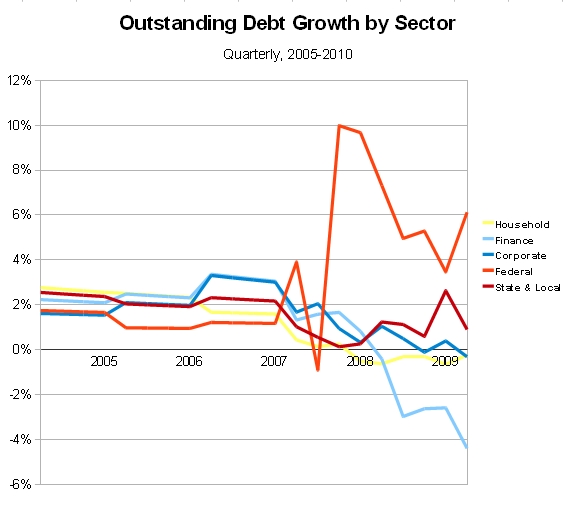
Over the last couple of years, when the gross increase in public debt has exceeded the gross decrease in private debt, markets have risen, whereas when private debt growth has outpaced public debt growth, markets have tanked.

However, last year Economist Gregory Mankiw articulated the position which according to Faber essentially echoes that of Fed #2 Janet Yellen and pervades much of the Fed generally, that “The problem is that people are saving money instead of spending, and we have to get the bastards spending to keep the economy going,” so the key is to inflate the money supply at something like 6% per annum. Thus, Faber says “As far as I’m concerned, the Federal Reserve will keep interest rates at 0, precisely 0…in real terms”.

I understand and respect his case, but for reasons I have delineated in RGD, I do not think the hyperinflation scenario will proceed as Faber assumes. That being said, I agree that the central banks will leave their interest rates at zero; the more important question is if that will ultimately have any relevance to anything during an ongoing debt-deflation process. Notice that contra both Keynes and Friedman, very liberal monetary policies are not instigating growth of the money supply.

The M3 money supply in the United States is contracting at an accelerating rate that now matches the average decline seen from 1929 to 1933, despite near zero interest rates and the biggest fiscal blitz in history.


Wake up and smell the depression

Some silly and formerly-rich women clearly do not understand the dynamic nature of investments:

Michelle Young was supposed to face her estranged husband Scot in the High Court this week, but has had to postpone the hearing while she finds further funding. For the last three years, the couple has been embroiled in a bitter fight over his alleged multi-million pound fortune which she says he is hiding and he claims he no longer exists.

Last December, Mr Young was ordered by the court to pay his wife £27,500 a month pending their divorce settlement but he has since been declared bankrupt. At their last court appearance, Mrs Young said she was down to her last £13,000 of savings and owes £660,000 in unpaid legal fees.

The guy has been declared bankrupt. The money is gone. Clearly his creditors understand this, so what sort of cretin finds it hard to grasp the concept? You don’t make £400 million without leverage, so it’s not at all hard to figure out where the money went. Profit by the leverage, die by the margin call.


Crackpot credentials

VDH considers the other European volcano.

Few wanted to listen when it was pointed out — well before the Greek meltdown — that on key questions of demography and immigration, the future of the European Union was bleak. The very idea that, in historical terms, socialism, agnosticism, pacifism, and hedonism were not only interrelated and synergistic, but also suicidal for civilization, was considered crackpot.

I seem to recall a certain cowardly atheist who thought I belonged in the category. I didn’t mind that characterization in the least because the reality is that most intelligent and independent thinkers are considered crackpots and lunatics by the unthinking masses, right up until the moment that they are proven correct.* And, of course, at that point, everyone who previously dismissed them immediately begins to pretend that what they had once characterized as “crackpot” was never anything out of the mainstream.

Today, the smarter progressives and equalitarians find themselves in a state of intellectual shock. The foundations of the erroneous beliefs for which they have so confidently thrown away centuries of history and tradition are crumbling before their eyes and they have literally nothing upon which they can fall back. The less intelligent ones, of course, have no idea that anything out of the ordinary has been happening in the diverse areas of economics, genetic science, and government pensions and so they continue to blithely advocate their empty progressive, equalitarian, big government ideas even as a world that has been built upon them teeters on the verge of complete collapse.

This most certainly does not mean that a freer, more traditional, more capitalistic world is in the making. The opposite is more likely true, at least in the intermediate term. But the truths of these matters will be known and the seeds of future freedom find fertile soil in which to grow.

* A relevant quote from Mises happened to pop up today: “Education rears disciples, imitators, and routinists, not pioneers of new ideas and creative geniuses. . . . The mark of the creative mind is that it defies a part of what it has learned or, at least, adds something new to it.”


As predicted

The mainstream media has gradually moved from discussing a jobless recovery to the “Great Recession” and is now beginning to contemplate a Great Depression 2.0.  Robert Samuelson is among the first:

It is now conventional wisdom that the world has avoided a second Great Depression. Governments and the economists who advise them learned the lessons of the 1930s. When the gravity of the financial crisis became apparent in late 2008, the response was swift and aggressive. Central banks like the Federal Reserve and the European Central Bank dropped interest rates and lent liberally to threatened financial institutions and rattled investors. The United States and many countries approved “stimulus” programs of tax cuts and additional spending. Panic was halted. A downward spiral of falling private spending and rising unemployment was reversed. The resulting economic slump was awful. But it was not another Great Depression. The worst has passed.

Or has it? Greece’s plight challenges this optimistic interpretation. It implies that celebration is premature and that the economic crisis has moved into a new phase: one dominated by the huge debt burdens of governments in advanced societies. Comparisons with the Great Depression remain relevant — and unsettling. Now, as then, we may be prisoners of deep and poorly understood changes to the world economic system.

As I explained in the book, the problem is debt combined with the fact that neither Keynesian nor Monetarist economics place much significance on it.  Even now, you will find some stubborn neo-Keynesians insisting that debt is good, that it cannot possibly be the root of the problem.  As Karl Denninger has repeatedly shown, their attempts to explain the situation demonstrate little more than their ignorance of simple mathematics as well as political economy.

The massive sovereign debts can never be repaid.  Nor can many of the private and corporate debts.  So, once the burden of servicing them becomes too great, they must be eliminated with either default or hyperinflation.  The frantic efforts of the various Western governments to shovel nearly $1 trillion into the maws of the desperate bankers is little more than an attempt to buy a little more time in the futile hope that the magical revival of Keynesian animal spirits will trump the inexorable mathematics.


So bankrupt indeed

Perhaps Helicopter Ben needs to tell Fannie Mae to relax and enjoy the grass shoots and GDP growth:

“When Treasury provides the requested funds, the aggregate liquidation preference on the senior preferred stock will be $84.6 billion, which will require an annualized dividend of approximately $8.5 billion. This amount exceeds our reported annual net income for each of the last eight fiscal years, in most cases by a significant margin.”

This, in English, means “We do not earn enough in a quarter to pay the dividend – that is, the interest on the borrowed money.”

So it’s not just homeowners who can’t pay their mortgages anymore. By the way, I don’t mean to worry anyone unduly, but I seem to recall that FNMA was the last big investment made by Ben Bernanke prior to this weekend’s Euro stabilization gambit. I’m beginning to think we’d be better off turning the Federal Reserve over to Goldman Sachs. After all, their traders didn’t lose money on a single business day during the first quarter. They must be really good!


Contagion

It looks like Portugal is coming to the plate, with Spain on deck:

Portugal
2-Year: 797 basis point spread over US Treasury
5-Year: 427
10-Year: 363

Spain
2-Year: 260
5-Year: 187
10-Year: 118

By way of comparison, the UK/US spread is 29.2 on the 2yr. The Greek/US spread is around 1840.


The nonexistent recovery

RGD readers will know that I’m very skeptical of the reliability of government economic statistics, mostly because they are a constantly moving target that mutate over time. However, a closer look at everything from TOTLL to today’s GDP Advance (3.2% annual) makes it appear as if the statistical shenanigans are growing exponentially:

I’m concerned with these numbers – quite concerned in fact. The Federal Government borrowed (and presumably spent) $462 billion in excess of tax receipts over the first three months of 2010. But PCE – personal consumption expenditures – was up $83 billion and federal spending was up only 3.5 billion.

Where did the other $375 billion go?

Into a black hole of covering existing obligations, it appears, and the final private demand GDP deficit covered by this is almost exactly 10% (GDP for the quarter is ~3.650 trillion, so $375 billion is roughly 10% of that.)

Karl Denninger isn’t the only one to notice anomalies with regards to today’s BEA release. Calculated Risk notices that Residential Investment isn’t behaving in its usual post-recessionary manner: “RI as a percent of GDP is at a new record low. And there is no reason to expect a sustained increase in RI until the excess housing inventory is absorbed. Notice that RI usually recovers very quickly coming out of a recession. This time RI is moving sideways – not a good sign for a robust recovery in 2010.”


And now Spain

First Greece. Then Portugal. Now Spain. It shouldn’t be long before Ireland’s credit rating appears in the news, as per RGD.

Spain’s credit rating was cut to AA from AA+ by Standard & Poor’s Ratings Services. The outlook is negative, S&P said.

It’s going to go lower than AA….


Here we go again

Another much-ballyhooed bazooka fails:

“We have gone past the point of no return,” said Jacques Cailloux, chief Europe economist at the Royal Bank of Scotland.“There is a complete loss of confidence. The bond markets are in disintegration and it is getting worse every day. “The ECB has been side-lined in the Greek crisis so far but do you allow a bond crash in your region if you are the lender-of-last resort? They may have to act as contagion spreads to larger countries such as Italy. We started to see the first glimpse of that today.”

Mr Cailloux said the ECB should resort to its “nuclear option” of intervening directly in the markets to purchase government bonds. This is prohibited in normal times under the EU Treaties but the bank can buy a wide range of assets under its “structural operations” mandate in times of systemic crisis, theoretically in unlimited quantities.

And here is a perfect example of the inherent danger – and stupidity – in centralizing any form of power. In the pre-Euro days, Greece could have devalued the drakhma and relieved the pressure on its bond market. The effects would have been negative, but limited solely to Greece. Now, thanks to the centralized structure of the EU, the bail-out expense threatens the pocketbooks of Germans and the debt contagion threatens Portuguese, Italian, Spanish, and Irish bonds.

The worst thing is that the proposed “emergency” solution involves further centralization, which involves kicking the problem down the road for a while. This means that when the debt issue resurfaces, it will threaten the ECB directly. The ECB would be wise to do what the Fed did not have the courage to do and let Greece default. Unfortunately, wisdom and central bankers appear to be mutually exclusive concepts these days.

I am amused by the continued expansion of the financial analogies, though. First the Fed had a “gun”, then the EU had a “bazooka”. Now the ECB has a “nuclear option”. But, like previous analogical armaments that were brandished so futilely, it can only be perceived as effective so long as it isn’t used. It’s an empty bluff, just like all the previous ones.

Here’s a few more details on the latest in the ongoing Euromeltodown:

ATHENS — Greece was pushed to the brink of a financial abyss and started dragging another eurozone country – Portugal – down with it Tuesday, fueling fears of a continent-wide debt meltdown. Stocks around the world tanked when ratings agency Standard & Poor’s downgraded Greek bonds to junk status and downgraded Portugese bonds two notches, showing investors that Greece’s financial contagion is spreading. Major European exchanges fell more than 2.5 percent, and on Wall Street, the Dow Jones industrial average finished down more than 200 points. The euro slid more than 1 percent to nearly an eight-month low.

“We have the makings of a market crisis here,” said Neil Mackinnon, global macro strategist at VTB Capital.

Greece is struggling with massive debt, and with prospects for economic growth weak it could end up in default. Its 15 eurozone partners and the International Monetary Fund have tried to calm the markets with a euro45 billion rescue package, but it hasn’t worked.

Standard & Poor’s warned that holders of Greek debt could take large losses in any restructuring, but a greater worry is that Greece’s debt crisis is mushrooming to other debt-laden members of the eurozone.

One bailout can be dealt with but two will be stretching it, and there are fears that other weak economies could be pulled down in the Greek spiral – including Europe’s fifth-largest, Spain. Can Germany, Europe’s effective paymaster, continue to bail out the weaker members of the eurozone?

The crisis threatens to undermine the euro and make it harder and more expensive for all eurozone governments to borrow money.

It has also disrupted cooperation between eurozone governments, with Germany resisting the idea of bailing out Greece unless strict conditions are met. Many investors think Greece will have enough money to avoid default in the coming weeks, but the future is cloudier. Both Standard & Poor’s and the Greek finance ministry insisted that the country will have enough money to make the euro8.5 billion bond payments due on May 19.

Beware the post-Ides of May….