Bloggers at the Treasury

The personable personalities behind the Neo-Keynesian lunacy aside, it’s pretty much as bad as I expected:

On HAMP, officials were surprisingly candid. The program has gotten a lot of bad press in terms of its Kafka-esque qualification process and its limited success in generating mortgage modifications under which families become able and willing to pay their debt. Officials pointed out that what may have been an agonizing process for individuals was a useful palliative for the system as a whole. Even if most HAMP applicants ultimately default, the program prevented an outbreak of foreclosures exactly when the system could have handled it least. There were murmurs among the bloggers of “extend and pretend”, but I don’t think that’s quite right. This was extend-and-don’t-even-bother-to-pretend. The program was successful in the sense that it kept the patient alive until it had begun to heal. And the patient of this metaphor was not a struggling homeowner, but the financial system, a.k.a. the banks. Policymakers openly judged HAMP to be a qualified success because it helped banks muddle through what might have been a fatal shock. I believe these policymakers conflate, in full sincerity, incumbent financial institutions with “the system”, “the economy”, and “ordinary Americans”. Treasury officials are not cruel people. I’m sure they would have preferred if the program had worked out better for homeowners as well. But they have larger concerns, and from their perspective, HAMP has helped to address those.

Needless to say, I’m shocked. These programs are NEVER designed to help the people they are advertised as helping in order to justify their passage through Congress. It was just another form of bank bailout. The mistake, of course, is the assumption that the banks are going to be in any better shape to handle the flood of foreclosures that have been delayed since the “expected” economic recovery has proved illusory. The fact that the past situation was dangerous is no indication that the future one will be any less so.

Finally, our conversation turned to the current macroeconomic doldrums. Thankfully, there was none of the “let’s look on the bright side” chipperness of Timothy Geithner’s recent New York Times op-ed. Treasury officials didn’t downplay how bad things are. They did point out that considering the headwinds the economy faces, things are a bit better than they might be. The account went roughly like this: Last year, after the doldrums of March, the economy grew faster and performed better than most would have forecast. But recently it encountered two obstacles, one expected, the other an unexpected near cataclysm. The spurt of GDP growth due to post-panic inventory restocking was always going to end. But a sovereign debt crisis in Europe strong enough to shake confidence and financial markets in the US was not expected. Taking all that into account, things are a bit better than they might have been. One Treasury official pointed out that if we could return to the path of consensus growth forecasts from just before the troubles in Europe, we would have two or three difficult years ahead of us yet, but would be on a decent path. I took this as a kind of optimistic but plausible thought experiment on where we might be going…. I was impressed that Treasury officials had a pretty good understanding of the impediments to growth going forward. They understood that the core problem preventing business expansion isn’t access to capital but absence of demand.

I find this self-serving and ex post facto explanation to be entirely dubious. The Treasury gang might have as reasonably broken into song and blamed Canada. I was one of many economics observers to expect numerous sovereign debt crises, which is why I was writing about them in RGD before they happened. I expected them to begin in Ireland and Spain, not Dubai and Greece, but sovereign debt overload is an extraordinarily target-rich environment these days. The only country that comes up for discussion in this regard that isn’t a likely candidate for the next debt crisis is Italy because its debt/GDP issues don’t take into account its sizable black economy.

The grimly amusing thing is that we are presently on the precipice of another 2008-style meltdown and precisely none of these bloggers or Treasury officials appear to be aware of it. This is probably because they’re clearly all still subject to the conceptual limitations of their Neo-Keynesian models. The core problem isn’t either access to capital or an absence of demand, but rather a widespread inability to service debt or add more debt combined with the natural shifting back of the demand curve to its normal non-debt-inflated limits. And this isn’t a problem they can do much about; in fact, trying to keep the insolvent zombie banks afloat throughout the debt-deleveraging process is only going to waste incredible sums of money and extend the depression for years.

As Instapundit likes to say, the country is in the very best of hands.


Living beyond your means

This is an extreme example of the cash-out game, but it shouldn’t be hard to understand why the US economy is so completely hopeless as a result:

It’s obvious from looking through the property records that many borrowers supplemented their lifestyles with regular trips to the home ATM machine. The regularity and the size of these withdrawals is astonishing. It also explains much about why houses are so popular in California. If owning real estate gives you the opportunity to obtain hundreds of thousands of dollars for doing absolutely nothing, ownership will be highly desired; in fact, it becomes the primary reason people buy homes. Californian’s live in their own personal ATM machines.

The owners of today’s featured property paid $441,000 on 4/25/1991. I don’t have their original mortgage information, but it is likely that they put 20% down ($88,200) and borrowed $352,800.

* On 5/27/1997 they obtained a stand-alone second for $50,000.
* On 12/7/1998 they refinanced their first mortgage for $387,500.
* On 3/26/1999 they got a $47,500 stand-alone second.
* On 12/28/2000 they refinanced with a $441,000 first mortgage and crossed the threshold of borrowing more than they paid.
* On 3/31/2004 they refinanced with a $536,250 first mortgage.
* On 10/5/2004 they obtained a $628,000 first mortgage.
* On 11/30/2005 they refinanced with a $686,250 Option ARM with a 1.5% teaser rate.
* On 5/3/2007 they obtained a second mortgage for $15,764.
* On 7/3/2007, after witnessing the above patter of serial refinancing, World Savings Bank brilliantly loaned them $788,000 in an Option ARM.

Total property debt is $788,000 plus negative amortization and missed payments. Total mortgage equity withdrawal is $435,200 including their down payment. Total squatting time was minimal as the bank moved quickly to evict these squatters.

The important thing to understand from this is that there is no such thing as “home ownership” with a mortgage. It’s just renting from a bank. The problem is that debt is intrinsically inflationary, (inflationistas take note regarding the implications of this in a debt-deleveraging environment), so the willingness of others to take on debt severely harms the ability of more prudent individuals to make purchases without debt.

On a related note, watch for panic over the UNEXPECTED collapse in home sales next week. Now that the federal credits have expired, Texas monthly home sales have fallen 25% to the lowest July level since 1997.


Ahead of schedule

And here I thought the first media references to Great Depression 2.0 wouldn’t occur until the fourth quarter:

The fake “recovery” was nice while it lasted, says famous apocalyptic forecaster Gerald Celente, founder of the Trends Research Institute. But now the fun’s over, and we’re headed for what Celente describes as the “Greatest Depression.” Specifically, the always startling Celente says the country is headed for rising unemployment, poverty, and violent class warfare as the government efforts to keep the economy going begin to fail.

The interesting thing isn’t that Celente is saying this. He’s been warning about this for a while. The interesting thing is that someone like Henry Blodgett is finally paying attention to him.


Yowzers

In which Karl Denninger prison-rapes Paul Krugman’s bizarre meanderings on Social Security:

Seriously. This tripe is so bereft of logic and actual mental acuity that it is unworthy of graduation from elementary school:

“About that math: Legally, Social Security has its own, dedicated funding, via the payroll tax (“FICA” on your pay statement). But it’s also part of the broader federal budget. This dual accounting means that there are two ways Social Security could face financial problems. First, that dedicated funding could prove inadequate, forcing the program either to cut benefits or to turn to Congress for aid. Second, Social Security costs could prove unsupportable for the federal budget as a whole.”

Baloney. This is called fraud in the private-sector. First, there is no dedicated funding. Second, all the money taken in over the years was not “invested”, it was spent.

“Social Security has been running surpluses for the last quarter-century, banking those surpluses in a special account, the so-called trust fund.”

That so-called “trust fund” is a fraud. It does not exist.

Here’s what actually happens (and Krugman knows this, which makes him a damned liar besides):

1. Your tax dollars go to Treasury
2. Treasury keeps them and issues “special” Treasury bonds to the Social Security “trust fund.”
3. Treasury counts these tax receipts against the federal deficit, making it look (much, until the last year) smaller than it really is.

Note the slight-of-hand here. Social Security gets an alleged “bond” but they can’t sell it to anyone but the Treasury. That is, legally it is an IOU, not a bond. A bond can be marketed in the open market to anyone who is willing to buy, for whatever they’re willing to pay. These are unmarketable (intentionally) and thus can only be redeemed in one place – at Treasury.

The problem is that Treasury spent the money and thus doesn’t have anything with which to redeem the IOUs!

Seriously, even people who don’t pay any attention to either politics or economics knows that the Social Security “trust fund” is nonexistent and that Congress has been operating on a pay-as-you-go system all along. I can’t even pretend to understand what Krugman was thinking when he wrote this ridiculous column. The money in the so-called “lock box” isn’t there because the box doesn’t exist either. The money is nothing more than yet another government debt as it was all spent years ago.


WND column

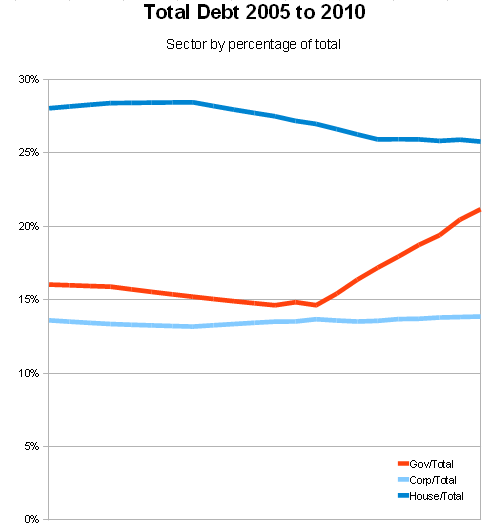
This is what I am referring to in today’s WND column. It succinctly shows the death of Keynesian economics in one simple graph. The empiricists who have rejected the compelling but non-empirical critiques of the Austrian School for eighty years will not find it so easy to dismiss the empirical evidence of the declining marginal utility of debt.

There will be no double-dip but only because the “recession” never ended. It was merely disguised due to the ludicrous metric of GDP which counts government borrowing and spending as economic growth. To insist that GDP growth is economic growth is to confuse the map with the territory.


But how many were saved?

The Wall Street Journal finally begins to notice that there is no economic recovery underlying the March 2009 advance:

The jobs picture is much worse than they’re telling you. Forget the “official” unemployment rate of 9.5%. Alternative measures? Try this: Just 61% of the adult population, age 20 or over, has any kind of job right now. That’s the lowest since the early 1980s — when many women stayed at home through choice, driving the numbers down. Among men today, it’s 66.9%. Back in the ’50s, incidentally, that figure was around 85%, though allowances should be made for the higher number of elderly people alive today. And many of those still working right now can only find part-time work, so just 59% of men age 20 or over currently have a full-time job. This is bullish?

(Today’s bonus question: If a laid-off contractor with two kids, a mortgage and a car loan is working three night shifts a week at his local gas station, how many iPads can he buy for Christmas?)

Any predictions on when the first serious mention of Great Depression 2.0 occurs in the WSJ? This can’t be an airy dismissal, but should be accompanied by an admission that there is no double-dip, it’s all just one giant multi-year contraction.


The Home of the Bankrupt

The bankrupt banks are pretending to be solvent. So, it should come as no surprise that the Federal government has been following their lead.

[T]he IMF has effectively pronounced the U.S. bankrupt. Section 6 of the July 2010 Selected Issues Paper says: “The U.S. fiscal gap associated with today’s federal fiscal policy is huge for plausible discount rates.” It adds that “closing the fiscal gap requires a permanent annual fiscal adjustment equal to about 14 percent of U.S. GDP.”

The fiscal gap is the value today (the present value) of the difference between projected spending (including servicing official debt) and projected revenue in all future years.

To put 14 percent of gross domestic product in perspective, current federal revenue totals 14.9 percent of GDP. So the IMF is saying that closing the U.S. fiscal gap, from the revenue side, requires, roughly speaking, an immediate and permanent doubling of our personal-income, corporate and federal taxes as well as the payroll levy set down in the Federal Insurance Contribution Act.

Such a tax hike would leave the U.S. running a surplus equal to 5 percent of GDP this year, rather than a 9 percent deficit. So the IMF is really saying the U.S. needs to run a huge surplus now and for many years to come to pay for the spending that is scheduled.

The scary thing is that these calculations indicating national insolvency are based on numbers that are ludicrously optimistic. As I have been saying for more than two years now, it’s not a question of if the system collapses, it’s only a question of when.


Anticipating the excuse

Paul Krugman finally produces what was always a totally predictable excuse for the failure of the Obama stimulus package:

It’s crucial to keep state and local government in mind when you hear people ranting about runaway government spending under President Obama. Yes, the federal government is spending more, although not as much as you might think. But state and local governments are cutting back. And if you add them together, it turns out that the only big spending increases have been in safety-net programs like unemployment insurance, which have soared in cost thanks to the severity of the slump. That is, for all the talk of a failed stimulus, if you look at government spending as a whole you see hardly any stimulus at all. And with federal spending now trailing off, while big state and local cutbacks continue, we’re going into reverse.

Krugman’s excuse for the failure of the Bush (2008) and Obama (2009) stimuli isn’t even new. Consider the following passage from a brilliant book written by an astonishingly handsome author more than one year ago:

Ironically, there is no shortage of historical examples to support the idea that even those who nominally subscribe to an empirical approach don’t hesitate to abandon their empiricism when the data doesn’t support their theories. Consider, for example, how two decades of failing mainstream economic policies in Japan have no more caused mainstream economists to conclude that their theories are incorrect than 70 years of economic failure in the Soviet Union caused socialist economists to abandon Marxism. Some excuse is always found to explain away the theory’s failure and rationalize its continued application; if the fiscal stimulus was not too small or too late, then the interest rate hikes were too large or too early. If the federal government’s expansionary efforts were unsuccessful during the New Deal, then it must have been due to their being overwhelmed by the contractionary policies of the state and local governments.
The Return of the Great Depression, 134

There’s really no reason to read Paul Krugman’s columns when you can read this blog and anticipate what he’s going to be writing one year later. Because Neo-Keynesians never learn from the inevitable failures of their economic models. In the Telegraph today, Ambrose Evans-Pritchard writes: “In Japan itself core CPI deflation has reached -1.5pc, the lowest since the great fiasco began 20 years ago. 10-year yields fell briefly below 1pc last week. Premier Naoto Kan has begun to talk of yet another stimulus package. “The time has come to examine whether it is necessary for us take some kind of action,” he said.”


Past as prologue

The New York Times embraces the myth of “the new normal” in an attempt to evade the obvious:

The new normal challenges the optimism that’s been at the root of American success for decades, if not centuries. And if it is here, the new normal could force Democrats and Republicans to rethink their traditional approach to unemployment and other social problems.

Some unusual suspects, like Glenn Hubbard, dean of the Columbia Graduate School of Business and an economic adviser to George W. Bush, are talking about a new, expanded role for the government in addressing the problem. In particular, Mr. Hubbard favors investing more in education to retrain workers whose jobs are never coming back. “If there is a new normal, it’s more about the labor market than G.D.P.,” he said. “We have to help people face a new world.”

For his part, Mr. Gross, also a free-market advocate, believes that it’s time for the government to spend tens of billions on new infrastructure projects to put people to work and stimulate demand.

First, if you believe it is time for the government to spend billions of dollars to put people to work and stimulate demand, you are not a free market advocate. Second, how is spending government money to “stimulate” the economy anything but a traditional approach to unemployment? The problem is debt and adding more public debt to the equation is only going to make matters worse. You would think this would be obvious, given that both Hoover and FDR tried spending billions of dollars to put people to work and what they got was the Great Depression. It is intriguing, but not surprising, to see all of the politicians and media figures so intent on taking the very actions that will cause the outcome they hope to avoid. What is remarkable is that they are doing this with the benefit of hindsight.


The limited debate

The NYT doesn’t know what a real deflationista is:

The split between the chief economists, whose work helps inform trading strategies recommended to investors by their firms, echoes a broader and sometimes fiercer debate among academic economists and commentators about the threat posed by deflation and what the government’s response should be.

According to the deflationistas, as they are nicknamed, a new round of stimulus spending by Washington is urgently required to stave off a Depression-like cycle of falling prices and wages that is difficult to reverse once it is set in motion.

Inflationistas, by contrast, worry more about the effect that additional government borrowing could have on the recovery. With the budget deficit expected to hover around $1 trillion a year for the next decade, they say, interest rates could eventually surge, making borrowing — and goods — more expensive. A double dip, they say, is highly unlikely.

This isn’t a genuine inflation vs deflation debate, it’s merely an intra-Keynesian one that completely misses the points made by the hyperinflationists and the true deflationists alike. A true deflationista is someone like Bob Prechter, who has long predicted that neither fiscal nor monetary policy can possibly prevent deflation brought about by the collapse of credit. The real debate – although it is more a question than a proper debate – is whether the central banks can print money faster than credit collapses in a fractional-reserve, debt-money system.

Given that there is $53 trillion in total credit market debt compared to $8.6 trillion in M2 and the mainstream deflationary fears have been caused by total credit merely remaining flat for the last two years thanks to the heroic debt-creation measures of the Soebarkah administration and the Federal Reserve increasing M2 at an annual rate of 5 percent, the outcome increasingly appears to favor the real deflationist camp.