This is just my personal list of favorites from Volume I and Volume II. I’m only considering the fiction here, not the essays, articles, or poems.
“Cincinnatus”, Joel Rosenberg, Volume II. This story about a retired, possibly traitorous general brought back for one last command is probably my favorite-ever mil-sf story. As excellent in conception as execution, it has had a distinct influence on the world of Quantum Mortis.
“On the Shadow of a Phosphor Screen”, William F. Wu, Volume II. The series features several stories from this world where wars are settled by professional gamers. It reads like a prophecy of Sega’s Total War series, but has a haunting edge to it that gives it a timeless feel.
“Superiority”, Arthur C. Clarke, Volume II. A clever and amusing exercise in explaining how technological superiority can be a weakness. Particularly interesting if you’ve read van Creveld’s Technology and War. It’s more relevant than the average general would like to think.
“Ender’s Game”, Orson Scott Card, Volume I. “Ender’s Game”. The original novella. Enough said.
“In the Name of the Father”, Edward P. Hughes, Volume II. This is possibly the most light-hearted post-apocalyptic tale ever told. I like the stories of Barley’s Crossing.
“Time Lag”, Poul Anderson, Volume II. A tribute to the significance of female steadfastness in times of war, as well as an illustration of how time and distance factor into the martial equation.
“His Truth Goes Marching On”, Jerry Pournelle, Volume I. As Tom Kratman once called it, “the Spanish civil war in space”. Philosophically deeper than you might think at first.
“‘Caster” by Eric Vinicoff, Volume II. A little longer than it needs to be, not quite as artfully written as the others, but an inspirational and optimistic war story.
“Ranks of Bronze” by David Drake, Volume I. Drake does Roman legions playing mercenary for aliens. A little short, but it’s a good battle scene.
“Call Him Lord” by Gorden R. Dickson, Volume I. Less about war than the price of leadership. A bit artificial, but it comes to an emotionally powerful close.
As far as the non-fiction goes, while the articles on High Frontier are fascinating for their historical significance, my favorite is “Proud Legions” by T.R. Fehrenbach, which appears in Volume II. In fact, I have to confess that of the nine volumes of THERE WILL BE WAR, Volume II is my favorite. That is the very high bar that Volume X will attempt to clear.
Van Creveld’s Equality is one of Castalia’s most absorbing releases, if you’re interested in history anyway—past history, not the historical destiny of your marching-drum ideology—the sort of history that’s not only full of holes where the victors and the monks wrote over chunks of the evidence, but the sort of history that, as far as we can tell, indeed has been repeating itself rather drearily.
As van Creveld says in his preface, the histories of our other two unattainable ideals, liberty and justice, have been written before—or, rather, attempted; there’s too much to read on all three of these subjects for one guy to do it at a go. But van Creveld does his best to describe all our tragic, failed attempts at equality. When we’ve bothered to make an attempt, that is.
Van Creveld also dwells on one of my all-time favorite tear-jerkers: the tragic failure of the classical fifth-century democracy at Athens. This was history’s most famous attempt at “one man, one vote on every issue,” and the resulting polis served as the cradle of the greatest explosion of civilized thought and art in our history. The glory lasted all of about a generation and a half, during which time the Athenian mob destroyed themselves by repeatedly voting to attack their neighbors at Sparta.
The Spartan attempt at equality, by the way, is more thoroughly given its due by van Creveld than I’ve seen in any other historical text. He also includes fresh perspectives on the interesting mishmash that was feudalism (a derogatory name invented by snooty post-feudalists); Locke vs. Rousseau vs. Montesquieu; the fitful, failed, and often bloody attempts of Hellenic city-states to achieve equality after Alexander; the ironically “vicious inequalities” of communism; the ever-miserable war of the sexes; and the medieval revolt of the French jacquerie. The book is as rich in historical detail and perspective as it is thick with bitter disappointment.
Over and over again, van Creveld is forced toward the same conclusion: there are hardly ever two individuals who are equal, much less entire social classes. And as lovely as it may be to enjoy citizenship (if you can get it) in a relatively egalitarian city-state, it’s only a matter of time before your polis gets swallowed up by the greater driving power—a power which may actually be the result of greater inequality and therefore organization—of a nearby empire. Take, for instance, the way the squabbling Greek city-states were swallowed by the burgeoning Macedonians’ power-lust. Alexander the Great actually managed to co-opt the Greek cultural prestige while stripping the Greeks of their political sovereignty and moving on to bulldoze the Middle East.
Oh, and capitalism never helped much. It may have used the traders and urban islands—which, clinging to the margins of feudalism, added a dash of meritocracy to the stupid-son mix—to get its momentum going. But then, says van Creveld, “The shift towards capitalism and absolutism did not mean that inequality grew less pronounced. On the contrary, the growing power of the modern state, which in many ways was based on a firm partnership between the kings and their nobilities, caused it to be accentuated even more.”
Read the whole thing there. As for the book itself, EQUALITY: THE IMPOSSIBLE QUEST is available at Amazon and at Castalia House. And speaking of Castalia House, you won’t want to miss Jeffro’s interview with Thomas Mays, US Navy Commander and author of A SWORD INTO DARKNESS:
Jeffro: I have to hand it to you… I was utterly riveted by the scene from your A Sword Into Darkness when they used those fancy missiles of yours on an asteroid for target practice. It’s never crossed my mind that such a thing could be a problem in the first place, much less that a real spaceship would have all manner of ancillary problems to deal with in the process. How did you come up with all of that?
Thomas Mays: You mean in terms of “It’s not like Star Wars, where the target blows up and that’s it?” Well, It’s a question of weapon effects. If you’re going to vaporize something, you have to have a mechanism that can contain the target long enough to apply sufficient energy to break down every molecular bond it has. That’s . . . a LOT of energy and actually very difficult to do. Even with antimatter, the target and the antimatter would tend to blow one another away from contact after only a few micrograms exploded. Aside from my engine (which is a handwavium 1g reaction drive with no reaction mass requirement, used so the story stays exciting (it moves at the speed of plot!)), most of the tech is within the realm of reason.
For the most bang for my buck, I wanted nukes. But nukes don’t work the same way exo-atmospheric. They burn and vaporize up close, and only produce a real blast effect if they blow up inside something. And if you do that, you’re going to have a lot of debris. How do you handle that? Use a different weapon that can reach out and touch someone. So I thought, LASER! But no. Lasers don’t zap things. They burn and vaporize, and they take time and focus. So that means I need big mirrors or lenses, and still the focal length will be relatively small. Lasers weapons are shorter range devices. Kind of like CIWS.
So, I went to my old standby: electromagnetic railguns, which I worked on for my Master’s Degree in Applied Physics. Figure out the proper shell velocity, then figure out your ammo for various effects. Everything in that scene derives from first principles. But I did have a lot of help and reference material from the Atomic Rockets website by Winchell Chung. That helped with a lot of the book’s technical details.
From The Year’s Best Science Fiction to Thieves World, I have always been a fan of anthologies. I find it interesting to read the work of various authors as they address similar topics; in some ways, appearances in anthologies allows the reader to better distinguish the true masters from the journeymen, the stunt writers, the formulaists, and the one-trick ponies. It’s also intriguing to see the difference between authors who are adept with the short form and novelists who really need more textual space within which to work. And of all the anthologies I ever read in my youth, my absolute favorite was THERE WILL BE WAR, created by none other than the science fiction great Dr. Jerry Pournelle himself.
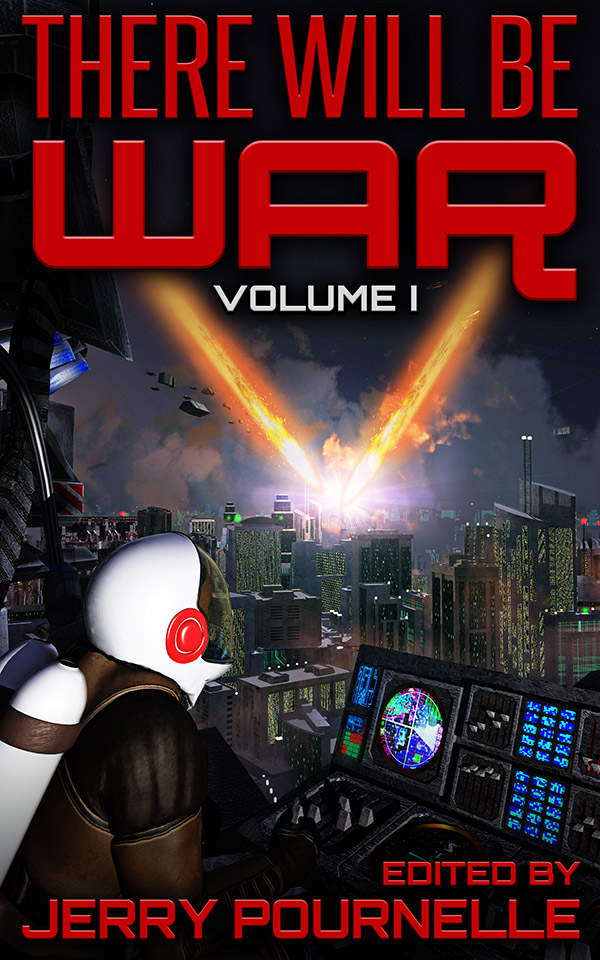
To me, Jerry Pournelle was a near-mythic name that appeared on the shelves of B. Dalton’s like an omnipresent demigod. I enjoyed his non-fiction essays even more than most of the fiction for which he was most famous, and looking back, he probably had as significant an impact on my intellectual development as Milton Friedman, Joseph Schumpeter, or Camille Paglia, not only as a writer, but as an editor. When I first read the first volume of THERE WILL BE WAR, with the unforgettable cover of a white-helmeted spotter calling in orbital artillery, I was deeply impressed by the way in which the essays informed the short stories as well as how the short stories tended to bring the essay subjects to life and make them more relevant to the reader.
And the names! Gordon R. Dickson. Philip K. Dick. Arthur C. Clarke. Poul Anderson. Joel Rosenberg. Robert Silverberg. Joe Haldeman. Niven and Pournelle. What was most impressive, however, was the way in which even the stories by the biggest names were occasionally trumped by then-unfamiliar names like Orson Scott Card, Edward P. Hughes, and above all, William F. Wu. THERE WILL BE WAR ran from 1982 to 1990, and finally came to an end around the same time as the Soviet Union, which had often served as a primary topic in the nine-volume series. It seemed apropos, after all. The Berlin Wall had fallen, an end to history had been reached, the long-warring nations of Europe were heading for monetary union, and, everyone assumed, peaceful political union as well, and many presumed that an end to war as we knew it was in sight as well. There would be no more war.
Being, as readers here know, somewhat of a pessimist when it comes to such utopian claims, reviving THERE WILL BE WAR was one of my first ideas when Castalia House was founded. I contacted Dr. Pournelle about it, but although he generally favored the idea, we never really got around to discussing it very seriously. I went with Plan B and created RIDING THE RED HORSE with LTC Tom Kratman instead. But I still wanted Dr. Pournelle to be involved, as I considered RED HORSE to be the spiritual successor of THERE WILL BE WAR. Upon being asked for a contribution, Dr. Pournelle graciously permitted me to include two of his pieces, a well-known short story set in the CoDominium universecalled “His Truth Goes Marching On” and an article on wargame design that I found to be particularly interesting. Tom also obtained a contribution from John Carr, the associate editor on several volumes of THERE WILL BE WAR, including the first one. RIDING THE RED HORSE was published last December and it has been very well received. Five months after its release, it is still one of the top ten bestsellers in Military Strategy and more than one reviewer has even referred to it as a virtual “tenth volume” of THERE WILL BE WAR.
But the most significant response came from Dr. Pournelle, as after looking over the new anthology, he asked me if Castalia House might be interested in republishing his own out-of-print anthology series. I allowed that, yes, perhaps Castalia might have some modest interest in considering a discussion of the possibility, immediately put it on top of our priority list, and after a few months of hard work from the ad hoc THERE WILL BE WAR team, I am very, very, very pleased to be able to announce not only the republishing of THERE WILL BE WAR Volumes I and II, but also the revival of the THERE WILL BE WAR anthology series with an actual Volume X, edited by Jerry Pournelle, as well. Volume I and Volume II of THERE WILL BE WAR are now available in ebook at Amazon and Castalia House for $4.99 each, and as the following reviewer of Volume I noted, despite being 33 years old, they have a lot to offer the younger generations who never had a chance to read them before. It was very rewarding to read the first review of Volume I from a reader too young to have encountered the original paperbacks.
This book is astonishing. A collection of short military science-fiction and essays put together in the early 80s by Jerry Pournelle, the book is older than I am and yet somehow manages to avoid seeming dated at all. The book was extremely well-regarded when it came out, and spawned a nine volume series, but for years has languished in semi-obscurity. How good is it? It’s got the original “Ender’s Game” novella by Orson Scott Card, and that’s not even the best story in the book!
If you’re a younger reader, odds are you’ve never even heard of half of these writers. And they’re all good. The stories are diverse, with everything from post-apocalyptic shootouts to huge sci-fi space battles. Sometimes the heroes win, and sometimes they don’t. But every time I found myself rooting for them.
But the real prize of the book is the non-fiction essays, which give a window into how scary the world was back when the Soviet Union was still a threat. One of the essays, ‘The Soviet Strategic Threat From Space”, discusses the end of the world in a cold, scientific manner that’s more chilling than any fiction could ever be.
“There Will Be War” introduced me to a ton of great new authors, and entire series that I had no clue even existed. For someone who’s just getting into science fiction, it’s a wonderful starting point. For veterans, it’s a way to revisit some of the old greats.
I will post later today at Castalia House about some of my favorites from these first two volumes, but I can assure you that if you enjoyed RIDING THE RED HORSE in any way, shape, or form, you will be find Volume I and Volume II of THERE WILL BE WAR to be very well worth reading. I very highly recommend both volumes.
Will these be released in print versions as well? Yes, in two-volume case laminated omnibus hardcovers. The first will probably appear in the July-August timeframe.
When will the next volumes be released? We expect to release Volumes III and IV in company with the VI+VII hardcover.
Does this mean the end of RIDING THE RED HORSE? No. RIDING THE RED HORSE Vol. 2 will focus on entirely new fiction. THERE WILL BE WAR Vol. X will consist primarily of Dr. Pournelle’s selections from the best and most significant military fiction published between 1990 and 2015.
Who did the covers? Jartstar and Chris came up with the title layout and a new artist, Lars, did the updated 3D images that are homages to the original painted covers. He’ll be doing the entire series.
Can we review the books on Amazon if we bought them from Castalia or read them previously? By all means, please do.
Jerry Pournelle’s There Will Be War series is returning to print. All nine volumes will be reissued by Castalia House in ebook and two-volume omnibus hardcovers.
I’m glad to see that Dr. Pournelle, who I have now known over 40 years, will have his iconic titles back on the market.
Jerry commented on the project’s history for File 770:
I am very pleased that we were able to revive, in both hardbound and eBook, the There Will Be War anthology series. The series was conceived during the Cold War, but most of the stories take place in other eras. I am not astonished that they hold up well long after the collapse of the Soviet Union ended that conflict. We will be releasing the original 9 volumes over the next year and revive the series after that. However much international politics may change, it remains likely that There Will Be War.
There is more, so read the rest there. As you can imagine, I am a tremendous fan of the anthology series, and indeed, Riding the Red Horse was created in conscious imitation of its ground-breaking blend of fact and fiction. Volume I is already ready to go and we are just putting the final touches on Volume II, after which we will release both of them. If you’re not subscribing to the Castalia House New Release mailing list yet, you’re probably going to want to do so soon because we will be announcing a very good new release offer in the next newsletter. There Will Be War was a tremendous influence on my own intellectual development, and not only are the books not conceptually outdated, they often feel remarkably prescient despite the end of the Cold War and the passing of the events upon which they are nominally focused. The reality is that the forces leading to war run much deeper than any of the national or societal differences that are usually blamed for it, which is why Dr. Pournelle is correct to observe that history has not ended, the secular utopia has not arrived, and there will indeed be war. I have highly recommended the books for decades, which is why getting them back into print was one of my top priorities for Castalia House.
We will publish the Volume I and II ebooks before the end of this month. Later this year, we will publish Volumes III and IV in ebook, and Volumes I and II together in an omnibus hardcover edition. We expect to publish all nine volumes, as well as the new tenth volume, before the end of 2016.
John C. Wright burst onto the science fiction scene in 2002 with his astonishing The Golden Age. Published by Tor Books, Amazon.com declared it to be “the most ambitious and impressive science fiction novel since China Miéville’s Perdido Street Station. Amazingly, it is John C. Wright’s debut novel.”
Publishers Weekly wrote: “It’s already clear, however, that Wright may be this fledgling century’s most important new SF talent.”
A record-setting five of those works were nominated for the 2015 Hugo Awards in three categories. A sixth work was also nominated for Best Novelette, but was subsequently ruled ineligible by Sasquan. All four of the Hugo-nominated short fiction works, as well as an essay from Transhuman, are included in this special release, which is available for free from Castalia House in both Epub and Mobi (Kindle) formats and will also be available in the Hugo packet.
2015 Hugo nominee Jeffro Johnson is better suited to make the following introduction than I am, so I will simply quote him in introducing the latest Castalia House blog star, Douglas Cole, the author of GURPS Martial Arts: Technical Grappling and a number of other combat-related RPG publications.
Game designer Douglas Cole will be joining Ken Burnside and myself at Castalia House with his new blog series called “Violent Resolution.” As you can see from his first post, this is going to be a doozy. From what I’ve seen, this will do for rpgs what Nick Schuessler did for wargames in his Space Gamer column. If you’re the type of person that’s always wanted a doctorate in comparative gaming, you will faint!
As for Violent Resolution itself, Cole himself explains what the weekly column is going to entail:
The column will focus on combat in games, mostly to the exclusion of other things. It will of course include fighting, but also how fights start and end. It will spend a great deal of time looking at game mechanics along the way, and will probably spend a lot of word count looking at what kind of storytelling environment is created by those mechanics.
Through the Lens
As the blog progresses, I’ll frequently be looking at combat with examples from different games. There will be others from time-to-time – notably when I have an anecdote from games I’ve played (or stopped playing) in the past. But by and large, I’ll explore this topic by looking at how certain games handle things.
Dungeons and Dragons, Fifth Edition
I’m going to refer to D&D5 here frequently, because you can’t talk about RPGs – especially combat in RPGs – without talking about the moose in the room. D&D-based games dominate the market of tabletop RPGs that all other games combined are pretty much an afterthought.
I’ll use D&D5 as a proxy for the kind of resolution system that is found as variations on a theme in Pathfinder, the D&D-derived Old School Renaissance (or Old School Revival? Maybe both!), and other games that are recognizably the same basic mechanic. All are recognizable as essentially the same game that I learned to play when I was 10 years old, roleplaying for the first time in 1981 – the Basic/Expert D&D boxed sets, followed by AD&D. Stepping into Swords and Wizardry, Pathfinder, or D&D is usually a matter of fine-tuning. You may need to understand the proper use of a Feat hierarchy, or what will kill your character as opposed to knocking him out, or get the feel for various special mechanics, such as the Advantaged/Disadvantaged mechanic newly introduced in D&D5 . . . but by and large if you’ve ever played D&D you’ll understand what’s going on pretty fast.
As the future leading publisher of military science fiction, the martial arts from the grand strategic to the tactical is of interest to us, and while I think it is highly unlikely that we will be able to convince Dr. van Creveld, Gen. Krulak, Gen. Gray, or Mr. Lind to take up blogging at Castalia House anytime soon, we are very pleased to have Mr. Cole intelligently addressing matters from the other end of the spectrum.
Martin van Creveld, the author of The Transformation of War, Technology and War, and the newly published Castalia House books A History of Strategy: From Sun Tzu to William S. Lind and Equality: The Impossible Quest, explains how the technological transformation of war has ruined the effectiveness of modern Western militiaries despite their massive technological advantages over their opponents. From his essay entitled “Pussycats”:
For several decades now, Western armed forces—which keep preening themselves as the best-trained, best organized, best equipped best led, in history—have been turned into pussycats. Being pussycats, they went from one defeat to the next. True, in 1999 they did succeed in imposing their will on Serbia. But only because the opponent was a small, weak state (at the time, the Serb armed forces, exhausted by a prolonged civil war, were rated 35th in the world); and even then only because that state was practically defenseless in the air. The same applies to Libya in 2011. Over there, indigenous bands on the ground did most of the fighting and took all the casualties. In both cases, when it came to engaging in ground combat, man against man, the West, with the U.S at its head, simply did not have what it takes.
On other occasions things were worse still. Western armies tried to create order in Somalia and were kicked out by the “Skinnies,” as they called their lean but mean opponents. They tried to beat the Taliban in Afghanistan, and were kicked out. They tried to impose democracy (and get their hands on oil) in Iraq, and ended up leaving with their tails between their legs. The cost of these foolish adventures to the U.S alone is said to have been around 1 trillion—1,000,000,000,000—dollars. With one defeat following another, is it any wonder that, when those forces were called upon to put an end to the civil war in Syria, they and the societies they serve preferred to let the atrocities go on?
By far the most important single reason behind the repeated failures is the fact that, one and all, these were luxury wars. With nuclear weapons deterring large-scale attack, for seven decades now no Western country has waged anything like a serious, let alone existential, struggle against a more or less equal opponent. As the troops took on opponents much weaker than themselves—often in places they had never heard about, often for reasons nobody but a few politicians understood—they saw no reason why they should get themselves killed. Given the circumstances, indeed, doing so would have been the height of stupidity on their part. Yet from the time the Persians at Marathon in 490 B.C were defeated by the outnumbered Greeks right down to the present, troops whose primary concern is not to get themselves killed have never be able to fight, let alone win.
Thanks to many of you, A History of Strategy: From Sun Tzu to William S. Lind is the #1 bestseller in History>Military>Strategy. The reviews are excellent; even the single 3-star review concludes: “Belongs of the shelf of every person who is interested in the theory and practice of warfare.”
Another review says: “A History of Strategy: From Sun Tzu to William S. Lind earned five stars from me for being so readable and packed with content, despite being so brief. This is the first book of Martin van Creveld’s I have read and I look forward to delving into his catalog. In addition to being a good read, Martin van Creveld’s svelte A History of Strategy: From Sun Tzu to William S. Lind is a wonderful way for those not well read in military strategy to begin their self-directed study. Martin van Creveld discusses all the notable war theoretician authors more or less in accord with their significance as well as some of the war artisan authors. Creveld also provides a “Further Readings” section to aid those so inclined. Given the limitations imposed on him (low page count) Creveld does a fine job covering the material.”
I’m in the middle of reading van Creveld’s Technology and War myself, and I can say with confidence that the reviewer will find delving into that catalog more than worthwhile. As for the “Pussycats” essay, the observation by a military historian should cause some serious strategic rethinking on the part of those who insist on repeatedly sending unmotivated troops unsupported by popular enthusiasm into unwinnable military conflicts. It won’t, but it should.
Martin van Creveld ranks high among military historians, and given the changes in technology since Napoleonic times, his work is a necessary supplement to Clausewitz. His reflections have influenced strategists and grand tacticians since his first books appeared, and as an Israeli historian, he has been in a unique position to observe the changing nature of modern warfare on both the grand strategic and tactical levels, particularly with regards to asymmetric warfare. Scholars and military planners ignore his thoughts at their peril.
I don’t entirely agree with him on the effectiveness of guerilla operations absent a sanctuary, or with his conclusions concerning Viet Nam, which I consider to be a victory won, then given up. And while the Iraq War was certainly unwise, I don’t believe that it was necessarily unwinnable, as the U.S. military was given an impossible mission, then undermined by political errors made above their pay grade. That being said, if winning is defined as a nation being better off after the war than it was before, it is hard to see how winning in Iraq was ever possible. So perhaps we agree after all.
But whatever your position on modern conflicts might be, Martin van Creveld’s writings are worth reading and they are vital to reaching informed conclusions about the art of war.
Jerry Pournelle Studio City, California
Castalia House has published a lot of books over the last twelve months. I’m proud of those books and I believe all of them are worth reading by at least one specific group of readers or another. But most books, even the excellent ones, are not what I consider to be absolute must-reads by everyone of sufficient intellect to comprehend them. Such books are very few and far between; the last one we published that I personally felt this strongly about was AWAKE IN THE NIGHT LAND by John C. Wright.
I feel much the same way about A HISTORY OF STRATEGY: From Sun Tzu to William S. Lind by Martin van Creveld, although for very different reasons. Most of you are aware that I am very well-read in strategic matters. I read Caesar and Mahan and Oman for entertainment, I rely heavily upon Frontinus, and to a lesser extent, Onasander and Vegetius, in my fiction, and I am no stranger to the great works of military strategy and tactics from the ancients to the moderns.
And yet, in A HISTORY OF STRATEGY, van Creveld not infrequently cited military thinkers of whom I’d never even heard before, let alone read. This is not a history of war, but a history of thinking about war, and it is arguably one of the most masterful summaries of a single millennia-spanning train of thought ever written. It’s not long, it’s not deep, and it’s not hard to follow, but it is an education in 116 pages. Read this and you will be better-informed on the subject of war than 99.99 percent of the human race.
Better still, you will be in a position to dive deeper into any one of a hundred areas and to understand where you are diving as well as the historical significance of that area. Van Creveld begins at the beginning, with the ancient Chinese, and proceeds methodically through time, crediting each cognitive breakthrough to its author before explaining its significance as well as its consequences.
I highly recommend this book, especially to parents who are homeschooling teenage boys. Featuring the foreword by Dr. Jerry Pournelle quoted above, it is available for $4.99 at Castalia House in both EPUB and Kindle formats and at Amazon.
Throughout history, ‘equality’ has tended to mean different things, and it usually only pertained to certain situations or within certain groups. The most powerful argument that he makes is towards the end of the book, in which he points out that equality is an essential concept in military life, but that it isn’t generally sustainable outside that context. Members of a military unit of similar ranks must be somewhat equal — else the army loses coherence. It can’t hold a formation in reality, or be conceived of in a useful way by officers, if there is no attempt to make those men more equal.
van Creveld: Without equality, cohesion is inconceivable. Cohesion, the ability to stick together and stay together through thick and thin, is the most important quality any military formation must have. Without it such a formation is but a loose gathering of men, incapable of coordinated action and easily scattered, and of little or no military use. In all well-organized armies at all times and places, the first step towards cohesion has always been to put everyone on an equal basis. Often the process starts when all new recruits are given the same haircut. Beards may have to be taken off, moustaches trimmed, piercings and jewelry discarded.
This is the proper understanding of equality: equality of rank within a hierarchy. It has a limited conceptual and practical utility that becomes wasted when thinkers apply the concept beyond its carrying capacity, so to speak.
I thought this was a perceptive review. The important thing to remember when reading the book is that van Creveld is a scholar, not an ideologue or a polemicist. While he doesn’t hide his personal opinions, he also doesn’t place any particular weight on them in comparison with the historical facts and concepts that he delves into and describes.