Now that the Lions Den series has been introduced with some more or less established writers, I thought it would be good to start bringing some new writers from the burgeoning independent publishing scene into the mix as well. I don’t know anything at all about Gunther Roosevelt, except that it is obvious there is no chance in Hell that his anthology, Tales of a New America, would be published by any mainstream SF/F publisher, with the possible exception of Baen Books. As always, if you’re interested in being one of the three two one volunteer reviewers of the book, please send me an email. We are all set for reviewers.
After 9/11/01, I had hoped that Americans would rally against one of the most vile and long standing enemies of humanity, Islam; but neither the experience of the wholesale slaughter of thousands of innocent Americans nor the glimpse of an unveiled totalitarian and psychotic Arabian evil could hold the sociopathic Left in check for long. Combining the Bush administration’s incompetent foreign policy, the President’s absurd belief that ancient places with tribal peoples filled with simmering animosities and rabidly violent inclinations could embrace impartial institutions and liberal democracy, along with the Left’s program of political correctness, destruction of Christian morality, indoctrination of the young, and corruption of all American institutions and triumph of crony capitalism — I realized that America was over.
Voting Republican, Libertarian or anything else was useless. Nothing could stem the tide of America’s financial and social destruction anymore than our elected representatives wished to stem the invasion by Mexicans, Asians, Africans, and Muslims regardless how many Americans were killed, raped, molested, robbed, and maimed by the illegal and legal hordes.
What could be done? Politics was hopeless. The people had no voice nor advocate no matter who they elected, and half were co-opted anyway and part of the scheme of government growth, employment, or benefit. The answer was as clear to me as it was to the Founding Fathers — That whenever any Form of Government becomes destructive of these ends, it is the Right of the People to alter or to abolish it.
It was also clear that moaning and complaining about the present situation was a waste of energy and trying to organize incremental reforms to re-establish a coherent and sane society was futile in the extreme.
What is needed is revolution, but before it can begin, people need a vision of what a saving remnant might accomplish in carving out a territory within America and building a new nation and ethno-state. People would need to see what a New America might look like where they could thrive as they once had, and if determined, might return to conquest in driving out invaders and their collaborators from ancestral homelands
Hence, the Tales of New America that offers that offers twenty-three snapshots from a period fifty years or so years into the future.
The Tales present a new society in the making, its cohering into a state with religious foundations, its gathering of people, and organizing of institutional machinery and an advanced military. You meet a border guard in a key outpost with the power of life and death trying to maintain his humanity while enforcing laws with harsh penalties.
There are athletes, soldiers, hardware store salesmen, foreign spies, Berkeley refugees, Mexican gang bangers trying to hang on to their territory, ghetto dregs when the well’s run dry, Leftist peaceniks facing their folly, mindless government bureaucrats revenged upon, and a movie producer helping to create a new Hollywood who make up some of the characters in the stories.
The reader will find that some stories are better written or more engaging than others, but that’s the beauty of an anthology like this — readers will disagree on what they most liked or didn’t enjoy as much.
Tales of New America is a panorama through time of possibilities for a thriving and prosperous future for civilization, the Northern European kind, that has done more good for more people and would continue to do so were it re-infused with great purpose and common identity.
LoneStarCon 3, the 71st World Science Fiction Convention, has announced the 2013 Hugo Award winners. 1848 valid ballots were received and counted in the final ballot.
BEST NOVEL Redshirts: A Novel with Three Codas, John Scalzi (Tor)
I think it is nice that McRapey is finally receiving the in-group validation he has so assiduously pursued over the years. While I tend to view this award as additional evidence of the decline of professionally published SF/F, I’m sure Redshirts is a perfectly fine unauthorized derivative of a television series from 47 years ago. It’s rated 3.7 stars out of 5 on Amazon, after all.
A literary sample from the Best Science Fiction Novel of 2013:
“Man, I owe you a blowjob,” Duvall said. “What?” Dahl said. “What?” Hester said. “Sorry,” Duvall said. “In ground forces, when someone does you a favor you tell them you owe them a sex act. If it’s a little thing, it’s a handjob. Medium, blowjob. Big favor, you owe them a fuck. Force of habit. It’s just an expression.”
“Got it,” Dahl said.
“No actual blowjob forthcoming,” Duvall said. “To be clear” “It’s the thought that counts,” Dahl said, and turned to Hester. “What about you? You want to owe me a blowjob, too?” “I’m thinking about it ,” Hester said.
And they say SF is in decline. I was mildly amused to see that the Hugo Awards honored no less than five people who were involved in some way in my expulsion from SFWA. This comment from Harsh also cracked me up:
“Scalzi now working on a new book called Cylon, the story of a misunderstood robot who’s picked on by mean old Colonial warriors.”
Impaler is a well written alternate history, marred with some unfortunate anachronistic insertions of modern sensibilities. I would also add that it is not for the faint of heart; fight sequences are brutal and gory, torture is a regular occurrence, and pederasty forms a foundational portion of the story.
Paulk effectively captures the feeling of the time period for the most part, both its religiousness as well as its savagery. She makes Vlad an understandable character, while not shying away from the reality of of the violence of the times and what was necessary for the man who would be king.
The primary criticisms I have of this book is that while it for the most part aims to be a gritty, historically based tale, it has a few elements that break the willing suspension of disbelief. First, Vlad forbids the rape and pillaging that regular accompanies a conquering army. This is almost believable, and I would have given it a pass, had not other issues come into play.
Towards the end of the book, some of the child victims of pederasty engage in homosexual behavior. Not only does Vlad give them a free pass, but he actively argues both an Orthodox priest and a Catholic priest into submission. This is so absurd it is beyond description. Further, he references in his arguments with the priests his well-read nature in the Scriptures as well as having compared translation notes. It is unlikely that most priests were even so conversant in the Scriptures at that time, let alone the nobles (who were in turn taught by the priests). A well educated noble would have been able to read and perhaps do his own accounts, but not engage in Scriptural debates. Similarly, a little later, he also reveals he is conversant in Jewish treatises as well. Simply put, this is laughable for the time.
Those criticisms not withstanding, Impaler was an interesting read and cleverly written. I would not recommend it for the tender hearted due to the violent content, but fans of historical fiction and alternate histories will likely enjoy it.
NB: This is the first of the three volunteer reviews. This one was written by DK.
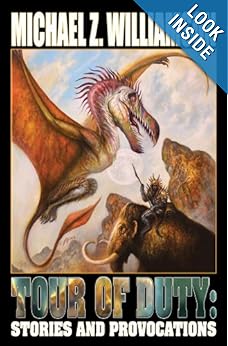
BB reviews Michael Z. Williamson’s Tour of Duty and finds it somewhat of a mixed bag. I have to admit, I was absolutely shocked that I didn’t hate the Valdemar stories, or at least, the two military ones set on the edges of it. Let’s just say that my opinion of Mercedes Lackey’s books is considerably less generous than Mr. Williamson’s. Also, unlike the reviewer, I really liked the gun porn at the end. After reading both articles on the 10 and 10 more manliest guns, I found myself checking out current prices on a few of the more interesting pieces. But I’m not sure which surprised me more, however, the fact that Mr. Williamson had written stories set in Valdemar or that he has such a high opinion of the GLOCK.
Those suspecting Mr. Williamson of possessing alternate sexual preferences on this basis should stand down, however, as he is highly sound on the 9mm round. As for the fiction, my definite favorite was the hunting in Hell story.
The book title implies some sort of tie-in between all of the short stories and that tie-in has to do with military or fighting life. In a general way, this is true.Michael Z Williamson threads together personal anecdotes and short stories and he closes out with recipes for shots. Not firearm shots, alcohol shots. A lot of the anecdotes are personal insights into the stories that follow. Some have to do with his personal deployment, some have to do with what sparked the story, such as the Poul Anderson tale. That story was quite original and I spent a lot of it trying to match up first names with famous people. If you read the book, you will understand what I mean. Some of the anecdotes are just general information on how he ended up writing in this or that fantasy world or how he ended up where he is in life. He has lived an unusual existence compared to most American citizens.
The first half of the book was particularly engaging. “Desert Blues” was nice to me. The imagery of mortar attack interwoven with music and altered lyrics and defiance of the enemy…I liked the feel of the story. It is the one that stood out the most. Probably because music is such a universal language, how we all blast the stereo on our favorite tunes, yardwork or housework made more bearable by lyrics and notes. He captures that in the story, but set in a combat zone and I am still not sure if it is fiction or nonfiction. After reading it, I wondered if he had that “moment” of clarity personally or not.
The stories from the Valdemar universe were familiar because I have read the original books by Mercedes Lackey but they were different enough to make me want to read the ones co-authored by Williamson and his wife.
I was expecting the whole book to be along the same lines but part way through, Williamson included stories about hell. More specifically, a special kind of hell for lawyers. Which could be an amusing premise, but I did not enjoy the tales at all. And after the first story, “Heads You Lose,” I felt the book didn’t have the impact that the first half had anymore. The two” Lawyers in Hell” stories were somewhat clever, certain characters locked in to their personas before they died, but it became tedious and no longer amusing after a handful of pages. And the book sort of went downhill from there for me.
I did ask Vox for guidance on this review because the book doesn’t follow a normal format, being short stories instead of one long tale, and his only directive was to think about whether the blog readers would enjoy it. I think some would enjoy the first half for the military action, and some might enjoy the second for the clever wordplay in the second half. The ending with the shot recipes, I just skimmed through them because I was not interested.
Out of 5 stars, I’d give the book a 2.5 overall, which would obviously be weighted towards the first several short stories.
The following excerpt is from “Desert Blues”:
The guy could play. Jazz mixed with blues and he just went on and on, silky and then snappy on the strings, playing his own fills and rhythm. It’s one thing on stage or in the studio with racks of gear and a mixing board, but he had a guitar and an amp.
The notes faded out as he dialed the volume down, and we all strained to hear it as long as possible. The dull roar of generators, ECUS and the remaining ringing from mortars meant we probably missed quite a bit. Still, it was what we had.
Then a strummed chord brought it all back to life with one of the greatest songs of all time.
“You get a shiver in the dark,
there’s a sandstorm in the park, but meantime
South of the Tigris you stop and you hold everything.”
I’ve tried playing Sultans of Swing. It really takes two guitars and a bass to get that groove. It can be done on one guitar, if the guitarist is just amazingly good.
This guy was that good and then some.
He played this syncopated, peppy rhythm, with this odd bluesy, jazzy, Arabian melody. It fit the mood, the environment and the time, and I knew I’d never hear anything like it, ever again. Not that I’d come back to Iraq even for a performance like this, of course…though I just might.
We just stood there and soaked it up, rapt or smiling, amazed or just oblivious.
“…Way on down south.
Way on down south, Baghdad town…”
No one moved, no one twitched. The oven-dry heat covered us, and my feet sweated from the still sun-hot sand, but I was not going to move. He sang and played and it was wistful and rich and American, even though Knopfler’s Scottish. This version, though, was pure American spirit.
After taking everyone’s opinions into account, I removed a few series, added a few more, and came up with the following order. Underlining indicates an incomplete series, or at least one I deem insufficiently complete to conclusively judge, while italics indicates a series I have not personally read.
The Lord of the Rings, Tolkien
The First Law, Abercrombie
Malazan Book of the Fallen, Erikson
A Song of Ice and Fire, Martin
The Black Company, Cook
Dragonlance, Weis & Hickman
The Chronicles of Thomas Covenant, Donaldson
The Riftwar Saga, Feist
The Long Price Quartet, Abraham
The Demon Cycle, Brett
The Stormlight Archive, Sanderson
The Belgariad/The Mallorean, Eddings
Codex Alera, Butcher
The Prince of Nothing, Bakker
Memory, Sorrow, and Thorn, Williams
The Deathgate Cycle, Weis and Hickman
The Wheel of Time, Jordan/Sanderson
The Sword of Truth, Goodkind
Shannara, Brooks
The Red Knight, Cameron
No doubt many will disagree with my opinions here, but they are not arbitrary. First, I’m judging the series as a whole. One thing I’ve noticed is a lot of series take a serious nosedive after a certain point. The Chronicles of Thomas Covenant would be number two on this list if judged solely on the first two Chronicles, (six books). Bakker’s series would have cracked the top ten were it not for the abysmal third book. And as crazy as it sounds, Martin could freefall if he doesn’t turn it around in this next book; post Dance, the “American Tolkien” already sounds silly.
I tend to suspect Brandon Sanderson will move up and Peter Brett will move down. Brett started great, but his demon world is a boring hive mind and he never got around to actually writing about eponymous Daylight War in the third book. I suspect that he may have fallen victim to Epic Author Disease even faster than Jordan or Martin did.
There are series that I love, that I consider much better than most of the series on this list. But they’re not epic, by which I mean I regard them as books that on some level are doing something similar to what I’m attempting to do. The whole reason that I’ve been closely considering the various epic fantasy series is to avoid the problems that have plagued some of these series in the past.
It’s too soon to judge ATOB, but good or bad, I can hope to keep improving. Some would even say there is considerable room for it….
Along with Dave Freer, Sarah Hoyt, and Chris McMahon, Kate Paulk is a member of the Mad Genius Club. She is also a Mensa-qualified history buff and her take on Vlad Tepes, aka Dracula, Impaler, is based on the actual historical figure and military leader, as opposed to the caped seducer. Please note that we now have our three volunteer reviewers.
Not Another Dracula Book
I get that a lot, since Impaler is – as the title suggests – about Vlad Dracula. Except, well… it’s not “another Dracula book”. For starters there’s the barest hint of a nod to the vampire legends, and for seconds, he’s the hero. Not anti-hero and not some PC navel gazing everyone is horrible and it’s all awful hero, either, he’s an honest to $DEITY$* actual hero in the old style. Also, because Impaler is alternate history, he wins.
Now that I’ve covered the plot in a nutshell (I really do describe the book to others this way. “Yes, it’s about Vlad the Impaler. He wins.” I think it might be the big grin when I say this that causes the faint of heart to edge away. That and the badge proclaiming “Dracula NEVER sparkled”), I should probably add a little more about what else makes Impaler not your typical Dracula book.
I hesitate to say that I researched the hell out of it, not least because any time I hear someone say that, the end result looks like the research came mostly out of the strange inner curves of their cranium rather than any actual library. I hope I got reasonably close to accurate, given that nobody has written “Everyday Life in Late Fifteenth Century Wallachia” – or if they have, they weren’t considerate enough to publish it in time for me to use it. A heck of a lot of architecture has vanished since then, too, so I spent hours chasing around for weird stuff like “What did Varna’s main gate look like in 1477?” (I didn’t find an answer to that one, so I guessed), “Where was Mehmed II in the winter of 1477/1478?” (Another guess – this one unfortunately essential to the plot), “What state were Constantinople’s walls in by early 1478?” (That one, I did get a more or less useful answer to).
From this the astute reader (meaning most of the folks here) might have guessed that a good chunk of Impaler is in the alternate side of history, and they’d be right. By the end of the first chapter Impaler is out of our timeline and into what might have happened if the man who was at one time regarded as the possible savior of Christendom had survived what was almost certainly an assassination attempt authored by Mehmed II (from a very safe distance – Vlad was the only person who ever scared Mehmed. Which in my opinion put Vlad on the right side of the line).
I started this because Vlad himself has intrigued me for years. Here was a man who was quite possibly the only hope his small nation had – someone with enough strength of will to challenge the noble class who had been going through Princes at the rate of one every couple of years on average (some of them with reigns so short any official portraits would have to be taken from their death mask), the determination to turn what would be called a failed state these days into a law-abiding nation (he succeeded), and the audacity to challenge the overwhelming power of the Ottoman Empire – which had been seen as unbeatable since the fall of Constantinople.
There were also the legends that suggested he inspired extraordinary loyalty, enough of them that there had to have been something there, particularly when some of these legends were authored by his enemies (of which he had many – not helped by Matthias Corvinus betraying him so he could use the crusade gold to ransom the crown of Hungary and forging “evidence” to that end – just like modern politics only with more blood), and the hints that the man behind the legends was strictly moral, determined, and had a vile semi-berserker temper that led him to fly into uncontrollable rages if something hit one of his triggers.
So I started to play with the question of what would Vlad have done if he had survived the assassination attempt. The rest of the book followed on from that.
Someone came up with this idea in the comments and I thought it would be interesting, especially because I recently started reading two would-be epic fantasies that are, in a word, DEEE-readful. About which more anon. Here are the epic series I’m considering for the list, but feel free to add more in if you feel they belong. To qualify, an epic fantasy has to be epic, it has to be big and fat and set in its own distinct, sprawling fantasy world. If the books in the series aren’t at least 600 pages apiece, (and 750 is better), they don’t count, although I’m willing to consider exceptions. For example, Glen Cook’s Black Company, in or out? I vote in due to the size and scope of the series, though not the individual books themselves. Harry Potter, on the other hand, is definitely out.
The Lord of the Rings, Tolkien The Wheel of Time, Jordan The Riftwar Saga, Feist Chronicles of Thomas Covenant, Donaldson Shannara, Brooks The Sword of Truth, Goodkind Malazan Book of the Fallen, Erikson A Song of Ice and Fire, Martin First Law, Abercrombie Prince of Nothing, Bakker The Black Company, Cook The Kingkiller Chronicle, Rothfuss The Belgariad, Eddings The Mallorean, Eddings Dragonlance, Weis & Hickman The Deathgate Cycle, Weis and Hickman The Long Price Quartet, Abraham The Stormlight Archive, Sanderson Mistborn, Sanderson The Red Knight, Cameron The Demon Cycle, Peter Brett
I was a little surprised to go back and discover that Silverberg’s Majipoor Cycle was a short as it is. I remember Lord Valentine’s Castle being a huge book, not a mere 479 pages. Anyhow, feel free to suggest any other epic fantasies that you would argue merit consideration, but note that I’ve already decided that Guy Gavriel Kay’s, Lloyd Alexander’s and Robin Hobb’s books are of insufficient scale to qualify as epic fantasy, whereas John Fultz’s and Mark Lawrence’s books are simply too short to make the cut. And while one could make a perfectly rational argument for Pratchett’s Discworld in its totality, I don’t think it belongs here for stylistic reasons, if nothing else.
Though Martin knows how to tell a good story, brilliantly weaving his complex plots with familiar tropes (without falling into kitsch), his appeal depends on more than just skilful prose. Brutal cruelty, sex, and disloyalty are the hallmarks of Martin’s world. This makes him, it is argued, far more realistic than Tolkien. As Lev Grossman, the fantasy author who first dubbed Martin “the American Tolkien”, writes,
“What … distinguishes Martin, and what marks him as a major force for evolution in fantasy, is his refusal to embrace a vision of the world as a Manichean struggle between Good and Evil. Tolkien’s work has enormous imaginative force, but you have to go elsewhere for moral complexity.”
There are no clear “goodies” in Westeros. Characters are honourable or treacherous depending on the day of the week. Good guys finish last and those who cling to noble principles are manipulated and/or beheaded. We sympathize with immoral characters like the incestuous Lannisters, Varys the Eunuch, and an assortment of murderers, rapists, and sadists. Nothing is taboo.
Tolkien’s G-rated narrative, critics argue, has burdened the fantasy genre with a “Disneyland Middle Ages”. Martin is more meaningful because he is morally ambiguous.
Although he is an admirer of Tolkien, Martin notes that “the whole concept of the Dark Lord, and good guys battling ugly guys, Good versus Evil … has become a kind of cartoon.” Fantasy doesn’t need any more Dark Lords or hideous enemies, because “in real life, the hardest aspect of the battle between good and evil is determining which is which”.
“I’ve always liked grey characters”, Martin said in a 2001 interview, “And as for the gods, I’ve never been satisfied by any of the answers that are given. If there really is a benevolent loving god, why is the world full of rape and torture? Why do we even have pain? … Why is agony a good way to handle [death]?”
The “game of thrones” is a cynical view of politics with its factional back-stabbing, unbridled lust, fickle allies and treacherous families. The anarchic world of Westeros is fundamentally defined by the ladder to power. “Some are given a chance to climb but they cling to the realm or the gods or love – illusions!
Only the ladder is real; the climb is all there is”, says the amoral and supremely calculating Lord Baelish.
In this moral fog there is no room for nobility and beauty. “Of all the bright cruel lies they tell you, the crudest is the one called love”, Martin wrote in his 1976 short story “Meathouse”. But the “realist” fantasy is limited to the basest dimensions of human experience. It’s like reading a newspaper which only features articles about Ariel Castro the Cleveland rapist, al-Qaeda suicide bombers and waterboarding at Guantanamo Bay. It is hard to imagine anyone wanting to live eternally in the brutal and sadistic Westeros.
Is Tolkien really less realistic, though?
The problem with Martin and his imitators is that their works reflect their crabbed and ugly souls. It is interesting to compare the early reviews of Martin’s first two books with the latest two books in the series; Martin is increasingly committing some of the very acts that he was praised for avoiding in the beginning.
Does anyone believe that John Snow is truly dead? Did anyone fail to notice that Martin ended A Dance with Dragons in much the same way that cheap sitcoms of the 1970s once ended their seasons? And how many characters that we were led to believe were dead are still wandering around Westeros in varying stages of life and undeath? Who has not marked the tragic decline of Tyrion Lannister from the witty dwarf who surmounted his short stature to the silly fool who falls off pigs?
Tolkien’s world was original and breathtaking. Martin’s is derivative and flat. Tolkien was a master of the structure of the epic tale. Martin wrote himself into an obvious structural impasse. But worst of all, where there is depth of soul and all the grandeur of Creation in Tolkien’s work, there is neither soul nor beauty in Martin’s. Martin focuses solely on the petty and ugly aspects of life, rendering his magnum opus more a commentary on his own nihilistic perspective than one upon the world in all its joys and sorrows.
Light is absolutely correct when he concludes that Tolkien “will still be sitting on the throne of fantasy in a hundred years’ time while George Martin will be dismissed as the practitioner of an early 21st Century fad for grimy pessimism.”
It’s not that Martin is a mediocre fantasy author. He is, in fact, a very good one. I very much enjoyed the first three books and I hope that the sixth one will have more in common with them than its immediate predecessor. But it should not escape the reader’s attention that most of the superlatives praising Martin so highly predate A Dance with Dragons.
This is why I don’t take either the effusive praise or the disdainful dismissals of A Throne of Bones very seriously. The story is not even one-quarter told. The jury is still out on Martin and it has barely even begun being selected on my behalf. But one thing I find very encouraging in this regard is the way in which my self-appointed enemies keep posting shamelessly dishonest reviews and trying to discourage people from reading Arts of Dark and Light. They just don’t seem to realize that if A Throne of Bones were truly as terrible as they say, or even merely mediocre, they would be encouraging everyone to read it.
Based on the cover art, I picked up this book anticipating something along the lines of THE DRESDEN FILES or GARRETT, P.I – you know, a hardbitten private investigator solves crimes involving supernatural creatures while dealing with the ever-evolving mess that is his personal and/or love life. (Depending on the skill of the writer in question, the series might eventually degenerate into an endless sequence of werewolf-on-vampire romantic interludes.)
HARD MAGIC is nothing like that.
It is speculative fiction in the purest sense of the word – changing one element of human history or technology and asking “what if?” from the question. In the case of this book, the premise is that in the mid-19th century, humans started developing magical powers for unknown reasons. As one might expect, this played havoc with quite a few different aspects of human society – World War I was bad, but World War I with zombies and fire wizards was much worse.
HARD MAGIC opens at the start of the Great Depression. Despite the Depression, the world is at peace – Nikola Tesla figured out how to use magic to build his fabled teleforce Death Ray, and Tesla’ s “Peace Rays” have made war obsolete…or so claims the government. Jake Sullivan, an ex-con with magical superstrength, is recruited by the Bureau of Investigation (the precursor to the modern FBI) to help bring down dangerous “Actives”, or magically empowered individuals. Jake quickly realizes that the Bureau is in over its head – in HARD MAGIC, Japan has been taken over by magic-using eugenic-minded fascists, led by an ancient wizard who is determined to make humanity stronger to face some unknown enemy…no matter how many people he has to kill in the process.
Meanwhile, an unwanted girl named Faye, feared for her unusual magical power of teleportation, grows up with her adoptive grandfather, who also has the same power. One day when cars full of armed men show up at her grandfather’s farm, Faye quickly realizes that Grandpa has a secret…and a lot of people are willing to kill to get their hands on that secret.
HARD MAGIC is chock-full of action, guns, adventure, and cool magical powers. It’s also a fascinating piece of speculative fiction. How would the use of magical powers shape human history? I especially liked the quotes from historical figures at the start of each chapter, altered slightly to contain the magical perspective. This also helps make the villains particularly villainous – 20th century era eugenics were bad enough, but magic-backed eugenics are even worse. (Also, there seems to be an unwritten law of alternate history fiction that zeppelins must make an appearance, and HARD MAGIC has zeppelins in spades.)
Definitely recommended, and I’ll be reading the sequel later this year.
The level of interest in the Lion’s Den has been high enough that I’m going to have to post one every week for a while. As it happens, Baen Books author Michael Z. Williamson has a newly released collection of essays and short stories entitled Tour of Duty: Stories and Provocations. It’s eclectic, and as you might expect from Mr. Williamson, restrained to the point of being demure. His post here is a selection from the opening essay “How I Got This Job” and raises some fascinating questions about his past.
If you would like to be one of the three volunteer reviewers, please email me.
It’s almost a stereotype that science fiction authors have an odd employment history. I got caught in the first round of military cutbacks in the late 1980s, wound up getting my re-enlistment canceled, and out the gate on a week’s notice. I had to get all the essential stuff I didn’t have—an apartment, a bed, kitchen utensils, a cat—on credit. Then I had to find a job in a sucky area for jobs. Champaign-Urbana being a small town with a large college has lots of well-educated, needy, underpaid applicants for jobs. I took some hourly positions in fabrication shops, and doing machine maintenance, and even as shift manager at a pizza place, until I could get enrolled for school with the GI bill to help. I also enlisted in the Army National Guard.
During this time, I hung out a lot with the Society for Creative Anachronism, and someone with a small business asked if I’d both craft armor and weapons for them to sell, and be a sales rep for those and other products. Every weekend, I was at Drill, or a convention, or a re-enactment. I stopped working day jobs and did school weekdays. The money wasn’t great, but it was enough to see me through classes.
A funny thing happened on the way to my degree. I went to a convention in Minneapolis. I arrived after a day of school, a night of driving, and no sleep, so I wasn’t really lucid after ten hours of setup and selling. A friend of mine introduced me to a friend of hers, wearing leather and spandex and nothing else except boots and a sword. We got to talking, and talking some more, and had a great time. She was curvy and cute, great to talk to, and almost psychic. While I was trying to come up with a clever way to say “is there somewhere more quiet we can go?” she asked me, “So, should we find somewhere more private?”
Good idea.
I actually was dating someone at the time, though not exclusively. I made a point of saying so, that I was free for the weekend, but couldn’t promise more than that. So we had the weekend.
A funny thing about one night stands. They don’t always last one night. A month later, she drove all the way to Milwaukee to join me at a convention there, and a month after that, she stopped by the apartment in Illinois on her way to Florida.
She never got to Florida, and still hasn’t. She managed, very politely, to divert my date for that weekend into an accomplice and roommate, move us into a rental house, find another roommate, and wind up my Significant Other.
Twenty-two years later, twenty of them married, Gail is still here. The bitch just won’t leave. On the other hand, I haven’t had any reason to throw her out. But it’s a one night stand. Honest.
I paid my way through college several ways. I had the GI bill. I had National Guard drills and volunteered as support for whatever extra days they needed people for. I was a stripper (yes, really) for decent money, though not often enough. The small enterprise I worked for moved and folded. We started our own small business. I worked on blades—repairs, sharpening, custom crafting, and selling retail at SF conventions, SCA events and occasional other events. She helped with sales, costumes, and the tax paperwork.
Gail went back to school, too, having previously attended University of Minnesota and a local college. She managed fast food, then wound up doing office management.
Winters were the slow season, and I spent those times trying to build up inventory, scrape money from what small events there were, stringing my wife’s income along into a fine thread, and writing.
I left school without a degree, though I have more than enough credit for a master’s. The problem is, it’s in electronic controls, history, English, physics, and none of it complete as a program. I was making enough from events, and enjoying it, that I didn’t miss the official stamps (I do hold a Journeyman’s certificate in HVAC, and a certificate in electrical controls).
Gail’s research suggested that if we moved, we could keep the same cost of living but earn more money. I wasn’t tied to down to any location. The only complication was that I had transferred back to the Air National Guard at this point, and would have a four hour drive for drill. It was workable, until I could find a slot in a unit closer to home.
So we moved to the Indianapolis area, staying with friends until we got settled, and yes, managing to earn twice as much money for the same cost of living. So I kept doing it, we managed with some great years and lean years, and in the late 90s, my firearm articles started getting published. Summers were, and still are, hectic with events. I took four years of winters to write “Freehold,” which is not my best writing, of course, but was heartfelt and earnest at the time.
SF, though, especially military SF, is not a sellers’ market. Several experienced authors advised me to “write short stories,” build up a following with sales, then get a novel sold.
It used to work that way. That was falling by the wayside at the turn of 2000, and is pretty much no longer valid advice, in my opinion.
My shorts got rejected, often because they sucked. I knew my grasp of language was sufficient. I knew I had good plots and characters, but something in the construction was missing.
By the time I wrote the first short story that follows, I thought I had a reasonable grasp of the art, and the friends I could trust to be honest not only liked it, but had discussions among themselves about it. Of course, that didn’t mean it would work for any particular periodical. It was frustrating.
I groused about this fact on Baen’s Bar, where I’d been holding lengthy debates on the history of weapons and the logistics around them. I was always careful to spell and punctuate properly. It’s what I do, and this was a publisher’s site. I didn’t want to make the people who use the language for a living cringe with my errors.
So I complained about all these rejections of, “Alas, we can’t use it at this time.” “Alas, it doesn’t quite grab us.” “Alas, it doesn’t fit our current needs.”
They were saying, “Dear aspirant: Sorry, try again.” Why pretty it up with archaic wordage?
Jim Baen replied, “Perhaps they’re trying to be alliterative. Alack, alas, alay…” He wrote a whole paragraph of alliterative A-words, which ended with, “That said, send me one. single. chapter. of something you’re working on and I’ll take a look at it.”
After a brief adrenaline shock I shooed my wife from the office (er, kitchen), and I emailed him “One. Single. Chapter.”
He replied, “I. Have. Read. It,” and offered some small advice, which of course I took. He suggested I add a bit on a page about a departure from Earth, describing the shuttle in detail. I didn’t see the point. It was a plot device more than anything, connecting two scenes. But, Mister Baen had been doing this as long as I’d been alive. I took his advice under consideration, and yes, it turned a break into a segue. An astute editor, that Mister Baen, which is of course why I’d been trying to court his attention.
He then asked for another chapter. A week later, he asked for another. He was politely unhappy with some rambling parts, which I fixed. We went on. Finally, he said, “Just send me the rest of the book,” and told me to politely remind him once a month. Six months after that, I got a late night email that said, “Mike, let’s call it a deal. I’ll take Freehold for (respectable sum of money for someone desperately broke at that time), and have Marla send you our boilerplate contract.”
I did consult with my friend Dave Drake to make sure I understood all the ramifications of said contract. But I said yes.
I still only have one TV in the house, and it’s used more for movies and games than TV. I got cable when it was necessary for Olympic coverage. My son plays the games. If it weren’t for the computer (no games here, either) I wouldn’t need a screen at all, really. I spend most of the time writing, ranting and creating. I do less events than I used to, but still quite a few. Some are large for promotion and profit. Some are small for promotion and to hang out with friends. I still forge blades and do repairs, but it’s a money-making hobby, not really a job. I also do product reviews to provide feedback to manufacturers, and to then promote the stuff that holds up well. I’ve reviewed tactical lights, cameras, guns, backpacks, survival rations, training videos, any number of items relevant to disaster preparedness.
So here I am, doing what I love doing, getting paid for it, and telling you about it.
 After 9/11/01, I had hoped that Americans would rally against one of the most vile and long standing enemies of humanity, Islam; but neither the experience of the wholesale slaughter of thousands of innocent Americans nor the glimpse of an unveiled totalitarian and psychotic Arabian evil could hold the sociopathic Left in check for long.