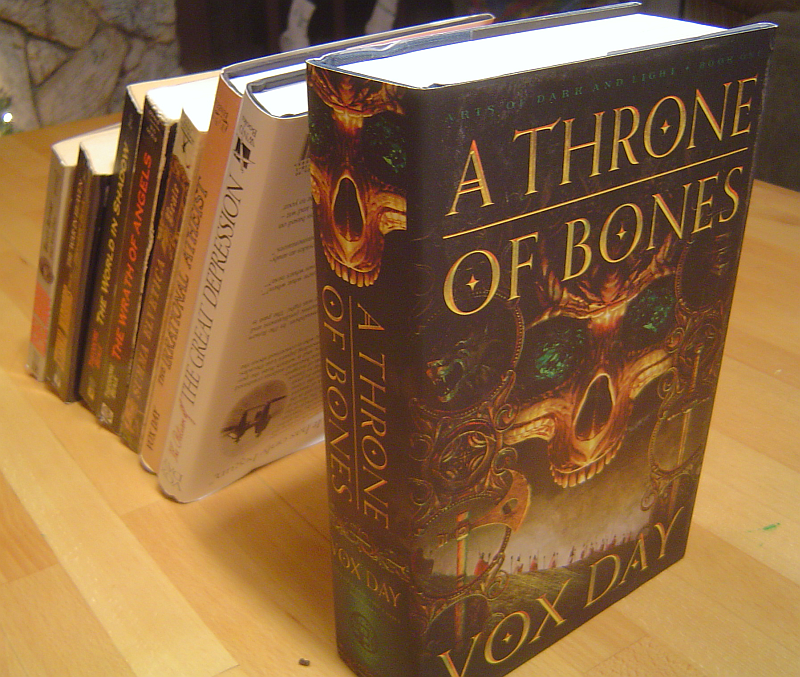
 I haven’t had the chance to see it yet, but Jamsco was kind enough to send me a picture of the hardcover. Interesting to see the progression from the days of teaming up with the OC to write a little paperback. It would be nice to think that the quality has improved in line with the quantity.
Tag: books
Amazon, the SFWA and authorial corruption
Amazon is entirely correct to limit author reviews on its site:
Scores of authors in Britain and across the Atlantic have recently reported
that their reviews have either mysteriously disappeared or were never
published. Amazon has now admitted that it has introduced a ban on authors leaving
reviews about other people’s books in the same genre because they may pose a
“conflict of interest” and cannot be impartial about their rivals.This means that thriller writers are prevented from commenting on works by
other authors who write similar books. Critics suggest this system is flawed because many authors are impartial and
are experts on novels.
Now, I can quite reasonably argue that I am one of the most impartial author-reviewers to have written a book review in the last 20 years. My integrity as a reviewer is literally unquestioned; I was the only active game developer permitted to write computer game reviews in Computer Gaming World, and I was allowed to do so under two different editors because they knew I would never sacrifice my credibility as a reviewer for any reason. Many readers know that I have quite favorably reviewed books by individuals whose politics I consider loathsome, whose opinions I consider idiotic, and whose characters I consider to be contemptible. To my eyes, a book stands alone; its provenance is irrelevant.
Unlike the vast majority of book reviewers in the SF/F industry, I simply do not permit my subjective opinions to color my objective reviews. It’s not that I don’t have any opinions, I simply refuse to take them into account when reviewing a book, a game, or a movie.
And yet, I not only don’t write reviews on Amazon, I fully support Amazon’s decision to bar authors from reviewing books and assigning them stars there. Why? Because for the last ten years, I have been privy to the corruption that is absolutely rife within the organization of the SFWA, the Science Fiction and Fantasy Writers Organization, as well as to the ideological corruption of the SF/F industry on the part of the publishers, the reviewers, and even the bloggers.
Read the rest at The Black Gate.
UPDATE: An SFWA insider confirms my observations: “[Vox] is correct when it comes to the inbred logrolling. As SFWA Bulletin editor from 1999-2002 I can attest to this first hand. A small clique and their “in” friends control quite a bit of what goes on in SFWA (at least it did back then and I have no reason to doubt that things have changed).”
UPDATE 2: I would be remiss if I left off this reviewer’s hilarious description of the Nebula award-winning Quantum Rose: “Kamoj Quanta Argali is the 18 yr old governor of a planet of former
slaves. When a newcomer on the world Havyrl arrives to recover from an
ordeal which left him half mad, he spies Kamoj taking a bath in a river
and falls for her. Impulsively Havryl offers to marry her which causes
strife and conflict throughout the region, as Kamoj’s spurned fiancee
vows revenge.”
Ye cats! The punchline? That’s from a reader who actually thought the book was all right and gave it three stars! It also appears Asaro is from the Isaac Asimov school of nomenclature.
A MAGIC BROKEN free on Kindle

A MAGIC BROKEN is free today from Amazon. If you already have a copy, you may wish to go ahead and grab the new one as it fixes six errata found in the previous version.
There are still some spots left for those interested in reviewing THE WARDOG’S COIN. So, if you wish to do so, please let me know via email. However, just to be clear, I’m not sending out the books for at least a month, because I’m not finished with the second of the two stories. A few of you will have already read one of the two, as an earlier version of QALABI DAWN used to be posted on my old Eternal Warriors site.
UPDATE: A MAGIC BROKEN has cracked the top 100 Free on Amazon and is now at #3 in Fantasy Epic, #97 overall. It will be interesting to see how high it can go, and if this will spark any consequent interest in A THRONE OF BONES.
UPDATE 2: Black Gate informs its readers about the Amazon offer and includes a mini-review of the novella.
UPDATE 3: As does the indefatigable Instapundit.
Head’s up: free book
Now that A Throne of Bones is out, Marcher Lord Hinterlands has enrolled A Magic Broken in Amazon’s Kindle Select program, which allows a publisher to give books away for free for a limited period of time. So, starting tomorrow, on December 24th and 25th, Kindle users will be able to download the novella for free. If you’ve been curious about my fiction but hesitant to pay the necessary price for one reason or another, tomorrow would be an excellent time to do it.
If you’ve already read AMB but hadn’t quite gotten around to reviewing it on Amazon, this would also be a very good time to pop your review up there. In related news, if you’re willing to commit to reviewing The Wardog’s Coin when it comes out, most likely towards the end of January, please let me know via email. I’ll be sending out review copies to the first 50 respondents upon the book’s release. This will consist of two short stories, one of which features a character who is likely to be a new perspective character in the second book of Arts of Dark and Light.
Mailvox: in time for Christmas
Glad to hear from JB that Marcher Lord Hinterlands was able to keep its word concerning the hardcovers and deliver in time for Christmas:
Received my copy yesterday! I gave it a quick once over and I have to say, the book looks great on the whole. The cover is somewhat muted in color in comparison to web images, but that was/is to be expected electronic gamma being what it is.
I’m looking forward to seeing it myself, but I expect I’ll have to wait another week or so. Thanks again to team OCD, whose speedy proofreading made this possible.
Mapping Selenoth

JartStar didn’t find it easy to map out Selenoth, mostly because I don’t think in spatial terms. This map to the right is from a very early version when the book was only half-written and we were kicking around the idea of eventually creating a VASSAL wargame around the story. I’ve long been interested in combining the zone-based game mechanics of War at Sea with a Divine Right system that combines diplomatic intrigue with battle, and perhaps one day I’ll even get around to designing it. The primary challenge he faced was translating locations into map terms from my description of events; if it takes 30 days to go from Amorr to Elebrion and one passes through an uninhabited forest, then that provides a certain amount of information about how things have to look.
I’m sure there were times he desperately wanted to beat answers out of me, but the problem was that because I am spatial relations-challenged, I couldn’t really provide them until I had figured out exactly what I required for the story to work as conceived. Was Lodi travelling west or east? If Theuderic was traveling to Amorr, why did he have to go through Malkan? The plot affected the geography and the geography affected the plot; as JartStar noted himself when he introduced the map to his Cartographer’s Guild.
“The map took nearly a year to do as author didn’t know where certain
locations would be until he had worked out the plot! It meant a lot of
revisions all of the way until the day it was literally going to press.”
The particular challenge was how to portray the allies and provinces of Amorr, since they were too small to show up on the continental map. The first attempt proved a little confusing; the editor at Marcher Lord actually got it backwards. But the zoom lines he suggested worked very well. It did lead to one minor problem in the text, as Falerum was described at two points in the original text as “the largest ally”, which is quite clearly not the case. But that was cleaned up in the errata.
As for rivers and lakes, they were left off for legibility reasons. In general, it can be safely assumed that every major city is built on a river, as is the case with regards to nearly all medieval European cities. Most fantasy maps that contain rivers are entirely misleading, as they only feature one or two rivers when the number of cities shown would indicate the need for an order of magnitude more; for some reason most fantasy lands don’t contain a reasonable number of lakes either. Given my ferocious hatred for long literary river journeys, it is totally appropriate that the rivers are not shown on the map as they will never, ever, feature in such a regard.
The map of Selenoth can’t hold a candle to the beautiful map of Middle Earth that I once owned in the form of a much-loved jigsaw puzzle. I can’t think of a single map that does. But I hope the readers find it both attractive and useful in following the story; thanks to JartStar’s heroic efforts, I think it is more geographically credible than most of the maps one sees in the genre.
A GoodReads review
D.M. Dutcher reviews A THRONE OF BONES:
It’s hard to sum it up since so much goes on in the book. At
800854 pages,
it’s long, and the first MLP hardcover release. The length doesn’t feel
too tedious though, with only the start of the book dragging a bit. Once
it gets past discussing the upcoming goblin fight, it gets much better,
as each new character has their own story and part to play.The
world is very interesting too. It’s sort of a fusion of Rome and
medieval Europe-imagine Rome with its legionnaires and patricians with a
church like in Thomist times and Vikings mingling with supernatural
creatures like elves and werewolves. The main focus is on Rome though,
and it adds a lot to the book by setting it apart from the generic
fantasy land it could be. It’s not just the gladiators and phalanxes,
but he gets the ethos of each nation and group right. You get inside
their heads, and it’s well done indeed.I also found that it
fixed something that I didn’t like about Game of Thrones. One of the
issues I had with the first book in that series was that the
supernatural and fantasy aspects felt tacked in, as opposed to purely
human drama. Vox though always makes the fantasy part noticeable if not
prevalent. This isn’t just “let’s make it fantasy because we really want
to tell a historical fiction story and ignore the parts we don’t like,”
but magic and fantasy have as much a part to play as the intricate
machinations between nobles. If anything, you wish there was a bit more
focus on it. The elves in particular….All in all, it’s a good, epic fantasy novel. It was better than I
expected. If you like more traditional Christian fantasy fare that is
clean and more aggressively spiritual (if not evangelistic) you may not
like this. But people who like well-written fantasy and Christians who
are okay with more realism and edginess to their books will probably
enjoy it quite a bit.
I’m pleased to see that readers are understanding that THE ARTS OF DARK AND LIGHT series is not traditional Christian fantasy fare. It was never intended to be, any more than it was intended to be a mindless attempt to do to GRR Martin what Terry Brooks did to JRR Tolkien in his Shannara series. I’m still amused by the charge that I am simultaneously mimicking Edward Gibbon and R. Scott Bakker(1); while it would still be wrong, one would do significantly better to assert the book is the bastard love-child of J.B. Bury and Joe Abercrombie. If critics want to claim that I am a derivative writer in the vein of the retrophobes, that is certainly their prerogative, but I would expect they might at least have the perspicacity to get the genuine influences right.
The reviewer is correct. The ethos of the book is definitely more concerned with the martial values than the Christian ones. This is the natural result of half the perspective characters either being military officers or what could reasonably be described as military intelligence. When I write my characters, I always attempt to focus on their current concerns rather using them as a vessel for some larger point. This is why the Marcus Valerius who is actively engaged with theological matters as part of a Church embassy led by a pair of noted ecclesiastic intellectuals is simply not going to be anywhere nearly as concerned with such elevated matters while commanding a cavalry wing in the middle of a battle involving some 30,000 combatants.
(1) In all seriousness, Bakker would probably be the last of the epic fantasy writers that I would attempt to mimic. Well, no, that would definitely be Jordan. Then Erikson, simply because I don’t even know how I would go about trying to imitate him. But I can’t mimic the best thing about Bakker, his florid, but absorbing style, and I can’t imagine wanting to imitate any of his plots or his characters. His worldbuilding is competent and reasonably substantial, but it doesn’t take a form in which I have any interest whatsoever, nor does it have anything in common with mine. Moreover, a simple look at the publication date of Summa Elvetica should make it obvious that Selenoth(2) is a world I created long before I’d ever heard of R. Scott Bakker.
(2) I will send a free hardcover to the first person who correctly guesses what computer game served as the original inspiration for the name of Selenoth. This offer will stand for one week.
It seems I was wrong
You don’t have to buy the hardcover from Marcher Lord. Apparently you can also purchase the hardcover from Amazon. Or, for that matter, from Barnes & Noble. It seems the official page count turned out to be 854 pages, not 852.
I couldn’t help but be a little amused by the first one-star review. Reader Beware! “I was sorely disappointed to find profanity, and vulgarity and a few
other things I found objectionable. If you are into Christian fiction,
this is not the book for you.”
The charge isn’t entirely accurate, however. While there is a fair amount of vulgarity, there is no profanity in the original Latin sense of the term.
Stay on target
I’ve been trying to keep this rant by a perceptive reviewer of A Storm of Swords in mind as I begin writing Book Two in ARTS OF DARK AND LIGHT:
My third and final gripe remains roughly the same as it was with the first two books and is, in a nutshell, this: too damned long. Forget the page count; Martin’s writing is good enough to read for ten thousand pages, I mean that he’s taking too long to get to the point. This third installment of the series ends in a quick succession of highpoints. It’s meant to build interest and steam going into the fourth, which it does (frustratingly so, given the time between releases). But most of the third book, like most of the second and the first before it, are build up. Three thousand pages of build up are simply not welcome, and certainly not in the face of a projected three thousand to come. There was even a point, somewhere near page 600 of this book, where I started to question my investment. After all, do I have any assurance that the next book, or the book after, will offer any satisfaction? How long will I have to wait, exactly, for any sort of a sense of closure on anything? How good is Martin’s heart? His cholesterol count? Blood sugar? I suppose, on the bright side, that this series helps a person develop their patience and endurance. But, I’ll tell you, couple this with my doubts of Martin’s having a master plan, and you have a potential nightmare in the making. Is it still possible that he does have a direction in mind, and that book six will end up with all of the strings neatly tied in a satisfactory bow? Yes-that’s still possible. But the hope dwindles with every passing page.
In the end, I will continue. Onwards to book four, I say, and quick about it. Frankly, I may have invested too much to turn back, now, no matter what happens. But I’m punishing Martin with one star less on this novel than I’d awarded the previous two. The book has the same quality as the others in the series, and the last fifty pages or so are rather exhilarating (and the scene with Sansa building the castle in the snow is just awesome-the kind of thing Martin must have had planned for a long time), but the slight problems become large over time, sort of like Malcolm’s explanation of fractals and chaos theory in Jurassic Park, or something. Unabated, these problems will choke him all the way down to a single star by series end. I only pray it doesn’t come to that.
The guy’s subsequent review of A Feast for Crows makes for reading that is more than a little amusing, as everything he feared and worse came to pass. It made me curious enough to see if he’d bothered to read A Dance with Dragons; apparently he hasn’t because despite reviewing everything from a Rob Zombie movie to Charles Dickens novels, he didn’t review that. But I thought it was remarkable that he anticipated the problems Martin subsequently exhibited as far back as the second book. In his review of A Clash of Kings, he presciently wrote:
[E]ven after two gargantuan novels, it is hard to see where the series is going. It’s hard to know, not what will be the final climax, but what even could be the final climax. As a for instance, somewhere near the beginning of Star Wars, we understand that eventually it will come down to a confrontation between Skywalker and Vader. In Rocky, we know that the crux will be Rocky’s confrontation with Creed. In Thelma and Louise, we know that the final climax will be a resolution of their flight-either they’ll find a way to get back into society, or they won’t in a profound way (incarceration, death, disappearing into another country). In A Clash of Kings, there are so many major characters and so many major events all awaiting a resolution, that I can’t even precisely piece out what forms the core conflict requiring resolution. Or what event short of global annihilation could bring about such a resolution. Is there a main protagonist or antagonist? Perhaps the Houses of Stark and Lannister provide those. Or, perhaps not (what of Daenerys, for instance, or the oncoming Winter)?
The problems he perceived so early are readily grasped by comparing the number of perspectives in the various novels. The count grew from 9 different perspectives in the first book to a combined 25 in the last two, which you may recall were originally supposed to be a single book. What of Daenerys indeed… what of Tyrion!
Anyhow, these are excellent object lessons to keep in mind as I’m starting to roll on the second book. I’m determined that Book Two will be better than its predecessor. It’s not too hard to see how things can spin out of control in books of this size, especially if you don’t have a tight grasp on who should be a perspective character and who should not be. I’ve already written scenes with one secondary character who has been newly promoted to the perspective level; I have to be careful to not to get too carried away with that.
I originally intended to go with two fewer characters than Martin, because the geographic separations meant that I’d probably need to go into more detail and devote more words to each since I didn’t have the benefit of the overlapping physical proximity that Martin did in A Game of Thrones. However, after writing A Magic Broken, it became apparent that the dwarf required his own storyline.
A few items of business. First, I noticed that one of the Amazon reviews mentioned the 225 errata. Those, and a fair number more, have all been fixed now and the cleaned-up version is already up on Amazon and BN. Marcher Lord will be sending out the new files to all of those who bought from them next week, both preorders and ebooks. I’m told that Amazon sends out an email confirmation when you buy an ebook from them, so if you were one of the early buyers and have the original version with the errata, please send me a copy of that email confirmation and I will send you the new .mobi file.
It’s easy to tell which version you have. If the title page on Location 2 of 13826 features a skull, that’s the original one with the errata. If it looks like a carved Roman wall and there is an appendix at the end of the book, that is the new one.
And if anyone knows how to get in contact with Don Athos, the Amazon reviewer, let me know. I definitely want to send him an ebook for review.
The Black Gate Christmas list
I first have to praise John for having the courage to announce a Christmas list rather than the increasingly common, and ludicrously insipid holiday list. And then, I would be remiss if I did not point out his good taste in including works by Howard Andrew Jones and yours truly in his top 10:
- A Guile of Dragons, James Enge ($17.95)
- The Bones of the Old Ones, by Howard Andrew Jones ($25.99)
- American Science Fiction: 9 Classic Novels, edited by Gary K. Wolfe ($70)
- Universal Classic Monsters: The Essential Collection ($149.98)
- Lords of Waterdeep, Wizards of the Coast ($49.99)
- The Weird, edited by Ann and Jeff VanderMeer ($39.99)
- Epic: Legends of Fantasy, edited by John Joseph Adams ($17.95)
- A Throne of Bones, Vox Day ($4.99)
- Three Parts Dead, Max Gladstone ($24.99)
- Books To Die For, edited by John Connolly and Declan Burke ($29.99)
I should note that if you’re looking for something you can wrap, A Throne of Bones is also available in hardcover from Marcher Lord Hinterlands for $34.99. To see the rest of the list, which goes 50 items long, go to The Black Gate Christmas List.