Very Correct Indeed

At least one commenter on Gab gets it regarding the student loan situation.

The thing is, Vox is very correct. Forgiving student debt is deflationary. Erasing a debt is literally removing money from the system (despite the money being fake and gay). This means that there is less to go around, and thus services and products require less of it to buy.

Its just like if we got a trillion dollars in cash and burnt it all. The relative ‘strength’ of the remaining notes is now stronger as there is less of it in the economy. Its very simple stuff really (of course in this economy, money does not work like that. It is literally made up numbers on a spreadsheet and doesn’t exist in the same way cash does, but it makes a useful analogy).

The real issue here is the battle between your logical understanding, and your emotional reflex to hate the idea of it. I will freely admit that it sucks. It feels very unfair, because it is unfair that people are getting their debts forgiven at the (theoretical) expense of the tax payer. Especially when more sensible people either didn’t get in debt, or paid it off by living very frugally. Add to that the fact that we know the vast majority of these students are going to be blue haired human detritus, who wish us all dead if they could have their way. Again, I admit that this fact does suck.

But ultimately, you’re going to have to step out of that mindset and look at the big picture, and understand that you just got to rip off the band aid. This whole situation was brought about my the government, and the greed of the college industry. Many many decades of passed since Universities became a place of learning for the good of society. Now is just a multi-billion dollar racket. This situation should never have been allowed to happen. After the debt is forgiven, it is very important that the entire University cabal be taken down. There should no loans given by the government. All further education loans should be completely private, so that banks have to know they will get their money back, which will ensure people won’t be getting into debt with garbage degrees. IT also means universities will have to be competitive with their pricing. I am also in theory not against a government giving grants for in-demand industries if it helps the economy overall (although I wouldn’t trust the current government to determine this given their agenda).

Stop being over-emotional retards and see the big picture. Just accept that it needs to happen. A society cannot grow and thrive when entire generations of young people start their lives with 6 figure debts which they will not be able to pay off. It crushes their soul, stops them having families and in the long run will hurt you more than the short term “its not fair”-ism of having to bite the bullet. Yes most students are retards, but put the blame where it belongs.

I go considerably further with regards to education policy. All student loan debt should be banned. It is not only usury, it is a particularly wicked form of usury because it is unnecessary. The entire edifice of education credentials needs to be toppled – it is already in the process of collapsing – because it is totally useless and accomplishes nothing except to give the SJWs in corporate HR an excuse to prevent the hiring of productive people of whom they disapprove for one reason or another.

Remember, once converged, an institution loses its ability to perform its primary function. Therefore, every converged institution should be eliminated – not fixed, eliminated – for being no longer fit for cause.

DISCUSS ON SG


It Tolls for DC

The Dark Herald notices some very bad signs at DC, formerly DC Comics:

DC Comics has for decades been able to survive as an IP farm. Yeah, it’s a loss leader and has been that way since forever ago but that red ink is barely a rounding error for Warner Brothers. And now they are seriously under the microscope. DC has never been audited by Warner Brothers before because it wasn’t worth doing it. It was actually a waste of money to find out if it was a waste of money. Because it obviously was. Now, DC Comics is having to explain its terrible decisions and why they are pursuing storylines that killed sales. The answer is, we wanted to be popular with the cool kids and you never cared about the money we burned doing it before now, so why not?

DC Comics didn’t send out their royalty checks to writers and artists. DC has never missed a royalty payment since they got bought up by Warner Brothers. The only reason they wouldn’t be sending out money is if there was no money to send.

I have it on very good authority that the royalties were finally paid, but they were paid uncharacteristically late. That’s a problem when large corporations are involved, because it means that the scheduled routine has been intentionally altered, most likely because the finance department is shuttling dwindling resources around from one department to another as needed.

DISCUSS ON SG


Proxy War 2.0

Ukraine is a proxy war between the USA and Russia and everyone knows it, including, most importantly, the Chinese. They also know that Taiwan is anticipated to be the next proxy war, which is why I expect Chairman Xi, who according to Lee Kwan Yew is the most intelligent senior actor on the international scene, to work out a peaceful alternative to shedding large quantities of Chinese blood on behalf of US neocons.

GLOBAL TIMES: Some argue that the US wants to use Taiwan as a “porcupine” and is ready to fight to the last drop of Taiwan people’s blood to weaken China just as what it did with Ukrainians. How do you view such an opinion? Does the US have such intent?

Berletic: This is actually the most likely scenario – using Taiwan as a proxy against the rest of China to exhaust it politically, economically, and militarily. The US is indeed conducting a similar proxy conflict against Russia through Ukraine. Many aspects of US interference in regards to Taiwan including political and military support, mirror what preceded the conflict now raging in Ukraine. The US deliberately picked a red line to Russia in regards to Ukraine and is now doing the same to China in regards to Taiwan. The US demonstrably doesn’t care about Taiwan’s future in any sense and has already begun preparing itself in terms of semiconductor production for a disruption in Taiwan Washington itself is attempting to create. The US will do everything in its power to realize this provocation by crossing red lines for China it knows cannot be ignored.

GLOBAL TIMES: Is there a trend that Washington is shifting from strategic ambiguity toward Taiwan to strategic clarity? Is this an adventurous move?

Berletic: The shift in Washington is one born out of desperation rather than adventurism. The US is out of time. China’s economic and military rise means that as each year goes by the US is less and less able to hold any sort of advantage over China should it provoke a conflict either directly or by proxy.

Empires are increasingly prone to fighting proxy wars in their final stages, because they simply do not possess the military might that was required to establish the empire in the first place. And they avoid direct confrontation for fear that they will be defeated; it’s much easier to spin and create separation from a proxy defeat than from a direct one. This foreign policy on the part of the empire’s foreign rulers is absolutely pro forma; history suggests that one should expect a domestic crackdown on regime critics to accompany the proxy wars that will almost certainly end in defeat.

DISCUSS ON SG


Gavin McInnes Arrested

Or, at least, that appears to be the case, pending confirmation:

Former Fox News host Gavin McInnes was apparently arrested on Thursday night after law enforcement gained access to his New York studio while he broadcast his network’s Thursday night live stream.

Shortly after his “Get Off My Lawn” live show began, police officers believed by Censored.tv subscribers to be federal agents gained access to the studio. McInnes, who founded the web network Censored.tv after being canceled on social media, was heard on the live stream having a heated verbal exchange with officers before leaving the studio. McInnes’ stream was left unattended for over an hour before it ended.

McInnes, standing at his desk, told the off camera law enforcement officers, “Yeah. Alright, I’m happy to do that. I’ll get a lawyer, and we will sit down and have a conversation. We’ll schedule a meeting, and I’ll sit down with my lawyer.”

The officer’s response to McInnes was not within range of the microphone, but after he spoke McInnes replied, “I didn’t let you in.”

What appear to be chirping noises made by police radios can be heard in the video, but viewers reported only silence after McInnes left the frame until the stream was taken offline.

Prior to the Thursday night incident, McInnes told viewers of Censored.tv that he had reason to believe he was under some sort of surveillance.

My assumption is that this is probably not connected to anything McInnes said or did, but is related to the recent raid on President Trump’s residence in Florida, and the way in which the FBI is attempting to build a case to arrest the president on grounds related to January 6 and the Proud Boys. If they don’t have anything useful on Trump, they’ll need to be putting pressure on people who might be able to give them something they can use to conjure up an indictment.

Unless, of course, it was this public act of shameless and unequivocally transphobic hate speech that landed him in hot water with the federal thought police.

Brittany Griner is a dude.

Gavin McInnes, 8 August 2022

Needless to say, the media won’t react to this arrest in anything like the manner they would if a CNN or ABC News host was taken into custody live on air. So keep that in mind the next time you hear them yapping about “freedom of the press”.

UPDATE: Or maybe it’s just pathological attention-seeking….

DISCUSS ON SG


Shut Up, He Explained

I put up a post on Gab attempting to explain to Boomercons that eliminating student loan debt was not inflationary. I was unsuccessful, on the basis of the 193+ replies.

Dear Boomercon,

Eliminating student loan debt is not inflationary. It cannot be inflationary, because in a credit economy, cancelling debt reduces the quantity of credit money in the system.

This is intrinsically deflationary.

Love,
Vox

So, because I am a kinder, gentler Dark Lord, I decided to helpfully explain to this woefully ignorant souls the nature of credit money and how it relates to the monetary phenomena known as “inflation” and “deflation”.

Dear Gab commenters,

The undeniable fact is that I know considerably more about economics, debt, and credit money than you do. Not only am I an economist by training, but I correctly predicted the 2008 financial crisis and I am the author of the labor mobility refutation of free trade.

Frankly, most of you appear to be functionally retarded where economics are concerned. So, I will type very slowly in order that a few of you might be able to follow along.

Most money is debt and it comes from nowhere. It is not printed by the government, it is literally created from nothing when a loan is taken out. This is inflationary. When a loan is cancelled, forgiven, or written off, the debt literally vanishes. This is deflationary, since it reduces the amount of money in the economy.

If the loan is paid off, either by the debtor or by a third party, then no money leaves or enters the system. It is a neutral action. If interest is paid on the loan, this is mildly inflationary but trivial at current interest rates.

That’s literally how debt money works, and if you don’t understand why L.1 is bigger and more important than the M1 money supply, then please stop sharing your opinion on the subject of student loans because you have absolutely no idea what you’re talking about.

Love,
Vox

DISCUSS ON SG


WW3 Mobilization Math

The Tree of Woe contemplates WW3 from a historical and statistical perspective, and reaches precisely the same conclusions I have.

Today, Russia spends 4.1% of its GDP on its military; America spends 3.5%; and China spends 2.1%. (Saudi Arabia, at 10.4%, and Israel at 5.2% are the two biggest spenders by ratio.) They are essentially on pre-war footing, demobilized.

To what extent could today’s superpowers match the mobilization of the WWII-era US and USSR?

According to the Center for Economic Policy Research (CEPR), about one-third of military spending is on personnel. The remainder is on equipment and operations, both of which are highly demanding on the economy’s manufacturing and energy sectors. At the outbreak of World War II, manufacturing and energy accounted for approximately 30% of the American GDP. From that basis, America spent 40% of its GDP on war. As a first approximation, therefore, the maximum extent to which an economy can be mobilized for defense spending might be 133% of its manufacturing and energy GDP.

At present, manufacturing and energy make up 41% of China’s GDP, 30% of Russia’s GDP, and 20% of America’s GDP. Therefore, the maximum mobilization we would expect their economy to achieve would be 54% for China, 40% for Russia, and 27% for America.

Wait, you ask — Why can’t we just “build more factories?” Because it’s very difficult to rapidly grow manufacturing. The fastest large-scale improvement I have found in looking at data is a 3% increase in the share of manufacturing per year for a major economy. Achieving this during wartime, when manpower is diverted into uniform and infrastructure is under attack seems unlikely. A nation can rapidly convert its peacetime manufacturing to wartime manufacturing, but it cannot rapidly build manufacturing capability where none existed. I assume that maximum mobilization might increase by at most 1% per year from their present level.

Even when taking advantage of pre-existing industrial infrastructure, mobilization is never instantaneous. In its best year, the US was able to mobilize from 10% to 35% (1941 to 1942), and the USSR was able to mobilize from 20% to 55% (1942 to 1943). That suggests the absolute best possible mobilization is a 3.5 increase annually. It’s not clear to me that any of today’s great powers could match those, due to the vastly increased complexity and fragility of our supply chains. Therefore I assume that actual mobilization can at most double yearly, until the maximum mobilization is reached. Therefore I estimate the following:

In one year, America could achieve 7% mobilization; in two years, 15% mobilization; in three years, 30% mobilization; in four years 31%; in five years 32%.

In one year, China could achieve 5% mobilization; in two years, 10%; in three years 20%; in four years 40%; in five years 60%.

In one year, Russia could achieve 8% mobilization; in two years, 16%; in three years, 33%; in four years 44%; in five years 45%.

Now, in considering what mobilization as a percentage of GDP means, we need to be sure we are comparing apples to apples. A comparison of nominal GDP won’t do. At a minimum we need to use Purchasing Parity Power (PPP) adjusted GDP. But even that might understate the relative capabilities.

In a July 2017 white paper by the Heritage Foundation called “Putting Defense Spending in Context: Simple Comparisons are Inadequate,” the authors found:

For the equivalent investment in terms of U.S. dollars, China and Russia respectively have 1.7 times and 2.5 times the purchasing power within their domestic markets… Due to differences in purchasing power across economies, then, two countries could hypothetically field the same size and quality force at dramatically different spending levels.

For example, the Chinese Yuzhao-class landing platform dock (LPD) costs approximately $300 million to build and is most similar in terms of displacement and capability to the U.S. San Antonio-class LPD. However, the purchase price of the San Antonio-class LP exceeds $1.6 billion per unit…

In the March 2015 article “China’s Military and Growing Political Power,” the CEPR notes:

Using exchange rates comparisons significantly understates the Chinese military spending. A much more realistic assessment is obtained using PPP terms… China’s military budget was 18% of that of the US using market exchange rate comparisons, but 33% of the one of the US using PPP exchange rates…

The correct exchange rate with which to compare military spending would be a price or unit cost ratio of military services in each country… We use market exchange rates as a measure of relative military equipment costs facing each country… For relative operations costs, however, we use PPP exchange rates as a reasonable proxy… Finally, relative personnel costs are obtained using manufacturing wages, either gross or net of on-costs, since this represents the social opportunity cost of military employment.

This low relative military costs exchange rate implies a real value of China’s military spending of 40% of the US in real terms – larger than the level implied by using PPP rates of 33%, and much larger than the market exchange rate based figure of 18%.

Thus the best estimates are that in relative terms, we have to scale up China’s GDP by (40%/18%) = 220% in order to get an accurate picture of its potential mobilization. Unfortunately CEPR did not provide a similar ratio for Russia, but we can approximate it by multiplying Russia’s PPP multiplier (250% of nominal GDP) by (40%/33%) = 120%, for a total multiplier of 300%.

This is not a pretty picture if you like the Star-Spangled Banner. China’s military-effective GDP is already almost 200% the size of America’s military-effective GDP, and its effective military spending is 130% of our own! Meanwhile, Russia — currently mocked in the mainstream press as an economic weakling — is maintaining an effective military budget of 30% of America’s. Given that the US tries to maintain military power across the entire globe, while Russia only needs regional dominance, this should make us very uneasy about our relative capabilities.

It gets worse when we consider mobilization over time. Much, much worse. US deindustrialization has virtually crippled our large-scale mobilization, while China has become an Arsenal of Authoritarianism. Below I have tabulated each nation’s expected Mobilization Ratio and used that to calculate its Effective Military Spending (EMS) per year of World War Next.

The longer the war goes on, the worse it looks for America. In year one, America is able to spend 64% of China and Russia’s defense budget. By year five, America can only spend 26% of its rivals’ defense budgets.

The Tree of Woe’s detailed research backs up the previously observed historical analogy, which is to say that the USA and its European allies today are in much the same position that Germany and its allies were during WW2. Neither the superior quality of German and Japanese manufacturing nor the superior quality of German troops were sufficient to even begin to make up for the massive advantage in manpower and manufacturing enjoyed by the USA-USSR-UK alliance.

The Sino-Russian alliance alone dwarfs the manpower and manufacturing capacities of the NATO alliance, even if NATO’s prospective allies in South Korea, Japan, and Israel are included. And if the rest of the BRICSIA nations – who are already aligned with Russia in this global conflict – are included in the equation, the conclusion is even more heavily stacked against the Were-West.

The key is this: manufacturing capacity can be repurposed during wartime, but it cannot be constructed from scratch.

This mobilization math explains why the neocons and their pets presently presiding over the European nations have been so desperate to “win the war in Ukraine”. The Empire That Never Ended’s chances in the proxy war between Kiev and the Donbass republics were considerably better than its odds in either a regional war or a global war, although as we’ve seen, the proxy war has already been won by the two former Ukrainian republics.


DISCUSS ON SG


A Good Start

Fake President Biden announces the first step in what we can hope is a path to forgiving all student debt and banning all student loans.

The president will forgive debts of up to $20,000 dollars for students who went to college on Pell grants and $10,000 for students who did not receive Pell grants. Debt forgiveness only applies to individuals earning less than $125,000 or couples filing joint earnings of $250,000.

Don’t make the mistake of defending the wrong thing because bad or stupid people happen, for whatever reason, to be doing the right thing for a change. Student debt is a scam, it should never have been legal in the first place, and the law preventing student debt from being discharged.

Make no mistake: if you’re on the side of the bankers and the Boomers and the universities here, you are absolutely and without question choosing the side of evil. And there is no amount of solipsistic argumentum ad personalem is going to make your argument any more convincing or moral, or any less economically ignorant and churlish.

Don’t forget the Parable of the Unmerciful Servant either.

Then the master called the servant in. ‘You wicked servant,’ he said, ‘I canceled all that debt of yours because you begged me to. Shouldn’t you have had mercy on your fellow servant just as I had on you?’ In anger his master handed him over to the jailers to be tortured, until he should pay back all he owed.

And FFS, discharging debt is not inflationary, so don’t even think about trying to cite that sort of media ignorance at anyone. In a credit money economy, debt-forgiveness is literally deflationary.

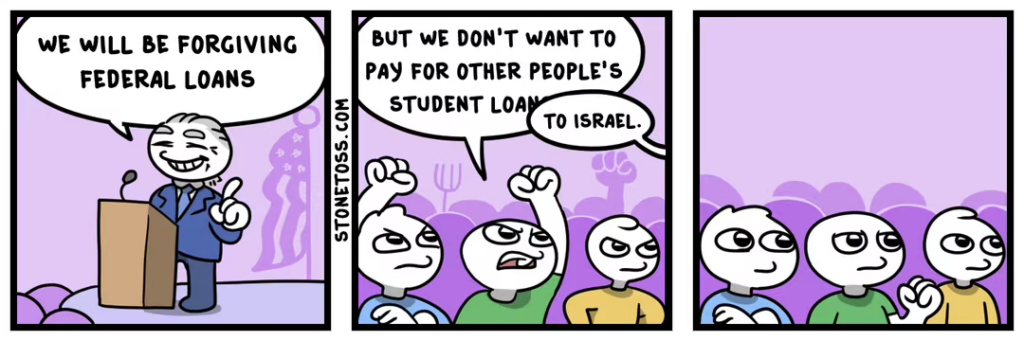
UPDATE: Stonetoss shows how to silence the Boomercon critics.

DISCUSS ON SG