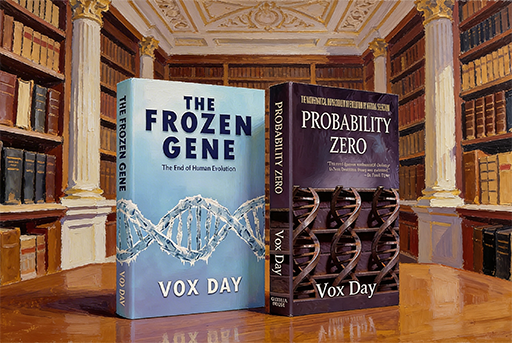
May I suggest a gift of some light reading material that will surely bring joy to any evolutionist’s naturally selected heart?
Sadly, this Darwin Day, there is some unfortunate news awaiting this gentleman biologist who is attempting to explain how the molecular clock is not supported by the fossil record.
As I explain in my book the Tree of Life, the molecular clock relies on the idea that changes to genes accumulate steadily, like the regular ticks of a grandfather clock. If this idea holds true then simply counting the number of genetic differences between any two animals will let us calculate how distantly related they are – how old their shared ancestor is.
For example, humans and chimpanzees separated 6 million years ago. Let’s say that one chimpanzee gene shows six genetic differences from its human counterpart. As long as the ticks of the molecular clock are regular, this would tell us that one genetic difference between two species corresponds to one million years.
The molecular clock should allow us to place evolutionary events in geological time right across the tree of life.
When zoologists first used molecular clocks in this way, they came to the extraordinary conclusion that the ancestor of all complex animals lived as long as 1.2 billion years ago. Subsequent improvements now give much more sensible estimates for the age of the animal ancestor at around 570 million years old. But this is still roughly 30 million years older than the first fossils.
This 30-million-year-long gap is actually rather helpful to Darwin. It means that there was plenty of time for the ancestor of complex animals to evolve, unhurriedly splitting to make new species which natural selection could gradually transform into forms as distinct as fish, crabs, snails and starfish.
The problem is that this ancient date leaves us with the idea that a host of ancient animals must have swum, slithered and crawled through these ancient seas for 30 million years without leaving a single fossil.
I sent the author of the piece my papers on the real rate of molecular evolution as well as the one on the molecular clock itself. Because there is another reason that explains why the molecular clock isn’t finding anything where it should, and it’s a reason that has considerably more mathematical and empirical evidence support it.