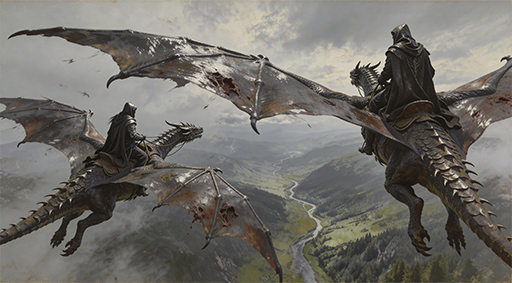
In a scrub oak on the western ridge above the valley, two crows sat on a branch and watched.
They were crebain, the black spy-birds of Dunland, large and clever and thoroughly unpleasant, with oily feathers and eyes like wet pebbles. They had been posted to this ridge six days ago, one of fourteen pairs stationed along the approaches to Rivendell, and they had spent those six days in a state of bored, malicious alertness, eating beetles and surveilling the comings and goings of the Elves below with the joyless diligence of creatures who serve darkness not out of conviction but out of a fundamental meanness of spirit that finds employment in darkness more natural than the alternative.
They had seen the eagle land the previous evening. They had taken note of it. They had thought nothing of it, of course, because eagles came and went from Rivendell with some regularity and the crows had not been briefed on what, specifically, to look for. They were told only to watch, and report, and be suspicious of everything, which came naturally to them.
But what they saw this morning was different. This was three great eagles, flying purposefully in formation at dawn, climbing hard and fast toward altitude, heading south. Even a crow could see that this was an event of some import, and perhaps even the reason they’d been sent here.
The first crow turned to the second and let out a series of harsh, rapid calls, the crebain’s equivalent of an alarm, a sound like a stick being dragged across a fence. The second crow took up the cry, louder, harsher, and together they launched themselves from the branch and flew upward, screaming into the brightening sky, circling and calling with a frantic, rasping urgency that carried far in the still morning air.
Far above them, so far above that the crows were invisible, mere specks against the grey-green earth, two dark flyers heard their cries.
The Nazgûl rode their fell beasts in a slow, wide patrol circuit above the southeastern approach to the valley, just as they had been ordered. They were high enough that the Elves below could not see them against the overcast, high enough that Elrond’s wards did not prickle and burn as they did at lower altitudes. The fell beasts were ancient, reptilian things, their vast leathery wings beating with a sound like wet canvas in a gale, they stank of carrion and old leather, and the Nazgûl upon their backs sat motionless as iron statues, only their hooded heads turning slowly, slowly, watching, and waiting.
They heard the crows before they saw anything. The crebain’s alarm carried upward through the cold air, shrill and insistent, and both Nazgûl turned their mounts toward the sound. The one called Ren, who in life had been a sorcerer of Harad and who retained, even in undeath, a certain professional attentiveness, extended his awareness downward to read the pattern of the crows’ distress, and then looked up higher, above the clouds.
He saw them.
Three bronze shapes, far to the south and climbing, already above the lowest cloud layer and pulling away with a speed that made the fell beasts’ labored flight look like the floundering of moths in honey. Eagles. Great Eagles, unmistakable even at this distance with their vast wingspans, the impossible speed of their ascent, and the way they caught the upper winds and floated on them like invisible rivers in the sky.
And from the lead eagle’s talon radiated an aura of power. It was a sensation that was more felt than seen.
The other Nazgûl felt it too. They turned to each other across the gap between their mounts, and between them passed a communication that was not language but something older and colder, a shared understanding that moved at the speed of dread.
The Ring.
Hoarmurath drove his fell beast upward, clawing for altitude. Ren followed. The fell beasts shrieked in protest, for they were creatures of the low airs, the murky thermals above battlefields and swamps, and the thin cold above the clouds was agony to them, but the will of the Nazgûl was irresistible and the beasts climbed, their wings beating faster, their reptilian lungs heaving in the thinning atmosphere.
But the eagles were already above them and pulling away. Gwaihir flew at the ceiling of the world, where the air was so thin that a Man would have lost consciousness in minutes, and his wings found purchase on winds that the fell beasts could not even reach. The gap between them widened, slowly, inexorably, the way dawn widens from a crack of light into the fullness of day.
Ren watched the eagles shrink against the depthless blue, and he knew that the fell beasts could not hope to catch them. Not in the open sky. Not at this altitude. They were built for strength, not for speed, and against the children of Thorondor they were as a carthorse to a king’s mount.
He raised one gauntleted hand and began to whisper.
The words were in the Black Speech, the language of Mordor, forged by Sauron in the dark years and spoken willingly by no living thing. The words flowed from Ren’s hood in a low, continuous hiss, like steam escaping from a crack in the earth, and the air around his outstretched hand darkened and thickened and began to hum with a frequency that was felt in the bones rather than heard in the ears. He cast a spell of far-speaking, a thread of dark will flung southward across hundreds of leagues toward the tower of Barad-dûr, toward one of the stones that could receive it, and it carried with it a single, urgent message:
They fly.