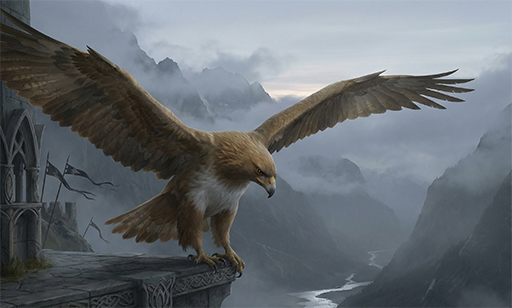
The sun had not yet cleared the Misty Mountains when Gwaihir the Windlord stepped to the edge of the terrace and opened his wings.
It was, by any measure, an extraordinary sight. The Great Eagles of the Misty Mountains were the noblest of all flying creatures in Middle-earth, descended from Thorondor who had scarred the face of Morgoth himself in the Elder Days, and Gwaihir was the greatest of his line. With his wings outstretched, he was thirty fathoms from wingtip to wingtip, his plumage a deep tawny gold shading to white at the breast, his eyes like polished amber set in a head the size of a horse. When he spread his wings on the terrace of Rivendell, the displaced air bent the grass flat in a circle forty feet across and set the pennants on Elrond’s house snapping like whips.
He stood there for a moment in the grey predawn light, his talons gripping the stone at the terrace’s edge, and looked out over the valley of Imladris. Below him the Bruinen ran silver and dark between its wooded banks, and the waterfalls caught the first thin light and held it in long threads of white. The air smelled of pine and cold water and the faintest trace of the kitchens, where someone was already baking bread, because in Rivendell someone was always already baking bread.
On his left talon, buckled with straps of pale leather so fine they might have been spun from spider-silk, hung a pouch no larger than a man’s fist. It was beautiful work, Elvish leathercraft at its most meticulous, with every stitch placed with the precision of a jeweler, and it contained an object of such malice that even Gwaihir, whose mind was as far from the concerns of rings and power as a mind could be, felt a faint unease in the talon that held it. A warmth that had nothing to do with temperature. A weight that had nothing to do with mass.
He ignored it. He was a creature of air, not earth. It was a thing of great earthly power, but whatever it was, it could not touch him.
Behind him, on the terrace, stood Gandalf, leaning on his staff, and Elrond, and the Hobbit — the small one who had offered to carry the thing himself, and who watched now with an expression that Gwaihir, had he been inclined to read the faces of Halflings, might have identified as something between relief and a lingering, wistful sense of having been made unnecessary. Beside the Hobbit stood another, stouter Hobbit who was holding a packed breakfast and looking up at Gwaihir with the frank, uncomplicated awe of someone who has never in his life pretended to be unimpressed by anything.
Gandalf raised his staff. “Fly well, Windlord. Fly high and fly true!”
Gwaihir turned his great head and regarded the wizard with one amber eye. He did not speak — not here, not in the lesser tongues of the earthbound — but he dipped his beak once, a gesture of acknowledgment between peers, and then he stepped off the edge.
For one held breath he fell and dropped like a stone past the terrace’s edge, past the carved balustrades and the trailing ivy, down toward the rushing water far below. Then his wings caught the air and he rose. The downdraft of his ascent shook the trees on both banks of the Bruinen and sent a flock of starlings scattering like thrown seeds. He climbed in a great spiral, each turn carrying him higher, and the morning light found him as he broke above the tree line and caught the gold of his plumage and set it ablaze, so that for a moment he burned against the pale sky like a second dawn, like a fragment of the sun itself given wings and will and sent forth over the world.
It was a sight that even the ancient Elrond, who watched the great eagle’s departure from the balcony of his private residence, found magnificent.
Gwaihir climbed. The valley of Rivendell shrank beneath him. The house of Elrond became a cluster of rooftops among the trees, the Bruinen but a silver thread, the mountains a rumpled cloth of green and grey. The air thinned and cooled and he welcomed it, breathing deep of the upper atmosphere where the wind ran clean and fast and tasted of nothing but sky. He turned south and east, toward the distant shadow on the horizon that was, even from this height, even in the early light, unmistakable. Mordor.
He was not alone.
From the high eyries of the Misty Mountains, where the peaks rose above the snow line into the uttermost airs, two more shapes detached themselves and rose. Landroval, Gwaihir’s brother, and Meneldor the swift. Meneldor was younger and smaller than the others, but, as his name suggested, swift, perhaps faster in flight than any eagle living. They had been waiting since before dawn, perched on the bare rock above the clouds, and now they fell into formation on either side of Gwaihir in a wide arrowhead, three golden shapes climbing in unison toward the roof of the sky.
This was Gandalf’s addition to the plan. Not one eagle but three — an escort, a guard of honor, a redundancy. If one were forced to turn aside, another could take the pouch. If the Nazgûl came, then two could fight them while the Windlord flew on. It was, Gandalf had argued, simple prudence. Gwaihir had accepted this reasoning with the tolerant patience of a creature who did not believe he required any assistance but understood that wizards always needed to feel useful.
The three eagles rose through a thin layer of cloud and emerged above it into a world of blinding white and depthless blue, and they turned their faces toward the East, and they rose higher into the sky.