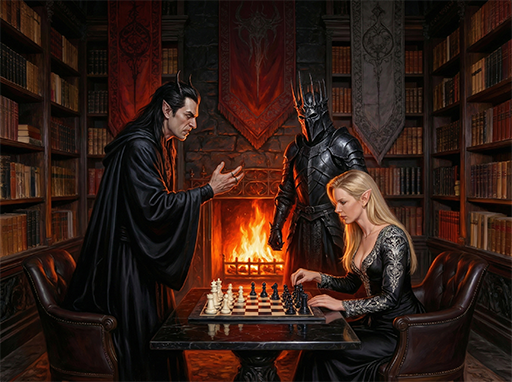
“The Witch-king proposes an assault,” said Khamûl. “A direct strike on Imladris. The full strength of the Nine, supported by two battalions from Dol Guldur and whatever host Saruman can muster from the south. The Witch-king believes that Rivendell’s defenses, while formidable, have not been tested by true military force in —”
“No.”
The word was quiet, but it filled the room the way darkness fills a cellar, completely and without effort. Khamûl fell silent.
Sauron rose from his chair and walked to the fire. He stood with his back to the room, looking into the flames, and the flames, one might have noticed, were not reflected in his eyes. Something older burned there.
“An assault on Rivendell is precisely what Elrond would want,” he said. “It is what Gandalf expects. They are not fools, Khamûl. Rivendell is a fortress of the spirit as much as of stone. The valley itself resists the Shadow — the Bruinen obeys Elrond, the passes are warded with arts that predate the founding of Mordor. An assault would cost us thousands of Orcs, at least three Nazgûl, and months of preparation, and even then success would not be certain. And while we spent our strength against those waterfalls and singing stones, Gondor would have time to marshal, Rohan would consolidate, and every petty lord from Dol Amroth to the Iron Hills would take heart. No. We will not assault Rivendell.”
“Then what does the Dark Lord command?”
Sauron turned from the fire. “The crebain. Saruman’s crows answer to him, but they will answer to me as well, and in any case the birds will do as they are told. I want crows over the Misty Mountains, crows over every pass and path between Rivendell and the south. I want to know what moves in and out of that valley — every rider, every company, every cursed halfing with a walking stick. Nothing leaves Imladris without my knowledge.”
“Anything else?”
“Two of the Nine, on their winged mounts, from a rotation of six. High patrol; they should not stoop low enough to provoke Elrond into a response, but close enough to see who travels in and out of Rivendell. They are to observe. They are not to engage. If they see the Ring-bearer moving, they report. They shall not attack. Not yet.”
“The Witch-king will find this response to be… restrained.”
“The Witch-king will find this wise, once he has thought about it for more than the three seconds he typically devotes to reflection. You may tell him the Lord of Barad-dûr said so.”
Khamûl bowed deeply and departed. The door closed behind him with a sound like a coffin lid settling uneasily into position.
Sauron stood by the fire a moment longer, then returned to his chair. Lúthiel had moved her knight while he was away from the table. He noticed this but said nothing. She cheated only when the position was already lost, and he found the habit endearing in a way he suspected said something unflattering about his character.
“You are concerned,” she said. It was not a question.
“I am thinking.”
He looked at the chessboard, but his eyes were not on the pieces. They were somewhere far to the west, in a valley of green and gold where his enemies were, at this very moment, deciding how to move against him.
“The Ring is in Rivendell,” he said. “And in Rivendell there are gathered, if Khamûl’s report is accurate — and it is at least partially accurate, which for Khamûl is exceptional — the Halfling who carried the Ring from the Shire, Gandalf, Elrond, and almost certainly representatives of the Dwarves and the men of the North. A council. They will be debating what to do with it.”
“And what will they do with it?”
“That is the question.” He moved a pawn, absently. “They cannot hide it. The Ring calls to me; wherever it rests, I will find it in time. They know this. They cannot unmake it by any ordinary means — Elrond knows this better than anyone, having watched Isildur refuse to cast it into the fire when he had the chance. So they must either wield it or destroy it.”
“And you think they will wield it.”
“I think they will be tempted.” He leaned back and pressed his fingertips together — nine fingers forming an incomplete arch. “The question is: who? Who among them has both the power to use the Ring effectively and the arrogance to believe they can control it?”
He was quiet for a time. The fire crackled. Lúthiel waited. She was, among her many virtues, an exceptional waiter.
“Elrond will not take it,” said Sauron. “He is too cautious. He remembers what happened with Isildur, and he has spent three thousand years being cautious as a form of penance for not having physically shoved Isildur into the fire when he had the chance, which, between us, he probably should have done. Elrond will counsel destruction. He will be right, and he will be ignored.”
“The Dwarf lords?”
“Dwarves are resistant to the Ring’s deeper corruptions — their minds are stone, slow to turn. But for the same reason, they cannot wield it with the subtlety it requires. A Dwarf with the One Ring would simply become a more stubborn Dwarf, which is a terrifying concept in its own right but not a strategic threat. No. Not the Dwarves.”
“The Halfling.”
“A carrier. A postman. The Ring chose him for proximity, not for power. He is no more capable of wielding the Ring against me than a sparrow is of wielding a siege engine. The Ring would eat him alive within a week.”
“Then who?”
Sauron’s eyes narrowed. “There is a Man in the north — Aragorn, they call him. Isildur’s heir. The last of the Númenórean line. He has power in his blood, old power, and the Ring would know it. The Ring would sing to him of kingship, of the throne of Gondor restored, of the Reunited Kingdom. He is dangerous.” He paused. “But he is also a Ranger. He has spent his life in the wild, deliberately avoiding power. A man who has refused the throne for sixty years is unlikely to suddenly decided to seize it through a weapon of the Enemy. Aragorn is not the threat.”
He fell silent, and the silence lengthened, and Lúthiel watched him arrive at the answer she suspected he had known since Khamûl opened his mouth.
“Gandalf,” said Sauron.
He said the name the way one says the name of an old colleague who has made a career of being underestimated and whose modesty one has never for a moment believed.
“Gandalf,” he repeated. “He is a Maia. My equal in nature, if not in craft. He has walked Middle-earth for two thousand years in the shape of an old man, pretending to be less than he is, playing the advisor, the wanderer, the friend of Hobbits and the lighter of fireworks. But he is a spirit of fire, and the Ring would amplify that fire a hundredfold. With the One Ring, Gandalf could challenge me directly. He could raise the Free Peoples not merely as a counselor but as a commander, and transform them into a power to rival this Dark Tower itself.”
“And his eagle,” said Lúthiel.
Sauron made a dismissive gesture. “Couriers and carriers. The eagles are proud creatures. They do favors for Gandalf out of old debts and older vanity, but they will not commit to a war on his behalf. Manwë’s birds have not intervened in the affairs of Middle-earth in any sustained fashion since the War of Wrath, and that was under direct instruction from the Valar. No. Gwaihir carried Gandalf out of Orthanc because it cost him nothing and flattered his self-regard. He cannot carry an army.”
“Would Gandalf take it?”
Sauron considered this with the seriousness it deserved. “He would tell himself he was taking it reluctantly. He would tell himself it was necessary — especially in light of Saruman coming over to me —that no one else could bear the burden, that he alone had the wisdom to wield it without being corrupted. He would be wrong, of course. They are always wrong. But he would believe it, and that belief is all the Ring needs.”
He moved his queen. “That is the danger. Not a warrior riding to my gates with the Ring on his finger. Gandalf. Working quietly, building alliances, using the Ring’s power to unite and strengthen and inspire, until one day I look west and find not a scattered collection of failing kingdoms but a single, coordinated force led by a Maia with the power of the One Ring and the submission of every once-free creature in Middle-earth.”
He studied the board. Lúthiel’s position was, despite her clandestine knight maneuver, quite hopeless. He could see checkmate in eleven moves.
“That,” said Sauron, “is what I must prevent.”
Lúthiel moved her rook. It was the wrong move, but she made it with great confidence, which he admired.
“And the crows and the Nazgûl patrol?” she said. “That will be enough?”
“For now. Gandalf is patient, but he is not infinitely patient. He will move soon, most likely within weeks, not months. And when he does, when he leaves that valley with the Ring, my servants will see him. And that is when I will strike.”
He took her rook with his bishop. “Your position is untenable, incidentally.”
She looked at the board, looked at him, and tipped over her king with one pale finger.
“Again?” she said.
“Again.”
She began resetting the pieces, bone-white and volcanic glass, and Sauron the Great, Lord of Mordor, Enemy of the Free Peoples of Middle-earth, settled into his chair and permitted himself a small, private smile. He had been outmaneuvered before. He had been defeated before. He did not intend to let it happen again. The Ring was once more in play, and the game — the true game, the one that mattered — was only beginning.
Outside the tower, far below, the plains of Gorgoroth stretched away under a sky of smoke and ember, and somewhere in the darkness, a large flock of crebain turned their black eyes westward and began to fly.