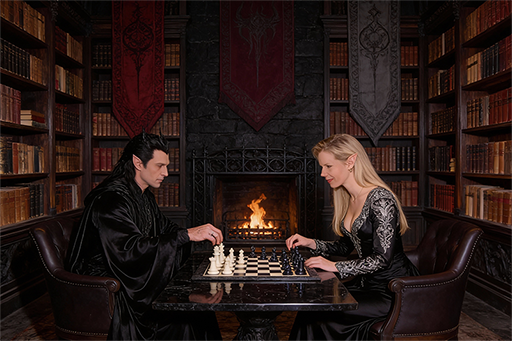
The library of Barad-dûr was not what most people would have expected, had most people been in a position to expect anything about it at all, which they were not, on account of being either dead or very far away and deeply committed to remaining so. It occupied the forty-third level of the Dark Tower, well below the great Eye’s chamber but far above the barracks and forges and pits where the common business of Mordor was conducted, and it was — there was no other word for it — comfortable.
The walls were black stone, naturally, but they had been hung with tapestries of deep crimson and charcoal grey, woven by captive artisans of considerable skill who had been treated quite well during their employment and then released to the interior settlements of Nurn, where they now ran a moderately successful textile cooperative. The shelves rose from floor to ceiling, carved from the dark wood of trees that grew in the sheltered vales south of the Ephel Dúath, and they held thousands of volumes — histories, treatises on metallurgy and linguistics, the collected philosophical works of the Second Age, several illustrated atlases of Middle Earth, and a modest but well-curated collection of erotic Sindarin poetry that Sauron would have denied owning if asked, which, of course, no one ever did.
A fire burned in a grate of black iron. Two chairs of dark leather faced each other across a table of polished obsidian, upon which a chess set had been arranged. The pieces were exquisite — one set carved from white bone, the other from volcanic glass — and the game was already underway.
Sauron sat in the chair to the left of the fire. He was not, at this moment, wearing the form of the great Eye, which he customarily maintained in the upper chamber by a combination of will and ancient sorcery and which he found, frankly, exhausting. In his library he preferred a more practical shape: tall, severe, dark-haired, with the handsome and slightly drawn features of a man who has been awake for several thousand years and finds the whole thing rather tedious. He wore a robe of black silk and no crown. His right hand, the one missing the finger where the Ring had once sat, rested on the arm of his chair. He had never bothered to restore it. He found that its absence tended to focus his mind rather helpfully when he found himself gravitating toward sloth.
Across from him, studying the board with an intensity that he found genuinely charming, sat Lúthiel.
She had been an Elf of Eregion, once. She was of Celebrimbor’s people, a seamstress of great talent who had worked alongside Sauron himself in his Annatar days, when he had walked among the Elves in a fairer form and taught them the craft of ring-making. She had seen through him long before the others. She had known perfectly well what he was. And she had, after a period of considerable internal deliberation that had lasted approximately three centuries, decided that it did not bother her. Indeed, much to the contrary, she found herself drawn to his darkness.
This was not, Sauron reflected, as uncommon as the histories of the Elves would have one believe. The Eldar presented themselves as uniformly noble, but immortality did strange things to those upon whom it was bestowed. Lúthiel had simply grown bored with virtue. She was not evil, at least, not by his standards. She had no interest in dominion or cruelty or the subjugation of peoples. She was merely done with the relentless earnestness of Elvish civilization, the repetitive songs about starlight, and the interminable councils about the proper stewardship of forests. She wanted to read interesting books and play chess with someone who could keep up with her, and Sauron, whatever his other failings might be, had always provided her with exceptional company.
She also liked wargs. A lot. To a degree that Sauron found almost disturbing. The orcs of Mordor knew her, and feared her, as Hiriel the Huntress, due to her habit of riding a very large pack leader at the head of a voracious pack and hunting orcs, goblins, and, Sauron suspected, the occasional Easterling.
She moved her bone-white bishop three squares. “Check,” she declared happily, looking pleased with herself.
Sauron looked at the board. She was right. His king was exposed along the diagonal, and her rook, previously blocked by the bishop, now commanded the entire file. He studied the position for a moment, then moved his king behind a pawn with a faint nod of acknowledgment.
“You are improving,” he said.
“I have been improving for nine hundred years. You might at least pretend to be threatened.”
“My king is in danger. That bishop maneuver was —”
There was a knock at the door. Three sharp raps, then silence. It was the knock of someone who had been taught precisely how to knock at this particular door and understood the negative consequences of improvisation.
“Enter,” said Sauron.
The door opened and a Nazgûl came in. It was not the Witch-king. From the figure entering emanated the pale, ephemeral menace of Khamûl the Easterling, the third of the Nine. He was still wearing his full kit of black robes, iron crown, and gauntlets, which meant he had come directly from the field and had not thought to change, which meant the news was either urgent or Khamûl had once again failed to grasp the concept of appropriate attire for different contexts. Sauron assumed the former.
“My lord,” said Khamûl. His voice came from the hood like wind through a keyhole. “I bring word from the western watches.”
“Speak.”
Khamûl glanced at Lúthiel. Sauron did not tell her to leave, and the Nazgûl had learned, over the centuries, that Lúthiel’s presence was a permanent feature of the library and that any question concerning her right to be there would be met with a decidedly negative response. Khamûl turned back to his master.
“Saruman’s prisoner has escaped. The wizard Gandalf — he was held atop Orthanc. He is gone.”
Sauron’s expression did not change, but his hand, the complete one, closed slowly around the arm of his chair. “How did this happen?”
“We are uncertain of the precise details. Saruman was reluctant to admit the wizard’s escape and his report was… incomplete. But our watchers in the mountains saw it clearly enough. An eagle, one of the skylords of the Misty Mountains, descended upon the tower of Orthanc and bore Gandalf away through the air.”
Sauron was quiet for a moment. “Which one?”
“Gwaihir, my lord. The Windlord. He carried Gandalf north and east at great speed. Our crebain tracked them as far as the upper vales of the Anduin before losing sight. It appears the eagle delivered him directly to Rivendell.”
“When?”
“Yesterday.”
“And you are telling me now?”
Khamûl shifted almost imperceptibly. The Nazgûl did not fidget — their bodies were too far past the threshold of ordinary physical response for anything so human — but there was something in the movement that served the same function. “As I said, Saruman was evasive, and so we wished to confirm the wizard’s escape rather than bring you false news, my lord. And there is more. The Halfling — the Ringbearer — we pursued him on horseback to the very borders of Rivendell but we were unable to cross the Bruinen.” The barest hint of resentment entered Khamûl’s voice. “The river rose against us.”
“Yes,” said Sauron. “It does that.”
He was quiet for a moment. Across the table, Lúthiel had returned her attention to the chessboard with the pointed discretion of someone who has lived long enough to know when to appear as if one has heard nothing.
“So,” said Sauron. “Gandalf is free. Gandalf has the Halfling. The Halfling has the Ring. And all three are in Rivendell, under the protection of Elrond.”
Saruman had failed. So, too, had the Nine. Sauron closed his eyes and repressed the urge to remove the iron crown from Khamûl’s head and force his entire body to pass through it in a very violent and painful manner.
He was not a happy dark lord.