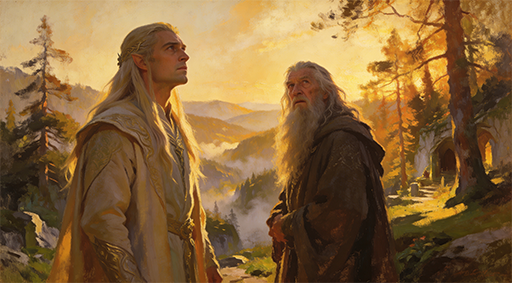
In Rivendell, the ground shook.
It was not a great sensation. It was merely a tremor, a shudder, the sort of thing that might have been mistaken for a cart passing on a nearby road. But the water in the fountains rippled, and the leaves of the ancient trees trembled without wind, and the light, the clear, golden light that always lay upon the valley of Imladris, suddenly dimmed, as if a cloud had passed before the sun. But there was no cloud. The sky above Rivendell was clear.
Gandalf felt it first. He was standing on the terrace where Gwaihir had departed that morning, his pipe unlit in his hand, and he had been watching the southeastern sky with an expression of quiet confidence that had been slowly, imperceptibly curdling into something else, something he had not felt in a very long time, something he had almost forgotten the shape of.
Fear.
The tremor passed through the stone beneath his feet, and the doubt became certainty, and the certainty was the worst thing he had ever felt.
Elrond emerged from the house. He did not run because Elf lords do not run, but he moved quickly with the controlled pace of someone who has received terrible news and is walking toward the place where he knows it will be confirmed. He came to stand beside Gandalf on the terrace, and for a long moment neither of them spoke. They looked to the east, toward the shadow on the horizon that was, even now, visibly darker than it had been an hour ago. It was visibly expanding to the north and to the west.
“The shadow grows,” said Elrond.
“Yes,” said Gandalf.
“Then—”
“Indeed.”
Elrond closed his eyes. When he opened them, they held something that Gandalf had never seen in them before, not in six thousand years of their acquaintance, not in the fall of Gil-galad, not in the ruin of Eregion, not even in the moment on the slopes of Orodruin when Isildur had taken the Ring and walked away to his doom. It was not despair, exactly. Elrond was far too old for despair, which is a youthful emotion that requires the ability to believe that things ought to be other than they are. It was something deeper, quieter, and more final.
“The Windlord has fallen,” said Elrond. It was not a question.
Gandalf said nothing. His hand, resting on the stone rail of the terrace, was trembling.
Behind them, in the garden, Frodo Baggins looked up from his book. He did not know what had happened. He did not yet understand the darkness that was gathering on the edge of the world, or the silence that had fallen over Rivendell as if the land itself was holding its breath. But he felt it. He felt the ground shiver, felt the light change, felt something vast and irreversible shift in the deep foundations of the world. The book slid from his hands, and he sat very still, and he was afraid.
On the terrace, Gandalf and Elrond stood side by side and watched the shadow rise in the east, and neither of them spoke, because there was nothing left to say.
The ring had been reclaimed.
The One Ring had returned to its maker.
The darkness was rising.
And soon the dark lord would rule over all Middle Earth.
THE END
And that, my friends, is why JRR Tolkien didn’t simply have the eagles fly the ring to Mordor.
QEFD