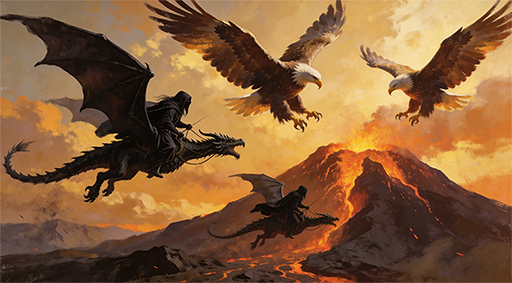
They came to Mordor in the sixth hour.
The clouds broke apart as the eagles crossed the Ephel Dúath, and the land below them was revealed in all its desolation, with the brown, cracked wasteland of the Plateau of Gorgoroth stretching away under a sky of smoke and sullen amber, the dark mass of Barad-dûr rising in the distant northeast like a needle of black iron thrust into the heavens, and there, directly ahead, filling the southern horizon with its vast and terrible shape, Orodruin.
Mount Doom.
The mountain was active. It was always active — had been since Sauron first bent its fires to his will in the forging of the Rings — and now it breathed a column of smoke and ash into the sky that rose miles above the peak and spread into a canopy of darkness that blotted out the sun. The slopes were black and red, veined with rivulets of cooling lava that glowed like infected wounds, and from the fractured cone at the summit a dull orange light pulsed in slow, rhythmic intervals, as if the mountain itself had a heartbeat.
Gwaihir descended. The air thickened as they dropped below the cloud layer — thickened with heat and ash and the acrid stink of brimstone, and the winds became treacherous, gusting unpredictably as thermals off the mountain’s slopes collided with the cooler air from the plateau. The great eagle’s wings adjusted constantly, reading the turbulence with an instinct born of millennia, but even Gwaihir felt the strain. This was not his sky. This was a sky of fire and poison, and every breath of it burned.
Landroval flew on his right. Meneldor on his left. The three eagles were tired — six hours at altitude, at speed, without rest — but the mountain was before them and the Sammath Naur was close, a dark gash in the face of the cone visible now even through the haze of ash. Minutes. They were minutes from the end.
The Witch-king came out of the smoke.
He came from below and to the east, rising on a fell beast that screamed as it climbed — a sound like iron tearing, like the death cry of something that had never truly been alive. He had been waiting in the lee of the mountain, hidden by the ash plume, and his timing was precise. The fell beast’s vast wings beat the fouled air and drove it upward on a collision course with Meneldor, the youngest and outermost of the three eagles, and behind him came two more — Uvatha and Adûnaphel on their own mounts, spreading wide to flank.
“Nazgûl!” The cry came from Landroval, less a word than a shriek in the eagle’s tongue, a sound of warning and fury that cut through the roar of the mountain. Gwaihir banked hard, and the formation broke.
Meneldor turned to meet the Witch-king. It was the brave choice and the wrong one. The fell beast was larger than Meneldor, uglier, and utterly without fear, driven by a will that was not its own, and the Witch-king rode it with the cold expertise of a warrior who had been killing from the air since before the founding of Gondor. They met in a tangle of wings and talons above the eastern slope, and for a moment the two shapes became one, a thrashing, screaming knot of feather and membrane and raking claws, and then they broke apart with Meneldor bleeding.
The wound was along his left side, where the fell beast’s claws had torn through feather and flesh to the muscle beneath. Meneldor’s wing faltered. He dropped, caught himself, dropped again. The Witch-king circled above him, patient, and the fell beast’s mouth hung open, trailing ropes of dark saliva, waiting.
But the Witch-king had made a mistake. He had committed to Meneldor, and in doing so he had left Uvatha and Adûnaphel to deal with Gwaihir and Landroval alone.
They were not enough.
Landroval struck Uvatha’s fell beast from above and behind with the full force of a diving eagle — talons extended, wings folded, falling like a bolt of golden lightning. The impact broke the fell beast’s spine. The sound it made was extraordinary — a wet, structural crunch that was felt as much as heard — and the black-scaled creature folded in on itself like a thing made of paper and fell, spinning, trailing a banner of dark blood, and Uvatha the Horseman, who had once ridden the plains of Khand with an army at his back, fell with it, his black robes streaming behind him, silent, and not without dignity, until the slopes of Orodruin received him and he was gone from the sky.
Gwaihir took Adûnaphel’s mount head-on. The fell beast lunged for him with its serpentine neck and snapping jaws, and Gwaihir caught its long neck in both his talons and wrenched in opposite directions. The fell beast’s neck broke with a sound like a green branch snapping, and Gwaihir released it and beat upward as the dead creature tumbled past him, its wings still twitching in purposeless spasm. Adûnaphel fell screaming, and her screams gradually faded as she plunged into the fires that coursed along the mountain’s lower slopes.
Two Nazgûl down. The Witch-king, seeing his support destroyed in a matter of seconds, pulled back. He drove his fell beast away from the wounded Meneldor and climbed, circling wide, and for a moment the sky above Orodruin was clear.
“Go!” Landroval screamed at Gwaihir. “The crack! Now!”
The Windlord turned toward the Sammath Naur. He could see it clearly — the great opening in the mountainside, dark and wide, lit from within by the deep red glow of the fires below. The air above it shimmered with heat. He folded his wings into a shallow dive, angling his descent toward the entrance, and the pouch on his talon — that small, exquisitely crafted pouch of pale Elvish leather — swung beneath him like a pendulum. Within it, the Ring seemed to pulse, seemed to burn, seemed to cry out in a voice that only the mountain could hear.
Four hundred yards. three hundred. He could feel the heat now, rising from the cone in waves that distorted the air and made the dark opening dance and waver. Two hundred yards. He adjusted his angle, spreading his wings to brake, preparing to stoop through the entrance and release the pouch into the abyss below —
And then the shadow fell over him.