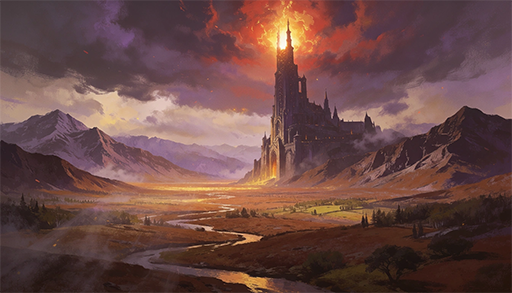
For a moment Sauron stood motionless in the dim library, and the only sound was the crackle of the fire and the slow breathing of Lúthiel asleep in her chair. He looked at her. He looked at the sketch on the desk — the careful charcoal lines, the sleeping face, the small frown. He had been happy, he realized. For perhaps an hour, in the quiet of the early morning, drawing a face he had studied for nine hundred years, he had been something very like happy.
He picked up the velvet cloth and covered the palantír. Then he left the library.
The staircase to the upper chamber of Barad-dûr was a spiral of black stone, nine hundred steps from the library level to the pinnacle, and Sauron climbed it at a pace that would have killed a mortal man. The tower narrowed as he ascended. The walls pressed closer. The air grew hotter and heavier, thick with the ambient sorcery that sustained the great working at the tower’s crown, and the darkness itself seemed to acquire texture — to become not merely the absence of light but a substance, a medium, the stuff from which the Eye was woven.
He emerged into the chamber at the top.
It was a circular room, open to the sky on all sides, and in its center stood the iron framework that held the Eye, a vast apparatus of dark metal and darker will, shaped like a lens or a pupil, within which burned the manifestation of Sauron’s searching gaze. When he was not here, the Eye was sustained by stored magics, turning slowly, scanning the horizon with a dim and general awareness. But when he was here at the summit, when he stepped behind the framework and placed his will into it like a hand into a glove, then the Eye blazed.
It blazed now.
The summit of Barad-dûr erupted with sorcery. Not the visible light of sun or star but a radiance of another kind entirely, a piercing, lidless, wrathful power that swept across the plains of Gorgoroth like a searchlight and leapt outward over the mountains of shadow, out across the brown lands and the wilderlands, out over the Misty Mountains and the vales and the rivers, reaching, seeking, burning through cloud and mist and the thin veils of Elvish concealment as if they were tissue.
He found them in less than a minute.
Three golden shapes, high above the clouds, south of the Gladden Fields and descending slowly as they crossed the eastern foothills of the Misty Mountains. They were flying in a loose formation, with the largest in the center and the other two flanking, and they were fast, impossibly fast, the wind of the upper atmosphere carrying them eastward like arrows loosed from a bow of infinite draw.
Gwaihir. He could see the great bird clearly through the Eye, every feather, every beat of those enormous wings, and there, dangling from the left talon, radiated power that reflected the light of the Eye’s own gaze like a mirror reflecting a torch, the Ring. The One Ring. His Ring. The band of gold he had forged in the heart of Orodruin in the time when the Middle Earth was young, into which he had poured his cruelty and his will
For one momentary, burning instant Sauron felt something that was neither fear and nor the cold calculation that had defined his existence for millennia. It was something much closer to fury. The sheer indignity of it astonished him. The supreme masterwork of the Dark Lord, the instrument through which the world would be remade in shadow and fire, hanging from an eagle’s foot like a woman’s ankle-charm, and carted over Middle-earth like a parcel.
The moment passed. The Eye narrowed, and its gaze locked onto Gwaihir with a focus that made the air between them hum, and Sauron began to calculate distances and speeds and the terrible, dwindling arithmetic of time.
The Witch-king would reach Orodruin in time. The fell beasts were slower than the eagles in the open sky, but Minas Morgul was closer to the mountain than Gwaihir was now, and the Nazgûl did not need to catch the eagles, only to be waiting for them when they arrived. It should be enough. But it might not.
Sauron had not survived three Ages of the world by trusting in what might be.
He withdrew his will from the Eye — not entirely, leaving it fixed on Gwaihir like a burning pin through a map — and sent his thought downward. Not to the war rooms or the forges or the barracks. Deeper. Down through the foundations of Barad-dûr, down through the bedrock of the Plateau of Gorgoroth, down into the roots of the earth where the stone was hot and slow and older than memory. Down to the place where something vast had been sleeping since before the tower was built, since before Mordor was Mordor, since the ruin of Thangorodrim and the breaking of the North, when a young dragon had crawled south through the bowels of the world with his father’s fire still burning in his blood and had found, in the deep dark beneath a plain of ash, a place to rest.
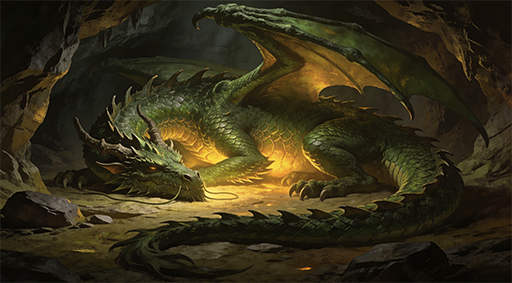
Felgarion the Wicked. The green-scaled son of Ancalagon the Black, whose wings had blotted out the sky above Angband, whose fall had broken the towers of Thangorodrim into rubble. Ancalagon was long dead, slain by Eärendil in the War of Wrath, but his son had survived, smaller than his sire but mightier than Smaug, mightier than Glaurung, mightier than any wyrm that had taken to the skies in the recorded Ages of the world. He had slept beneath the foundations of Barad-dûr for five thousand years, dreaming of fire and ruin in the timeless way of dragons, and Sauron had let him sleep, because there had never been a need sufficient to justify waking him.
Until now.
Sauron spoke. Not aloud, for the word he used had no sound, belonging to a language older than the Black Speech, older than the tongues of Elves, a language of pure will that had been spoken in the forges of Aulë before the world was made. It was a name. A command. A promise. It passed through stone and magma and the compacted silence of millennia, and it reached the place where the dragon lay coiled in the dark, his scales green as emeralds, his closed eyes like furnace doors banked and waiting.
And the great beast heard his voice, and woke.