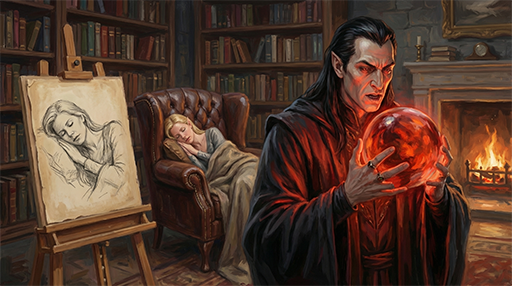
In the library of Barad-dûr, the palantír woke.
It sat on a plinth of black iron in the corner of the room, shrouded in a cloth of dark velvet, and it had been silent for days — Sauron used it sparingly, preferring the Eye for broad surveillance and the palantír for directed communication, and there had been no one he wished to communicate with. But now the stone blazed beneath its covering, a sullen red-orange glow that seeped through the velvet like blood through a bandage, and a sound came from it — not a sound, exactly, but a pressure, a tightening of the air, the psychic equivalent of a hand gripping a shoulder.
Sauron looked up from his desk.
He had been sketching. This was not widely known — it was not, in fact, known to anyone except Lúthiel, and she knew better than to mention it — but Sauron was a draughtsman of extraordinary skill. He had been a Maia of Aulë before his fall, a craftsman and shaper of things, and the impulse to create had never left him, even as the objects of his creation had grown darker and more terrible over the millennia. Tonight — or rather, this predawn hour, for Sauron kept no regular schedule and had not slept since approximately the year 1600 of the Second Age — he had been drawing Lúthiel.
She was asleep in the chair across from him, curled with the unconscious grace of an Elf at rest, one hand still resting on a book that had slid from her lap to the floor. He had been working in charcoal on heavy paper, capturing the fall of her hair across the chair’s arm, the particular way the firelight found the line of her jaw, the slight frown she wore even in sleep, as if her dreams were presenting arguments she found unconvincing. It was a good likeness. He was pleased with it.
The palantír pulsed again, and the pleasure evaporated.
He crossed the room in three strides, pulled the velvet aside, and placed his hand on the stone. The surface was hot — not physically, but in the way that a live wire is hot, carrying a current that had nothing to do with temperature. The stone’s depths swirled and cleared, and he saw Ren’s hooded face, and behind it the open sky, and behind that —
Eagles. Three of them. Heading east.
“Speak,” said Sauron.
Ren’s voice came through the stone like a whisper carried on a dead wind. “My lord. Three Great Eagles departed Rivendell at dawn. They climb above the clouds and fly east at speed. The lead eagle carries something on its talon. I can feel it, my lord. The Ring. They carry the Ring.”
Sauron’s hand tightened on the palantír. The stone creaked beneath his grip — an impossible sound from an object that could not be broken by any physical force, but the stone knew its master’s will, and his will in that moment was a thing of terrible, focused violence.
“East,” he said. “How far east? What is their heading?”
“South of east, my lord. Toward —”
“Mordor.”
The word was quiet. The room was quiet. Behind him, Lúthiel stirred in her chair but did not wake. On the desk, the charcoal sketch watched the room with serene, sleeping eyes.
Sauron’s mind moved very fast. It was one of his great advantages — he had been a being of intellect before he had been a being of power, and even now, even after millennia of corruption and diminishment, his capacity for rapid, precise calculation was undiminished. The eagles had departed at dawn. Rivendell was approximately four hundred leagues from Orodruin. Gwaihir’s speed, at altitude, was — he searched his memory, consulted the deep archives of his knowledge of the Maiar and the great beasts — perhaps sixty leagues per hour. Perhaps more, with a following wind.
Six hours. Seven at most.
They were not bringing the Ring to wield against him. They were not marching an army to his gates. They were flying, in the high airs, above the reach of his ground forces, above the reach of most of his aerial forces, straight toward Mount Doom.
They were going to destroy it.
“Gandalf,” he breathed, and for a moment, he found himself almost admiring the boldness of the fool. Not an army. Not a king with the Ring on his finger. An eagle carrying it in its talons. The simplest plan. The most elegant. The one he had not considered because he had been so busy thinking about the realities of power that he had forgotten that his enemies might be frightened enough to throw it away in order to deny it to him.
That thought lasted approximately one and a half seconds. Then Sauron acted.
“Ren. Where is the Witch-king?”
“At Minas Morgul, my lord. With Gothmog’s forces.”
“And the others? How many of the Nine are mounted?”
“The Witch-king has his beast. Uvatha and Adûnaphel are at the Morannon with their fell beasts saddled. The rest are here, near Rivendell.”
Three. Three Nazgûl with fell beasts within striking distance of Mount Doom. It was not enough. It might have to be enough.
“Send the Witch-king to Mount Doom. Now. This moment. He is to take Uvatha and Adûnaphel from the Morannon and fly directly to Orodruin. They are to circle the mountain. Nothing enters the Sammath Naur. Nothing approaches. Do you understand? If an eagle comes within a league of that mountain, they are to bring it down. Kill it. I do not care how.”
“My lord, the fell beasts cannot match the eagles at altitude —”
“They do not need to match them at altitude. The eagles must descend to enter the mountain. At low altitude, in the fumes and thermals above Orodruin, the battlefield is even. The Witch-king knows this. Send him. Now.”
He released the palantír. The light in the stone died.