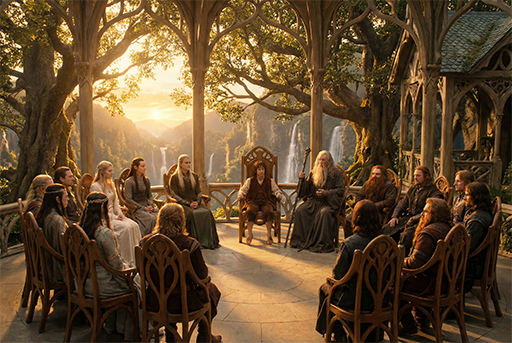
The morning light fell upon Rivendell like a benediction, gold and pale through the leaves of the ancient trees, and the sound of waterfalls threaded through the air like music half-remembered. The council had been called in the great terrace overlooking the valley, and representatives of every Free People sat arranged in a wide crescent of carved chairs. Elves of Rivendell and the Woodland Realm, Dwarves from Erebor, Men of Gondor and the wild North, and a Hobbit who looked as if he very much wished he were anywhere else.
Frodo Baggins sat in a chair that was slightly too tall for him and tried not to let his feet swing. Beside him, Gandalf the Grey leaned on his staff and surveyed the assembly with an expression Frodo had learned, over many months, to associate with a man who has already made up his mind but intends to let everyone else talk themselves into exhaustion first.
Elrond Half-elven stood and opened the proceedings with a history of the Ring. He spoke at considerable length. He spoke of Sauron’s forging of the One in the fires of Orodruin, of the Last Alliance and the fall of Gil-galad, of Isildur’s bane and the creature Gollum and the extraordinary improbability of the Ring passing to a Hobbit of the Shire. He spoke with the unhurried gravity of someone who has lived six thousand years and sees no reason to abridge.
Boromir, son of Denethor, shifted in his seat. He had ridden many weeks from Minas Tirith and was not accustomed to being a member of an audience.
“Let us use the Ring against Sauron,” he said, at the first breath Elrond drew. “Give it to the armies of Gondor and let us —”
“No,” said Elrond.
“But —”
“No.”
Gandalf lifted one hand. “Boromir. The Ring answers to Sauron alone. Any who wield it will be consumed by it. It cannot be used. It can only be destroyed.”
“And it can only be destroyed in the place where it was made,” said Elrond. “In the fires of Mount Doom, in the land of Mordor.”
A silence followed this pronouncement — or rather, a silence attempted to follow it, but was immediately interrupted by several people speaking at once. Gimli the Dwarf suggested that they simply smash the thing with an axe, but when this was attempted, the axe shattered spectacularly and Gimli sat down again looking more than a little chagrined. Legolas mentioned that the Elves would never be safe while the Ring endured. Boromir brought up Gondor’s need again, and once more, everyone ignored him.
Through all of this, Frodo felt the Ring against his chest, hanging on its chain, and a strange certainty had been growing in him since before the council began. It was the kind of certainty that arrives not as a comfort but as a weight, pressing down on the shoulders with quiet and terrible patience. He knew, with a clarity that surprised him, what he was going to say. He had known it, perhaps, since Weathertop, or since the Ford, or since the day Bilbo had given him the Ring and gone away.
He stood up.
“I will take the Ring to Mordor.”
The words fell into the assembly like a stone into a pond. Frodo felt every eye turn to him — the tall, ageless eyes of the Elves, the shrewd eyes of the Dwarves, the complicated eyes of Aragorn, the frankly skeptical eyes of Boromir. He drew a breath. His voice, when it came again, was small but steady.
“I will take the Ring to Mordor. Though I do not know the way.”
He stood there in the silence that followed, three feet six inches of determination, and waited for someone to say something. The moment stretched. Gandalf was looking at him with an expression that was not quite pity and not quite admiration and was, if Frodo was reading it correctly, largely preoccupied with something else entirely.
“That is a very noble offer, Frodo,” said Gandalf.
“Thank you,” said Frodo.
“Very noble. Very brave. And completely unnecessary.”
Frodo blinked. “I’m sorry?”
Gandalf rose from his seat and addressed the council with the air of a man who has been waiting for exactly the right moment and is rather pleased with himself for having found it.
“My friends,” he said. “As many of you know, I was recently imprisoned atop the tower of Orthanc by Saruman the White, who has turned to darkness and now serves the Enemy. I was rescued from that imprisonment by Gwaihir the Windlord, the chieftan of the Eagles of the Misty Mountains.”
“We are aware,” said Elrond, with the faintest trace of impatience.
“Gwaihir bore me through the sky at tremendous speed,” Gandalf continued, as if Elrond had not spoken. “From Orthanc to the fields of Rohan in a matter of hours. A journey that would take a company on foot many weeks, if not months, and which would require passage through some of the most dangerous territory in Middle-earth.”
He paused and looked around the council with bright, expectant eyes.
“The distance from here to Mordor is approximately four hundred leagues,” he said. “On foot, through the wilderness, over mountains and through marshes, past enemy fortifications and patrolled borders, the journey would take months. It would be fraught with danger at every step. The Ring-bearer would need a company of protectors. Even then, the odds of success would be vanishingly small.”
Aragorn was watching Gandalf with an expression of dawning comprehension. Frodo was watching him with an expression of dawning alarm.
“Gwaihir,” said Gandalf, “can fly four hundred leagues in less than a day.”
The silence that followed this statement was qualitatively different from the silences that had preceded it. It was the silence of an idea so obvious that everyone present was rapidly calculating whether they could claim to have thought of it first.
“The eagles,” said Elrond.
“The eagles,” said Gandalf.
“Gandalf,” said Frodo, and there was a faint note of desperation in his voice that he was not entirely proud of. “I said that I would take the Ring. I have offered to bear it.”
“And it was a magnificent offer,” said Gandalf warmly. “Truly. The courage of Hobbits never ceases to amaze me. But consider, Frodo — you would walk for months through trackless wilderness, facing Ringwraiths and Orcs and untold hardship, when instead we might simply have the Ring flown directly to Mount Doom in the span of an afternoon.”
“But surely,” said Boromir, who had been growing increasingly restless, “the Enemy would see an eagle approaching. His Eye watches from the tower of Barad-dûr. The Nazgûl ride fell beasts through the air. An eagle would be spotted and intercepted.”
Gandalf smiled. “Gwaihir flies higher than any fell beast can reach. The eagles are creatures of the high airs, the uttermost peaks. The Nazgûl patrol the lower skies on their winged mounts, but they cannot match the altitude or speed of one of the Great Eagles. Gwaihir could fly above the very clouds, invisible from below, and descend upon Orodruin before Sauron could muster his response.”
“But the entrance,” said Gimli, who was a practical sort. “The Sammath Naur — the Crack of Doom — it is within the mountain. Can an eagle enter it?”
Every head turned to Elrond. The lord of Rivendell was quiet for a long moment. His eyes had gone distant, as they did when he was consulting the vast and impeccably organized archive of his memory.
“I have been to Orodruin,” he said at last. “I stood at the threshold of the Sammath Naur with Isildur after the fall of Sauron. I recall the entrance well.” He paused. “It is wide. Very wide. It was carved — or rather, torn open — by volcanic force. The passage into the mountain is high-vaulted and broad. An eagle, even one of the Great Eagles, with a wingspan of some thirty fathoms —” He paused again, and there was something almost reluctant in his voice, as if he would have preferred the logistics to be more complicated. “An eagle could enter it. With room to spare.”
“There you are,” said Gandalf.
Frodo sat down slowly. He was experiencing an emotion he could not quite name — something between relief and an obscure sense of redundancy, as if he had spent weeks steeling himself to lift a great boulder only to watch someone roll it aside with a lever.
“I should like to ride the eagle,” said Aragorn. “I can bear the Ring.”
This declaration produced another brief silence, though of a different character. Aragorn, heir of Isildur, Chieftain of the Dúnedain, sat straight-backed in his chair with the composed dignity of a man who has spent decades wandering the wild places of the world in deliberate preparation for a moment of destiny and does not intend to be left out of it on a technicality.
“Someone must ensure that the Ring is cast into the fire,” he said. “The eagle cannot do it alone. It has no hands. I will ride Gwaihir into Mordor, bearing the Ring, and throw it into the Crack of Doom myself.”
“A brave proposal and one well worthy of your line,” said Gandalf. “But consider: you are the heir of Isildur. Isildur himself could not resist the Ring’s call. The Ring would know you. It would whisper to you of the throne of Gondor, of the reunited kingdoms, of your right to rule Middle Earth. The temptation, for you above all others, would be —”
“I can resist it,” said Aragorn firmly.
“With all respect, my son,” said Elrond, and the phrase carried the particular weight it always does when spoken by someone who has watched civilizations rise and fall, “that is what Isildur thought too.”
Aragorn’s jaw tightened, but he did not argue further and nodded in silent acquiescence. He knew the history as well as anyone.
“This raises the essential question,” said Gandalf. “Who — or what — should bear the Ring on this flight? The great advantage of the eagle is not merely its speed. It is resistance. Gwaihir is not a creature of ambition. He desires no kingdom, no power, no dominion over others. He is a bird. An exceedingly large and noble bird, to be sure, but a bird nonetheless. The Ring’s power lies in its appeal to the will — to the desire for mastery. What does an eagle desire? Updrafts. Thermals. The occasional mountain goat. The Ring would have very little purchase on such a mind.”
“You are suggesting,” said Elrond, “that we tie the Ring to an eagle’s leg and let it fly unaccompanied into the heart of Mordor?”
“I am suggesting,” said Gandalf, “that we place the Ring in a pouch secured to Gwaihir’s talons, and that Gwaihir fly at maximum altitude directly to Orodruin, enter the Sammath Naur, and release the pouch into the fire. The entire operation need take no more than six hours.”
“And if the Ring tempts the eagle to turn aside?” asked Legolas.
“To what end?” said Gandalf. “What would the Ring promise an eagle? Dominion over the skies? Gwaihir already has that. A hoard of gold? Eagles have no use for gold. An army of servants? Eagles are solitary creatures who find the company of most other beings tedious. The Ring’s entire mechanism of corruption depends on exploiting desire, and the desires of an eagle are so thoroughly alien to the desires of the Ring’s maker that the two are, for all practical purposes, incompatible.”
“The wind does not desire a crown,” murmured Elrond, and something in his ancient voice suggested that he was quite taken with the elegance of this.
“But the Quest,” said Frodo. He was aware that his voice sounded rather small. “The journey. The sacrifice. Bilbo always said that adventures were the making of a Hobbit —”
“Bilbo,” said Gandalf gently, “also said that adventures made you late for dinner. I think, Frodo, that in this case, being home in time for dinner is rather the point.”
Sam Gamgee, who had been lurking behind a pillar in open defiance of the council’s protocols, leaned forward and whispered, “He’s got you there, Mr. Frodo.”
Frodo looked around the council one last time. He saw the faces of the great and the wise, the warriors and the kings, and on every one of them he saw the same expression: the faintly embarrassed recognition that the answer had been, all along, absurdly simple.
“Then it is decided,” said Elrond, rising. “Gwaihir the Windlord shall bear the One Ring to Orodruin. Gandalf shall speak with him and make the arrangements. The Ring shall be secured to his person by means yet to be determined — I suggest we consult with the leatherworkers of my household — and he shall depart at first light tomorrow.”
“And the rest of us?” said Boromir, who looked as if he had been cheated of something but was not entirely sure what.
“The rest of us,” said Elrond, “shall wait.”
“I hate waiting,” said Gimli.
“You may pass the time in my halls,” said Elrond. “The kitchens are beyond compare. The library is extensive. The gardens are in late bloom.”
“I was willing to carry the Ring,” said Frodo quietly, to no one in particular.
Gandalf placed a hand on his shoulder. “And that willingness, Frodo, is precisely why you were the right Hobbit to offer. The courage to give one’s life is no less real for being, in the end, unnecessary. You would have carried the Ring all the way to Mordor on foot, through fire and darkness, and that is a thing worth honoring.”
“But you’re not going to let me.”
“No. Most certainly not.”
Frodo looked up at the sky, where high above the valley of Rivendell, a distant shape circled on broad wings in the morning light. It was Gwaihir, called by some means that Gandalf had no doubt arranged in advance, already descending toward the terrace with the unhurried confidence of a creature who has never in his long life had reason to fear anything below him.
“Right,” said Frodo. “Well. I suppose I’ll have another cup of tea, then.”
And the council, having solved in a single morning the problem that would have otherwise consumed the better part of a year and the lives of a considerable number of good people, adjourned for an early lunch.