Dennis McCarthy has responded to my response to his initial critique:
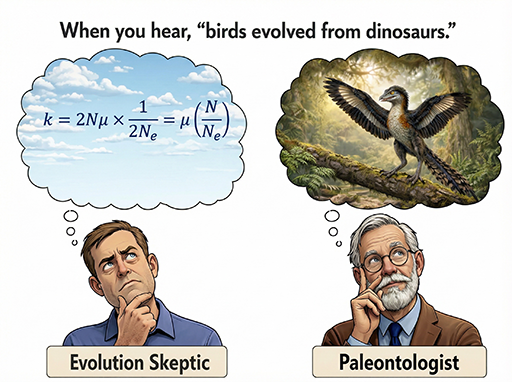
“Ahh,” says the evolution-skeptic, “I don’t care about fossils or biogeography or stories about salamanders or moths. Vox Day has proved mathematically that it can’t happen, so I don’t even have to think about any of this.”
First, Vox Day’s central argument in Probability Zero concerns neutral mutation fixation rates, which says nothing about natural selection and is largely orthogonal to most of what we have been discussing. Even if Motoo Kimura’s neutral theory—and the equations Vox Day disputes—were entirely mistaken, that would not overturn Darwinian evolution, nor would it undermine any of the empirical facts or conclusions considered so far. Vox Day himself effectively concedes as much in his response:
And in the interest of perfect clarity, note this: Dennis McCarthy’s critique of Probability Zero is not, in any way, a defense of evolution by natural selection. Nor can it be cited as a defense of speciation or Darwinism at all, because neutral theory has as about as much to do with Darwin as the Book of Genesis
Actually, my full post response (like this one) did indeed defend evolution by natural selection. And the only reason I veered from the subject of Darwinism at all was to address Vox Day’s main mathematical arguments—and it is Day’s main arguments that are not relevant to Darwinism or evolution by natural selection. And this is true despite what Day frequently implies, what his readers persistently infer, and what the subtitle of Probability Zero plainly states.
Secondly, as I showed, his two main analyses were both flawed. He contended that it was essentially impossible, given the circumstances of mutation rates, population size, fixation-probability, etc., for the human lineage to have acquired 20 million fixed mutations in the nine million years since humans and chimpanzees last shared an ancestor.
As before, I invite those who are interested in participating in the discussion to read the whole thing there and comment on his site. I will refrain from responding to it until tomorrow. I will note that this is why it is important to read The Frozen Gene as well as Probability Zero, as the former completes the comprehensive case begun in the latter. I have, however, taken the liberty of correcting his cartoon.
By the way, I would be remiss if I did not mention that the print edition of TFG will feature a preface from a somewhat surprising source. The ebook will be updated accordingly, of course.